Politics
The House Article | Ed Miliband: “Andy Has Given Us The Permission To Be Heard Again”

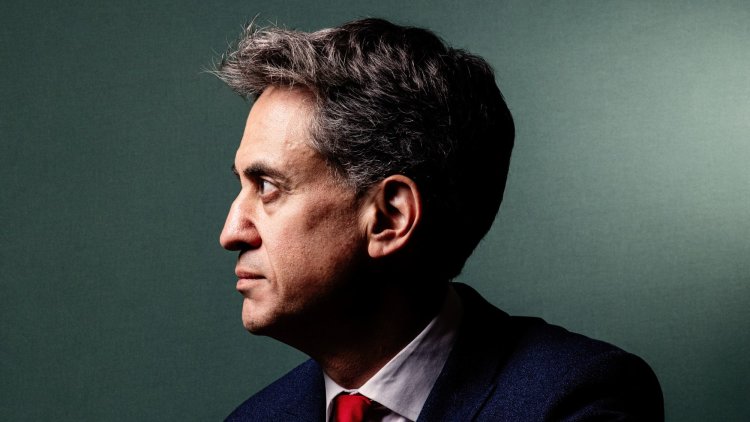
Ed Miliband (Photography by Louise Haywood-Schiefer)


14 min read
Ed Miliband has landed a Great Office of State – not as Chancellor but as the new Foreign Secretary. He talks to Sienna Rodgers about why Keir Starmer had to go, how Andy Burnham is resetting the culture in government and his approach of ‘resilient idealism’ to the new job
The Foreign Secretary wants you to know that he really loves his new job. Nobody expected Ed Miliband to land here: the chancellorship was what he wanted, and if he couldn’t secure No 11, it was rumoured he could be headed to the Department for Business. Before Andy Burnham’s ascent became inevitable, he was even thought to have half an eye on 10 Downing Street itself.
Alas for Miliband, Burnham chose the ‘safe’ option of John Healey – but the new Foreign Secretary seeks to radiate contentment. “I think you can probably tell, I really love this job,” he tells The House, dialling in from New York, where he is attending the United Nations General Assembly before Labour conference.
He says he is, in particular, delighted to be working once again with his old boss Gordon Brown, who has a government role in global finance and is helping to prepare for the UK’s presidency of the G20 next year. That, and he is seizing the opportunity to apply traditional Labour principles to foreign affairs at a time of huge global instability.
“Sometimes foreign policy can be thought of in a very technocratic way. This is about putting our Labour values, our progressive values, into practice internationally. That’s the way I see the job.”
When Labour suffered its disastrous result in the 2019 election, a group of politicians and others got together to review what had happened and put recommendations to the party. The commissioners – including Miliband, as well as Shabana Mahmood and Lucy Powell, both now in Cabinet – concluded that the party needed a ‘big change’ offer on the economy combined with a neutralising approach to social issues.
There was an assumption when Sir Keir Starmer became leader that these findings would be influential, considering the outfit organising the exercise – Labour Together, then called – had been headed by Morgan McSweeney, who choreographed his rise. But this was not to be.
Instead of that clear narrative of bold action came the ‘Ming vase’ approach; and while Labour did win a landslide in 2024, Miliband was among those who wanted a more obviously political agenda communicated.
For Starmer, there may be a bitter irony in the fact that it was Miliband, among those who encouraged him to leave a successful legal career for politics in 2015, who was then at the head of efforts to persuade him to leave a decade later.
The then energy secretary does not demure at the claim that he was the first Cabinet minister to advise Starmer that the jig was up.
“Look, I’m not going to get into my private advice to Keir,” Miliband says, before effectively confirming his role. “I was concerned about where the party was and what it meant for our ability to transform the country, and I felt that a change was necessary.
“I do feel that Andy, who I think is doing brilliantly, has given us the permission to be heard again, and I think we were losing the permission to be heard, frankly. I say this with deep regret because Keir is a friend of mine, an incredibly decent person. I think he handled his departure incredibly honourably. But I do think what’s happened since has shown why we were right to make the change.”
The new Prime Minister, Miliband enthuses, is determined “to be bold in his political project” and “has both an analysis of what is wrong with Britain and how to put it right”. Perhaps most importantly, “he’s shown an ability to articulate that narrative”.
“Now, this is not to say that Keir didn’t have a huge number of achievements to his name,” Miliband adds, polite but damning. “I think the party will always be grateful for the extraordinary job he did between 2019 and 2024 in rescuing the party, in winning the general election. What he did and what he oversaw in the first two years, including his advocacy on climate and my issues, is something I will always be grateful to him for. It’s really important not to diminish his achievements.”
The Foreign Secretary predicts that “history will look kindly” on Starmer. This would be handy, for the former PM has apparently told friends that he would like to reach the top of foreign affairs just as he did in the British legal and political arenas. If he achieves as much, could that be awkward for Miliband in his new role?
“Not at all,” he replies at once, going on to praise Starmer’s stance on Ukraine. “I would really welcome Keir playing a role in the future on the international stage. I think he has a brilliant ability to do that. I don’t think we’ve seen the last of Keir Starmer in public service.”

And yet evidently Miliband believes something had gone quite badly wrong in Starmer’s government – not only in terms of its inability to cut through to voters but also internally. Asked whether there has been a cultural reset under Burnham, he says “yes” without hesitation.
“It’s really hard to get the culture right. It’s something he and I talked about a lot in advance of him becoming Prime Minister, it’s something I talk to James a lot about,” he continues, referring to No 10 chief of staff James Purnell with whom he worked in government as a fellow minister last time.
“Honestly, one of the things that I’ve learnt in politics is how important culture is. Maybe it’s bloody obvious, but the way you work and operate – it’s what I’m trying to do in the FCDO.”
The Foreign Office has been through a difficult period of late, with the merger, a culling of jobs and the controversial sacking of Sir Olly Robbins as permanent secretary. Staff morale has been low, which the Foreign Secretary acknowledges – “That’s a fair point” – and expresses a determination to turn around.
Does he find Burnham to be a people pleaser? The PM is often accused of it. “What does that mean, being a people pleaser?” Miliband asks. That he finds it difficult to say no; that he agrees to things in the moment that he will later be forced to renege on because they were not wise. “Not really.”
What Miliband finds interesting about Burnham is this: “He’s somebody who’s learnt a lot about himself; about the way he succeeds as a politician. I think the thing he’s learnt above all is to follow his own political instincts.”
It sounds remarkably similar to his own journey, from embattled Labour leader to confident Cabinet minister who admirers and haters alike agree has been one of the most effective at bending the Whitehall machine to their will.
So, the pair have learnt the same lesson in recent years?
“Yeah, exactly,” he agrees. “One lesson Andy learnt is, don’t follow the advice of everyone else – follow your own instincts. It’s so true in politics. You’re much better off doing the thing you believe in, and then if you make a mistake, if it goes wrong – which, things will go wrong – you haven’t done something that someone else persuaded you to do.
“He’s very clear about what he believes. He’s very clear about his political project. This is the fundamental thing, which is what the British people want: somebody who says, ‘Look, this is where I’m taking the country, and this is what I believe.’ I think that is what Andy is doing, and that’s why people are responding.”
There has been confusion, however, on the question of whether this is a government of continuity (Healey’s message) or change (Burnham’s). One is aimed at the markets; the other at the country. Which is true?
“Obviously there’s elements of continuity, but I think of it as a turning of the page,” Miliband says. “It’s consistent with the manifesto because the manifesto was a manifesto for change. But I think it’s a change in approach.”
“I think there’s a rather homogeneous view of the Jewish community in the media, and the Jewish community does not speak with one voice”
Not for the first time, Ed Miliband now has a job that his brother David was tipped for. He ignores a question on whether David Lammy has put him in touch with JD Vance, preferring to talk about his “excellent” meetings with Marco Rubio, but happily reveals that he and his older brother – foreign secretary himself from 2007 to 2010 – have discussed his new role.
“We’ve obviously talked about the job. His advice is to follow your instincts and do what you think is right,” he says.
“I’ve been in politics a long time. I feel an incredible privilege to be doing this job. I genuinely do. I’m thinking about this for my conference speech: if you’d said to my parents, both refugees, that not one but both of their kids would be the Foreign Secretary of Britain, they’d have thought that was just ridiculous. I mean, just, no way!”
As Labour leader, Miliband accused the Daily Mail of overstepping the mark when it called his late father, a Marxist academic, “the man who hated Britain”. Today, he is keen to share how much his parents are shaping his approach to foreign policy.
“I think a lot about what they thought about Britain, which is they thought it was a sanctuary for them, but it was also about what Britain stood for – the rule of law, international solidarity, the foundation of the United Nations, all of those things,” he explains.
“I’m a believer in Britain’s positive influence in the world. It’s right for us. Some people say, ‘You can either pursue your values or pursue your interests.’ Us pursuing our values is in our interest because a stable world, a world where a rule of law is followed, is also a world that is a foundation for peace and prosperity.”
Miliband will want to see the UK’s 0.7 per cent target for official development assistance restored at the soonest possible date, but he toes the party line when asked. While it is “really important” – including for climate resilience, and he wants to make climate “a national security issue for the first time” – he concedes, “I’m not going to second-guess decisions that John makes”.

Healey is under intense pressure to make the numbers add up at the upcoming Budget, while giving himself enough headroom and honouring Burnham’s early promises – all within the existing fiscal rules. Burnham may be better at “articulating the narrative” than his predecessor but his government is no less in hock to the bond markets than the last.
Unfortunately for Burnham’s boosterism, this also comes at a time when an unpredictable US is forcing Britain to reassess its security. The fragmentation of western alliances comes as adversaries draw closer together and while threats are intensifying and the technological sophistication of modern warfare is advancing quickly.
Even as our control of the Falklands is called into question by Argentina’s Javier Milei, President Donald Trump hinted he would not come to the UK’s aid, while Benjamin Netanyahu’s son seized the opportunity to undermine Britain.
“This is non-negotiable,” Miliband says of the Falklands, repeating: “This is non-negotiable. The Falkland Islands have made absolutely clear that they want to remain British. We are going to uphold their right of self-determination. Our commitment to the Falklands of remaining British is absolutely unwavering, and my message could not be clearer.”
So, across most of the Labour Party, it is not seen as optional that the Chancellor both funds the Defence Investment Plan and increases defence spending to three per cent of GDP in the next parliament and to 3.5 by 2035.
Miliband may privately see the world in terms of petrostates and electrostates, with Trump resistant to net-zero on this basis, but such tensions must remain unspoken. Britain, too reliant on the US to do a Mark Carney, is strengthening its relationships with other middle powers – but quietly.
Reflecting on the biggest move he has made so far in his short time as Foreign Secretary, issuing sanctions on Israeli settlements, Miliband is particularly proud of his and Burnham’s ability to surprise people with the announcement that France and Canada among others were acting in parallel.
But since he unveiled the import ban on goods from illegal settlements in the occupied territories, some have expressed concern that it would affect sensitive areas such as the Jewish quarter in Old Jerusalem. Does he believe that part of the plan is sensible?
“I think our plan is the right plan. We’ve said that there is going to be a narrow group of religious exemptions, and that’s something we’ll have a dialogue with the Jewish community about,” he says, confirming that its application is not yet fully decided and will have to be worked out before implementation in six to nine months.
In the Commons, Miliband appeared embarrassed that the government hadn’t done more before now. Britain “should have acted earlier”, he told MPs. So, why was the government so inhibited? Was it down to Labour’s recent history with antisemitism?
“I don’t know, really,” Miliband says. He would like to talk instead about why he is proud of the action that has now been taken.
“I was very influenced by my mum. She passed away at the end of May. She had this very traumatic childhood as a Jewish refugee in hiding during the Second World War; lost her father. But before she got ill, in the 20 years after my dad died in 1994, she became a massive campaigner on these issues. I thought a lot about what she would have thought, and I think it is interesting – her background and her empathy with the suffering of the Palestinians.
“When she died, somebody wrote to me and said she was a ‘resilient idealist’, and I’ve rather got to like this phrase. I think resilient idealism is maybe partly what I’m trying to practice in this role, which is: the world is a complex place, but I still believe in changing it for the better.”
Following an interview on Radio 4’s Today programme, the BBC received complaints that Justin Webb had asked Miliband if he would be attending synagogue – the implication being that he wasn’t Jewish enough. Was he hurt by the line of questioning?
“I thought it was slightly unfortunate, really. But I think Justin Webb is a decent guy. I don’t think he intended it that way,” Miliband replies.
“But what do I really think about this? I think there’s a rather homogeneous view of the Jewish community in the media, and the Jewish community does not speak with one voice. The Jewish community has a whole range of views on these questions,” he adds.
“I bow to nobody in my determination to tackle antisemitism, to ensure that Jews feel safe in Britain, and it’s incredibly important. That’s why I went out of my way in my statement to recognise what many Jews in Britain feel.
“But there is no inconsistency between being the most vehement opponent of antisemitism in any form and being deeply, deeply supportive and empathetic to the plight of the Palestinian people.
“And in a way, I felt like it was important for my statement to be – if I can put it this way – a teachable moment about some of these issues, because we need to explain these questions.”
As much as Westminster was surprised by Miliband’s new brief, now that the shock has worn off, the former Labour leader seems genuinely excited by the opportunity to apply his own intensely political approach to it.
He has spent much of his career being told to stay in the confines of what is realistic, but Miliband says he – like Burnham – has learnt to tune out those advising him to override his instincts. Rejecting the technocratic style so familiar to us all over the last two years, he instead casts himself as the ‘resilient idealist’.

>