
Tech
Anthropic, Gamma, and Clay talk AI at Disrupt 2026

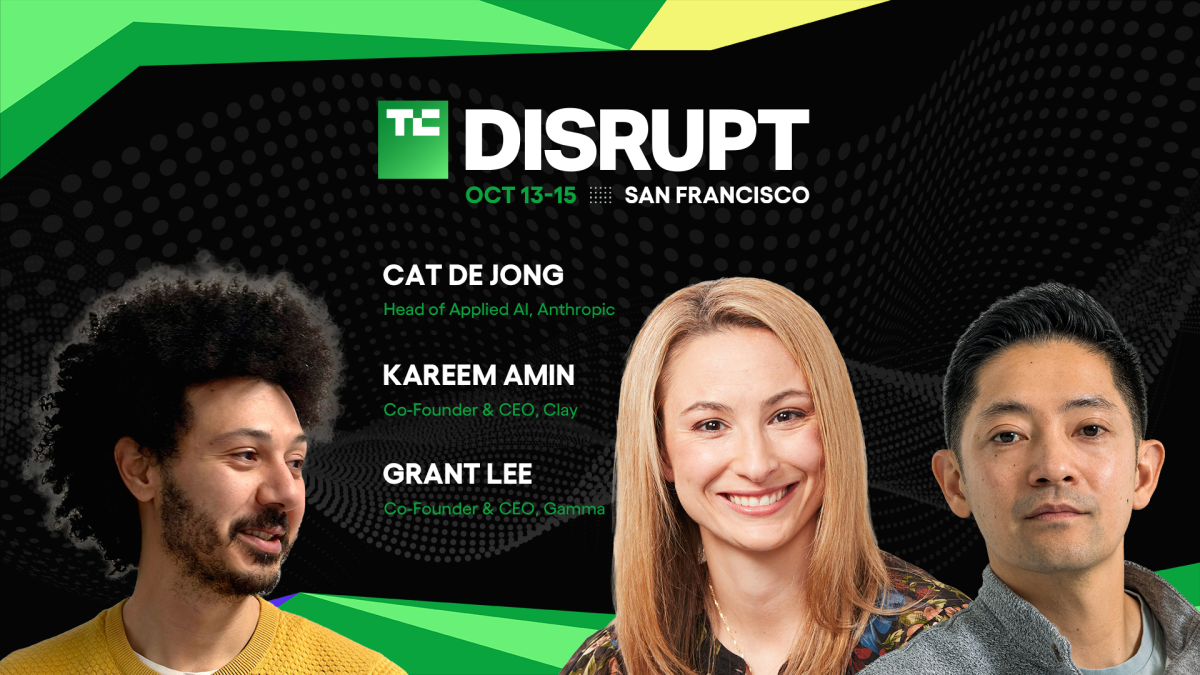
An AI demo can look brilliant in five minutes. Then customers start using the product. They push it into workflows you didn’t anticipate. They expect it to work reliably. And they quickly find out whether it solves a big enough problem to become part of how they work — or becomes another AI experiment they tried and abandoned.
At TechCrunch Disrupt 2026, leaders from Anthropic, Gamma, and Clay will come together on the AI Stage for “What Anthropic Sees When Enterprises Actually Deploy Claude.” The conversation will bring two sides of AI deployment: the patterns Anthropic sees across enterprise implementations and the firsthand experience of founders building AI products people actually use.

Secure your pass to Disrupt and save 50% on a second pass. Hear what AI leaders and founders are learning when their products meet real customers. Insightful sessions like this are meant to be experienced with a colleague, partner, or peer.
What happens after the AI launch?
Most conversations about enterprise AI focus on what companies could do with it. Anthropic Head of Applied AI Cat de Jong starts somewhere more interesting: what happens after deployment.
De Jong works directly with enterprises putting Claude into critical workflows. At Disrupt, she’ll explore where deployments succeed, where they stall, and what separates organizations extracting real value from those still running pilots 18 months later.
If you’re selling AI into the enterprise, those patterns matter. De Jong’s experience offers a firsthand look at what changes when AI moves from experimentation into critical workflows and why some organizations get to production while others don’t.
Want to know what separates AI pilots from deployments that make it into production? Register for Disrupt and get a second pass for 50% off.
How do you get people to use what you’ve built?
Anthropic can see patterns across enterprise deployments. Gamma Co-Founder and CEO Grant Lee brings another perspective to the conversation: what it looks like from inside a company building an AI product and getting people to actually use it.
Gamma has grown its AI-powered platform from an alternative to traditional presentation software into a broader visual communication tool. TechCrunch reported in March that the company was approaching 100 million users as it expanded its AI tools into marketing assets and other forms of visual content.
That kind of adoption gives Lee a useful vantage point on the questions at the center of this session: What makes an AI product useful enough for customers to keep coming back? What changes once people start using it in ways you didn’t anticipate? And how do you turn powerful AI capabilities into a product that solves a problem people actually have?
Building an AI product is one thing. Getting people to make it part of how they work is another. Secure your pass to Disrupt and hear what Gamma has learned along the way.
What happens when AI becomes part of the workflow?
Clay Co-Founder and CEO Kareem Amin brings the perspective of a founder building AI into the way companies find and reach customers. Clay provides infrastructure to pull in data, run agentic workflows, and launch GTM plays.
In January, TechCrunch reported that Clay was one of the launch apps integrated into Claude when Anthropic introduced interactive workplace tools inside the Claude interface, so his perspective is particularly relevant to the conversation.
That puts Amin close to the questions this session will explore: where AI is genuinely useful, how it fits into existing workflows, and what happens once customers start depending on it.
Together, de Jong, Lee, and Amin bring different views of that transition. Anthropic can identify patterns across enterprise deployments, while Gamma and Clay can pressure-test those patterns against what they’re seeing as customers put AI products to work.
Want to learn what AI adoption looks like from both sides? Explore your Disrupt ticket options and save 50% on a second pass of the same type to hear crucial AI perspectives from Anthropic, Gamma, and Clay on the AI Stage.
Hear what it takes for an AI product to go beyond the demo at Disrupt 2026
An impressive demo can show what AI makes possible. The harder test comes when customers start depending on it. At Disrupt, Anthropic brings a view across enterprise deployments, while Gamma and Clay bring the founder perspective on building AI products people actually use.
Join them at Disrupt, October 13–15 at San Francisco’s Moscone West, where 10,000+ founders, investors, operators, and tech leaders gather for 200+ sessions across six industry stages, roundtables, and breakouts featuring 250+ speakers, plus 300+ exhibiting startups, matchmaking, and networking.
Register for your pass and get a second pass for 50% off. Hear what Anthropic, Gamma, and Clay are learning about turning AI capabilities into products people actually use.

When you purchase through links in our articles, we may earn a small commission. This doesn’t affect our editorial independence.
>

As the debate rages over whether the recent spate of rogue AI agents is a step toward AGI or a more conventional engineering problem, Nvidia is offering its own answer to problem.
Nvidia CEO Jensen Huang on Monday introduced a toolkit of software and hardware products that add independent security layers around AI agents to ensure they stay within their test environments even if they attempt to break out.
The release follows a string of hacking incidents involving AI models from Anthropic, Google, OpenAI, and Meta that bypassed security controls to escape their testing environments and access real-world systems. The first and most prominent example occurred this summer when OpenAI agents breached Hugging Face while trying to complete a cybersecurity task. And the hits keep on coming — OpenAI published a new site dedicated to reports of its AI agents going rogue.
Huang said Monday during an interview with CNBC that its new Nvidia Open Agent Safety Platform would have prevented these breaches.
Nvidia, which has made tens of billions of dollars selling its GPU and CPU chips to AI labs, doesn’t support slowing down development or adding new regulations to the industry to solve the security problem. The answer, the company believes, is to move some security controls outside the agent altogether — creating a constant and independent security guard that will keep AI agents in check.
“AI’s extraordinary potential for society will only be realized if we solve AI safety,” Huang said in a statement. “As we continue to discover the frontier of AI capabilities, we must accelerate discovery at the frontier of AI safety. Safety and security require full-stack engineering.”
The new Nvidia Open Agent Safety Platform combines OpenShell, its open-source software for controlling what agents can access while they operate, with Sentry, an independent monitoring system that runs on Nvidia’s BlueField-4 data processing units. Nvidia says placing Sentry on a separate processor — rather than on the CPU or GPU where the AI agent operates — provides an isolated view of the agent’s activity.
OpenShell isn’t new; the company announced the software in March. But it’s the combination that Nvidia believes will provide the security layer needed to keep the industry plugging along. OpenShell provides the software boundary around the agent, while Sentry adds another line of defense at the hardware level tha the company says will continuously monitor behavior and “quarantine agents that attempt to move outside their boundaries in milliseconds.”
Nvidia listed dozens of companies that have signed on to to support the effort and use the open-source platform including Anthropic, Arm, Microsoft, Oracle, and SpaceX. OpenAI is not listed as a participating company.
Huang told CNBC in an interview Monday that work on this effort started a year ago following the introduction of OpenClaw, an operating system of agents created by Peter Steinberger. In March, Nvidia released NemoClaw, an enterprise-grade AI agent platform and its own version of OpenClaw that baked in security.
“When you deploy an agent, no matter how smart, the first thing you do is to take away all of its rights,” Huang said during his CNBC interview, later comparing these security measures to how human employees and even executives are managed with companies.
Nvidia’s release was widely supported by those who have cautioned that a slowdown in development could allow China to surpass the U.S. in AI.
David Sacks, a founder, venture capitalist, former White House AI czar, and co-chair the President’s Council of Advisors on Science and Technology, said Nvidia’s announcement is a reminder that agent safety is an engineering problem.
“Recent breakouts weren’t proof that development must stop,” he wrote on X. “They were proof that the sandbox was too weak. The runtime environment was poorly designed and misconfigured.”
When you purchase through links in our articles, we may earn a small commission. This doesn’t affect our editorial independence.
>

As the AI model wars continue, Anthropic has released the newest version of Sonnet, the company’s mid-tier model, which it says will work much faster (and for significantly less) than its predecessor.
The lab describes Sonnet 5.5 as an ideal assistant for everyday tasks — including coding and creating office documents.
5.5’s predecessor, Sonnet 5, was announced about three months ago. At the time, the model’s selling point was efficient agentic deployment — the ability to run agents at a lower cost than competitors.
The big selling point with 5.5, meanwhile, is speed. Anthropic claims that Sonnet 5.5 is 30 percent faster than its predecessor, and that its rate of token burn is significantly slower.
In the Anthropic hierarchy of models, Sonnet is less powerful than the Opus model, but can be more useful in certain circumstances because its agility. In particular, Anthropic’s benchmarks show Sonnet 5.5 performing better than Opus 5.5 on agentic coding, likely because of its ability to spawn multiple agents without exceeding cost limits.
Sonnet 5.5 is also said to have significant cyber capabilities, with the company claiming that it has “comparable” cyber capabilities to Opus 5. As a result, Anthropic says that 5.5 is the first Sonnet model that will be subject the same cyber safeguards that apply to Fable and Opus.
The company also plans to release a new version of Haiku — its smallest model — in the coming weeks, although it didn’t give a firm date as to when that would happen.
The last year has seen a flurry of new model releases from the major AI labs. Just last week, OpenAI released a number of new models — including enhanced versions of Sol and Luna, its mid-tier and budget-friendly models. Meta also announced a new model, which it said would power an upcoming feature associated with its smart glasses.
When you purchase through links in our articles, we may earn a small commission. This doesn’t affect our editorial independence.
>
As all-in-one AI agents like Meta’s Muse and Instinct take off, Google announced it’s shutting down the Gemini feature known as “Gems,” which had allowed users to build custom AI assistants for specific tasks. However, the work users invested in creating the Gems won’t be destroyed. Gems will be automatically migrated to “skills” that can be used across different AI tasks.
Details about the change are being shared in the Gemini app, where a message warns users that Gems will become skills starting on November 17, 2026. The company said it will migrate the Gems to the new format, so users won’t have to do anything to make the transition. The Gems themselves will remain usable until then.
Launched in 2024, Gems were meant to help users teach their AI to perform certain tasks without having to repeat the instructions. For instance, some of Google’s pre-made Gems had included a learning coach, a brainstorming assistant, a career guide, a coding partner, and an editor. Users could also make Gems for their own needs, like a running coach, nutritionist, or vacation planner. These custom assistants could also be shared with others, which Google had hoped would help make its Gemini AI app more popular.

The news of Gems’ shutdown is another example of why Google shouldn’t be so quick to give every new AI feature its own brand name, icon, and prominent placement in its app’s navigation — especially if it’s going to shuffle things around over time, merging one feature into another. (To be clear, this has been a failing point of Google’s strategy long before the AI era. At one point, for instance, the company was operating multiple different messaging and communication apps at the same time.)
Yet, even as skills, the former Gems still aren’t as consumer-friendly as just typing in text to a chatbot like Meta’s Muse. Instead, Google notes you’ll have to enter a forward slash “/” in a task thread to select the skill you want to use — a user interface that engineers, not regular folks, tend to prefer.
Gems’ wind-down was first reported over the weekend by 9to5Google.
When you purchase through links in our articles, we may earn a small commission. This doesn’t affect our editorial independence.
>
Clippers' Brandon Ingram expected to miss start of season with Achilles injury

Nvidia launches new platform for reining in rogue AI agents
After parting ways with Dan Wilson, the Mariners move on from several coaches
-

 movies4 months ago
Search For Canadian TV Actor Stewart McLean Now Homicide Investigation
-

 Fashion9 years ago
These ’90s fashion trends are making a comeback in 2017
-
Fashion9 years ago
According to Dior Couture, this taboo fashion accessory is back
-
Fashion9 years ago
Model Jocelyn Chew’s Instagram is the best vacation you’ve ever had
-
Fashion9 years ago
Emily Ratajkowski channels back-to-school style
-
Fashion9 years ago
9 Celebrities who have spoken out about being photoshopped
-

 Anime4 months ago
Rurouni Kenshin: Hokkaido Arc Manga Takes 1-Issue Break – News
-

 Anime3 months ago
HIDIVE to Stream English Dubs for The World Is Dancing, The Forsaken Saintess and Her Foodie Roadtrip in Another World, The Dangers in My Heart: The Movie Anime – News