Entertainment
The Skydance Era of Media Begins
In this edition: The Skydance era; CNN’s leadership; Netflix’s sports play; Disney’s TV economics; Skydance’s integration test
Welcome back to “The Media Front.”
Paramount and Warner Bros. have spent more than a century building two of Hollywood’s most recognizable names. Starting Tuesday, the company that sits above them will carry a much younger one: Skydance.
David Ellison revealed Friday that the combined Paramount-Warner Bros. company will be called Skydance, choosing the name of the company he built to sit atop an empire that will include Paramount Pictures, Warner Bros., HBO, CBS, CNN, DC Studios, Nickelodeon, Paramount+ and HBO Max.
Ellison said the idea is to preserve the identities of Paramount and Warner Bros., not bury them beneath a new corporate brand. But the name still tells us something about the company he intends to build — and where the power now sits.
For much of Hollywood history, Paramount and Warner Bros. were the institutions other companies wanted to become part of. They survived ownership changes, technological upheavals and generations of executives because the brands themselves carried enormous cultural weight. Now both are becoming part of something named for Ellison’s much younger company.
That doesn’t mean audiences are suddenly going to the movies to see a Skydance release instead of a Warner Bros. or Paramount film. Ellison has explicitly said he wants those brands to remain in the spotlight, and preserving them makes obvious business sense.
But the new company isn’t Paramount Warner Bros. It isn’t Warner Paramount. And Ellison didn’t create some neutral corporate identity designed to split the difference between two century-old studios.
He chose Skydance.
The decision caps a week in which the shape of Ellison’s new company started coming into focus.


A federal judge approved Paramount’s settlement with 12 state attorneys general, clearing the way for the $110 billion Warner Bros. Discovery acquisition to close. Wall Street banks also completed a roughly $52 billion debt sale tied to the transaction. Mattel CEO Ynon Kreiz is joining Ellison as co-CEO, while HBO’s Casey Bloys is expected to oversee the combined streaming business.
Warner Bros. film chiefs Mike De Luca and Pam Abdy are expected to depart when the merger closes. The way their exits unfolded offered an early glimpse of how the transition is playing out. De Luca and Abdy learned from press reports Thursday night that they would not be joining the merged company before Ellison formally called each of them Friday morning, TheWrap’s Sharon Waxman reported. The conversations were tense, with Abdy telling Ellison: “Good luck to you. I left you 39 movies.”
Meanwhile, Ellison has asked CNN CEO Mark Thompson to stay and discussed a new contract with him.
Put it all together, and this looks less like Paramount adding Warner Bros. Discovery to the company that already exists than Ellison building something new on top of both. That’s where things get complicated.
Warner Bros. has its own way of making movies. HBO has spent decades protecting a specific identity around premium television. CNN has its own journalistic traditions and global infrastructure. CBS has its own history. Those differences are part of what made each of them distinctive in the first place.
Skydance now has to bring all of them together without flattening what made them valuable.
That may prove harder than picking a name.
Ellison has emphasized scale, technology and creative ambition as central to his vision. But the combined Skydance will also carry roughly $80 billion in debt and is targeting $6 billion in cost savings. Those goals aren’t necessarily incompatible with preserving the company’s individual brands, but they create an obvious tension.
Two major streaming services, two film studios, multiple television operations and two national news organizations give Skydance extraordinary reach. They also create duplication, competing priorities and a lot of expensive infrastructure. Some of that will almost certainly have to change.
There is precedent for old entertainment brands surviving comfortably beneath newer corporate identities. Most viewers don’t think much about which holding company ultimately owns the movie, television show or news program they’re watching. And Ellison may be right that a separate umbrella gives Paramount and Warner Bros. more room to remain themselves than combining their names ever could.
For generations, Paramount and Warner Bros. were among the names that defined Hollywood. Skydance was a company trying to establish itself within the industry they helped create. Now Skydance will be the name above both.
Whether Ellison can deliver the promised savings without weakening those assets — and preserve their individual cultures while imposing a new strategy from above — will take years to answer. But this week gave us the clearest indication yet of how he wants us to think about the company he’s building.
Paramount and Warner Bros. will remain.
The new empire belongs to Skydance.
A.J. Katz
Media Editor
Follow me on social!


CNN’s Leadership Picture Comes Into Focus
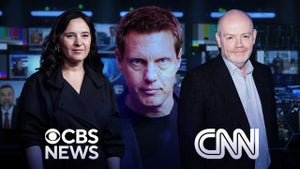
David Ellison has asked Mark Thompson to remain CEO of CNN after Paramount completes its Warner Bros. Discovery acquisition, with the two discussing a new contract that would keep Thompson atop the network. CBS News Editor-in-Chief Bari Weiss is not expected to have editorial or operational oversight of CNN when the deal closes.
The development begins to answer one of the biggest questions surrounding CNN’s future under Paramount: who will run it. But it doesn’t resolve the larger question of how CNN and CBS News ultimately coexist under the same owner — particularly as the combined company looks for billions of dollars in merger savings.
For Thompson, the immediate question is how much authority he can secure. For Weiss, it is whether her mandate remains confined to CBS News. And for Ellison, keeping both leaders in place may give him something valuable as the integration begins: time to decide whether two very different news organizations ultimately remain separate.
My full piece: Mark Thompson’s CNN Talks Raise the Stakes for Bari Weiss | Analysis


Netflix Rediscovers Appointment Television
Netflix spent years teaching viewers that television didn’t have to happen at a particular time. Its emerging sports strategy increasingly depends on giving them a reason to show up together anyway.
Chief Content Officer Bela Bajaria described the company’s approach at Puck and MoffettNathanson’s In the Arena conference this week as identifying sporting events that can become moments — from Christmas Day games to MLB and the FIFA Women’s World Cup — rather than simply recreating the full-season rights strategy of a traditional sports network. Netflix also announced that longtime NBC Sports host Rebecca Lowe will join its broadcast team for next summer’s Women’s World Cup.
That may explain what Netflix sees in sports. The company doesn’t need to rebuild the television schedule it helped dismantle. It can cherry-pick the events most capable of doing something streaming has historically struggled to reproduce: creating a large audience watching the same thing at the same time.
My full piece: Rebecca Lowe Joins Netflix’s Women’s World Cup Broadcast Team


Disney Grapples With TV’s Changing Economics
Disney Entertainment Co-Chairman Dana Walden offered a revealing snapshot this week of the problem facing traditional television: A show can still matter culturally and attract millions of viewers without those audiences necessarily adding up to the business they once did.
Speaking about the future of “Jimmy Kimmel Live!,” Walden acknowledged that late night has become a challenging part of the television business as linear audiences shrink and more viewers consume clips and other programming on demand. Kimmel can reach millions of people across those platforms, but Walden said Disney is still trying to make sense of the economics of producing an expensive late-night show for an audience increasingly scattered across them.
It’s a problem that extends well beyond Kimmel. Television audiences haven’t disappeared so much as fragmented across linear, streaming and digital platforms, while the business models built to monetize them haven’t always kept pace. For Disney, the question isn’t simply whether viewers still want traditional television. It’s whether the economics can follow them wherever they’re watching.
Loree Seitz’s full piece: Disney President Dana Walden Talks Jimmy Kimmel’s Future on ABC: ‘We’re Trying to Make Sense of the Business’

WaxWord: Skydance’s First Integration Test Gets Messy
David Ellison hasn’t officially taken control of Warner Bros. yet, but one of the first major personnel moves of the new Skydance era is already proving messy. Warner Bros. film chiefs Mike De Luca and Pam Abdy learned through press reports Thursday night that they would not be joining the combined company before Ellison called each of them Friday morning to confirm their exits, TheWrap’s Sharon Waxman reported.
The conversations were tense. Ellison told the executives that the combined company would carry significant debt and needed to restructure, according to Waxman. Both were angry over how their departures were handled, with Abdy telling Ellison: “Good luck to you. I left you 39 movies.”
It’s an early reminder that combining two Hollywood institutions will involve more than finding efficiencies on a spreadsheet. Skydance is targeting $6 billion in cost savings, which will inevitably mean difficult decisions about executives, operations and overlapping businesses. De Luca and Abdy may be among the highest-profile departures, but the way their exits unfolded shows how complicated imposing a new structure on Warner Bros. could become.
Waxman’s full piece: David Ellison Finally Calls Mike De Luca and Pam Abdy to Inform Them of Exit They Read About in the Press | Exclusive

What’s Next: This Week’s PRO — Fox News at 30
Fox News turns 30 Wednesday.
When Rupert Murdoch and Roger Ailes launched the network on Oct. 7, 1996, CNN had already spent 16 years defining cable news and few could have predicted that the newcomer would eventually become the dominant network in the category.
Three decades later, Fox enters its fourth decade from an unusual position: Its power within cable news remains formidable even as the cable bundle that helped build the business continues to shrink.
For TheWrap, I spoke with Fox News Media President and Executive Editor Jay Wallace, on-air talent and industry experts about how the network built that position, the ratings and revenue behind its dominance and what Fox’s next chapter looks like as the TV ecosystem around it changes.
Look for the full analysis this week on WrapPRO.

Also on TheWrap
On My Radar
>