
Entertainment
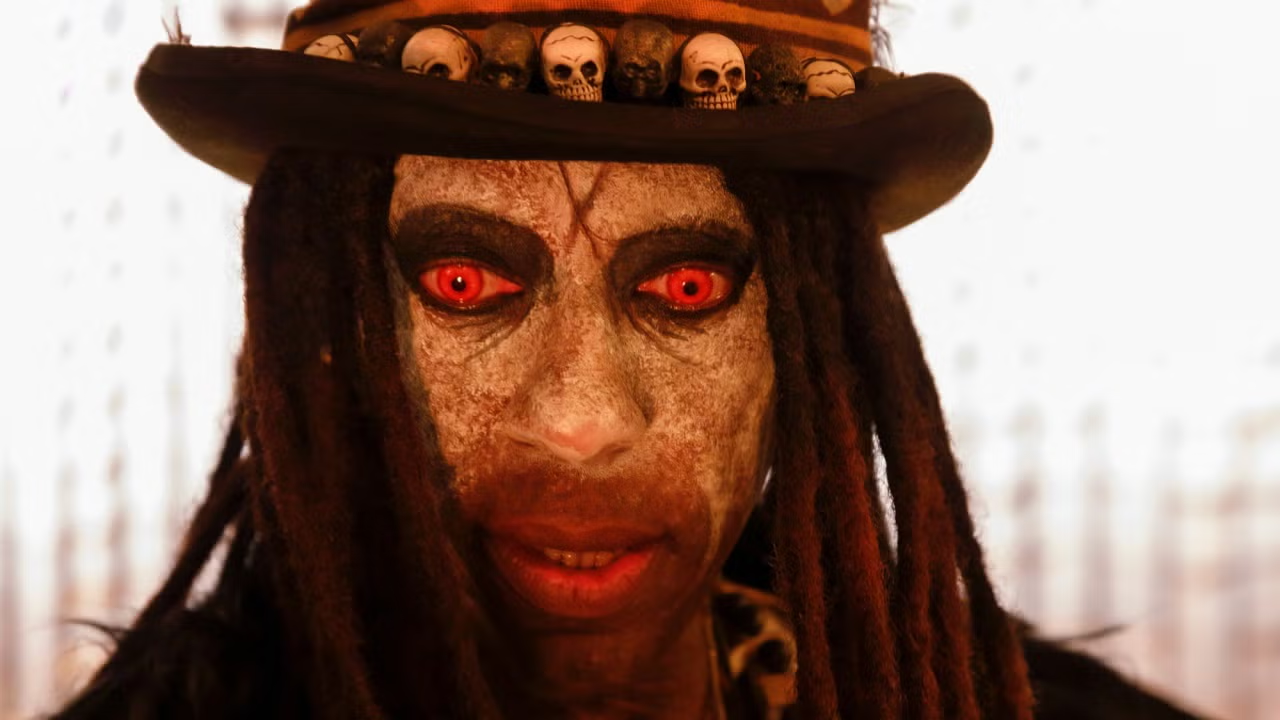
AHS 13: Your Guide to Orlando Jones and Papa Legba

Note: This story contains spoilers from “American Horror Story: 13” Episode 8.
One of the most powerful character in all of “American Horror Story” is back for Season 13. Papa Legba made his return in the eighth episode of this season on Thursday night.
The spirit first appeared in the “Coven” season of the FX thriller from Ryan Murphy and Brad Falchuk and briefly returned for the antichrist-focused “Apocalypse.” Now that Satan is a threat, the witches are calling on him again for another favor. Here’s what to know about the actor behind this mighty dealmaker.
Who plays Papa Legba in “American Horror Story: 13”?
That would be Orlando Jones.
Previously, the Gatekeeper of the Spirit World was played by Lance Reddick in “Coven” and “Apocalypse.” Reddick died suddenly in 2023 of heart disease. A prolific actor, Reddick starred in several critically acclaimed shows and movies throughout his career including HBO’s “The Wire,” ABC’s “Lost,” HBO’s “Oz,” “White House Down” and the John Wick franchise.
He also starred as Zeus in Disney+’s “Percy Jackson and the Olympians,” a series that was released after his death and earned Reddick a Children’s and Family Emmy Award nomination.

What else has Orlando Jones starred in?
Before joining the “American Horror Story” universe, Jones was one of the original cast members of “MADtv.” He also played the African god Anansi in Starz’s “American Gods” and has starred in “Evolution,” “Drumline,” ABC’s “Abbott Elementary,” Adult Swim’s “Teenage Euthanasia” and Apple TV’s “Swagger.”
How is Papa Legba connected to “American Horror Story: 13”?
Papa Legba is the Gatekeeper of the Spirit World and responsible for balancing the scales of life and death. Though he often makes deals with the witches, he has a thorny relationship with the coven. But because Papa Legba often requires such a high price for his deals, they don’t always happen.
In “Apocalypse,” he briefly plotted with Cordelia (Sarah Paulson) to eliminate the antichrist Michael Langdon (Cody Fern). Though that plan didn’t come to fruition, it shows he’s willing to make deals against dark forces — a detail that’s important to remember in a season that literally involves Satan. Cordelia ultimately made a deal with him to bring back Marie Laveau (Angela Bassett) in exchange for the new Voodoo Queen Dinah Stevens (Adina Porter), but that swap was erased when Mallory (Billie Lourd) went back in time to kill the antichrist.
Cordelia attempts to make another deal with him in “13.” In exchange for bringing back Marie Laveau, Cordelia and her newly resurrected mother Fiona (Jessica Lange) agree to hand Queenie (Gabourey Sidibe) over to the gatekeeper. Queenie volunteers to suffer in hell after the trio realize that Fiona is their best bet at getting Marie Laveau on their side and Cordelia is too weak to be punished. Cordelia and Fiona let Queenie return to her personal hell of working in fast food but promise they will come back for her.
“American Horror Story” airs new episodes Thursdays on FX and Hulu.

>
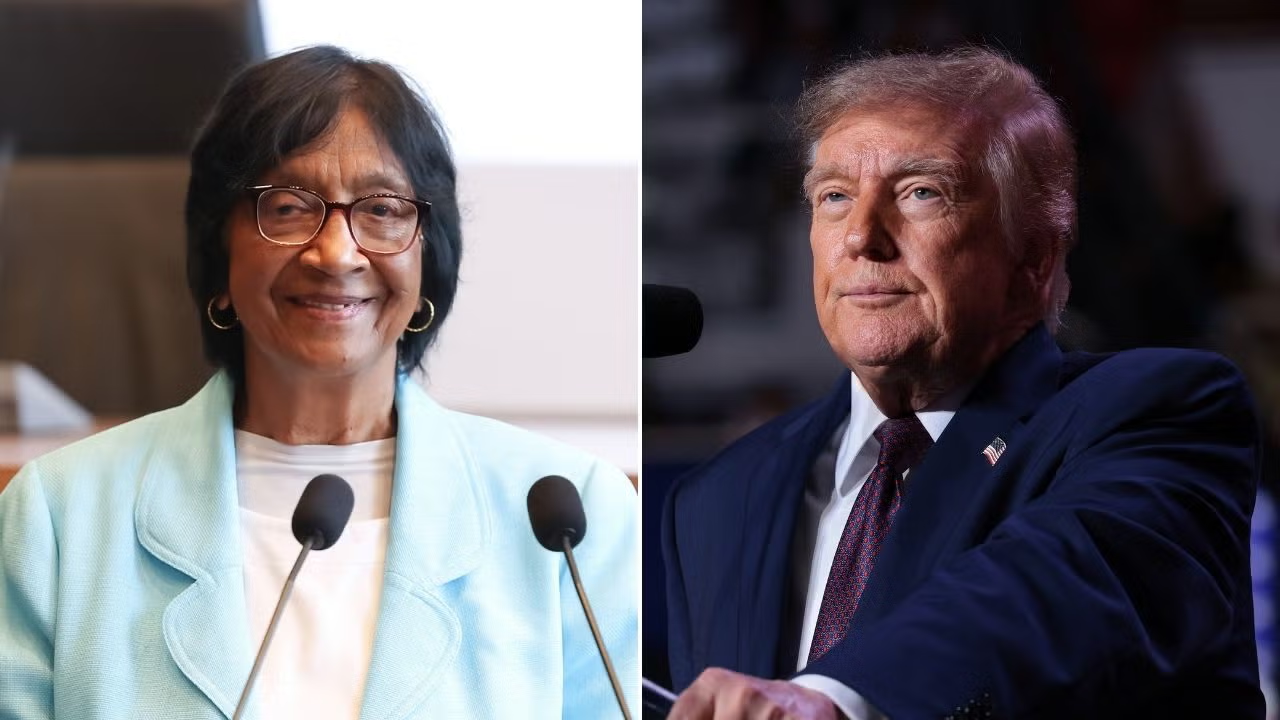
Nobel Peace Prize winner Navanethem “Navi” Pillay poked fun at President Donald Trump in the moments immediately after finding out she had been named as this year’s honoree.
In a video shared on X, Pillay could be heard jokingly telling those applauding her, “If you clap a little bit more, I may share this prize with Trump.” Her comment was met with laughter from her supporters in the room. She was in Nuremberg, Germany, when she found out the news.
Pillay, 85, was there attending a forum, in the same city where Nazi war criminals were put to trial in the aftermath of World War II. She was in the same room where the trials took place when she was announced as the 2026 Nobel Peace Prize winner.
The South African-born jurist and former U.N. human rights chief has built a decades-spanning career over the course of her life. Through her work, she has done everything from defended the rights of a then-imprisoned Nelson Mandela to helming a panel that determined Israel committed genocide in Gaza. The Nobel Peace Prize committee said Friday she had been chosen in honor of her work promoting international law at a time when it is under attack.
Amazing moment.
Navi Pillay has received the Nobel Peace Prize ! https://t.co/HL3r1PJzLO
We are at the Nuremberg Court; I cannot think of a stronger symbol for her Nobel prize.
We are all so thrilled!
This is her first reactions upon hearing the news: https://t.co/Crbj6XdiyQ
— Agnes Callamard (@AgnesCallamard) October 9, 2026
“This year’s laureate has been instrumental in ensuring that war crimes, crimes against humanity and genocide are prosecuted,” the Norwegian Nobel Peace Prize Committee wrote in a statement Friday, explaining its decision to award Pillay on the prize’s 125th anniversary. “At a time of existential challenges – including more wars and conflicts than the world has seen in a long time – international law is no longer just a supplement to peace and security. It is an absolute necessity.”
“The system of international law is under tremendous pressure, and its institutions are under attack,” the committee continued. “In awarding this year’s Nobel Peace Prize, the Norwegian Nobel Committee wants to remind the world that the rule of law – national and international – underpins the system we have set up to ensure peace and resolve conflicts non-violently. Peace requires justice.”
Both U.S. President Donald Trump and Israeli Prime Minister Benjamin Netanyahu have rejected the genocidal findings of Pillay’s U.N. commission regarding Gaza.
“The Nobel Prize committee has lost its moral compass,” the official X account for Netanyahu’s office wrote Friday in response to Pillay’s win. “It has awarded its highest honor to a bigot who built her career around inventing and propagating blood libels against the one and only Jewish state.”
Pillay’s dig at Trump comes one year after Venezuelan opposition leader María Corina Machado was awarded the 2025 Nobel Peace Prize for her efforts fighting against tyranny in Venezuela. She won despite President Trump’s open campaigning for the award. Machado later gave Trump her Nobel prize, after the United States removed then-President Nicolás Maduro from power in Venezuela.
However, the Nobel Committee has labeled the move purely symbolic, stating that the prize itself cannot be transferred by a winner.

>

When you name your movie “Drinking and Driving” — assuming it’s not some kind of pun that leads into a wholesome comedy about a NASCAR star named Richard Drinking — you preemptively lower everyone’s expectations for the role models they’re about to see onscreen.
It’s certainly warranted in the case of Avalon Fast and Jillian Frank’s new movie, a slice-of-life dramedy about the empty recklessness of two friends who wile away the days of their early adulthood with an endless stream of substance abuse in their small rural hometown. Drinking and driving have become a regular part of the routine, as mundane as 5 a.m. cocaine bumps or curing hangovers with molly after spending another late night partying in a loose acquaintance’s basement.


It’s not like Palmer (Avalon) and Iris (Frank) have anything better to do. Their lives are small and seemingly meaningless: the two girls never left their hometown, work the same dead-end restaurant job, and even share a bed on the nights they manage to make it home in time to sleep. With a limited social circle, they end up hanging out with the same neighbors and swooning over the same toxic boys who all look like Post Malone if his career had never taken off. Palmer and Iris seem to enjoy themselves a solid 60 percent of the time as they drift from backyard to dirt bike track to someone’s basement or car. The Jarmusch-esque “plot” revolves around them meeting up with an acquaintance named Levi (Ethan Hawksworth) and his cousin Phoenix (Henri Gillespi), in town and bopping from place to place without a plan.
The film is admirably committed to documenting this lifestyle without much idealization or condemnation. Occasional moments of real, spontaneous joy emerge, and others reveal the crushing emptiness of lives going nowhere, but the script doesn’t lean too hard in either direction. Fast and Frank provide enough context clues to show us that these girls dealt with mediocre parenting and limited economic mobility — enough to keep humane viewers from judging or disliking them too much, but mercifully not enough to turn it into a story of victimhood.
The first two acts of “Drinking and Driving” almost play like a nature documentary, showing us four creatures in their natural habitat going through the only survival mechanisms they know. The cinematography feels deliberately ugly, with greens, grays, and browns blurring together to paint a muddy picture of the town you never make it out of. The often-handheld camerawork creates the sensation of watching old home videos, even if most of these encounters don’t seem worthy of documentation.
“Drinking and Driving” is downright cinéma vérité compared to the expressionism of Fast’s earlier work like “Camp,” but it still drifts slightly away from pure realism by the end. Much of the film plays its own version of conventional “the party has to end eventually” coming-of-age beats, even if these parties never seem that great to begin with. But since these girls don’t have anything that looks like conventional adulthood waiting for them, the film wisely steers them away from maturity and toward a kind of spiritual liberation. Can real transcendence come from sharing physical pleasures with unremarkable people who just happen to live in the same town as you? Nobody can fully answer that question, but Fast and Frank get closer than you might think.
Even if no scene is particularly riveting on its own, the film still comes together into something oddly compelling. “Drinking and Driving” seems to exist in a liminal space where the past is not worth remembering, and the future is nothing to look forward to, so all there is to do is squeeze any hedonistic pleasure that you can out of today, even if we can already see that those experiences won’t be worth remembering either. The small-town American setting grounds the film in a sense of regional specificity, but that sense of 2020s malaise and the pockets of joy that it occasionally creates should be universal.
Grade: C+
A Muscle Distribution release, “Drinking and Driving” will screen at BAM Rose Cinemas from October 11-13.
>
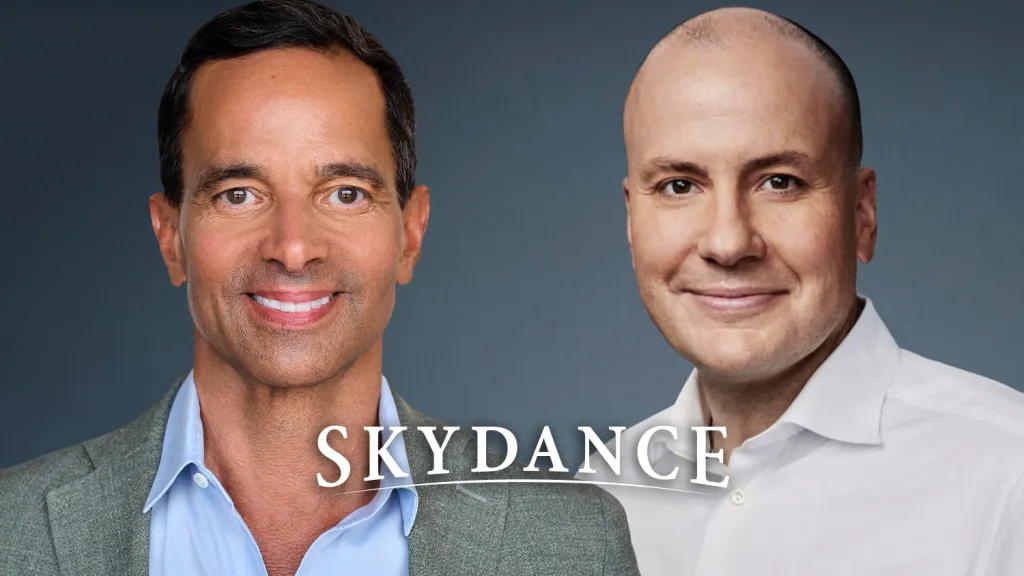
Skydance‘s CEO Business Leadership Team unveiled on Monday features only Co-Chairs, with everyone in the group sharing oversight of a division alongside someone else. All pairs come from the same side of the merged Paramount-Warner Bros. Discovery company (WBD’s Casey Bloys & JB Perrette for DTC and James Gunn & Peter Safran for DC; Paramount’s Dana Goldberg & Josh Greenstein for film) except for one crossover duo: Paramount’s George Cheeks and WBD’s Perrette, who will serve as co-Chairs of Skydance TV.
The move marks the latest shared leadership position for Cheeks and also a new role he has not been in yet — at least by title — as Chief Content Officer of Skydance TV, a unit spanning Skydance’s three TV studios, Warner Bros. TV, CBS Studios and Paramount TV Studios, CBS and about 30 basic cable networks. As Skydance TV Chief Business officer, Perrette will oversee the division’s ad sales, distribution, content sales and international operations.
For a decade now, Harvard Law graduate Cheeks has been the business partner to a creative executive, whether it was as Co-President of Universal Cable Prods. and Wilshire Studios alongside Dawn Olmstead or as NBC Entertainment Co-Chairman alongside Paul Telegdy. Now he is the creative executive alongside Perrette with a title matching that of Skydance DTC Chief Content Officer Bloys, one of TV industry’s most accomplished development executives.
That caps a long evolution for Cheeks that can be traced back to one of his first Hollywood jobs, while having Perrette as Chief Business Officer across DTC as well as TV Studios and linear networks corrects a structural flow that existed at both Paramount and WBD.
The Business Guy
After stints at entertainment law firms Loeb & Loeb and Hansen Jacobson Teller and the BA & legal department of Castle Rock Entertainment early on, Cheeks landed a business and legal affairs job at MTV Networks. There, along with drafting deal memos, he also started doing script coverage for then-top programming executives Tony DiSanto and Liz Gateley.
Cheeks got his first formal assignment on the creative side — and showed his talent relations skills — when, as EVP Business Operations for NBC and Universal TV, he was put in charge of NBC Late Night in 2014. Lorne Michaels took a liking to him (while disliking his predecessor) and took him under his wing, valuing his creative sense by asking for his feedback on writer packages and taking him to auditions.
Cheeks has acknowledged that getting the NBC Late Night gig changed his career, fueling his aspirations to straddle business and creative. He would later be handpicked as the main liaison to NBCUniversal’s other uber TV producer, Dick Wolf, for similar reasons (the procedural king wanted to switch executives), proving that he can work well with top-level talent.
Still, when Bonnie Hammer announced Cheeks and Olmstead’s appointment as UCP co-Presidents in early 2018, she called Olmstead a “talented creative executive” while praising Cheeks’ “business savvy” as “second to none.” Similarly, Steve Burke’s statement about Cheeks’ promotion as NBC Entertainment co-Chairman alongside Telegdy later that year called him “a strategist and masterful dealmaker.”
That is a perception Cheeks carried over in his 2020 move to then-ViacomCBS as President and CEO of CBS Entertainment, with David Nevins initially serving as the division’s Chief Content Officer. That changed in 2021. Overseeing CBS-branded operations in various roles over the past five years — including another shared one as co-CEO of Paramount Global — varnished Cheeks’ creative credentials as he worked closely with such executives as CBS Entertainment President Amy Reisenbach and CBS Studios President David Stapf.
Now Cheeks, who also has been overseeing Paramount’s basic cable networks, will be focusing on programming and marketing content while expanding his portfolio to include Warner Bros. TV, Paramount TV Studios as WBD’s cable brands, leaving most of the business areas to Perrette. (Given his business background, Cheeks is still expected to get involved in some decisions.)
Bundling Linear & Streaming Business Ops
Legacy media companies such as Skydance are faced with managing the transition from linear TV to streaming, and Perrette serving as Chief Business Officer across both direct-to-consumer and linear networks/TV studios will help facilitate that as the two areas have become intertwined in many key areas such as carriage agreements, ad and content sales.
For instance, in affiliate distribution deals for linear networks, carriers increasingly insist on bundling the streaming service. The same goes for ad buyers who package ad time across linear and digital.
And then there is content licensing, which could be a lot more efficient if the studios’ distribution divisions and their sibling streamers are overseen by the same business op executive. For instance, CBS and Paramount+ had been siloed, with Paramount+ automatically asking for exclusivity on virtually all CBS series. A holistic approach would help determine whether certain shows need to stream exclusively on Paramount+ or, based on their engagement and other metrics, they could be licensed to other platforms too, bringing in revenue that can be used to produce more shows.
Straddling both areas will also give the business executive in charge more ownership over next-day CBS series to better integrate them into the platform alongside the Paramount+ originals. (CBS fare, a big viewership driver in-season, is expected to stay largely on Paramount+ until the streamer’s merger with HBO Max is completed within the next couple of years.)
Additionally, the new streamlined structure with Perrette across both linear and streaming business ops makes for simplified and expedited decision-making. At WBD, where he was CEO of global streaming, it was a quartet of executives collaborating on these decisions: Perrette, CFO Gunnar Wiedenfels, Chief Revenue and Strategy Officer Bruce Campbell and President of International Gerhard Zeiler.
‘The Odd Couple’ 2.0?
In addition to being the only cross-company pair in the top Skydance executive echelon, Cheeks and Perrette share another distinction — Cheeks is the only former Paramount Global and Perrette the only former Discovery executive in the group.
As for compatibility, both are bringing in good track record. Perrette already has his successful partnership with Bloys, and Cheeks has showed that he could work with anyone.
Cheeks joked about it when asked in 2019 how he gets along with Telegdy, a flamboyant, larger-than-life personality.
“We literally could not be more different. It’s like Casting 101: ‘Let’s cast this dude and that dude and they’re so different, they’re an odd couple,’” he said at NATPE.
Cheeks clearly impressed Hollywood moguls with his performance as he keeps getting cast as half of executive couples.
>
ESPN adds Pat McAfee alt-cast to Super Bowl 61, 'Monday Night Football' coverage

Master AI Chip Principles With New IEEE Design Program

Nobel Peace Prize Winner Navi Pillay Pokes Fun at Trump
-

 movies5 months ago
Search For Canadian TV Actor Stewart McLean Now Homicide Investigation
-

 Fashion9 years ago
These ’90s fashion trends are making a comeback in 2017
-
Fashion9 years ago
According to Dior Couture, this taboo fashion accessory is back
-
Fashion9 years ago
Model Jocelyn Chew’s Instagram is the best vacation you’ve ever had
-
Fashion9 years ago
Emily Ratajkowski channels back-to-school style
-
Fashion9 years ago
9 Celebrities who have spoken out about being photoshopped
-

 Anime4 months ago
Rurouni Kenshin: Hokkaido Arc Manga Takes 1-Issue Break – News
-

 Anime3 months ago
HIDIVE to Stream English Dubs for The World Is Dancing, The Forsaken Saintess and Her Foodie Roadtrip in Another World, The Dangers in My Heart: The Movie Anime – News