
Palestinian-American academic, literary critic, and political activist Edward Said, Mantova, September 19, 2001.
Photo by Leonardo Cendamo/Getty Images


The Bend Film Festival wraps on Sunday after presenting awards for the 23rd edition of the cinematic spectacle in central Oregon.
Ramzi Bashour’s debut feature Hot Water, starring Lubna Azabal (Coriolanus), Daniel Zolghadri (Funny Pages), and Dale Dickey (Widow’s Bay), won Best Narrative Feature. The filmmaker, born in Lebanon and based in New York City, crafts an offbeat road trip movie involving a mother and son “stopping at diners, motels, and hot springs” in the American West.
The jury, comprised of Whitaker Lader, Charlie Sextro, and Sebastián Hernández, wrote Hot Water “charmed our socks off. The film took us on a memorable journey across the U.S. where we were privileged to witness the prickly detours of a mother/son relationship. Although this marks the director’s feature debut, it was clear to us that this is only the beginning of a long, storied filmmaking career considering how much life and love they packed into a low-budget movie.”
Palestinian-American academic, literary critic, and political activist Edward Said, Mantova, September 19, 2001.
Photo by Leonardo Cendamo/Getty Images
In Documentary Feature Competition, the top prize went to Edward Said: Between Worlds, director Maiken Baird’s portrait of the late Palestinian scholar and activist. The film traces Said’s journey from Mandatory Palestine (then under British control) to exile with his family in Egypt after the 1948 Nakba and establishment of the state of Israel, and his eventual relocation to the U.S. where he became a professor of comparative literature at Columbia University in New York. After the 1967 Arab Israeli war and Israel’s occupation of Gaza and the West Bank, Said became a leading voice for the Palestinian cause.
The documentary jury, comprised of Oscar winner Diane Becker (Navalny), Mia Bruno, and myself, wrote, “In his own words more than two decades after his death, through the archive recordings of his own voice, Edward Said: Between Worlds is a nuanced, timely, and reflective film of the complicated Palestinian identity after the war in 1948 as well as a portrait of the Palestinian academic who advocated for coexistence in a time where such voices were few and far between.”
‘I Got Bombed at Harvey’s’
FunMeter
Documentary jurors presented a Special Jury Award for Craft to I Got Bombed at Harvey’s, directed by Bryan Storkel and Amy Bandlien Storkel, a rollicking story of a man with a grudge and a thousand pounds of dynamite with which to exact vengeance on his perceived enemy at a Nevada casino.
“These filmmakers elevate the true crime genre through a riveting story of toxic masculinity and a patriarch’s malign control over his sons who become unwilling accomplices in a bizarre bombing plot,” we wrote. “This entertaining film is highlighted by superb editing, an electric pace, well-lit interviews with relevant participants, seamless integration of archive and recreations that evoke Lake Tahoe in 1980 and the locus of action – Harvey’s Wagon Wheel Resort and Casino.”
‘The Lake‘
Courtesy of Abby Ellis
The doc jury also selected a winner in the 2026 Environmental/Outdoor Features Competition, choosing from among nonfiction films “centered on the relationships between humans and nature — by turns adversarial, exploitative, mutually beneficial and endlessly evolving.” The top prize there was awarded to The Lake, directed by Abby Ellis, a film exploring the environmental catastrophe posed by the rapidly shrinking Great Salt Lake in Utah.
“What is at stake when we remain locked in a stalemate over how to address the dire state of our natural world?” the jury wrote. “What would it take for a community, a government, an industry, to recognize and act on how truly desperate the situation has become? Through the riveting exploration of those frantically navigating what is at once both so imperative and so intractable, The Lake illuminates the powerful truth that we do not have time to waste.”
Mr. Mungai in ‘Kikuyu Land‘
Courtesy of Trifilm Studios/Photo by Andrew H. Brown
In the competition for Best Indigenous Feature, the prize went to Kikuyu Land, directed by Bea Wangondu and Andrew H. Brown. That film, set in Kenya’s contested tea fields, examines “the enduring legacy of colonial exploitation.”
“The issues at the center of this film reach far beyond its borders,” wrote the Indigenous Feature jury, comprised of LaRonn Katchia, Dawn Jones Redstone, and Johnnie Jae. “Colonialism has shaped communities around the world, and its effects continue to influence the lives people lead and the futures they are trying to create. This film offers a powerful example of that kind of reckoning, showing that accountability can begin when we’re willing to turn the same scrutiny we apply to the world back toward ourselves.”
In a statement, BendFilm Programming Director Selin Sevinç noted, “These award winners represent the kind of bold, urgent independent cinema we’re committed to championing. Each of these films meets the moment with artistry, authenticity, and vision. I can’t wait to see what’s next for both these stories and their talented tellers.”
The Tower Theatre, one of the venues for the Bend Film Festival.
Matthew Carey
The festival, which opened Wednesday, October 7 and closes Sunday, presented its Indie Filmmaker of the Year Award to Oscar-nominated director Rory Kennedy. She brought two of her films to Bend – The Trial of Alec Baldwin and Freefall: A Reckoning for Boeing.
Actress Tantoo Cardinal was named BendFilm’s Indigenous Honoree. The star of Killers of the Flower Moon, Dances With Wolves, Black Robe and many other films was born in Alberta, Canada and is of Cree and Métis heritage.
The 2027 Bend Film Festival is set to unfold from October 6-10.
These are additional prizes award at the 2026 Bend Film Festival:
SHORT FILM COMPETITION
The 2026 Narrative, Animated and Documentary Shorts jury comprised Daniel Crooke, Max Geschwind and Laura Henneman. The inaugural Youth Jurors were Poppy Post, Mac Schlaadt, and Cora Martin.
Best Animated Short Film: Living with a Visionary by Stephen P. Neary
“For its inventive animation and the way it uses the form to tell a story that feels both deeply personal and completely original, this film shows us what it means to love and live alongside someone whose creative drive and purpose can consume everything around them— and how the person beside the visionary has a story and perspective of their own.”
Best Comedy Short Film: The Oracle by JJ Adler
“This film had us laughing from the beginning and kept finding ways to surprise us as it went along. The premise is so simple and clever, but the ensemble — led by an all-too-recognizable character actor — had us in the palm of their hand the entire time. The sharp, confident, neurotic, and genuinely funny filmmaking demonstrates a firm grasp on telling this deeply chaotic but also resonant story about our desire for certainty and how ridiculous we can become when we’re desperate for someone, or something, to tell us what to do.”
Best Dramatic Short Film: Skin on Skin by Simon Schneckenburger
“This film announces the arrival of a major new voice in international cinema, one whose commanding control over craft and tone anchors this story’s volatile milieu with rich soulful resonance. While it’s a story of two strangers, and their emotional and physical proximity to one another, it’s also a study of the walls erected to divide neighboring nations, labor and capital, and the majority from the other. That you can practically feel the sweat on the brows of these characters speaks to the overwhelming audiovisual power that director Simon Schneckenburger imbues in every frame of this raw cry for liberation and connection.”
Best Documentary Short Film: Still Standing by Victor Suarez and Livia Albeck-Ripka
“This haunting documentary details a devastating environmental reality through an urgent and unexpected lens, not simply in its atypical focus selecting whose story to tell, and when, but through its arresting formal approach which evokes displacement, dread, and the near-invisible danger of lingering contamination. The chilling contradiction found in the filmmakers’ blend of immediacy and detachment mirrors the transformation of 9,000 homes in Altadena, California from domestic bliss to toxic abyss after quote-unquote surviving the Eaton fires of early 2025.”
Best Indigenous Short Film [selected by jurors LaRonn Katchia, Dawn Jones Redstone, and Johnnie Jae]: First Descent: Kayaking the Klamath by Jessie Sears
“This film weaves together the generations of work following the historic removal of multiple dams on the Klamath River with the hopeful journey of the next generation of Indigenous river stewards as they navigate, and learn their relationship to this precious resource.”
Special Jury Award for Creative Vision: Dropping Off by Will Mayo and Ian Scott
“This film surprised us with its blend of comedy and drama and its unusual cinematic approach to a recognizable setting. The strong visual and editing style, combined with a wonderfully natural central performance brought both perspective and emotional weight to a fictional story that still feels like it could be unfolding, right now, in a Los Angeles neighborhood.”
Youth Jury Award for a Short Film: The Boy with the Dinosaur Head by Imran J. Khan “This film explores the complexities of identity in a society that deems differences to be undesirable, and the impact this has on younger generations.”
>
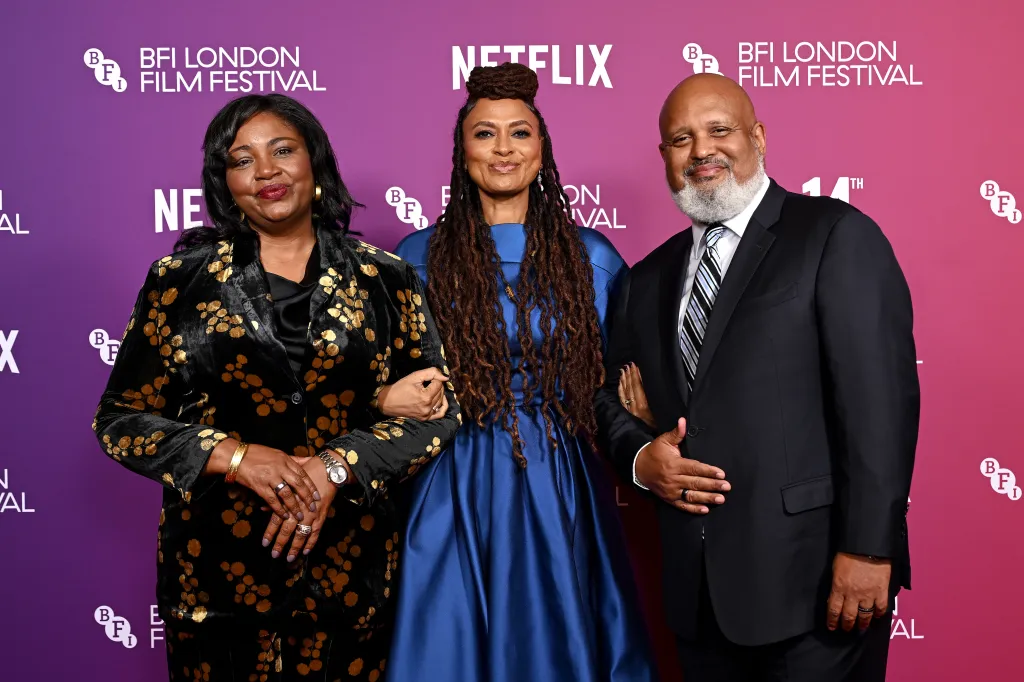
Ava DuVernay continued the rollout for the 14th, the documentary feature she has produced and directed at Netflix, this evening in London, where the film screened as the Special Documentary Presentation at the London Film Festival.
The film arrived in London following its debut bow at the New York Film Festival on October 9.
“I jumped straight on a plane and came here to see how these ideas feel in another country,” DuVernay told the packed-out London crowd as she introduced the film.
As it turns out, DuVernay’s ideas were exactly what the LFF audience had been looking for. The LA-based filmmaker and her producers, Tammy Garnes and Paul Garnes, were given a lengthy, impassioned standing ovation as they walked on stage for a post-screening Q&A session with BFI programmer Grace Barber-Plentie (Standing ovations are pretty rare at the LFF, where audiences are passionate but rarely emotive).
The film, which arrives ten years after DuVernay’s Emmy Award-winning 13th, details how the 14th Amendment and its foundational principles of birthright citizenship, due process, equal protection under the law, and the prohibition for heads of state to engage in acts of insurrection, ratified post–Civil War, are now under systematic attack.
DuVernay builds the film’s narrative using a wide and often surprising range of interview subjects. Contributors include expected names like Representative Alexandria Ocasio-Cortez, former Georgia State Representative Stacey Abrams, and social justice activist Bryan Stevenson. But the Selma filmmaker also includes contemporary voices like political streamer and influencer Hasan Piker alongside MAGA republicans like Anna Paulina Luna.
“It was important for us to have a vast range of points of view. We wanted the audience to feel represented,” DuVernay told the London audience. “We reached out to more than 300 people who would be considered Republican or MAGA, and only four responded and said they would do it.”
DuVernay told the LFF crowd that she had no real intention of returning to the subject of the U.S. Constitution after the 13th, which covers the 13th Amendment, but became intrigued by the idea of interrogating the history behind the 14th Amendment during President Donald Trump’s second reelection campaign.
“It was the summer of 2024, when Donald Trump was campaigning for a second term, and I heard him talking about birthright citizenship,” she said. “One of the first things he said he would do—as a campaign promise—was challenge birthright citizenship. I thought, ‘Oh, wow. That’s the Fourteenth Amendment.’ That’s all I knew about it.”
Indeed, President Donald Trump signed an executive order challenging U.S. birthright citizenship on the first day of his second term in office, which was later ruled unconstitutional by the U.S. Supreme Court.
“But he also began systematically challenging every other part of the Amendment,” DuVernay said, explaining how the film developed.
“Part of our investigation, and our attempt to unpack all of this, was the horrible realization that no one person knew everything we needed to know. For 13th, there was a book called The New Jim Crow by Michelle Alexander that was like our bible for that film. For this film, there was no single book because there were so many pieces. A major part of the work was trying to piece everything together while the news was coming in in real time. It really evolved organically.”
The 14th runs just over 100 minutes, but covers an enormous scope of U.S. history, drawing a direct line from the Reconstruction era to President Trump’s second term.
“As we were researching, one thing that shocked me was how much we had forgotten,” Tammy Garnes said. “We started making a timeline. Every day we were making the movie, we documented something happening in the United States that shocked us or had a connection with the Fourteenth Amendment. And every single day, we could find something.”
Garnes added: “The truth is there. It’s just a matter of whether or not you want to see it, hear it, and internalize it.”
The 14th will debut globally on Netflix on December 4, following a theatrical release in select U.S. and U.K. theaters beginning on November 27. DuVernay told the LFF that her primary takeaway from the production is that “systems are not static.”
“We often feel that we’re governed by the laws, politicians, and policies that we live within and under. But systems are motivated by people, and we need to remember that systems can be changed by people,” DuVernay said.
“This film was not made to give you hope at the end. It was made to ensure we’re all standing together in a place of truth and sobriety. That we’re clear-eyed about where we are and honest about where we need to go. I hope that’s how you feel afterward. That was the goal.”
The LFF runs until Oct 18.
>
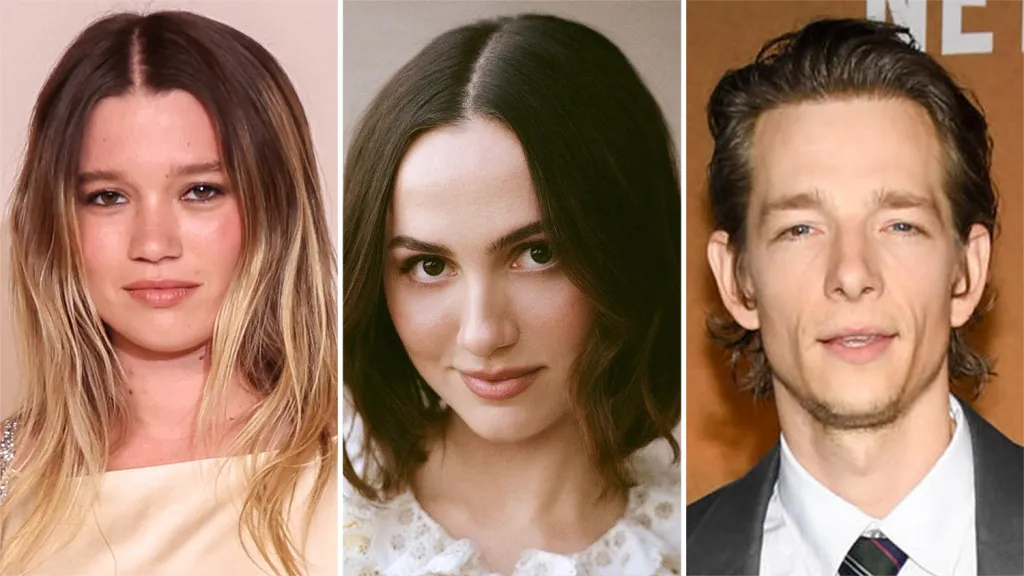
EXCLUSIVE: Rain Spencer (Good Girl Jane, The Summer I Turned Pretty, Big Girls Don’t Cry) has joined Maude Apatow (Poetic License, Euphoria) and Mike Faist (Steven Spielberg’s West Side Story, Challengers, East of Eden) in writer and director Sarah Elizabeth Mintz’s (Good Girl Jane) dramatic film The Maid of Orleans.
Amira Casar (Call Me By Your Name, La Maison, The Contractor) and Stefan Crepon (Andor, Peter Van Kant) have also been cast in key roles.
In The Maid of Orleans, a curious game of cat and mouse ensues when an ambitious young woman travels to Paris to assist a tortured visionary on his French production of Joan of Arc.
Mintz is also producing the feature together with Shuli Harel and Jeff David (See You When I See You). Astute Films is producing as well as fully financing the film.
“It’s a great gift to work with artists I admire and trust as I do this team, and I can’t wait to share what we’re cooking up together,” Mintz said.
The Maid of Orleans filming is underway in Paris, France. The film marks a reunion between Mintz and Spencer, who starred in Mintz’s Good Girl Jane.
Mintz was a Sundance Fellow in the 2017 Writer’s Intensive with her feature Good Girl Jane, which premiered in U.S. Narrative Competition at 2022 Tribeca Film Festival winning both the Founders Award for Best U.S. Narrative Feature as well as Best Performance in a Narrative Feature for Rain Spencer.
Spencer recently wrapped a leading role in the Anne Hathaway produced feature Little Five opposite Ariana Greenblatt and David Oyelowo. She can currently be seen starring in the Jane Campion-produced Big Girl’s Don’t Cry, which was directed by Paloma Schneideman and premiered at Sundance earlier this year. She will next be seen reprising the role of Taylor Jewel in the highly anticipated The Summer I Turned Pretty movie for Amazon MGM.
The Maid of Orleans will be Spencer and Mintz’s third collaboration. Earlier this year, they wrapped production on Mintz’ second feature film in upstate NY.
Amira Casaris a veteran of numerous international film and TV productions like Apple TV’s La Maison with Lambert Wilson and Carole Bouquet; SND’s drama Visions with Diane Kruger and Mathieu Kassovitz; National Geographic’s dramatic mini-series A Small Light with Bel Powley and Liev Schreiber; Paramount’s The Contractor starring Chris Pine, Sony Classic’s critically acclaimed Call Me By Your Name with Timothee Chalamet and Armie Hammer directed by Luca Guadagnino and CBS Films’ At Eternity’s Gate directed by Julian Schnabel featuring Willem Dafoe, Rupert Friend, Oscar Isaac and Mads Mikkelsen.
Casar frequently appeared in French films and television productions including TF1’s The Divine Sarah Bernhardt starring Sandrine Kiberlainand and Lauren Lafitte; Metropolitan Films’ Sisters in Arms starring Dilan Gwyn, Camelia Jordana, Esther Garrel, Maya Sansa, Nanna Blondell and Noush Skaugen; Studio Canal’s mini-series Savages with Marina Fois, Roschdy Zem, Souhella Yacoub, Dali Benssalah, Sofaine Zermani, Lyna Khoudri and Ilies Kadri and Canal+’s series Versailles with George Blagden, Alexander Vlahos, Tygh Runyan, Suart Bowman and Evan Williams.
Stefan Crepon is most recognized for a recurring role in Canal+’s TV dramatic thriller The Bureau starring Mathieu Kassovitz, Florence Loiret Caille and Jonathan Zaccai; Playtime’s drama Peter Von Kant written and directed by Francois Ozon featuring Denis Menochet; Isabelle Adjani and Hanna Schygulla and Lucas Films’ series Andor with Diego Luna, Stellan Skarsgaard and Adria Arjona.
Crepon’s other credits include: Diaphana Distribution’s Man’s Skin opposite Catherine Deneuve, Karin Viard and Laurent Stocker; ARP Selection’s Sanguine starring Mara Taquin and Karin Viard, Zinc’s Vultures costarring Sami Bouajila, Mallory Wanecque, Jean-Pierre Darroussin and Valerie Donezelli; Netflix’s Lupin with Omar Sy and Ludivine Sagnier as well as Elle Driver’s drama Promises featuring Isabelle Huppert and Suffiane Guerrab.
Spencer is repped by UTA, Range Media Partners and Yorn Levine. Faist is represented by WME, Brillstein Entertainment Partner and Jackoway Austen Tyerman Wertheimer Mandelbaum Morris Bernstein Trattner Auerbach Hynick Jaime LeVine Sample & Klein. Apatow is represented by WME, Mosaic, Ziffren Brittenham. Mintz is repped by WME and Hirsch, Wallerstein, Hayum, Matlof and Fishman.
>
Some of the year’s most acclaimed films were represented Monday at a BFI London Film Festival industry panel on the realities of co-production. Producers behind Cannes winner Fjord, current award hopefuls Paper Tiger, Everybody Digs Bill Evans and The End of It and international Oscar winners Sentimental Value and I’m Still Here swapped lessons on making films across borders.
Moderated by film podcaster and programmer Wendy Mitchell, A Shared Vision: Perspectives on Co-production, held in association with The Hollywood Reporter, brought together Dyveke Bjørkly Graver, producer/partner at Eye Eye Pictures (Fjord), Alan Maher, co-managing director and producer at Cowtown Pictures (Bill Evans), Adrià Monés, founder and CEO at Fasten (The End of It), and Rodrigo Teixeira, founder and producer at RT Features (I’m Still Here, Paper Tiger).
Differences in paperwork were a topic discussed by Maher and others, with panelists pointing out that producers in the U.K. and Ireland tend to be used to having “more lawyers and more meetings” involved than is the case elsewhere in Europe.
Different work approaches across countries and regions also were part of the debate. “I think maybe the biggest cultural difference I’ve experienced on a film was with a Norwegian-Greek co-production,” Norway’s Bjørkly Graver shared. “We are just so different in how we are as people. Norwegians are very put together and not showing emotions — very low conflict level, low drama.”

From left: moderator Wendy Mitchell, Dyveke Bjørkly Graver, Alan Maher, Rodrigo Teixeira and Adrià Monés.
Having a Greek co-producer she trusted helped her navigate the difference. “I was very happy I cooked this one up with one of my closest industry friends in Greece who guided me through it. The director was coming to me, saying, ‘They’re shouting at me. We’re arguing.’ And [my Greek producer friend] was like: ‘This is just normal conversation in Greece.’”
Teixeira pointed to the contrast with Hollywood. “Hollywood is different. It’s industrial,” he explained. “It’s meeting with 25 people, … 30 people talking to you. You don’t have any power.”
The Brazilian producer also shared how he feels about his repeated work with James Gray, most recently on Paper Tiger. “I know how to work with James,” Teixeira said. “When I work with James, my money always comes back. I always make money. James Gray films are a safe investment.”
>


Search For Canadian TV Actor Stewart McLean Now Homicide Investigation


These ’90s fashion trends are making a comeback in 2017
According to Dior Couture, this taboo fashion accessory is back
Model Jocelyn Chew’s Instagram is the best vacation you’ve ever had
Emily Ratajkowski channels back-to-school style
9 Celebrities who have spoken out about being photoshopped


Rurouni Kenshin: Hokkaido Arc Manga Takes 1-Issue Break – News


HIDIVE to Stream English Dubs for The World Is Dancing, The Forsaken Saintess and Her Foodie Roadtrip in Another World, The Dangers in My Heart: The Movie Anime – News