
Jeremy Allen White’s Jeff Horwitz and Mikey Madison’s Frances Haugen in Aaron Sorkin’s The Social Reckoning.
Sony Pictures


>
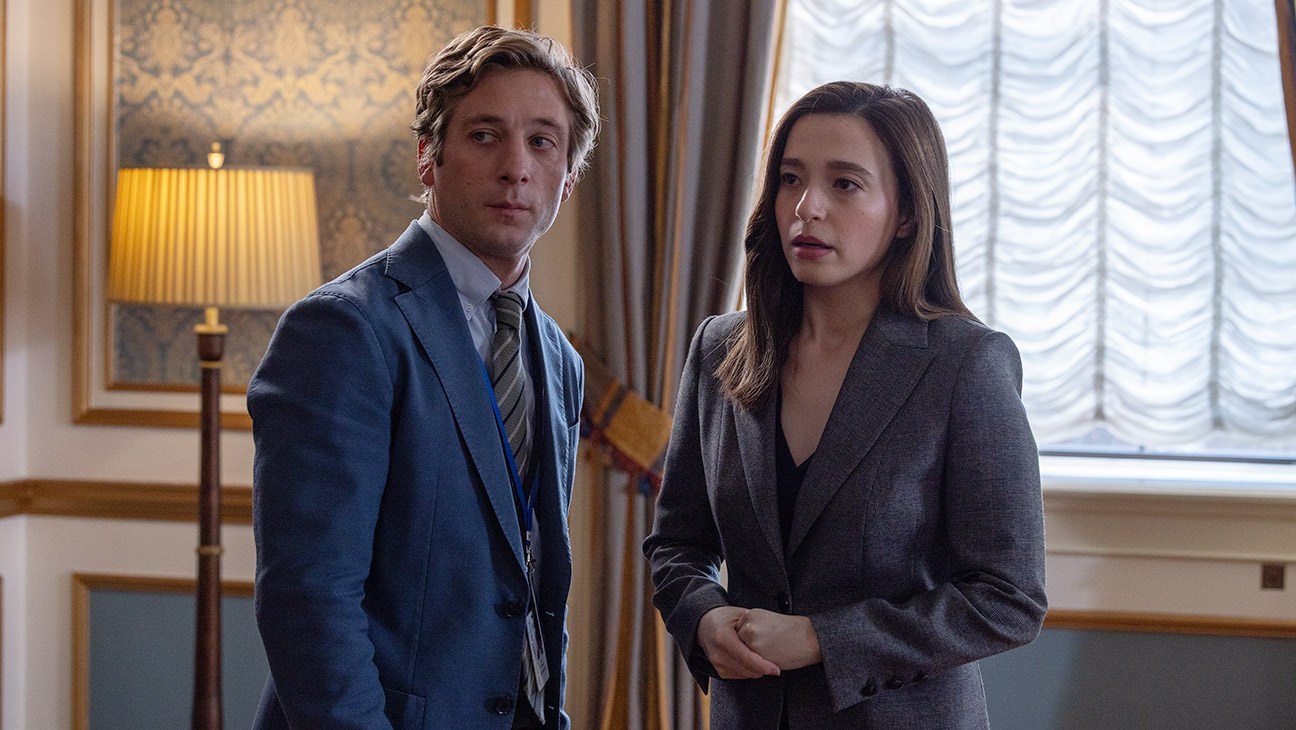
The Social Reckoning stars Mikey Madison and Jeremy Allen White each had their own unique anxieties about following up 2010’s beloved The Social Network.
When I last caught up with Madison in February 2022, I made a meal out of the overlap between her roles in Scream (2022) and Once Upon a Time in Hollywood (2019). She was a great sport about it, but two points she made stuck with me. She was eager to move beyond the kinds of roles audiences had come to associate her with, and she actively sought out parts that scared her. She clearly meant it. Just three years later, she won the best actress Oscar for Anora, in which she delivered one of the most audacious performances in recent memory.
Naturally, the pressure of revisiting the world created by Oscar-winning screenwriter Aaron Sorkin and director David Fincher in The Social Network — which her Once Upon a Time in Hollywood director Quentin Tarantino has called the best film of the 2010s — certainly weighed on Madison.
“I definitely felt that way,” Madison tells The Hollywood Reporter in support of The Social Reckoning’s Oct. 9 theatrical release. “I often have minor panic attacks before starting a movie, but the idea of being scared to start something means that I could potentially be doing some interesting work that is pushing me outside of any comfort zone.”
Madison was all set to undergo a major transformation into Frances Haugen, the former Facebook product manager who, in 2021, blew the whistle on the company’s continued prioritization of profit over public safety. But Sorkin, now serving as both writer and director, threw her for a loop when he advised her against trying to mirror the real Haugen.
“I assumed that would be the vision. But after hearing Aaron very adamantly say that he did not want me to do that, it took me a while to wrap my head around it,” Madison says. “Ultimately, I did fall in love with the character that he had written on the page. So that approach did allow me to have more creative freedom in a sense, which I’m grateful for. But in the future, I look forward to possibly having the opportunity to authentically and faithfully represent a real person.”
Two-time Emmy winner White plays former WSJ tech reporter Jeff Horwitz, who helped Haugen expose Facebook’s wrongdoing through The Facebook Files, a series of reports based on data from the 22,000 documents she leaked. Unlike Madison, White wasn’t as overwhelmed by the reputation of The Social Network, largely because he viewed The Social Reckoning as more of a companion piece than a direct sequel.
“My focus and real place of interest was, Is this a movie I would want to see? Is this a compelling film? Is it saying something? Are the characters interesting?” White says.
White did hesitate at the prospect of playing another real-life figure so soon after his intimidating portrayal of Bruce Springsteen in Scott Cooper’s underappreciated gem, Deliver Me from Nowhere. However, the same creative freedom that initially irked Madison actually intrigued White. Compared to Springsteen or Facebook founder Mark Zuckerberg, Horwitz and Haugen were largely unfamiliar to the public, giving White more room to make the role his own.
“I shared with [Sorkin], ‘I’m really hesitant about playing another real person next. I’d like to do a new story about a character that I can create on my own and not feel handcuffed to other people’s ideas about this person,’” White recalls saying. “So Aaron just said, ‘At the end of the day, this is my version of Jeff. This is my story. I want you to use the text in my script.’ So it was the best of both worlds. I got to gather a lot of extra information [about Horwitz], but I also had a tremendous amount of freedom on set.”
Below, in a conversation with THR, Madison and White also discuss their near-total absence from social media and how The Social Reckoning only reinforced their decisions to stay away.
***
Actors tell me all the time that the jobs they want the most are often the ones that terrify them the most. I can’t think of anything more terrifying than making a companion film to what might be the greatest film of the 21st century, The Social Network. Did fear motivate both of your commitments to The Social Reckoning?
MIKEY MADISON That’s a good question. I often have minor panic attacks before starting a movie, but even though it’s torturous, the idea of being scared to start something means that I could potentially be doing some interesting work that is pushing me outside of any comfort zone. I never want to play a character where I’m like, Yeah, this is inside my wheelhouse. I’ve done it before. I want to push myself outside of limits that feel comfortable. So, yeah, I definitely felt that way.
JEREMY ALLEN WHITE I agree that The Social Network is a great film, but I don’t think I necessarily attached the two films too much. Aaron wrote both of them, so they’re obviously attached in that way. They’re in the same world, and there’s one character [in common] played by another actor [Jeremy Strong] in our film. But my focus and real place of interest was, Is this a movie I would want to see? Is this a compelling film? Is it saying something? Are the characters interesting? Is this film a good film? Does it have the capability of being a really good film? It does, and it did.
Jeremy Allen White’s Jeff Horwitz and Mikey Madison’s Frances Haugen in Aaron Sorkin’s The Social Reckoning.
Sony Pictures
Mikey, you’ve always been a ghost as far as social media is concerned. And Jeremy, you have one or two accounts, but you seem to do the bare minimum. They feel obligatory.
WHITE That is correct.
Has this story only validated your existing beliefs about social media?
WHITE Yeah, I think so. You’re right that I have a distant relationship with my social media account. I was late to the game, too. I waited a long time before getting any of that stuff. It wasn’t for any moral reasons. It was more just out of self-preservation. I’ve had seeds of doubt and fear about the effects of social media for a long time, just an uneasy feeling around it. In recent years, it’s become clear why, and those fears and doubts have been more easily realized. Then, though the process of preparing, learning and making this film, all those ideas have been reinforced even further.
So I’m comfortable at my distance, but outside of my personal relationship with social media, I think more about young people, my children and kids their age. We have a responsibility as the adults in the room to make sure they can enter this world safely and comfortably — and then form their own relationships with these apps at a certain point. But hopefully, we’re able to keep their worlds as small as possible for as long as we can.
Mikey, once you read this script, did you playfully gloat to your reps that you were right to not be on social media all this time?
MADISON (Laughs.) Honestly, I’m really lucky in that my agents and managers have always respected my decision to not be on social media. Maybe they saw it as slightly stubborn at first, but it’s just the best decision for me overall.
WHITE It turns out you don’t need TikTok when you have an Oscar. It’s fine.
MADISON & WHITE (Laugh.)
Touché. Jeremy, you went from playing one of the most famous people on the planet in Bruce Springsteen to playing another real guy named Jeff Horwitz who most people couldn’t pick out of a lineup. Was your blood pressure a lot lower playing this real-life person?
WHITE For sure. When I met with Aaron, Deliver Me From Nowhere was about to come out. I had a really great time making that film and spending so much time with Bruce. But it was a tremendous amount of pressure, and I was a nervous wreck as I was meeting with Aaron. I shared with him, “I’m really hesitant about playing another real person next. I’d like to do a new story about a character that I can create on my own and not feel handcuffed to other people’s ideas about this person.”
Aaron heard me and immediately spoke to my hesitation, saying, “Look, I understand you had to play Bruce that way.” He was already speaking to Jeremy Strong about playing Zuckerberg, and he said, “Mark Zuckerberg is a very public person like Bruce, and people already have ideas of each person. They know how they move and how they speak. They already have their own interpretations.”
While Jeff and Frances are public people to an extent, you’re right that the majority of people do not know who they are. So Aaron just said, “Look, read as much as you want, watch videos, listen to his voice and do all the work you want. But at the end of the day, this is my version of Jeff. This is my story. I want you to use the text in my script.’” So it was the best of both worlds. I got to gather a lot of extra information because Jeff is a real person who’s left an imprint in this world, but I also had a tremendous amount of freedom on set.
Mikey Madison’s Frances Haugen and Jeremy Allen White’s Jeff Horwitz in Aaron Sorkin’s The Social Reckoning.
Sony Pictures
Mikey, you were fully prepared to transform into Frances Haugen, but Aaron pulled you back from going too far with it. Do you think that was partially because Jeremy Strong was already doing such a hardcore replication of Zuckerberg? Do you think Aaron wanted his two leads to be freer and looser in comparison?
MADISON I think that’s a possibility. I was prepared [to transform] and was very open to doing so. I assumed that would be the vision. But after hearing Aaron very adamantly say that he did not want me to do that, it took me a while to wrap my head around it. Ultimately, I did fall in love with the character that he had written on the page. I was like, The most important thing is that I just tell this story as honestly and truthfully as I can tell it. I hope that when the real Frances watches The Social Reckoning, she feels the integrity and love we put into it. So that approach did allow me to have more creative freedom in a sense, which I’m grateful for. But in the future, I look forward to possibly having the opportunity to authentically and faithfully represent a real person.
***
The Social Reckoning is now playing in movie theaters.
>
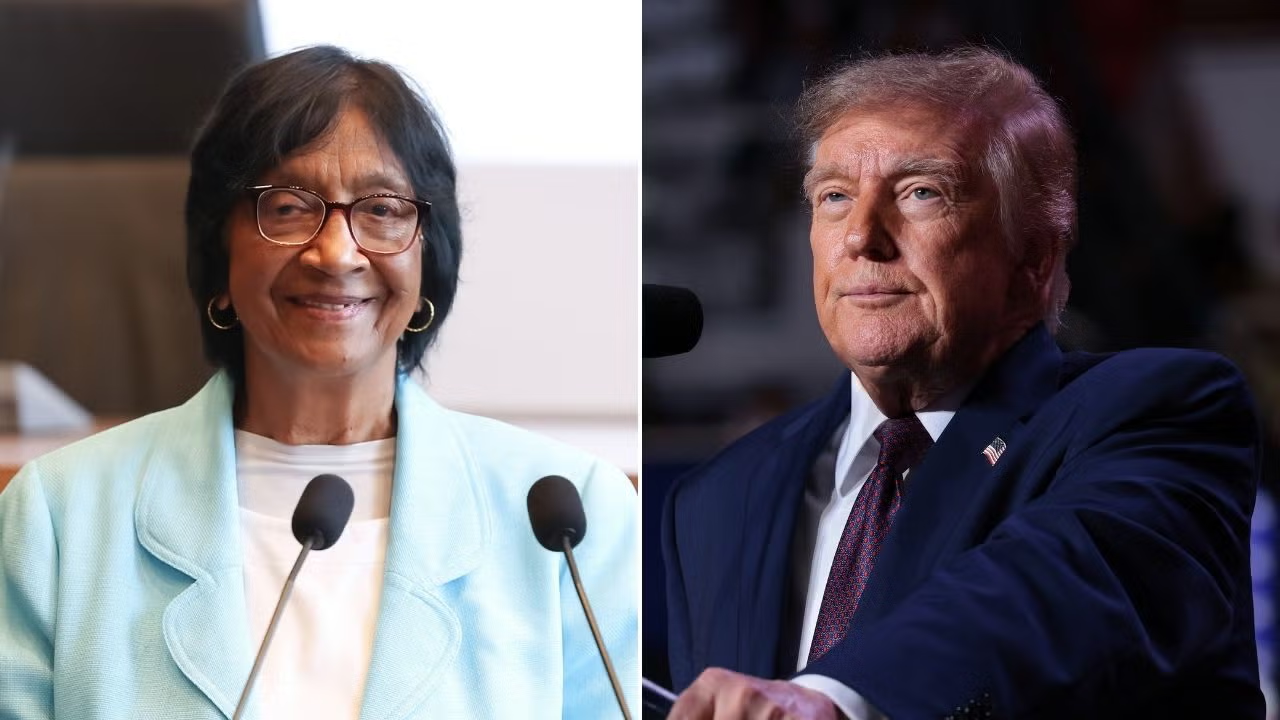
Nobel Peace Prize winner Navanethem “Navi” Pillay poked fun at President Donald Trump in the moments immediately after finding out she had been named as this year’s honoree.
In a video shared on X, Pillay could be heard jokingly telling those applauding her, “If you clap a little bit more, I may share this prize with Trump.” Her comment was met with laughter from her supporters in the room. She was in Nuremberg, Germany, when she found out the news.
Pillay, 85, was there attending a forum, in the same city where Nazi war criminals were put to trial in the aftermath of World War II. She was in the same room where the trials took place when she was announced as the 2026 Nobel Peace Prize winner.
The South African-born jurist and former U.N. human rights chief has built a decades-spanning career over the course of her life. Through her work, she has done everything from defended the rights of a then-imprisoned Nelson Mandela to helming a panel that determined Israel committed genocide in Gaza. The Nobel Peace Prize committee said Friday she had been chosen in honor of her work promoting international law at a time when it is under attack.
Amazing moment.
Navi Pillay has received the Nobel Peace Prize ! https://t.co/HL3r1PJzLO
We are at the Nuremberg Court; I cannot think of a stronger symbol for her Nobel prize.
We are all so thrilled!
This is her first reactions upon hearing the news: https://t.co/Crbj6XdiyQ
— Agnes Callamard (@AgnesCallamard) October 9, 2026
“This year’s laureate has been instrumental in ensuring that war crimes, crimes against humanity and genocide are prosecuted,” the Norwegian Nobel Peace Prize Committee wrote in a statement Friday, explaining its decision to award Pillay on the prize’s 125th anniversary. “At a time of existential challenges – including more wars and conflicts than the world has seen in a long time – international law is no longer just a supplement to peace and security. It is an absolute necessity.”
“The system of international law is under tremendous pressure, and its institutions are under attack,” the committee continued. “In awarding this year’s Nobel Peace Prize, the Norwegian Nobel Committee wants to remind the world that the rule of law – national and international – underpins the system we have set up to ensure peace and resolve conflicts non-violently. Peace requires justice.”
Both U.S. President Donald Trump and Israeli Prime Minister Benjamin Netanyahu have rejected the genocidal findings of Pillay’s U.N. commission regarding Gaza.
“The Nobel Prize committee has lost its moral compass,” the official X account for Netanyahu’s office wrote Friday in response to Pillay’s win. “It has awarded its highest honor to a bigot who built her career around inventing and propagating blood libels against the one and only Jewish state.”
Pillay’s dig at Trump comes one year after Venezuelan opposition leader María Corina Machado was awarded the 2025 Nobel Peace Prize for her efforts fighting against tyranny in Venezuela. She won despite President Trump’s open campaigning for the award. Machado later gave Trump her Nobel prize, after the United States removed then-President Nicolás Maduro from power in Venezuela.
However, the Nobel Committee has labeled the move purely symbolic, stating that the prize itself cannot be transferred by a winner.

>

When you name your movie “Drinking and Driving” — assuming it’s not some kind of pun that leads into a wholesome comedy about a NASCAR star named Richard Drinking — you preemptively lower everyone’s expectations for the role models they’re about to see onscreen.
It’s certainly warranted in the case of Avalon Fast and Jillian Frank’s new movie, a slice-of-life dramedy about the empty recklessness of two friends who wile away the days of their early adulthood with an endless stream of substance abuse in their small rural hometown. Drinking and driving have become a regular part of the routine, as mundane as 5 a.m. cocaine bumps or curing hangovers with molly after spending another late night partying in a loose acquaintance’s basement.


It’s not like Palmer (Avalon) and Iris (Frank) have anything better to do. Their lives are small and seemingly meaningless: the two girls never left their hometown, work the same dead-end restaurant job, and even share a bed on the nights they manage to make it home in time to sleep. With a limited social circle, they end up hanging out with the same neighbors and swooning over the same toxic boys who all look like Post Malone if his career had never taken off. Palmer and Iris seem to enjoy themselves a solid 60 percent of the time as they drift from backyard to dirt bike track to someone’s basement or car. The Jarmusch-esque “plot” revolves around them meeting up with an acquaintance named Levi (Ethan Hawksworth) and his cousin Phoenix (Henri Gillespi), in town and bopping from place to place without a plan.
The film is admirably committed to documenting this lifestyle without much idealization or condemnation. Occasional moments of real, spontaneous joy emerge, and others reveal the crushing emptiness of lives going nowhere, but the script doesn’t lean too hard in either direction. Fast and Frank provide enough context clues to show us that these girls dealt with mediocre parenting and limited economic mobility — enough to keep humane viewers from judging or disliking them too much, but mercifully not enough to turn it into a story of victimhood.
The first two acts of “Drinking and Driving” almost play like a nature documentary, showing us four creatures in their natural habitat going through the only survival mechanisms they know. The cinematography feels deliberately ugly, with greens, grays, and browns blurring together to paint a muddy picture of the town you never make it out of. The often-handheld camerawork creates the sensation of watching old home videos, even if most of these encounters don’t seem worthy of documentation.
“Drinking and Driving” is downright cinéma vérité compared to the expressionism of Fast’s earlier work like “Camp,” but it still drifts slightly away from pure realism by the end. Much of the film plays its own version of conventional “the party has to end eventually” coming-of-age beats, even if these parties never seem that great to begin with. But since these girls don’t have anything that looks like conventional adulthood waiting for them, the film wisely steers them away from maturity and toward a kind of spiritual liberation. Can real transcendence come from sharing physical pleasures with unremarkable people who just happen to live in the same town as you? Nobody can fully answer that question, but Fast and Frank get closer than you might think.
Even if no scene is particularly riveting on its own, the film still comes together into something oddly compelling. “Drinking and Driving” seems to exist in a liminal space where the past is not worth remembering, and the future is nothing to look forward to, so all there is to do is squeeze any hedonistic pleasure that you can out of today, even if we can already see that those experiences won’t be worth remembering either. The small-town American setting grounds the film in a sense of regional specificity, but that sense of 2020s malaise and the pockets of joy that it occasionally creates should be universal.
A Muscle Distribution release, “Drinking and Driving” will screen at BAM Rose Cinemas from October 11-13.
>


Search For Canadian TV Actor Stewart McLean Now Homicide Investigation


These ’90s fashion trends are making a comeback in 2017
According to Dior Couture, this taboo fashion accessory is back
Model Jocelyn Chew’s Instagram is the best vacation you’ve ever had
Emily Ratajkowski channels back-to-school style
9 Celebrities who have spoken out about being photoshopped


Rurouni Kenshin: Hokkaido Arc Manga Takes 1-Issue Break – News


HIDIVE to Stream English Dubs for The World Is Dancing, The Forsaken Saintess and Her Foodie Roadtrip in Another World, The Dangers in My Heart: The Movie Anime – News