
L-R: Director Ava DuVernay with Stacey Abrams, former member of the Georgia House of Representatives
Ryan Postas/Netflix


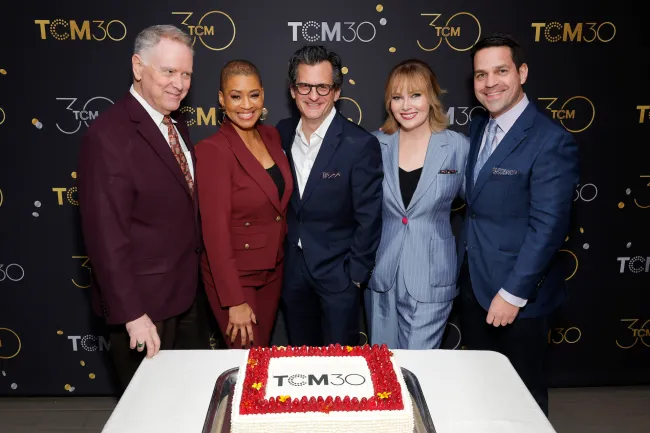

Craig Zobel, a director known for his work on such prestige series as Mare of Easttown and The Penguin, is set to direct a feature adaptation of Something Is Killing the Children, the popular comic book series from James Tynion IV and Werther Dell’Edera, with Jason Blum and his Blumhouse among the producers.
Stephen Christy and Tynion IV will produce the film for BOOM! Studios/Penguin Random House, alongside Blum for Blumhouse. Shaun Sutton and Ryan Turek will exec produce alongside Adam Yoelin and Mette Norkjaer, with Dell’Edera acting as co-producer.
The news came out of New York Comic-Con, where Blumhouse laid out its 2027 slate.
First published by BOOM! Studios, an imprint of Penguin Random House, in 2019, Something is Killing the Children centers on Erica Slaughter, a monster hunter who arrives in the small town of Archer’s Peak after children begin disappearing to take down the creature preying on them. It’s the most successful original horror comic book since The Walking Dead, with more than 5 million copies sold worldwide, having been translated into more than 20 languages in 14 countries.
While developing the live-action feature, Blumhouse is simultaneously developing an adult animated series version of Something Is Killing the Children to be shepherded by Tynion IV.
A DGA Award nominee and three-time Emmy nominee, Zobel broke out with indies like Compliance and Z for Zachariah before going on to work on shows such as The Leftovers, American Gods, Westworld, Mare of Easttown and The Penguin. He also helmed the satirical horror film The Hunt and just wrapped production on Turpentine, a new thriller starring Melissa McCarthy and Connie Storrie. He is repped by CAA, SSM&L, Entertainment 360 and Jackoway Austen Tyerman.
Blumhouse–Atomic Monster is in theaters this weekend with Rob Savage’s Universal horror Other Mommy, based on the novel Incidents Around the House by Josh Malerman. Their slate for next year includes the Joshua Giuliano buzz title River, Mike Flanagan’s The Exorcist: Martyrs, Anything but Ghosts from Obsession‘s Curry Barker, a new Paranormal Activity, the Savage-helmed Mole People, a new Blair Witch Project from Dylan Clark, Sleepover from director Jacob Chase, and Drew Hancock’s Seasons.
>
In the months leading up to the end of the American Civil War, Frederick Douglass spoke at the Massachusetts Anti-Slavery Society’s annual meeting in Boston about what would remain after the rebellion was defeated. “That enmity will not die out in a year,” he warned. “It will not die out in an age.”
In Ava DuVernay’s new documentary “14th,” constitutional law expert Sherrilyn Ifill recalls Douglass’ words from his speech “What the Black Man Wants.” A distinguished attorney, Howard University law professor and former head of the NAACP Legal Defense Fund, Ifill is the closest thing the film has to a narrator. Her invocation of Douglass serves as a refrain, returning again and again to make one thing clear: we are living in one of the ages he predicted.


The Fourteenth Amendment made birthright citizenship the law of the land, ensuring that formerly enslaved people and others born on American soil — like the children of Chinese railroad workers, for example — were citizens. But Ifill astutely explains one of its great failures: Against Douglass’ wishes, the amendment did not explicitly protect the right to vote. Douglass foresaw that leaving Black voting rights vulnerable would give the same people who fought to preserve slavery the opportunity to strip those rights away for generations.
“14th” looks back at history as a necessary playbook for the present. We are living amid the gutting of the Voting Rights Act, widespread voter-suppression efforts and challenges by the Trump administration to birthright citizenship. The message is crystal clear: This isn’t just history. It’s right now.
A companion piece to DuVernay’s 2016 documentary “13th,” which examined the constitutional amendment banning slavery through the lens of mass incarceration, “14th” arrives a decade later during the second Trump administration. It is a maximalist odyssey through American history, guided by leading thinkers including Ifill, Bryan Stevenson, David Blight and Jelani Cobb; commentators such as Van Lathan; and politicians including Alexandria Ocasio-Cortez, Jeff Flake and Stacey Abrams. Together they trace how the amendment transformed the country and what is at stake as its guarantees come under sustained attack.
The two films share structural and visual DNA. Both rely on a series of talking heads to tell their stories. However, where “13th” placed its interview subjects against textures associated with prisons and hard labor, “14th” seats its experts in libraries, museums and universities, halls of learning that insist visually on the value of expertise at a moment when expertise itself is under attack.
An animated five-pointed star represents the amendment’s five sections, each point gradually torn away as the documentary charts the erosion of its protections. In this sense, perhaps the most successful part of “14th” is that it performs a real public service. Its first section is also its strongest, offering vital information the filmmakers correctly assume many viewers do not know: who shaped the amendment, how Reconstruction transformed American citizenship and how many of the values we associate with multiracial democracy emerged from the constitutional revolution that followed the Civil War, not from the Constitution signed in 1787.
But “14th” has so much to tell us that its refusal to edit more rigorously works against it in the end. More than 50 talking heads appear. DuVernay clearly wants to reach as broad an audience as possible, incorporating conservatives alongside progressive advocates, politicians, historians, attorneys, comedians and political influencers. The instinct makes sense in this era of hyperpolarization. Yet cinematically, the sheer number of interviewees dilutes the power of the strongest voices.
Did we really need Hasan Piker in his Birkenstocks and wide-leg pants in order to reach young viewers? Probably not. By the time Gen Z political influencer Dean Withers appears for the first time near the end of the doc to deliver a sleepy sound bite that feels destined for the cutting-room floor, you start wondering why DuVernay is introducing another character when so many compelling figures already onscreen could have been reappeared and probably said it better.
Even the captioning of subjects feels oddly inconsistent. Van Lathan is not identified until his second appearance. The same happens with historians Eric Foner and David Blight. These may sound like minor details, but in a work asking viewers to track dozens of people across several centuries of American political history, they add to the cognitive clutter.
Sherrilyn Ifill could have solved much of this. Of the more than 50 interviewees, hers is the voice the documentary can’t help but return to. She grounds “14th,” and one wishes DuVernay had committed more fully to her as a narrative guide, as she speaks in a way that is accessible and engaging. (The study and application of the fourteenth amendment has been her life’s work.) Had the film stayed closer to her, she might have served as the connective tissue carrying viewers through its historical turns and accumulating reasons for despair. Instead, she disappears for stretches before returning with the Douglass refrain. To absorb and be impacted by material this dense, the broad audience DuVernay clearly wants to reach needs someone to hold its hand. Ifill could have been that person.
The larger problem is not simply the talking-head format but the claustrophobia it creates. One of the most welcome sequences follows Devon Henry, the Black contractor responsible for removing Confederate monuments along Richmond’s famed Monument Avenue after white contractors refused the job. I found myself taking an involuntary deep breath when his sequence began. Suddenly, someone was walking. Moving through space without explaining something. For a moment, the movie opened up. Henry’s sequence demonstrates how powerful the documentary becomes when its formal choices carry as much weight as intellectual ideas.
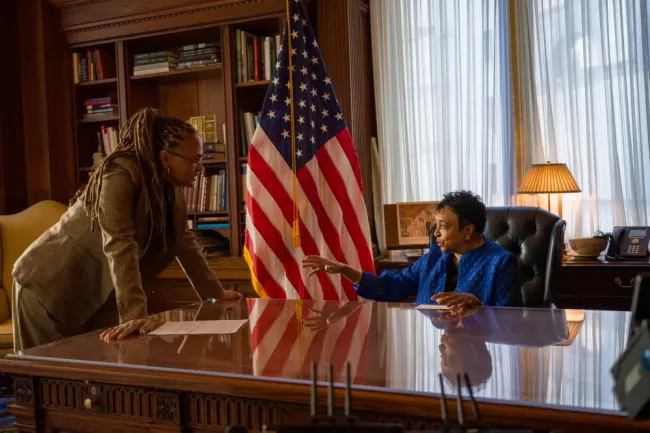
Carla Hayden’s appearance at the Library of Congress offers a similar reprieve. Instead of sitting posed with the camera capturing her face from a side angle — she actually gets the hero shot treatment -— she walks through one of the country’s great repositories of knowledge greeting visitors. The simple act of watching her move provides visual relief and the kind of impact words on their own rarely inspire.
DuVernay does find inventive ways to animate the past though, and the archival material ranks among the film’s greatest strengths. Black life during Reconstruction appears not only in the South but in places we may not immediately associate with Black citizens like New Mexico or Boston. The images capture the extraordinary scope of Black efforts to educate themselves, build institutions and participate fully in citizenship after Emancipation. Archival photographs subtly come to life through animation, giving motion to otherwise static images and drawing a visual line from the people living through Reconstruction to those living now. The effect is simple but powerful: this is the past, but these were ordinary people moving through their own present just like us.
Comedy provides another effective pressure valve. Clips from standup specials by George Carlin, Paul Mooney, Neal Brennan and Hasan Minhaj inject much needed comedic relief about American history. Once Mooney plants the seed of his joke about how unhappy white Americans seemed after slavery the later images of Confederate memorial groups and white crowds at lynchings take on a surreal resonance.
Musically, “14th” feels like a hip-hop rock opera for the end of democracy, or perhaps a plea to save it, propelled by thumping beats. When an instrumental version of Kendrick Lamar’s “Alright” appeared, for example I instinctively snapped my fingers and thought, yes. But the documentary moved on so quickly that the cue barely had time to land. That moment encapsulates the larger problem with the film: “14th” does not lack compelling material. It just has too much of it.
About two-thirds of the way through its hour-and-forty-minute runtime, I simply could not absorb any more, despite being deeply interested in the subject. The project might have benefited from an episodic structure, perhaps giving each section of the amendment room to breathe. (That is of course easy for me to suggest from outside the realities of documentary financing and Netflix distribution, but the formal choices contribute to unecessarily exhausting ride.)
DuVernay has said she did not want the movie to “feel like medicine,” and the “14th” is energetic, accessible and frequently entertaining. But in casting such a wide net, the film overloads the viewer with information to the point of suffocation. That leads to a certain irony: “14th” arrives in an era that already feels like too much, one in which overwhelm about politics has become part of daily life. The documentary wants to move viewers beyond despair, yet its sheer density risks reproducing the paralysis it hopes to overcome.
By the end, Ifill argues that we are once again standing at an inflection point comparable to the one the architects of Reconstruction faced. The people who emerged from the Civil War had to imagine a fundamentally different country and then write that vision into law. Americans now have an opportunity, and perhaps an obligation, to debate in good faith what the next iteration of democracy should be, she argues. That may be the most important idea in “14th.” The amendment was revolutionary because it imagined an America that had never existed before.
Which brings us back to Douglass, speaking in January 1865, just over three months before the Civil War ended. “When the tall heads of this rebellion shall have been swept down,” he warned in “What the Black Man Wants,” its leaders might disappear, but the “rank undergrowth of treason” would remain. That spirit, he said, and Ifill wisely recounts, would pass “from sire to son.”
“That enmity will not die out in a year. It will not die out in an age.”
More than 160 years later, “14th” makes the unsettling case that the age Douglass warned us about is still not over. And where do we go from here? That is up to us.
“14th” premiered at the 2026 New York Film Festival. Netflix will release it in select theaters on Friday, November 27, and then on Netflix on Friday, December 4.
>

14th, the documentary directed by Ava DuVernay that premiered Friday night as the closing-night film of the New York Film Festival, begins with several American presidents taking the oath of office: FDR, Eisenhower, JFK, LBJ, Nixon, Carter, Reagan… each of them swearing to “preserve, protect, and defend the Constitution of the United States.”
We know where this sequence is headed – it culminates with Donald Trump swearing that oath to become the 47th president. Then it immediately cuts to Trump sitting down for an interview with Kristen Welker of NBC News who asks him, “Don’t you need to uphold the Constitution of the United States as president?” Trump’s response: “I don’t know. I have to respond by saying, again, I have brilliant lawyers that work for me.” Astonishing.
Trump’s disregard for the Constitution and blatant violation of his oath go back to his first term – for example, flouting the Foreign Emoluments Clause. In his second term he has brazenly attempted to take an axe to a key provision of the 14th Amendment that guarantees birthright citizenship. Section 1 reads in part, “All persons born or naturalized in the United States, and subject to the jurisdiction thereof, are citizens of the United States and of the State wherein they reside.” Couldn’t be clearer, right? That critical section of the amendment ratified in 1868 resolved the status of African Americans, who under slavery, of course, were not deemed citizens.
DuVernay’s compelling documentary argues that amendments 13, 14, and 15 – passed within five years of the conclusion of the Civil War — amounted to a “Constitutional reset” that clarified rights for all Americans, including newly freed slaves. The filmmaker’s previous documentary, the Oscar-nominated 13th, examined that concise amendment which, in 32 words, formally abolished slavery. The new film, in a sense, is the sequel, going section by section through the far more expansive text of the 14th Amendment.
L-R: Director Ava DuVernay with Stacey Abrams, former member of the Georgia House of Representatives
Ryan Postas/Netflix
The documentary’s overall thesis is that the 14th Amendment laid the groundwork for a multiracial democracy (for that reason, it’s easy to see why Trump would attack it). Historians, political leaders and other experts interviewed in the film stress Section 1’s equal protection clause, making the vital point that equality movements in the U.S. have relied on that clause as their legal justification.
It’s highly unlikely the 13th, 14th, or 15th amendments would have passed if the secessionist Southern states had not been compelled to endorse them as a condition for readmittance to the Union. As the film explores, white supremacists in the South wasted little time undermining the 14th Amendment – as well as the 15th, which guaranteed voting rights without regard to “race, color, or previous condition of servitude.” They did so through a campaign of terror that included the lynching of thousands of African Americans, and by mythologizing the “Lost Cause” fantasy that genteel antebellum society had been a boon to Black and white alike and that secession had been about preserving states’ rights.
Trump supporters storm the U.S. Capitol on January 6, 2021 in Washington, DC.
Win McNamee/Getty Images
Section 3 of the 14th Amendment, as the film examines, addressed those who had taken up arms against the Union, barring from political or military office any person who had engaged in “insurrection or rebellion” in violation of their oath to defend the Constitution. That, the film argues convincingly, should have immediately disqualified Trump from office in view of his urging supporters on January 6 to “fight like hell” to overturn a free and fair election.
Not only that, of course, but Trump pardoned the vast majority of the insurrectionists on his first day back in office in 2025 and has attempted to create a compensation fund for them (violating, the film suggests, section 4 of the 14th Amendment).
Ambassador and former U.S. Sen. Jeff Flake in ‘14th‘
Netflix
Most Republicans have caved to Trump since he took office the first time. 14th makes space for a couple who refused to fold – former Sen. Jeff Flake (R-AZ) and Steve Schmidt, a senior campaign adviser to Sen. John McCain during the latter’s 2008 run for president. Schmidt states it clearly: “We are in one of the great moral crises” in U.S. history. The virtue of DuVernay’s film is that it reframes our understanding of the importance of the 14th Amendment and its moral purchase.
14th also serves as a warning – noting that the U.S. Supreme Court rejected Trump’s executive order that denied birthright citizenship but not in a unanimous decision. It was 6-3. Associate Justices Clarence Thomas, Samuel Alito and Neil Gorsuch dissented, with Thomas claiming the amendment only spoke to the condition and status of freed slaves. The film makes it clear that Trump and his allies won’t give up on negating birthright citizenship – and how could one expect otherwise given Trump’s blithe disregard of the Constitution?
Stylistically, 14th resembles 13th – with beautifully lit interviews, stunning animation of still photos and dynamic graphical elements. Its most daring thrust is incorporating excerpts of incisive comedy sets by comics George Carlin, Paul Mooney, Hasan Minhaj and Neal Brennan (Carlin brilliantly points out that America was “founded by slaveowners who wanted to be free.” Mooney hilariously embroiders on how “white folks” were never happier than when they owned Black people). Inevitably, 14th is didactic – a history lesson, if you will, but the kind every American should experience if they want to continue living under a form of government of the people, by the people, and for the people.
I don’t foresee 14th enjoying the same level of awards success as DuVernay’s 13th, which showed how American society had essentially re-created the conditions of slavery through mass incarceration. That film had a very human face, as viewers came to see how whites stigmatized Black people as inherently suspect, reconstituting forced servitude through other means. The 14th Amendment is far more abstract and thus less likely to stir emotional reactions.
The film serves as a fitting call to action reminding those who believe in a multiracial and multi-faith democracy that “we are all founders and framers” of the Constitution. For that, DuVernay deserves the highest praise.
Title: 14th
Festival: New York Film Festival
Distributor: Netflix
Release date: December 4, 2026
Director: Ava DuVernay
Cast: Stacey Abrams, Eric Foner, Sherrilyn Ifill, Jeff Flake, Steve Schmidt, Hasan Piker, Alexandria Ocasio-Cortez, Jelani Cobb, Lonnie Bunch, David Blight, Robert S. Chang, Amanda Frost, Dean Withers, Carla Hayden, Keeanga-Yamahtta Taylor, Gov. JB Pritzker (D-IL), Donald T. Critchlow
Running time: 1 hr 40 mins
>


Search For Canadian TV Actor Stewart McLean Now Homicide Investigation


These ’90s fashion trends are making a comeback in 2017
According to Dior Couture, this taboo fashion accessory is back
Model Jocelyn Chew’s Instagram is the best vacation you’ve ever had
Emily Ratajkowski channels back-to-school style
9 Celebrities who have spoken out about being photoshopped


Rurouni Kenshin: Hokkaido Arc Manga Takes 1-Issue Break – News


HIDIVE to Stream English Dubs for The World Is Dancing, The Forsaken Saintess and Her Foodie Roadtrip in Another World, The Dangers in My Heart: The Movie Anime – News