
movies
John Malkovich: Oscars Campaign “Only Way to Get People to Theaters”

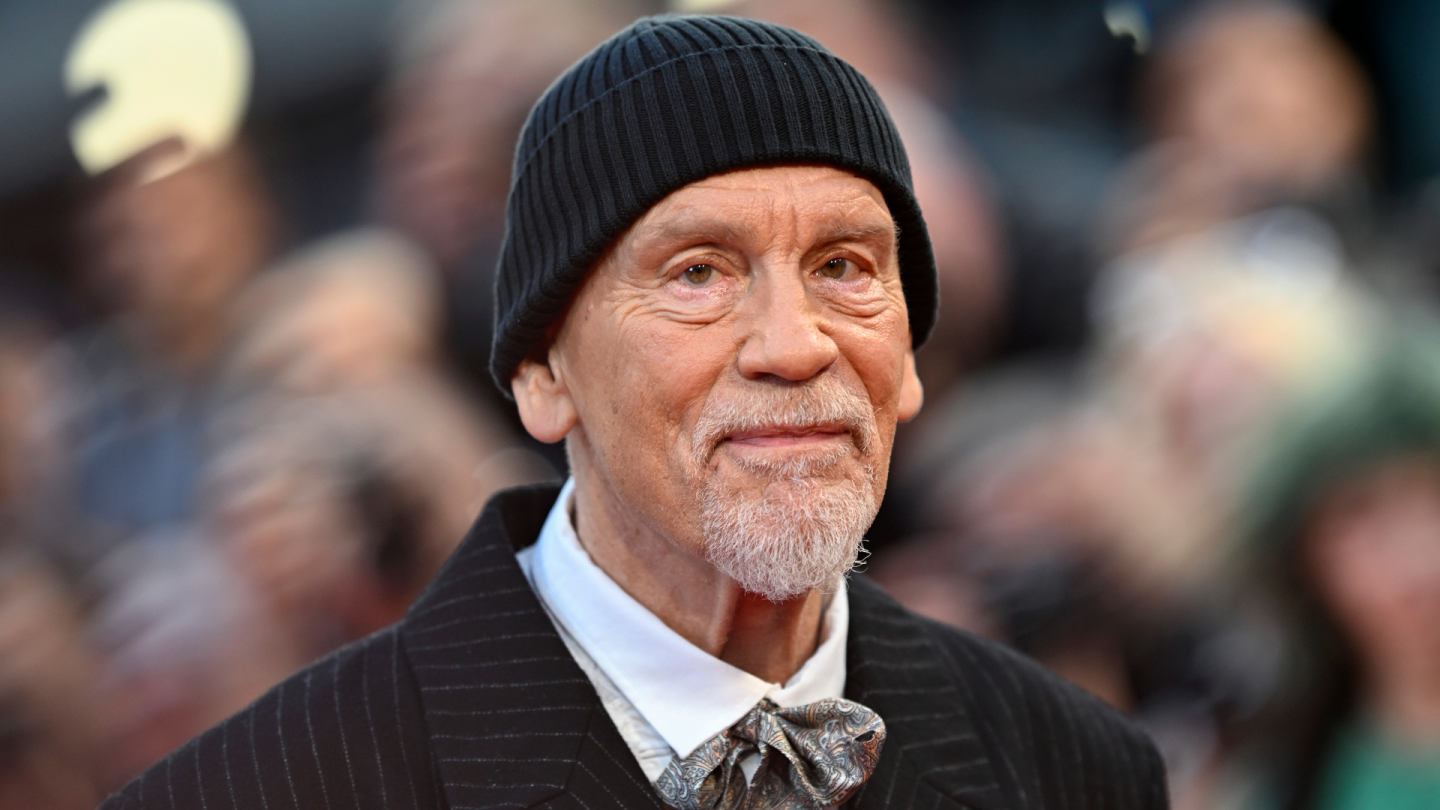
John Malkovich is well aware of his current awards momentum, even if the “onslaught” of attention doesn’t quite suit his “native personality.”
The U.S. star has hit the festival circuit with Martin McDonagh’s tragicomedy Wild Horse Nine, his performance in which is being hailed as potentially the best of his career and almost certainly an Oscar nomination lock. It isn’t the first Academy Award nod he’ll have earned — he’s been recognized before in 1985 and 1994 for Places in the Heart and In the Line of Fire, respectively — but at a BFI London Film Festival talk on Sunday afternoon, the actor conceded the awards campaign is an entirely different beast in 2026.
“[I feel] probably different [about awards consideration] than I did [when In the Line of Fire came out] because the movie business existed [and] it maintained, undeservedly in my opinion, a very high position in the culture. And when I say undeserved, [I] mean there weren’t that many Chinatowns or Godfathers or Godfather IIs,” he began. “Now, [the awards trail] is the only way to get people to go to the theaters, the whole thing, and that’s months and months and months.”
He recalled being nominated for Places in the Heart and going to his first and only Oscars in 1985. He was in the car and asked his “a little bit bossy” manager, Phyllis, if he could go in through a side door. “‘Honey, it’s the Oscars,’” she clicked in his face. “There is no side door!” The entire room of attendees burst into laughter at Malkovich’s story. “So that’s my native personality in the face of that onslaught,” he said about embarking on another campaign for Wild Horse Nine. “But also, I’m a grown-up. It’s a part of the business now.”
He remembered that his early films made their money even before the big Oscar night. “Now, [winning an Oscar] seems to be the only way you get people to actually go to a theater.” When asked if it broke his heart after Malkovich admitted he’s unsure his daughter would consider going to the theater these days, Malkovich simply said: “No, because I’m 72 years old. Things change. I don’t really like thinking, ‘Things aren’t what they used to be.’ They just change, and you either change with them or die. And I prefer to change with them.”
Wild Horse Nine stars Malkovich and Sam Rockwell as Chris and Lee, longtime CIA partners stationed in Santiago, Chile who are dispatched to Easter Island by their bureau chief (Steve Buscemi). Against the surreal backdrop of the island’s monumental Moai statues, the pair begin reckoning with their murky shared past. At the same time, Chris forms an unexpected bond with two rebellious Chilean students, played by Mariana di Girolamo and Ailín Salas — an encounter that threatens to unravel the agents’ friendship and the conspiracy in which they have become entangled.
The BFI London Film Festival premiere of the film took place on Friday night, where Malkovich, Rockwell and McDonagh made an appearance at the glitzy red carpet event.
Naturally, Malkovich was asked about a running theme in many of his movies — the Kennedy assassination — particularly because his character in Wild Horse Nine is implied to have played a major part in the death of the former U.S. President. When asked about his personal opinion on the matter, the actor replied: “I know what didn’t happen is what they said happened.”
Malkovich described McDonagh as a “great writer” and a “direct, kind” filmmaker. “He can give great notes,” he continued. “He told me about one of the scenes with big heads… He just came over and said, ‘More David Attenborough,’ which I just thought was one of the greatest notes, and which I didn’t do very well.”
He likened his co-star Rockwell to “a trainer at SeaWorld feeding fish to a shark.” Confused chuckles from the audience had Malkovich explaining: “If you watch him 20 times, you get a good idea of how good he is at that… He’s such a great colleague, such a wonderful actor, and so fantastic in this, everything he does is perfect, and he can go any which way at any second.”
Malkovich confessed he is “not a political person,” but said Wild Horse Nine is wildly existential and evocative when it comes to themes of grief and mortality.
He covered the milestones of a vast and vibrant career across Sunday’s session, from Dangerous Liaisons and working with Clint Eastwood to the West End and how he came to star in 1999’s Being John Malkovich, a set on which Malkovich admitted to “having a moment” and “being an asshole” when filming on a particularly hot day. He even discussed a little of his ancestry — Malkovich recently discovered he is 43 percent Romanian — and the rarity of reading a genuinely brilliant script.
“It’s so rare to read a great screenplay and make a really excellent film. And you can work as hard as you like. You can give a really interesting performance, and if the film isn’t very good, it’s absolutely meaningless,” said Malkovich. “It doesn’t mean anything. It’s totally waste of your time in the public.”
To end, Malkovich was probed on his film set to be released next century, 100 Years, from director Robert Rodriguez. To his knowledge, the movie currently sits behind bulletproof glass in a vault and will open in the year 2115. “I have tickets,” the actor joked. “I don’t think I’ll be at the opening night. You know, my grandchildren won’t even be here as well.”
The 70th BFI London Film Festival runs Oct. 7-18.
>
ABC‘s last time carrying the Super Bowl in February 2006 was a memorable one, with then-hot sophomore drama Grey’s Anatomy delivering one of the most talked about lead-out programs in the history of the Big Game, Part 1 of a bomb-themed two-episode arc that drew 38.1 million viewers.
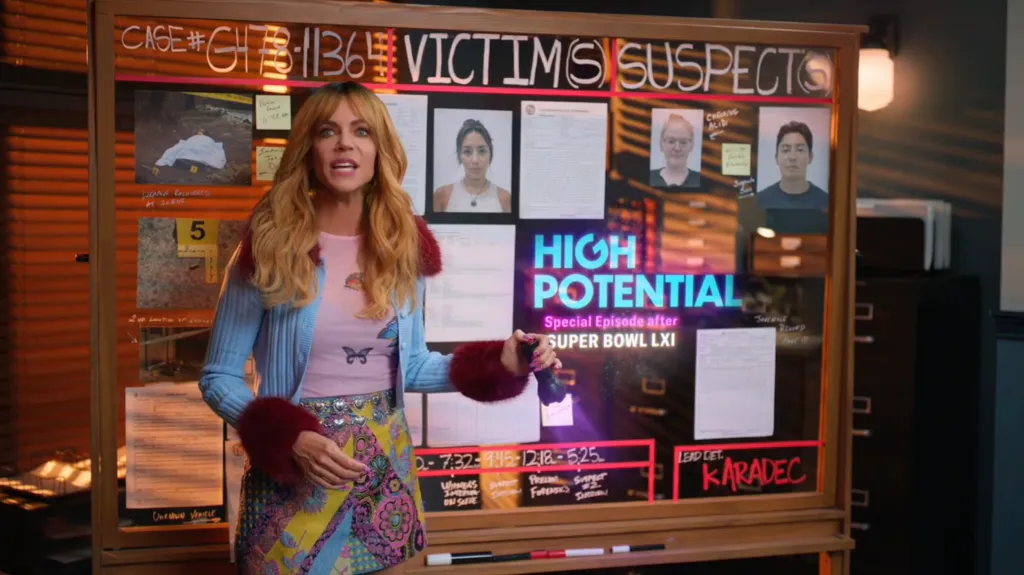
Twenty years later, ABC is picking up where it left off, slotting its flagship series that is also early in its run, High Potential, immediately following Super Bowl LXI on ABC and Disney+ on Sunday, Feb. 14, 2027. Like Grey’s Anatomy, I hear High Potential is planning a two-parter, with the special post-Super Bowl episode as Part 1, ending on a cliffhanger that will be resolved in Part 2 airing in the show’s regular time slot the following Tuesday.
The upcoming Season 3 of High Potential will not launch after the Super Bowl; the series starring Kaitlin Olson is expected to return earlier, likely in January. (For the first time in its run, High Potential is not on the fall schedule this season.)
Olson announced the news of the special post-Super Bowl epsiode Monday night in a promo that ran on-air and online during Monday Night Football.
Super Bowl LXI will air on ABC, ESPN and Disney+, which explains why High Potential will stream on Disney+ for the first time outside of the bundle. Its streaming home is on fellow Disney platform Hulu, both for next day episodes and previous seasons.
In 2000, ABC also aired Part 1 of a two-part episode of a popular drama series, The Practice, after the Super Bowl.
High Potential finished the 2025/2026 broadcast season as the No. 1 show in adults 18-49 (3.35 rating) and the No. 3 show among total viewers (16.01 million) over 35 days of viewing on ABC, Hulu, Hulu on Disney+ and digital platforms.
The series follows a single mom with an exceptional mind (Olson), whose unconventional knack for solving crimes leads to an unusual and unstoppable partnership with a by-the-book seasoned detective.
High Potential stars Olson as Morgan, Daniel Sunjata as Karadec, Javicia Leslie as Daphne, Deniz Akdeniz as Lev “Oz” Ozdil, Amirah J as Ava, Matthew Lamb as Elliot, and Judy Reyes as Selena. 20th Television produces the series, which is based on the French format Haut Potentiel Intellectuel (HPI) and was created in the U.S. by Drew Goddard.
Goddard and Sarah Esberg of Goddard Textiles, new showrunners Nora and Lilla Zuckerman and Olson serve as executive producers. Andrea Massaro (Goddard Textiles) is a co-executive producer.
>
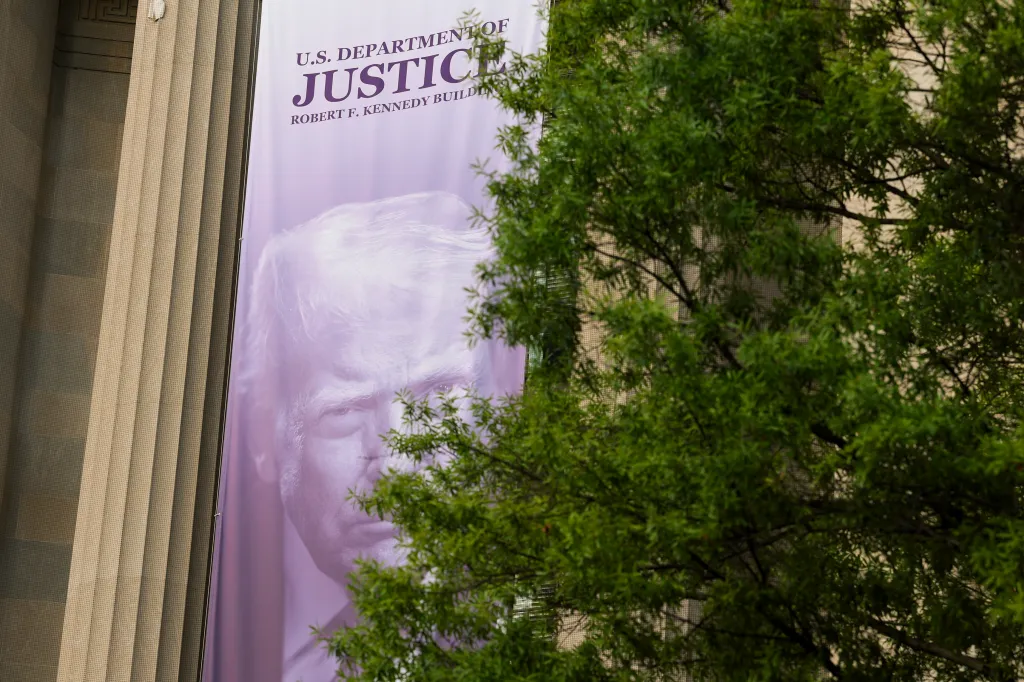
News that the Justice Department is investigating five major networks for suspending the White House TV pool last month was met with outcry that it was another example of Trump administration retaliation against the media.
Alarming as it may be to First Amendment groups, among antitrust experts, there are doubts that the DOJ would have much of a case.
Section 1 of the Sherman Antitrust Act restricts competitors that restrain competition. In this case, the five networks that make up the TV pool — CNN, Fox News, ABC News, CBS News and NBC News — last month withheld their participation to protest the White House’s exclusion of CNN. For about four days, that meant fewer video images and other coverage of Trump that week, including the ceremonies surrounding the visit of Chinese President Xi Jinping.
William Kovacic, global competition professor of law and policy at George Washington University, said, “I think you have to take any lawsuit from the Department of Justice seriously.”
But he said an antitrust claim against the networks likely would have a “very remote prospect of success.”
At issue is “what is the predominant character of the behavior: Is it a commercial interest or is it designed to achieve some form of First Amendment expression?”
“To me, if there is a commercial aim to this, it is well hidden,” said Kovacic, a former chairman of the Federal Trade Commission.
Diana Moss, vice president and director of competition policy at the Progressive Policy Institute, said via email, “Group boycotts are illegal when they stifle competition, such as forcing a competitor(s) out of the market.”
She added, “Presumably, the arrangement among the five networks is designed to increase coordination and efficiency in the distribution of news footage. There is no anti-competitive intent or effect. The networks were responding in solidarity to repression of a free press (1st Amendment).”
Court Precedence
The lines between commercial conduct and protected First Amendment activity can be blurred, but courts have sided with boycotting parties even then.
Sam Weinstein, professor at Cardozo School of Law and former attorney in the DOJ’s Antitrust Division, said that “typically a non commercial boycott is protected by the First Amendment.”
“It would seem to be a non starter,” he said.
He cited the Supreme Court’s 1982 decision in NAACP vs. Claiborne Hardware Co., involving an organized 1960s-era boycott of white-owned businesses in Mississippi. The justices held that the state could not hold the protesters liable for damages when they engage in lawful activity protected by the First Amendment.
Weinstein also referred to another Supreme Court case, FTC vs. Superior Court Trial Lawyers, when the justices ruled that a boycott by court-appointed lawyers for indigent defendants violated antitrust law, as its purpose was to to gain increased compensation. The majority compared it to horizontal price fixing.
The latter case, Weinstein said, is different from what happened with the TV pool. Prices and compensation were not at issue.
It’s still unclear whether the networks will comply with the DOJ investigative request, but the networks already made it clear that they were jointly suspending participation in the pool, releasing a statement that “no administration should restrict a news organization because it objects to its reporting.”
“The real question is a question of law, not a question of fact,” Weinstein said.
In a statement, a spokesperson for the DOJ said over the weekend, “Members of the television press pool have boycotted covering White House events. Group boycotts among commercial competitors can violate the Sherman Act. The Antitrust Division is simply investigating to determine whether these news organizations have violated the antitrust laws.”
“An End Run Around”
Democrats already have accused the Trump administration of politicizing the Antitrust Division, violating the norms that have separated the White House from the DOJ since the Nixon era. The investigation of the networks is likely to add another example to their arguments.
Bob Corn-Revere, chief counsel for the Foundation for Individual Rights and Expression, said via email, “Threatening an antitrust investigation is just another example of this Administration misusing regulatory authority to punish the media for doing something the President dislikes. Political boycotts are part of a longstanding American tradition and are protected under First Amendment law.”
He added, “Whether the government’s excuses are dressed up as ‘national security’ or antitrust law, this is another attempt by the Administration trying to make an end run around the First Amendment to control news coverage.”
>

Ink has hit London.
Danny Boyle and his starry cast, led by Jack O’Connell and Guy Pearce, took to the BFI London Film Festival carpet for the U.K. premiere on Monday night, around a month after it opened the Venice Film Festival.
“I expect the difference to be palpable,” began O’Connell, star of Sinners and 28 Years Later: The Bone Temple, to The Hollywood Reporter about finally putting Ink in front of its native audience. “It’s a London film. If it doesn’t work here, it’s not going to work anywhere.”
The movie, adapted from James Graham’s stage play, depicts Pearce’s Rupert Murdoch as he enters the British newspaper scene, acquiring the then-failing tabloid The Sun in 1969. Hiring Larry Lamb (O’Connell) as editor, the two combined far-right political reporting and populist rabble to turn the paper into a dark force in British media. Murdoch would take the lessons learned at The Sun and apply them to build his U.S. media empire with The New York Post and Fox News.
Backdropped by the smoky, seedy journalistic epicentre that is Fleet Street, O’Connell said he didn’t categorize the notorious Lamb as a “bad” person. “I think he was just perhaps overly ambitious,” said the star. “I think this guy was on a pursuit, or his obsession was newspapers, and I guess he broke a couple of rules along the way. And it wasn’t victimless, but yeah, I don’t consider him an out-and-out bad guy.”
Pearce, on the other hand, told THR he’s keen to meet up with Murdoch for brunch. He said about being cast as the Australian-born media mogul: “Liz [Murdoch] told me that her dad was happy with me playing him, but I don’t know to what degree that is. I can’t really speak to that, to be honest. He might watch the film and go, ‘Eugh! Jesus Christ, what were they thinking?’” He certainly thinks that the feature “will resonate” with fans in the British capital.
Boyle, director of Trainspotting, Slumdog Millionaire and 28 Days Later, said the film showcases an integral origin story that speaks to the sensationalism of our current climate. “You can argue about whether they introduced this entirely or whether they nurtured something that was latent within us,” he said to THR. “But it is the beginnings of the attention economy, of the clickbait economy, of the ‘What’s next? Swipe, move on.’ It’s the very beginnings of it there, the beginnings of the fire, and now it’s a bushfire that’s all around us, everywhere. And I don’t know whether we’re going to survive it… But if you want to understand it, I think there’s a very good case for this [as] the place where it began.”
Playwright Graham concurred with Boyle’s analysis, explaining that Ink is a deeply British piece of work. “I really believe that by drilling down into its Englishness and the ’60s, the people in America, Europe, everywhere will relate to this story, which is essentially a story about how a disruptive bunch of people in the ’60s turned something around,” he said. “[The Sun] was the worst-selling paper in England and [they] made it the biggest-selling paper in the world, and I feel like people will link that to what’s happening at the moment in tech and Silicon Valley and that culture of breaking things, disrupting things, challenging things.” (Boyle actually likened Lamb and Murdoch’s achievement of out-selling The Daily Mirror to “a local pub team beating Real Madrid.”)
The screenwriter continued about the unique beast that is Fleet Street: “No other country in the world has had its newspapers on one street with all the restaurants and bars and culture, and I feel like the richness of that and the seduction of that, but also the ugliness of that specificity, really appeals to people across the world.”
British star O’Connell, who has also collaborated with Boyle on the 28 Years Later films, jokingly said the director’s “gone quiet” about their next project together, though admitted they are “inseparable.” On which film from this year he’d have liked to have been involved in, the actor coyly confessed it’d be Martin McDonagh’s CIA tragicomedy Wild Horse Nine.
The 70th BFI London Film Festival runs Oct. 7-18, and opened with the European premiere of Andrew Scott’s tearjerker Elsinore. Some of the glitziest galas so far include Wild Horse Nine, Artificial, Paper Tiger, Possible Love, Bunker and La Bola Negra. Check out THR‘s Screen Talks coverage from this year’s London Film Festival and chats with Andrew Scott, John Malkovich, Javier Bardem, Naomi Ackie, Ava DuVernay, Cynthia Erivo, Sofia Coppola and Danny Boyle.
>

Happy Sports Day From Around the Anime World, Part I – Interest [2026-10-12]

Kacey Musgraves Buries Kristi Noem With Snarky James Talarico Clapback
Brewers land Game 2 haymaker. Can Dodgers make this a series?
-

 movies5 months ago
Search For Canadian TV Actor Stewart McLean Now Homicide Investigation
-

 Fashion9 years ago
These ’90s fashion trends are making a comeback in 2017
-
Fashion9 years ago
According to Dior Couture, this taboo fashion accessory is back
-
Fashion9 years ago
Model Jocelyn Chew’s Instagram is the best vacation you’ve ever had
-
Fashion9 years ago
Emily Ratajkowski channels back-to-school style
-
Fashion9 years ago
9 Celebrities who have spoken out about being photoshopped
-

 Anime4 months ago
Rurouni Kenshin: Hokkaido Arc Manga Takes 1-Issue Break – News
-

 Anime3 months ago
HIDIVE to Stream English Dubs for The World Is Dancing, The Forsaken Saintess and Her Foodie Roadtrip in Another World, The Dangers in My Heart: The Movie Anime – News