
Tech
Can the AI industry persuade data center opponents by getting rid of NDAs?

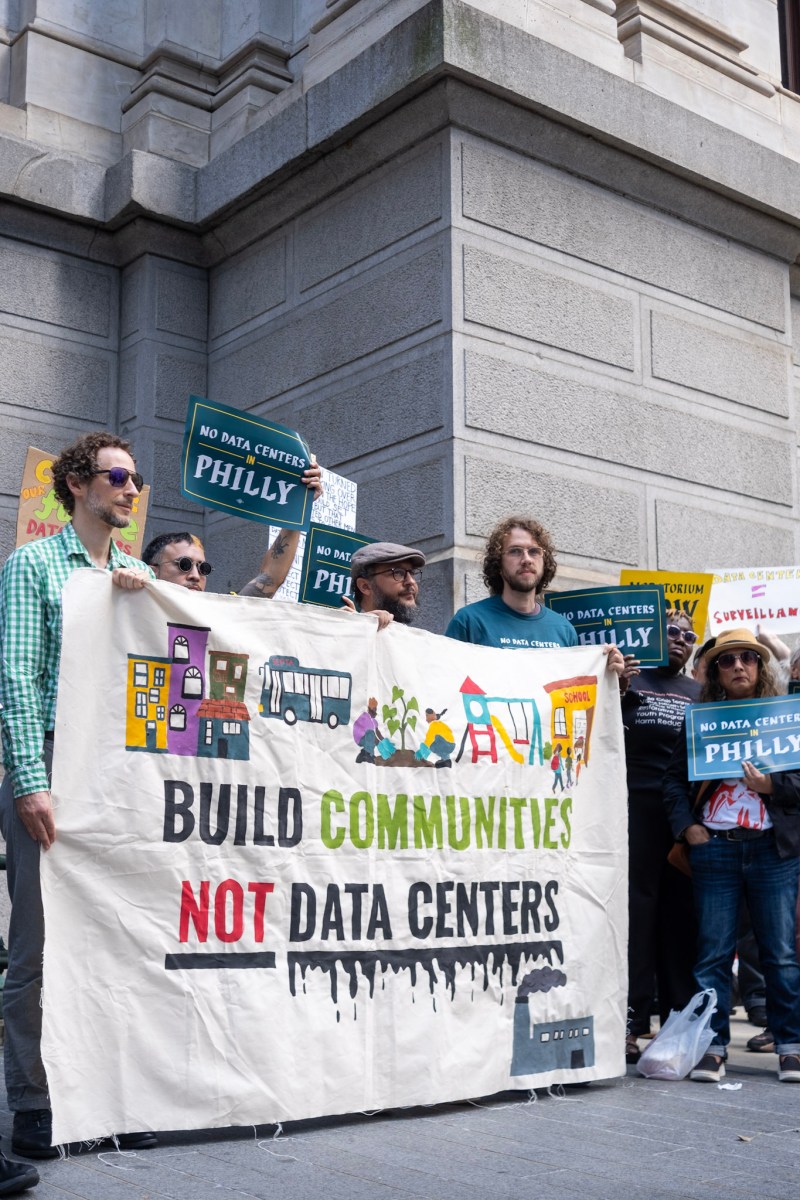
Amazon recently followed Microsoft’s lead and said it will no longer use nondisclosure agreements (NDAs) while negotiating with local governments over data centers.
On the latest episode of TechCrunch’s Equity podcast, Sean O’Kane, Rebeccan Bellan and I discussed Amazon’s announcement, which came in the middle of a longer blog post making the case that data centers are actually good for communities.
Rebecca was a bit skeptical that the recent spate of data center moratoriums will have a lasting effect, especially since the moratoriums only last for a year or two and “these data centers aren’t coming online for the next two, three, four, five years,” though I countered that data center backers definitely seem worried.
Sean, meanwhile, suggested that a big reason for the backlash is the industry’s poor communication.
“We’ve seen, through a lot of the controversy and backlash to AI and data centers, that the industry just does a really poor job explaining itself, and that they are obviously and constantly frustrated with the fact that most people can’t envision a world in which this stuff is useful for them,” he said.
Keep reading for a preview of our conversation, edited for length and clarity.
Sean O’Kane: It’s an interesting thing that it was sort of buried in the blog post and part of a larger story that Amazon’s clearly trying to tell. I guess I understand why they weren’t putting it in the foreground, but to me, this is at the root of so many of the problems that the tech industry currently faces when it comes to AI broadly, but data centers in particular.
There are so many things that could be said about whether or not people should be worried about the effect that data centers have on their property values, on their electricity bills, on their water usage in the area, and whether or not those things are real problems, inflated problems, etc. etc.
I think so much of that just really goes back to the fact that a lot of these projects are being negotiated essentially in secret. Sometimes they’re being negotiated [with the public knowing] that it’s a data center, but just not knowing who’s actually going to use it or occupy it at any point.
This is a long-standing issue with the tech industry. I always go back to the mid-2010s when Uber was expanding really fast. Uber was one of the companies that really used this tactic a ton when it came to working with local governments. In particular, I remember I was working at The Verge at the time and we had a freelancer write a story about a city outside of Orlando where Uber was trying to negotiate tax subsidies to subsidize rides for people to use public transit after the Uber trip.
The whole thing was negotiated in secret. And not only that, which was frustrating on its face, but also, because of the secrecy, you could just see Uber getting really comfortable with asking for a lot of other stuff, too.
So there needs to be more of this. I’m glad Amazon’s doing this. We’ll see if it actually does have any positive effect, but people are pretty entrenched right now.
Rebecca Bellan: Yeah, I’m curious about what effect this will have and whether it will lead to communities successfully delaying or or killing any infrastructure that the companies need to build. What I’ve heard from some people I’ve spoken to, who deal with data centers every day, a lot of these moratoriums that are getting passed — and there are a significant number of them, including one recently in San Francisco, which is pretty ironic — but they’re only for like a year or two years.
But these data centers aren’t coming online for the next two, three, four, five years. All of the buildouts are going to be massively delayed for a number of reasons from zoning to funding. Of course, if the pushback keeps going, then it might have an effect, but I often wonder just how much of an effect this political pushback is having on this.
Anthony Ha: The moratorium I’m most familiar with is the one in New York. I believe it’s a one year moratorium, and that’s on permits for large projects. [Technically, it’s until the state finalizes an environmental review process, which is expected to take a year.]
So already, there’s some wiggle room within that. And often, they’re framed as: “It’s not like we think [data centers are] bad, let’s not do this. It’s [that] we need to take the time to study this.” Which gives them a lot of room to say later on, “Actually, we’ve decided this is great. We love it.”
But you can tell that the people trying to build these data centers are worried, which is why you have these unhinged tweets from people like Trump or David Sacks. Only time will tell in terms how long and how deep that [community] resistance is, but I do think they are worried.
It’s also noteworthy that Microsoft, earlier this year, made a similar announcement about not using NDAs. I don’t think that getting rid of the NDAs automatically is going to make the people who opposed these data centers be like, “Great, let’s let’s do it. I’m in.” But I think the beginning of that conversation is, “Well, we don’t even know what the heck you’re doing, because you’ve negotiated all this stuff in secret.” So it does seem like a good first step.
Sean: The larger problem here is just a communication problem, right? This is a problem I think that goes across the entire tech industry, but it’s especially acute now, because we’re living in the era of “going direct” and “you don’t need to talk to the media, the media is dead,” etc.
And I’m not trying to beat that horse, because we’re in the media and [we] think we’re still relevant. But we’ve seen, through a lot of the controversy and backlash to AI and data centers, that the industry just does a really poor job explaining itself, and that they are obviously and constantly frustrated with the fact that most people can’t envision a world in which this stuff is useful for them. And that’s because, a lot of time, the [technological] ability’s not there, and in part because they’re just not explaining it well.
I wrote a story last week about how it’s been a year since we’ve really heard Tesla beating its own drum about building towards what it originally was calling “sustainable abundance” and is now “amazing abundance” as its mission statement. It’s just wild to me that we’re a year into that, and the company still doesn’t have a very good definition of it, especially considering that they released this whole multi-page PDF laying it out when they announced this, and even Tesla’s biggest fans criticized Elon Musk and Tesla for how unspecific it was. It read like LLM nonsense.
Anthony: One of the things this has made me think about is just the narrative and this sense that for a while, it really felt like it was being pushed down our throats — this idea of, “This is inevitable, this AI-driven future, and get on board or you’re just going to be left behind.”
Obviously that future is barreling ahead in a lot of ways, but in a few key ways, there have been these obstacles. What I’ve really liked about that is this sense of “No, you actually have to make the case for it.” You can’t just say, “This is the future, shut up.”
And then specifically about Tesla and the abundance thing, what was shocking to me is not so much that they haven’t come up with a definition of abundance, but that that was a promise that they were making in the first place. I think [that] speaks to how strange our relationship to Tesla, and particularly the people who are invested and ride-or-die for Elon, [has become.] It’s not about, is this company going to sell a lot of cars? It’s about this vision for remaking society. Or at least, that’s what they’re being sold.
When you purchase through links in our articles, we may earn a small commission. This doesn’t affect our editorial independence.
>

Meta’s Superintelligence Lab released a pair of new state-of-the-art models on Monday, Muse Wonder and Muse Wonder Full, representing the company’s first attempt at a frontier model.
Where Muse Spark aimed to be a lightweight model that could perform at low latency, the Wonder models are larger and said to be more capable, with higher benchmark scores and better results on complex tasks like coding.
According to Meta’s testing (presented in the model card), Wonder and Wonder Full achieve comparable benchmark scores to Fable 5.1 and GPT-6 Astra.
“Together, they mark the next step on our scaling ladder and a major leap toward personal superintelligence,” Meta’s blog post about the models reads.
That scale is reflected in the pricing: Accessed through the Meta Model API, Wonder will cost $4.00 per million input tokens and $20.00 per million output tokens, making it roughly equivalent in cost to GPT-6 Sol or Opus 5.5.
Notably, Wonder Full will only be available to Muse Code subscribers, and will not be served through the API. Both models will also be used to power the Muse agent.
In keeping with Meta’s interest in developing personal assistants that can perform tasks over a long period, the company placed particular emphasis on the new models’ ability to retain and synthesize information given by the user, a property Meta calls “active memory.”
To achieve better recall, Meta highlighted the MemoryBench benchmark, which challenges continual learning and memory construction frameworks. According to the company’s testing, Muse Wonder now scores higher on MemoryBench than Fable, Opus or Astra.
“We put a tremendous amount of effort into making sure your model can remember what’s important to you over days, weeks, months and beyond,” said research scientist Kavya Kopparapu in a video accompanying the launch.
The new models are the first frontier model release since Scale AI founder Alexandr Wang restructured Meta’s AI efforts in August of last year. Since then, Meta has released its lightweight Muse Spark model and Muse agent, but has avoided the kind of state-of-the-art model releases OpenAI and Anthropic are known for.
According to the post, the models were trained at Meta’s Prometheus data center in central Ohio, which came online earlier this year.
When you purchase through links in our articles, we may earn a small commission. This doesn’t affect our editorial independence.
>
This article was originally published by Canary Media.
The geothermal startup Fervo Energy is now selling power to the grid from its Cape Station project in Utah — marking the first time a utility-scale, next-generation geothermal facility has achieved such a feat worldwide.
The Houston-based firm turned on an initial 33-megawatt unit late last week and has been testing and ramping up output since then. On Thursday, Fervo will officially begin commercial operations, supplying carbon-free electricity to Shell Energy, a retail power provider in California.
Cape Station, a $2 billion project that will eventually be 500 MW, is unique among the world’s commercial geothermal plants. While other facilities draw on naturally occurring hot water and steam, Fervo has engineered its own geothermal resource deep underground. The startup uses drilling techniques from the oil and gas industry to create reservoirs in hot, dry rocks that generate steam to produce electricity.
“Traditional geothermal would have never been done in southern Utah,” says Dawn Owens, Fervo’s senior vice president and head of development and commercial markets.
With the first unit online, Fervo says it is working to commission two more 33-MW power blocks by 1 January, 2027. The project’s remaining 400 MW — which is supported by a new agreement with Google — is under construction and slated to come online in 2028.
Fervo’s Next-Generation Geothermal Journey
Fervo already operates a 3.5-MW commercial pilot plant in Nevada, which went online in late 2023. Owens says the pilot, called Project Red, was important for demonstrating the technology itself. But firing up Cape Station proves that Fervo’s approach can achieve utility scale and export power to wider markets.
“This is massive for both Fervo and the geothermal industry at large,” she says.
Fervo, which went public in May, is leading the fast-growing movement to develop clean, always-on geothermal power to meet soaring demand from data centers and balance growing supplies of intermittent solar and wind energy. Next-generation geothermal firms have raised billions of dollars in private capital in recent years to develop and deploy technologies that can harness energy in harsh, deep environments.
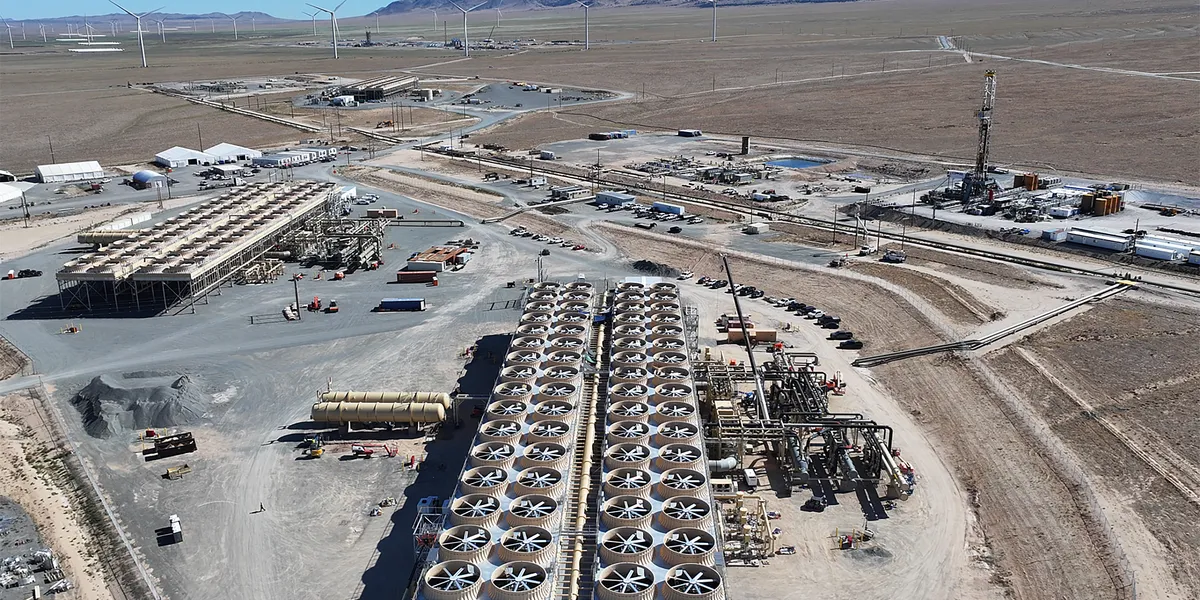
 Drilling continues at Fervo Energy’s Cape Station geothermal plant in Beaver County, Utah, where the company plans to ramp up production to 500 MW. Fervo Energy
Today, geothermal represents just 0.4 percent of total U.S. electricity generation every year. Expanding geothermal’s share of the mix will require not just building more projects like Cape Station but also tackling high upfront drilling costs and other economic and regulatory barriers — all while working to limit potential impacts on communities and the environment, experts say.
“Fervo’s first power achievement shows investors the size and scale of the opportunity to fuel many more such milestones across developers and sites in the future,” says Mitchell Smith, who serves as grid lead for the Mountain West Geothermal Consortium. The bipartisan initiative is calling for increased public and private financing “to help bring more projects online responsibly and at the speed of demand,” he added.
Enhanced Geothermal Energy Gets Cheaper
Fervo has declined to disclose the terms of its power purchase agreements for in-progress and future development, which together represent about 1,000 MW, or enough to power roughly 1 million U.S. homes every year. Phase 1 of Cape Station is set to deliver power at $7,000 per kilowatt, while Phase 2 should come at $5,500 per kilowatt, the company previously told Canary Media. (By comparison, the average cost to build a natural gas–fired power plant was $2,157 per kilowatt in 2025.)
Along with slashing drilling costs, enhanced geothermal projects could improve their economics by delivering power when it’s most valuable to utilities, according to researchers. While geothermal plants traditionally provide around-the-clock, baseload power, next-generation facilities might operate flexibly during certain periods — like in the evening, when solar output declines — to reduce overall grid costs. Geothermal plants could also operate “behind the meter” to directly power data centers, so that the costs of adding new electricity capacity aren’t passed on to utility customers, Owens says.
“We’ve been saying all along that our technology makes geothermal more scalable and affordable in more places,” she says. On Cape Station’s powering-up, she adds, “That’s just something no next-generation geothermal company has ever been able to do before.”
From Your Site Articles
Related Articles Around the Web
>

The U.S. Air Force will buy data collected by WindBorne Systems‘ fleet of autonomous weather balloons under a new contract that could be worth nearly $50 million to the startup.
WindBorne currently has about 700 weather balloons flying around the globe, collecting atmospheric sensor readings that the company sells to customers and also feeds into its own AI weather forecasting model. WindBorne, founded in 2015 and based in Redwood City, Calif., is one of the first organizations to directly feed empirical data into a deep-learning weather model.
The company has worked closely with the U.S. government, particularly the National Weather Service and the U.S. Air Force and Navy, but this is the single largest contract the company has participated in. The contract is worth up to $49 million, but the Air Force pays only as it needs data. It can place orders for specific regions at specific times. So far, it has ordered $1.7 million worth, and executives expect more orders to follow.
“This is largely a vehicle through which continued growth of the constellation can be supported, as well as some work on research and development to continue to improve the hardware and performance of the balloons,” WindBorne co-founder and CTO Andrey Sushko told TechCrunch. He adds that the contract, which was awarded without competitive bidding, is “a determination by the government that for this capability of collecting global data, we were the only company able to provide it in the way that met their needs for these operations.”
WindBorne CEO John Dean told TechCrunch in August that the company had raised a $37 million Series B round to continue scaling its business. Earlier this summer, the company released the latest version of its forecasting model, WeatherMesh 6, which it says provides more accurate forecasts than the traditional model run by the European Centre for Medium-Range Weather Forecasts (ECMWF), which simulates the atmosphere using the laws of physics.
Since the arrival of transformer model architectures and the ECMWF’s release of a massive weather dataset a few years ago, AI weather forecasting has become one of the more productive uses of deep-learning technology. Meteorologists previously relied on expensive supercomputers running detailed equations that approximate how the atmosphere behaves. Now, end-to-end learning can ingest decades of weather data and issue predictions more quickly.
Models built by frontier labs and government agencies are proving more accurate than traditional forecasts, although it is still a jagged frontier, with both types of forecasts required to enable useful understanding of the weather. Google DeepMind’s latest weather model offers important new capabilities, and its cyclone forecasting tools are becoming increasingly central to how the US government responds to hurricane season.
In August WindBorne became the first organization to send an unpowered flight system — one with no engine — to collect data in the eye of a typhoon. The company maneuvers its balloons by adjusting their altitude, bleeding air, or dropping sand carried as ballast, to send the vehicles into winds that take them where they need to go.
“That’s a pretty novel step, and the two ingredients for that are one, having good wind and weather models, and knowing how to navigate them; and two, having a large enough constellation that you have balloons in the right places,” Sushko said. “It’s one of the first times that a deep-learning model was used for actual operational decisions.”
When you purchase through links in our articles, we may earn a small commission. This doesn’t affect our editorial independence.
>
Maryland club tennis program suspended indefinitely for distributing racist images

‘James Gray Films Are a Safe Investment,’ ‘Paper Tiger’ Producer Says
Bills vs. Rams live updates: NFL ‘Monday Night Football’ score, prediction, odds and latest
-

 movies5 months ago
Search For Canadian TV Actor Stewart McLean Now Homicide Investigation
-

 Fashion9 years ago
These ’90s fashion trends are making a comeback in 2017
-
Fashion9 years ago
According to Dior Couture, this taboo fashion accessory is back
-
Fashion9 years ago
Model Jocelyn Chew’s Instagram is the best vacation you’ve ever had
-
Fashion9 years ago
Emily Ratajkowski channels back-to-school style
-
Fashion9 years ago
9 Celebrities who have spoken out about being photoshopped
-

 Anime4 months ago
Rurouni Kenshin: Hokkaido Arc Manga Takes 1-Issue Break – News
-

 Anime3 months ago
HIDIVE to Stream English Dubs for The World Is Dancing, The Forsaken Saintess and Her Foodie Roadtrip in Another World, The Dangers in My Heart: The Movie Anime – News