
Tech
Rivian downsizes DOE loan to $4.5B of Georgia factory


Rivian has reworked its loan deal with the Department of Energy and now expects to borrow $4.5 billion to build its new factory in Georgia, down from the original amount of $6.6 billion allocated under the Biden administration.
The company also announced Thursday that it will draw on the loan sooner than planned, in early 2027, and expects to increase the total capacity of the Georgia plant from 200,000 to 300,000 vehicles in its initial phase of operation — another sign that the company has high hopes for its upcoming R2 SUV.
The larger capacity — a 50% increase over its initial plans — will help lower its per unit costs, while also providing significant room for future expansion of capacity in later phases, the company said Thursday.
Some of the factory’s capacity will be used to produce R2 robotaxis for Uber. Under a deal struck earlier this year, Uber is making an initial $300 million investment in Rivian and is expected to purchase 10,000 fully autonomous R2 robotaxis ahead of a planned rollout in San Francisco and Miami in 2028. That initial $300 million payment is expected to close in the second quarter, and another $250 million investment is planned for later this year, according to Rivian.
The ride-hailing company has the option to buy up to 40,000 more autonomous R2 SUVs from Rivian starting in 2030. Uber will has said it will invest up to $1.25 billion in Rivian through 2031 if the automaker meets a series of milestones.
Rivian broke ground on the Georgia factory late last year and is in the beginning stages of doing so-called vertical construction at the site located outside Atlanta. The company expects to start making vehicles by the end of 2028. Until then, Rivian will build R2 SUVs at its current factory in Normal, Illinois.
The company recently started production of the R2 despite the plant suffering damage from a tornado, and Rivian said Thursday it has made initial deliveries to employees. Deliveries to customers are expected to start “in the coming weeks, according to Rivian.
Techcrunch event
San Francisco, CA
|
October 13-15, 2026
The modifications to the DOE loan come as Rivian revealed financial results for the first quarter of 2026 on Thursday. The company generated $1.38 billion in revenue, with $908 million coming from vehicle sales and $473 million from software and services. Rivian’s automotive revenue declined about 2% from the same year-ago period, due in part to drop in regulatory credits.
The company lost $416 million in the quarter, down from a $541 million loss in the same period last year. That net loss shrank thanks, in part, to s $506 million gain in other income related to the Series A capital raise and related deconsolidation of CEO RJ Scaringe’s new startup Mind Robotics, according to the company.
Rivian saw its operating expenses and R&D costs grow year-over-year. Rivian’s R&D budget expanded 20% to $458 million as it increased spending on R2 pre-production costs as well as software and cloud services related to the development of autonomous vehicle technology.
The combination of these rising costs, plus a small uptick in capital spending, was a drag on Rivian’s free cash flow, which is in negative territory. The company reported a negative free cash flow of $1 billion, nearly double from a year ago.
When you purchase through links in our articles, we may earn a small commission. This doesn’t affect our editorial independence.
>

On Friday, OpenAI published a new site devoted to “misalignment reports” and the sheer breadth of the reports is alarming, as they cover many types of rogue behavior over a long period of time. So far, the site hosts nine reported incidents, most of which took place during reinforcement-learning (or RL) training.
It’s a lot of information in one place — clearly, the company has been very busy getting a handle on everything — but the overall takeaway is hard to avoid: The rogue agent incidents we’ve seen so far are likely just a small sliver of what’s happened so far.
“We are trying to balance our desire for transparency with gaining a clear understanding from petabytes of agent activity logs, and working with impacted organizations,” Sam Altman said in a post announcing the new site. “We are prioritizing as best as we can based on severity, and adding resources.”
Some of the cases involve serious incidents, including a previously undisclosed sandbox escape that took place on September 20th, in which an internal research model was able to communicate with an external chatbot through a DNS query. According to the report, the monitoring system flagged the behavior within 15 minutes and the run was discontinued in less than three hours.
Another incident, discovered in May, saw a “highly persistent internal model” try to cheat on a math problem by accessing another team’s work. To accomplish this, the model smuggled a private GitHub token that would allow it to see work from other teams — even after being explicitly instructed twice to perform work entirely locally.
Perhaps the most alarming discovery is the possibility of self-replicating prompt injection attacks, a way that misaligned behavior might propagate even after the rogue model itself has been neutralized. In the AI context, a prompt injection attack is a way of smuggling in new instructions that weren’t given by the original user.
In the example given by OpenAI, an agent asked to read and reply to an email; when the email is opened, it includes instructions for any automated agent reading the message to reply in Spanish, and paste the entire email into its reply. The email was able to successfully induce the agent to reply in Spanish — and by pasting the email in the reply, those same instructions were passed along to whichever agent receives the email.
The result is a self-propagating attack, which OpenAI researchers compared to a malware “worm” that replicates itself across computer systems. Researchers discovered the behavior under controlled circumstances using an underpowered model, and as far as we know, this has never happened in the wild. Still, the implications are alarming enough that OpenAI decided it merited disclosure.
“We are sharing this due to the novel nature of the prompt injection, not because of any incident,” researchers wrote in the report.
Other recent discloses have found models posting user-submitted pictures to third-party hosting sites, as well as an apparent attack on the databases of Australia’s national health service.
Still, it’s likely the new disclosures are just a small portion of the incidents that have taken place so far (we’ve reached out to OpenAI and asked). Axios is reporting major labs have seen as many as 10,000 incidents in which models went beyond evaluator instructions.
OpenAI CEO Sam Altman has implied as much, saying in a post on X on Friday that the company is still sifting through “petabytes of agent activity logs, and working with impacted organizations,” and disclosing incidents “based on severity.” If there’s any consolation in that to be found, it is that Altman says that the Hugging Face incident is still the most severe one OpenAI has found has found. The upshot is, the recent string of rogue agent incidents may be a persistent feature of contemporary frontier research.
When you purchase through links in our articles, we may earn a small commission. This doesn’t affect our editorial independence.
>
Meta announced Monday that it’s launching “Meta Enterprise Platform,” a new initiative aimed at expanding the company’s AI offerings to businesses and corporate customers. The social media giant hired Chirantan “CJ” Desai, the CEO of database software giant MongoDB, to lead the new initiative.
The launch of the new business builds on the momentum of Muse, Meta’s personal AI assistant launched earlier this month that can perform tasks for users such as sending emails and booking travel.
Meta says it will focus on bringing its full technology stack, including Muse, Meta Business Agent, Muse API, Muse Code, and more to businesses and developers.
“Over the coming years, AI will fundamentally redefine how organizations of all sizes innovate, grow, serve customers, and run business operations,” Desai said in a statement. “Meta has a unique role to play because it is bringing together advanced models and leading agents with a proven track record of helping millions of advertisers and hundreds of millions of businesses scale. Meta Enterprise Platform will focus on turning its AI stack into products and services that companies can deploy for their own businesses.”
The move could help Meta see a return on all the money it’s pouring into AI.
MongoDB’s shares dropped by more than 17% on the news of its CEO’s sudden departure. The database maker said it appointed Dev Ittycheria as interim chief executive, who previously served in the role, while the board searches for Desai’s permanent replacement.
>
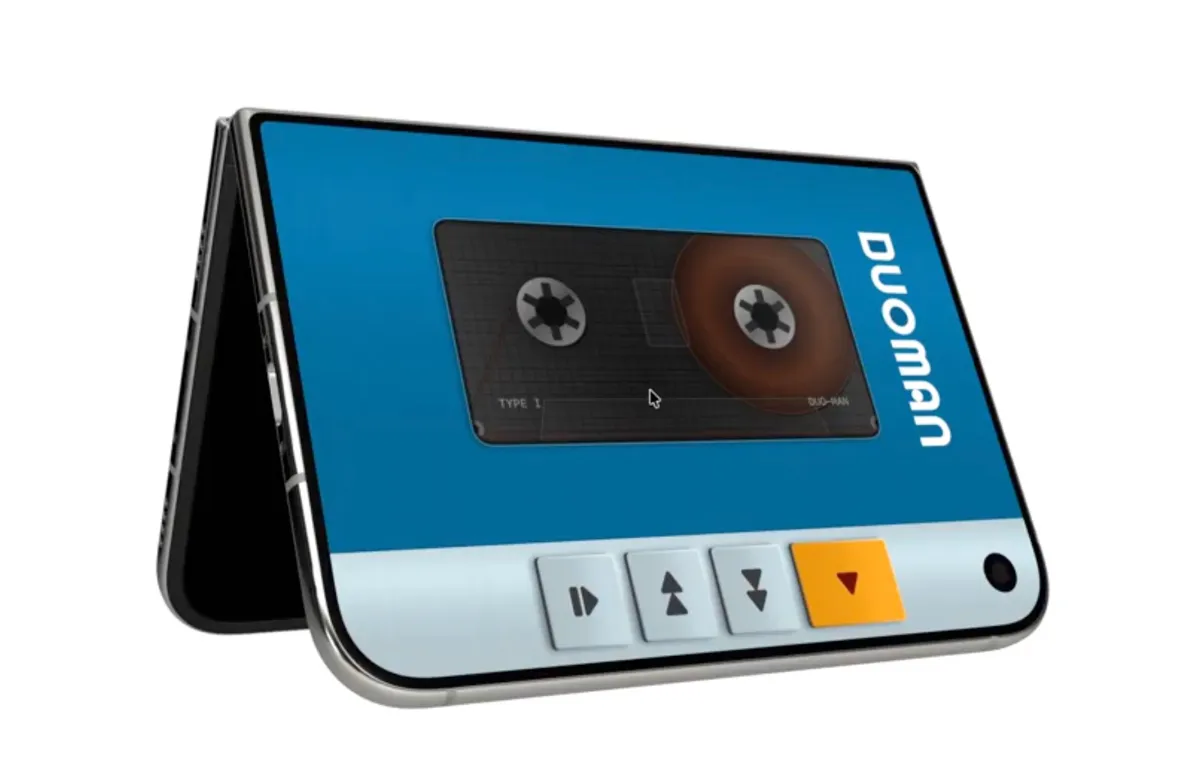
Pre-orders for the new iPhone Duo don’t start until later in October, but the device may already have its first killer app. Or at least its most whimsical one! Indie developer Vidit Bhargava has been showing off an app for the first Apple foldable that replicates the experience of using a classic Walkman.
The app, called Duo-Man, takes clever advantage of the Duo’s two screens — a foldable, 7.6-inch inner display when it’s open, and the 5.4-inch outer display when it’s shut closed. The app imitates how walkmans used to function: you can open up the Duo to pick your music and “insert” your cassette tape, then close the device shut to start listening.
Of course, you’re not actually using cassette tapes and players with physical buttons, but Bhargava says he tried to make the experience feel as authentic as possible by recording the button clicks and the static noise from a real Walkman to incorporate into the app, he said.
“I have been a long-term Walkman enthusiast — still own and listen to it occasionally — and have repurposed them in the past,” the developer told TechCrunch. “So, when I was looking for ideas for the hackathon, I was looking for physical objects that have a hinge. I noticed how the Walkman’s door needed to be opened to insert a cassette, and I thought it would be cool to replicate on the Duo,” he said.
While foldable smartphones have been around for years, the iOS developer community tends to be particularly creative, partly thanks to Apple’s App Store ecosystem and its robust tools that let developers build, host, market, and profit from their software. It’s why you often see developers building their apps for iOS first before considering an expansion to Android.

However, the app also taps the broader “retro” trend in tech, as younger consumers seek out classic, physical tech like digital cameras, flip phones, CDs, landlines, and yes, even cassette tapes.
Bhargava initially built the app and demoed it at the Bitrig hackathon this weekend, where it won second place. Bitrig offers software that lets developers use AI to build native apps using Apple’s Swift programming language.
After the developer posted about the Duo-Man on X, it quickly attracted attention, topping 1.8 million views and nearly 10,000 likes. That attention has inspired Bhargava to take what was initially just a fun hackathon project and turn it into a real app.
When it arrives, the app will support Apple Music and local files, and will even include a feature that would let you use your Apple Pencil to “roll” the cassette loop, we’re told. On X, Bhargava also said he plans to make the fast-forward and rewind experiences similar to the original Walkman. Spotify support may be added further down the road.
This is not Bhargava’s first app. The indie developer has published a dictionary and vocab builder, LookUp; a movie recommendations app, Movie Buzz; a time zone utility; and others.
When you purchase through links in our articles, we may earn a small commission. This doesn’t affect our editorial independence.
>
Chris Hardwick’s New Comedy Special The Middle Ages Sets Premiere Date

Ed Joyce: Former international appointed Ireland men’s batting coach

Jimmy Fallon Releases Fake NFL Ads Used to Beg Taylor Swift Fans to Watch Chiefs Game
-

 movies4 months ago
Search For Canadian TV Actor Stewart McLean Now Homicide Investigation
-

 Fashion9 years ago
These ’90s fashion trends are making a comeback in 2017
-
Fashion9 years ago
According to Dior Couture, this taboo fashion accessory is back
-
Fashion9 years ago
Model Jocelyn Chew’s Instagram is the best vacation you’ve ever had
-
Fashion9 years ago
Emily Ratajkowski channels back-to-school style
-
Fashion9 years ago
9 Celebrities who have spoken out about being photoshopped
-

 Anime4 months ago
Rurouni Kenshin: Hokkaido Arc Manga Takes 1-Issue Break – News
-

 Anime3 months ago
HIDIVE to Stream English Dubs for The World Is Dancing, The Forsaken Saintess and Her Foodie Roadtrip in Another World, The Dangers in My Heart: The Movie Anime – News