
Sports
The Oilers, and Connor McDavid, wasted another year of contention. What went wrong? What’s next?


A swift and surprising first-round playoff exit by the Edmonton Oilers amounted to much more than 11 wasted days in April.
This six-game loss to the Anaheim Ducks — which wrapped up with a 5-2 loss on Thursday night — set fire to another precious year of potential Stanley Cup contention and raised serious questions about Edmonton’s chances of summiting the mountain before Connor McDavid’s contract expires and the rest of the core ages out.
The stakes were raised considerably when McDavid came to the organization with an offer it couldn’t refuse. Not only did he leave millions of dollars on the table last October with a contract extension that didn’t include a salary jump, but McDavid officially stamped a 2028 expiry date on the club’s contention window by deliberately selecting a two-year term for his new deal.
“Two years makes a lot of sense,” McDavid said then. “It gives a chance to continue chasing down what we’ve been chasing down here with the core guys that have been here, and (leaves) a little bit of money (for the team) to work with, too.”
A premium was immediately added to each remaining year in which the game’s best player was assured to wear royal blue and orange, which is why Thursday’s season-ending loss to the precocious Ducks carried added significance.
Coming off consecutive trips to the Stanley Cup Final, and entering a playoffs in which McDavid said “it really feels like it’s anybody’s year,” it was definitely not their year. McDavid clearly was compromised by an ankle injury that limited his game-breaking agility against the Ducks, and he wasn’t alone. Leon Draisaitl and Zach Hyman looked to be playing through pain during the series, while defensive-minded centers Jason Dickinson and Adam Henrique were each forced to miss multiple games.
However, those springtime injuries only tell a fraction of the story about what went wrong for the 2025-26 Oilers.
This was a team that finished with 93 points – its lowest total since 2018-19 – and still somehow ended up with home-ice advantage for a series with the Ducks, who qualified for the playoffs with a minus-15 goal differential. Edmonton should have had the upper hand in the “pillow fight.” Instead, the Oilers squandered a lead in three of the four games they lost to Anaheim, getting soundly outplayed on special teams throughout.
The main reason McDavid spent so long contemplating the $25-million, two-year extension he signed on Oct. 6 is that he had reservations about the direction of the team. His desire to win in Edmonton alongside Draisaitl, Hyman, Ryan Nugent-Hopkins, Darnell Nurse and other roster mainstays was stronger than ever, but he was mindful of the possibility of a step back — like the one that ended up occurring.
“There’s no secret,” McDavid said in October, “that with a team that pushes for it every year like we have for the last number of years — four or five years we’ve given up first-round picks and prospects and all of that stuff — there’s not a ton of young guys (coming up in the organization), you know?”
Plenty more futures were expended in the months that followed, with only negligible results to show for them.
Management made a pledge to McDavid during a series of conversations last offseason about remaining all-in on the chase for a championship. They promised to rebalance and improve the roster around their superstar forwards. And McDavid showed faith in that plan by requesting a below-market contact that left valuable room to maneuver under the cap ceiling.
“He’s curious,” Oilers general manager Stan Bowman said then. “He likes to know what’s coming and what the thoughts are and how I see the team and how we can get better. It’s all very good discussions, good dialogue back and forth. He’s a very smart guy in addition to being an amazing player.
“He’s got a lot of good ideas, and that’s why it’s fun to talk hockey with him.”
It’ll be interesting to hear if the tone of those conversations changes following a loss to the Ducks that no one in Edmonton saw coming. This one hurt. The Oilers fell 14 wins short of lifting the Cup after being two wins and one win shy, respectively, in the previous two years.
McDavid’s burning desire to bring the Oilers to the promised land remains, despite the setback, according to league sources, but he’s likely going to expect management to deliver on specific roster adjustments this summer, rather than accepting general promises.
The road to a first-round elimination, and a roster in such need of real change, was not short. When Bowman took over the general manager’s job in July 2024, he did so with a surprise on the way — and not a pleasant one. On Aug. 13, at a point in the offseason typically still reserved for rounds of golf and Caribbean vacations, the St. Louis Blues tendered offer sheets to a pair of young Oilers.
Forward Dylan Holloway and defenseman Philip Broberg were former first-round picks and far from finished products — both had spent time in the AHL during the 2023-24 season — but they represented something that, under Bowman’s predecessor Ken Holland and president Jeff Jackson, the Oilers had seemed to terminally lack: quality depth with the potential for growth.
St. Louis took advantage of the untenable cap situation. Jackson, acting as interim GM after Holland’s exit, on July 1 signed a raft of veteran free agents — Henrique, Viktor Arvidsson, Jeff Skinner, Connor Brown, Corey Perry, Mattias Janmark, Josh Brown and Troy Stecher — blowing past the salary cap and putting deals for RFAs such as Holloway and Broberg on the back burner.
The thought, at the time, was that the Oilers would figure things out with both in due time and agree upon low-cost bridge deals. That’s not how it played out. Holloway and Broberg both signed bridge deals, but they did it with the Blues.
Rather than match the offers and create a situation in which he’d have to make an unplanned trade of a high-cost player or two, Bowman let Holloway and Broberg walk, taking back second- and third-round draft picks as compensation. Bowman’s priority at the time, one he cited as part of the reason for the decision, was figuring out a new contract for Drasaitl.
“(Holloway and Broberg) can probably grow into those deals, but as of today, they’re way above their actual performance,” Bowman told The Athletic’s Pierre LeBrun when the dust had settled. Both immediately emerged as important, long-term pieces in St. Louis.
Since then — even through two Cup final runs — Bowman has been chasing the exact kind of medium- and short-term solutions Holloway and Broberg would’ve offered, and he’s missed on more swings than not. Vasily Podkolzin, acquired from the roster-squeezed Vancouver Canucks in August 2023 for a fourth-round pick, was an early win, and pound for pound, possibly Bowman’s biggest win. A feisty, physical middle-six winger with enough skill to score 20 goals or more, he emerged as a key contributor during the 2025 playoffs and carried it over into 2025-26.
Bowman’s next trades of consequence, at the trade deadline in March 2025, had a through-line. He was adding depth players, albeit ones who’d make sense at the right price, at an immense cost in terms of outgoing assets. Trent Frederic, a solid bottom-sixer with Boston, primarily cost the second-round pick Edmonton received for the Holloway offer sheet, along with a fourth-rounder. Jake Walman, a puck-moving top-four defenseman who’d thrived after San Jose acquired him from Detroit in a contract dump, cost a conditional first-rounder.
After the 2025 Cup run, both would sign long-term deals (Frederic for seven years at a $3.85 million cap hit, Walman for eight years at $7 million), locking them into Edmonton’s core, and neither has made those contracts look particularly good. Walman has become an all-defense bottom-sixer at a premium price, and Frederic was a healthy scratch against the Ducks.
Meanwhile, of those eight free agents Jackson signed, only Henrique, a fourth-line center who was injured against Anaheim, and Josh Brown, who played 10 NHL games in 2025-26, remain with the organization.
Bowman’s first real crack at free agency with the Oilers, meanwhile, wasn’t fruitful — he had extensions for McDavid, Bouchard, Frederic and Mattias Ekholm to worry about and, the thinking went, a goaltending problem to solve. Stuart Skinner, after three seasons worth of overall solid play, had been benched twice during the 2025 playoffs, and backup Calvin Pickard was not a long-term solution.
Bowman signed Kasperi Kapanen, who’d come off the scrap heap to provide decent postseason minutes, to a one-year, $1.3 million deal and fourth-line center Curtis Lazar for one year and $775,000. Both have delivered, to some degree. The highest-profile attempts at navigating the salary cap while addressing the middle six for 2025-26, though, fell flat. Andrew Mangiapane (two years, $3.6 million) was waived after 52 games and prospect Isaac Howard, acquired from the Tampa Bay Lightning in July, couldn’t stick in the NHL.
One hole up front would be plugged by Matt Savoie, a quality young winger acquired from the Buffalo Sabres for center Ryan McLeod. Savoie started the Ducks series on McDavid’s wing and did not score a goal in the series. (McLeod is centering Buffalo’s second line in the postseason.) Another opening went to Jack Roslovic, who signed on Oct. 8 for one year and $1.5 million. He scored 21 goals in the regular season and, like Savoie, none against Anaheim.
The goaltending situation went unaddressed before the inconsistency Skinner battled during his first three NHL seasons began to look more like a feature than a bug. By December, Bowman was ready to move on. That decision may have been the correct one, but the timing was suboptimal and the specifics were worse. Bowman sent Skinner to the Pittsburgh Penguins for Tristan Jarry, a less-consistent, more-expensive replacement, along with a second-round pick and, bafflingly, Brett Kulak, a useful, playoff-proven defenseman.
In Pittsburgh, Skinner was good enough to be the Penguins’ Game 1 starter in a first-round matchup with the Philadelphia Flyers. Kulak, meanwhile, was flipped to the Colorado Avalanche, where he’s still playing as a second-pair defenseman for the Presidents’ Trophy winners.
With Edmonton, Jarry put up a .857 save percentage and saved fewer goals than expected in 13 of 19 appearances before losing his job down the stretch to journeyman Connor Ingram. Jarry is signed for two more seasons at a $5.375 million cap hit — a fact that compounds the issue of his poor performance. In March, before Ingram took control of the job, Edmonton seemingly scrambled to fortify the roster with Dickinson and defenseman Connor Murphy. Those two were acquired in separate trades with the Chicago Blackhawks and cost the Oilers first- and second-round picks, partially because their cap situation necessitated 50 percent salary retention by Chicago.
Both are good players. Neither were the scoring forward Edmonton hoped to add at the deadline, and Murphy was a de facto replacement for Kulak, who was sent to Pittsburgh in part to create space for Jarry’s contract.
In the series against Anaheim, Dickinson struggled to stay in the lineup due to an ankle injury. Murphy was part of an ineffective penalty kill and a defensive pairing that was outscored in its minutes, and Jarry saved 34 of 38 shots in one game’s worth of relief of Ingram — a 4-3 overtime loss. When he went back to Ingram for Game 5, coach Kris Knoblauch complimented Jarry, but called Ingram “our guy.”
“And now that our season’s on the line,” Knoblauch continued, “we felt that we would go with our guy.”
It was Ingram in net for Game 6, too. He allowed four goals on 26 shots.
Patience is not a virtue typically associated with Oilers owner Darryl Katz. The added urgency brought on by a closing Cup window could also influence whether any significant organizational changes follow a season that fell way below expectations, with Jackson, Bowman and Knoblauch all under scrutiny.
From a roster perspective, Edmonton needs to solve a problem as old as McDavid’s NHL career: Who is starting in goal?
Jarry has two pricey years remaining on his contract, but did not imbue any confidence that he can capably shoulder a meaningful load. It wouldn’t be surprising if Edmonton looked to move on. Ingram is a pending unrestricted free agent, and the list of other potential July 1 goaltending options carries nothing resembling a sure thing, It includes Skinner, Frederik Andersen, Vitek Vanecek, David Rittich and 37-year-old Sergei Bobrovsky.
Perhaps there’s a trade to be explored with the St. Louis Blues for Jordan Binnington. The Vegas Golden Knights have a well-paid backup in Adin Hill, but it’s hard to imagine them rushing to help out a Pacific Division rival.
It’s going to be tough. It’s going to be talked about.
Up front, there’s also work to be done, with Dickinson, Henrique, Roslovic, Kapanen and Lazar all eligible to test the open market. If the price is right, each has a case to return. But in a rising cap environment, there could be the allure of bigger paydays elsewhere to contend with.
Murphy is the only pending UFA among the defensemen, but the biggest decision arguably surrounds Nurse. He owns a no-movement clause on a contract with $9.25 million owed in each of the next four years. If the Oilers could clear that cap commitment, it would free up money for other needs. They need to try.
However, as the Oilers entered the offseason sooner than expected, the biggest source of optimism could be found in the long summer that comes with it. They’ll get additional rest. Because unless something unexpected happens, it’s going to be up to the same old faces to make sure one of their two remaining shots at a championship doesn’t get wasted next year.
>

MILWAUKEE — When they approached teams to express interest in acquiring their players last week, the Minnesota Twins could provide a mix of prospects and the ability to take on payroll to enhance their offers.
While the Twins were always authorized in years past to make trade-deadline deals using prospects, a significant amount of cash has rarely been available to the front office.
But in an attempt to improve the roster and hopefully win back disinterested fans through aggressive moves, Twins chairman Tom Pohlad wanted to provide general manager Jeremy Zoll with sufficient resources to make meaningful additions.
Twins chairman Tom Pohlad discusses the team’s trade deadline strategy
Dan Hayes
Zoll quickly recognized the benefits of entering discussions with a wallet flush full of cash.
In making three deals between July 30 and Aug. 3, the Twins absorbed more than $8 million in 2026 payroll from the Toronto Blue Jays, Baltimore Orioles and New York Mets. Being able to add payroll this season limited how much the Twins needed to surrender in prospect capital to acquire high-leverage relievers Jeff Hoffman and A.J. Minter and starting pitcher Dean Kremer.
“The ability to add payroll was huge,” Zoll said. “It was really helpful to be able to work through a wide variety of conversations. I’m really grateful for Tom Pohlad’s partnership and support along the way. We had really productive conversations leading into this deadline process about how we wanted to attack that and do everything that we could to improve the club. I felt like I was in lock step with him along the way.”
With Minter, the Mets were motivated to trim payroll rather than maximize the return on their rental reliever. Though Minter was one of the top left-handed relievers available, the Twins acquired him for what MLB graded as the team’s No. 21 prospect (Billy Amick) and 29th-best prospect (Bruin Agbayani) because they took on the rest of Minter’s $3.5 million salary.
Had they not absorbed salary, one team source who spoke on condition of anonymity to allow for candor suggested the Twins would have needed to surrender a prospect in the 10-15 range, perhaps as high as No. 8.
Knowing his team would be a buyer, Pohlad made sure to be clear with Zoll that he would have ample resources at his disposal. By the time they acquired Dean Kremer on July 31, the Twins had added $5 million in payroll. Another team source, granted anonymity to provide insight into the team’s strategy, said Pohlad offered access to more cash than the team had ever had before: “Tom’s not f—ing around.”
Pohlad said he simply wanted to make a difficult endeavor easier for Zoll.
“We were committed to giving (Zoll) the financial flexibility to make this team better,” Pohlad said. “I think the results of what happened at the trade deadline were in no small part a function of having that financial flexibility and that clarity at the outset. Now somebody has to go out and execute that, and that is a very hard thing to do, and he did that masterfully.”
Here’s what else we learned about the Twins at the trade deadline.
• Yes, the Twins expressed interest in Los Angeles Angels shortstop Zach Neto, a player they’ve been intrigued by for multiple seasons. Yet the timing of a national report Monday noting the Twins were all over Neto arrived a few days late.
The Twins reached out to Los Angeles before the weekend began to see if that team’s front office would be open to dealing Neto only to discover it would cost more than they were comfortable paying. Neto wasn’t moved at the deadline.
As evidenced by the team’s decision to promote No. 2 prospect Kaelen Culpepper on Friday, four days after the deadline, the club hoped to bolster its shortstop play.
The Twins also were in discussions for Reid Detmers and Jose Soriano, who was traded to Toronto.
• Indicating they were buying didn’t prevent teams from inquiring about catcher Ryan Jeffers, who is a free agent at the end of the season. With multiple teams pursuing catching help, Jeffers drew plenty of interest, but the Twins decided to keep their roster intact.
“He’s a big part of what we’re doing right now,” Zoll said. “We wanted to make sure we were not taking any steps backwards this year just to acquire future value to say we did. Had a clear goal of making the team better and wanted to deliver on that.”
Whether the Twins make Jeffers a qualifying offer or not depends on how he plays the rest of the season. But if the club thinks Jeffers would receive a long-term contract in free agency, the Twins seem unconcerned with making him a qualifying offer, which would net them a compensatory draft pick. While it could be perceived as a gamble to offer him a one-year deal expected to be worth at least $23 million, a source close to Jeffers said the catcher would reject the offer and be a free agent. Even if he accepted, the Twins would secure Jeffers, who’s in the middle of a career year, on a one-year deal, which would help bridge the gap to prospect Vahn Lackey’s eventual promotion to the majors.
• One person familiar with the team’s thinking who was granted anonymity to speak candidly said the Twins’ aggressive spending plan is repurposing what the organization originally intended to do beginning in 2023. When they re-signed Carlos Correa to a six-year, $200-million deal that January, the Twins were operating on a five-year plan under Derek Falvey in which payroll would increase every year to support the roster.
Only one year later, ownership pulled the plug on the plan and asked Falvey to reduce payroll by $30 million, a move Pohlad has since identified as a misstep. Team officials believe the move saved the money up front but cost the franchise far more money over the long run.
Pohlad has repeatedly said the Twins’ future payrolls would increase and that the team needs to spend more than $100 million on payroll to compete. Though it’s almost a certainty the Twins would never approach their $248 million payroll from 2023, Pohlad views the small-market San Diego Padres’ model as a positive.
“To build the business, we’ve got to win,” Pohlad said in July. “And to win, we’ve got to put a better product on the field. There does need to be an upfront investment made. But when we make an investment, we have to be successful. We have to f—ing win. If we do that, then people will come and it will all work.”
Do trade deadline deals lead to World Series rings?
Joe Crisalli
• Curious to see how the Twins front office works at the deadline, Pohlad spent time with Zoll and others in the front office and had an opportunity to see how many hypothetical possibilities arise during the process. But as the deadline neared and the work started to speed up, Pohlad left the Twins front office alone to conduct business.
Pohlad kept in contact with members of the front office via text and email over the past few days in case he was needed to sign off on a deal. One point made by Falvey last December when Pohlad took over was that the team’s new chairman would need to learn about most aspects of the business on the fly.
“It was a great learning experience,” Pohlad said. “It was a great team-building experience, particularly between (Zoll) and myself, and to some degree (Twins manager Derek Shelton). I felt like we had a very clear plan going in. I had a lot of confidence in (Zoll), and things turned out the way we hoped.”
>

Cavenagh was joined in the room by chief executive Jim Gillespie and shareholder Paraag Marathe.
Gillespie was asked about the appointment of McInnes, who fell just short of winning the title with Hearts last season.
“You can go for a Pep [Guardiola] style manager or a [Jurgen] Klopp style manager – we wanted a Klopp-style manager who plays on the front foot,” Gillespie said.
“Derek has been high on our list for a long time and we think he fits the style and culture of this club.”
He also confirmed the club are seeking clarification from the SFA regarding the VAR call that led to a Hibernian penalty in Sunday’s 2-1 defeat.
“It was my understanding that it has to be a clear and obvious error for the referee to be called over,” Gillespie said. “I didn’t see that as either clear or obvious.
“We need a strategy for developing referees and VAR.
“My question for the SFA would be ‘what is the strategy for improvement?’ – we have to get improvement.”
>
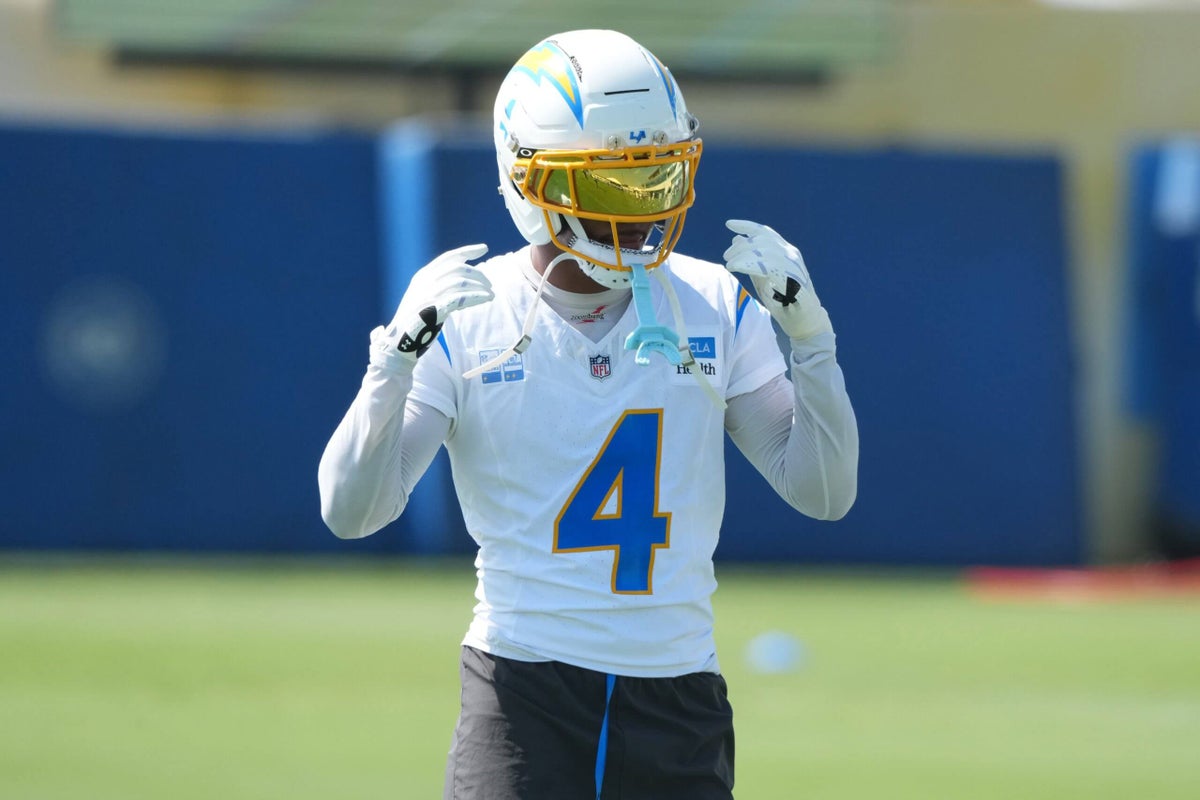
EL SEGUNDO, Calif. — Third-year Los Angeles Chargers cornerback Tarheeb Still is familiar with the fanfare of training camp.
When the post-practice huddle breaks, fans in attendance flock to the barriers, handing over hats, jerseys and posters they’d like to turn into souvenirs personalized by one of their favorite players. Still typically signs a few things, as was the case on Saturday, even when he didn’t participate in practice for an undisclosed reason. But for all the fans whose days Still has helped make, one from this summer stands out.
Sitting on his couch, scrolling social media during the first week of camp, Still came across a video of a fan asking for Justin Herbert’s signature. The fan said it was his third year attending camp and trying to get the quarterback’s autograph. He said his speech disability had made it difficult in the past.
Still responded to the post, saying that he would help the fan out. The next day, Still went up to Herbert before practice and asked him to sign a hat. When practice ended, Still knew who he was looking for in the crowd.
“That specific experience was kind of … it was kind of emotional,” Still said. “You could tell it really meant a lot to him. I almost shed a tear.”
tarheeb made it happen 🥹 pic.twitter.com/g8k6ZhVjw1
— Los Angeles Chargers (@chargers) July 29, 2026
The Chargers posted the fan’s reaction to their social media, where he cheers with excitement and then comes to the front of the crowd to meet Still. That shot of him and Still smiling together is his new profile picture.
“It was the best experience ever,” Still said. “It was an amazing feeling that I got to help him do that, and also he was so passionate and so grateful. It was just amazing.”
Still enters a pivotal third season in 2026, and in camp he’s been vying for snaps at outside corner next to veteran Donte Jackson and fellow 2024 draft pick Cam Hart. Jackson, who has played eight NFL seasons, gave props to Still for his versatility in the secondary.
“The sky is the limit for Tarheeb. He’s one of the smartest players I’ve ever played with, and that says a lot for a Year 3 guy,” Jackson said. “He’s going to be one of the guys that you see on the ticker making a lot of money.”
As a rookie, Still was eager to step up when the veteran starters battled injuries, and it turned into a standout season for the fifth-round pick. He led the team with four interceptions, one of which he returned for a 61-yard touchdown against the Atlanta Falcons.
“Tarheeb’s a player who established he belonged right away,” coach Jim Harbaugh said. “He’s in the process of seeing how far he can take it.”
Reflecting now, Still attributed his early success to a simple mindset.
“It wasn’t really much thinking, none of that,” Still said. “Just going out there, being young, having fun. Just embracing it, being in the league, but also really just trying my best to see the team succeed.”
The stats didn’t jump off the page for Still as much in Year 2. He ended the season with seven pass deflections, 53 tackles and without a takeaway, all fewer than the year prior.
“Last year, I was trying to be right about everything, instead of just being like how I was my rookie year, just limit the thinking,” Still said. “I’m prepared. I’m in the playbook. I scout the team. I know they’ve got a good feel for what’s going on. The coaches do a good job preparing us. So it’s really just not thinking, letting your ability take over.”
Still said he wants to get back to “playing more free” in 2026, combining the knowledge and confidence built in his first two years to take the next step.
The defense is also working under new coordinator Chris O’Leary, whom Still described as intentional and “super detailed.” O’Leary was the Chargers’ safeties coach during Still’s rookie season in 2024, so the chemistry was built before O’Leary returned to Los Angeles this offseason.
“We’re on him constantly about just being an ultimate competitor,” O’Leary said earlier in camp about Still. “Can you be the same guy day in and day out no matter who you’re guarding, who you’re up against, how you feel? That, to me, is the step we’re pushing him in this year. Be that guy every single day. But he’s been really good.”
For Still to unlock his potential in the upcoming year, he said it will come down to the small things: preparation, diet, habits. So, what’s success look like in 2026? And, as Harbaugh said, how far can Still take it?
“Whatever level I get myself to,” Still said. “I know that they have the confidence in me. I know they have trust in me. I know my teammates do, but really it’s just about me taking that next step to really make that big jump.”
Another new detail for Still this year: his number. He switched to No. 4 this offseason after wearing No. 29 the past two years. Still wore No. 4 during his final two college football seasons at Maryland, and he also said the number has relevance to the street he grew up on in Sicklerville, N.J.
Of course, it’s also the number Harbaugh wore during his two seasons with the Chargers organization in 1999 and 2000, but the head coach didn’t let that add any pressure, Still said.
“People that are from around that area will understand. It really means something to me where I’m from. It makes a lot of people happy back home,” Still said.
“And then, also, who doesn’t want a single digit in the league?”
>

Insights from Twins’ trade deadline: Ability to add payroll a game changer

DreamLab Films Boards Satirical Iranian TIFF Title ‘Head to Head’

Rangers chair Andrew Cavenagh expects up to five more signings
-

 movies3 months ago
Search For Canadian TV Actor Stewart McLean Now Homicide Investigation
-

 Fashion9 years ago
These ’90s fashion trends are making a comeback in 2017
-
Fashion9 years ago
According to Dior Couture, this taboo fashion accessory is back
-
Fashion9 years ago
Model Jocelyn Chew’s Instagram is the best vacation you’ve ever had
-
Fashion9 years ago
Your comprehensive guide to this fall’s biggest trends
-
Fashion9 years ago
9 Celebrities who have spoken out about being photoshopped
-
Fashion9 years ago
Emily Ratajkowski channels back-to-school style
-
Fashion9 years ago
A photo diary of the nightlife scene from LA To Ibiza