
Anime
How to Compose an Anime Soundtrack: An Interview with Haikyu!! and My Hero Academia’s Yuki Hayashi

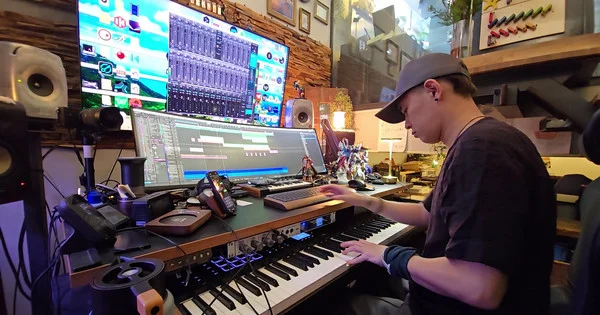

Music is an important part of any anime—and in some cases can make or break the show entirely. To find out a bit more about how anime soundtracks are made, we sat down with Yūki Hayashi, the composer of anime like Haikyu!!, Kiznaiver, and My Hero Academia—including the famously memeable “You Say Run”.
To start off, we talked a bit about how far into production he is usually contacted to score an anime. “It can vary depending on the show in question. It can be about six months in advance. But recently, with NETFLIX and simultaneous international releases, they can start a year or so in advance,” Hayashi began. “Some can be pretty short—like three months in advance. But normally, it’s about six months.”
But how does he come to decide on whether to take on a job or not? “It’s probably if it excites me or not,” Hayashi told me. “I’m sometimes a little too busy to take on a project. But sometimes, if they insist that they want me on the project—I mean, I really appreciate that they’d insist on it being me, so I might try to rework my schedule so I can help them out. It mainly comes down to if I really want to work on it or not.”

So what exactly was it that got Hayashi excited enough to work on what would become some of his most well-known scores? “For Haikyu!! it was it being a sports story. I played sports myself. That was one of the big influences on how I got into making music. So sports stories have a special place in my heart.” Hayashi said. “When I accepted the Haikyu!! job, I hadn’t worked on a lot of sports stories yet. So, to get that opportunity was really… I remember being really happy.”
“For My Hero Academia, that was about a decade ago. I don’t really remember all that much,” Hayashi admitted. “It was a really popular Shonen Jump manga. And reading it, I really felt it was something that was worth making an anime out of. I remember thinking that it was a chance to make music for a genre I’m good at.”
Once into the creative process, Hayashi has to figure out how much to get into the source material—be that a manga, book, or previously done anime. “There are times when I really dive deep into the source material, and there are times when I don’t. […] Basically, I always ask the director or producer how they’re changing things from the source material. How do they want to portray this anime? Do they want to diverge completely, or basically do a remake?” Hayashi explained. “If they say they want to diverge, I try not to let the source material influence me too much. Obviously, I’ll ask a bit and maybe read a bit, but I’ll avoid going too deep. I’ll try to prevent myself from having any preconceptions.”
“For original anime, it depends on the script, or the director or producer,” he added. “I’ll ask what sort of piece they’re making. I’ll often also make suggestions like, ‘What if we try it like this?’ Stuff like that helps lead to creating new things.”

From there it comes time to get onto the actual composing. “Well, I basically use this computer to compose,” Hayashi said, gesturing to the massive combined computer/piano setup behind him. “Basically, when I’m at my piano, it’s a lot of trial and error. There’s finding melodies and cord progressions and such. But the important thing is what sort of concept is it—what sort of image to have at first overall when creating the anime music. It’s important to have that down before composing. Without that, you end up really lost.”
“I mean, with anime, you’ve got 40 or 50 pieces all for a single season. If you compose without thinking first, there’s no balance to it,” he continued. “’I’ll try this for this sort of music…’ ‘It’s this sort of story, with this sort of plot, and this sort of protagonist…’ That helps with deciding on instruments, music genre, and tempo. I generally get the concept down first before I start actually composing.”
All that said, Hayashi tends to compose his songs, in his own words, “backwards.” “I’m a little different from others. A lot of times, I compose the melody or the leitmotif at the very end,” he told me. “I compose the orchestral foundation, then I inject what I’ve felt listening to that music. And then I often hone the melody last. I’ll consider the individual characters or the plot when I’m working on the orchestral part, I create the back track, and finally I’ll often shape what it is that comes up inside myself.”

While part of this is personal preference, part of it is also based on how the music is delivered to and then used by the anime’s sound director. “There’s the technical term: ‘stem.’ Basically, when sending in music, if a piece has drums, guitar, and vocals, you send in the drum track, guitar track, and vocal track separately so they can match it to a scene: ‘This part isn’t dramatic, so leave out the drums.’ ‘Add the drums when the protagonist starts running’—that’s what the sound director does.”
“If you put too much emphasis on the leitmotif, the music can become too specific, like just for one character,” Hayashi continued. “This is especially true for [Masafumi] Mima, the sound director for My Hero Academia. He often takes music for one character and uses it somewhere completely different. So I sometimes get requests to keep the leitmotif down to a minimum. Or he’ll ask to have it in a separate stem file.”
One of the most challenging parts of being the composer for several hit anime is coming back to score the subsequent seasons and movies. “[Using My Hero Academia as an example], I did season one, but at the time, I had no idea there’d be a ‘final season’—that the series would go all the way to season eight,” Hayashi said. “With any series, at first you always give it your all. I actually often laugh about this with my composer friends.”
“Basically, we get a request sheet from the sound director,” he explained. “It describes it like, ‘They’re giving 100% fighting.’ It mentions that there’s this ultimate battle. So we do our best to make an exciting piece to go with it. Season one ends, then we get the order for season two. And there’s another boss battle. And when you read [the sound director’s instructions] it says there’s an enemy even more powerful than the last one. So it has to be more than last time where we put 100% into composing. Maybe we add a vocal chorus or add tons of rock music elements. Then season three comes and there’s another boss battle. There’s this progressive musical inflation going on! So we always talk about how the heck we get through all that amongst ourselves.”

Hayashi is well aware of how his work has been received by audiences outside of Japan (especially when it comes to “You Say Run” which he talks about at length in the previous part of this interview). “I’ve gone as a guest to overseas live performances. I’ve sometimes been asked to appear for a special encore, or just as a guest to an orchestral concert. Most times, I don’t perform. I just listen as a member of the audience.”
“There’s a difference in audiences. Japanese audience members tend to be shy and quiet, but going to America, they’re all… To have them listen to our music and cheer so loudly is such an experience,” he related to me. “For a performer, it’s really fortunate to be able to perform overseas. It’s something I’m really looking forward to.”
To close out the interview, Hayashi had the following words: “I’d like to say thank you for always watching and listening to my music. Starting in 2026, I’m hoping to go overseas more to play or have more opportunities to perform more. By doing so, I hope it’ll give people an opportunity to know my music and Japanese anime. I hope everyone continues to enjoy more series, and will listen to my music. Thank you very much.”
To see this interview in full, check out the video below.
>


© SMILE-UP
The official website for Smile Up, the agency formerly known as Johnny & Associates, announced on Monday that President and Representative Director Noriyuki Higashiyama is stepping down from his position. Managing Director Akira Abe is also stepping down. The change will take place on October 1 after both of their terms expire. Masayuki Yamada, a lawyer who currently serves as an executive in charge of compliance, will become the new President and Representative Director. Takayuki Jin will be the new Managing Director. Smile Up’s Board of Directors decided that it would be appropriate to change the structure as it anticipates dealing with legal procedures and decisions in the future.
Amidst the changes, Smile Up will continue to be responsible for handling the compensation measures for sexual abuse victims of the agency’s late founder Johnny Kitagawa, a process that started in November 2023. The company will shut down after the compensation measures are completed.
Higashiyama announced in October 2023 that the Johnny & Associates agency would change its name to Smile Up starting on October 2023, as part of the company’s “vision” to earn back fans’ trust.
During that time, the Johnny & Associates agency established a separate new entity Starto Entertaintment in December 2023 to oversee talent management operations.
Kitagawa’s Allegations
Higashiyama had previously stated in September 2023 when the agency publicly admitted for the first time that Kitagawa did sexually abuse a large number of aspiring pop star teenagers from the 1970s to 2010s that the company would not change its name.
At the press conference that September, then-president Julie Keiko Fujishima stated she was retiring as president, but will remain the representative director and owner of the company. The agency stated it is taking measures to compensate for the damage caused and prevent reoccurrences.
After the September press conference, sponsors in Japan announced they would not renew contracts with Johnny’s, or indicated they would disassociate themselves from the agency. More recently, NHK stated last week that it will “not make new requests to entertainers from … [the agency] to perform in its programs for the time being.” This policy will extend to the popular New Year’s Eve music program Kohaku Uta Gassen.
Meanwhile, more alleged victims had also come forward with stories of abuse, including former Kis-My-Ft2 member Kyohei Iida. Kyodo News reported that Higashiyama said during the press conference in 2023 that the committee established to oversee the compensation measures had “so far received consultations from 478 sex abuse victims, with 325 of them seeking compensation.”
March 2023 BBC Report Leads to External Probe
In March 2023, the BBC released an hour-long documentary titled Predator: The Secret Scandal of J-Pop, which detailed “a long history of allegations of sexual abuse, made by boys in [Kitagawa’s] agency” and why “the Japanese media remained largely silent.”
In April 2023, Kauan Okamoto, a Japanese-Brazilian singer and songwriter, held a press conference and claimed Kitagawa abused him about 15 to 20 times between 2012-2016 when he was still a member of the agency, and said he knew at least three other people who had also been abused.
After OKAMOTO’S press conference, a group of fans and idols held a press conference that May stating they had sent a petition to Johnny & Associates calling on the company to apologize and launch an investigation.
An external probe set up in late May 2023 to investigate Kitagawa concluded that August that Kitagawa sexually abused members of the agency for decades, and that the agency had covered up Kitagawa’s behavior. Kitagawa’s family members had allegedly known what he was doing and did not do anything to stop him.
Kitagawa’s Death and Past Allegations
Kitagawa died at 87 in July 2019 due to a subarachnoid hemorrhage (a form of stroke). Fujishima then became president in September 2019.
Kitagawa founded Johnny & Associates in 1962 after establishing the male idol group Johnnys. Johnny & Associates went on to establish and manage many male idol groups such as SMAP, Arashi, Tokio, KinKi Kids, V6, KAT-TUN, and Hey! Say! JUMP. The members of idol groups under the management of Johnny & Associates are collectively known as “Johnny’s.”
Kitagawa previously faced allegations of sexual misconduct during his career. The Shukan Bunshun magazine published 14-week expose in 1999 detailing accusations of child abuse and sexual exploitation. However, the accusations never resulted in formal criminal charges. Kitagawa and Johnny & Associates sued the magazine, and the magazine lost the first trial in March 2002. However, the magazine effectively won its Tokyo High Court appeal in July 2003. The High Court’s decision stated the alleged victims’ testimonies were “generally consistent” and “specific, frank, and detailed.” The decision also stated Kitagawa had “no concrete counterargument or rebuttal evidence.”
Sources: Smile Up via Hachima Kikо̄, NTV News via Yahoo! News,
>


© 2026 Kodansha USA Publishing., Akane Shimizu
The November issue of Kodansha‘s Shonen Sirius magazine announced on Friday that Akane Shimizu‘s Cells at Work! manga will get a new spinoff manga by Koma Warita and Kawede Sakaki titled Hataraku Saibō Dental (Cells at Work! Dental) in the next issue on October 26.
The new battleground for the series is the inside of the mouth, which hides its own secrets.
Choko Aozora and Meku Kaire ended the Cells at Work! Cat manga on March 26. The manga’s fifth and final compiled book volume shipped on May 8. Aozora and Kaire launched the spinoff manga of Akane Shimizu‘s Cells at Work! manga in Monthly Shonen Sirius in May 2023. Kodansha USA Publishing has licensed the manga, and published the first volume in English on September 22.
Shimizu launched the original Cells at Work! manga in the March 2015 issue of Kodansha‘s Monthly Shonen Sirius magazine, and ended it in January 2021.
Kodansha USA Publishing is releasing the main Cells at Work! manga in English, and is also releasing the following spinoff manga and books: Cells at Work: Bacteria!, Cells at Work!: Neo Bacteria!, Cells at Work! White Brigade, Cells at Work! Baby, Cells NOT at Work!, Cells at Work! Code Black, Cells at Work and Friends!, Cells at Work: Platelets!, Cells at Work! Lady, and Cells at Work! Picture Books.
Source: Shonen Sirius November issue
>

Series entered hiatus after 100th chapter in May

© Youichi Takanashi, Shueisha
The official X (formerly Twitter) account for Yōichi Takahashi‘s Captain Tsubasa franchise announced on Monday that the Captain Tsubasa: Rising Sun Finals manga will resume serialization on October 6, with new chapters on Tuesdays.
The series entered a hiatus after its 100th chapter in May.
The series launched on the new Captain Tsubasa World website in July 2024 in the form of storyboards.
The 20th and final compiled book volume of Captain Tsubasa: Rising Sun and the third and final volume of Captain Tsubasa Memories 4: Saikyō! Meiwa FC Densetsu both shipped simultaneously in June 2024.
Takahashi announced his retirement from serializing his long-running manga franchise in 2024. The Captain Tsubasa Magazine magazine’s issue that released in April 2024 was the last one. The 20th and final issue of the magazine featured the final chapters of the Captain Tsubasa: Rising Sun The Final and Captain Tsubasa Memories 4: Saikyō! Meiwa FC Densetsu manga.
Takahashi’s original 37-volume Captain Tsubasa manga ran in Shueisha‘s Weekly Shonen Jump magazine from 1981 to 1988, and it inspired four television anime series, four anime films, several OVAs, and a stage play. The manga is available in about 20 countries.
The original soccer manga revolves around 11-year-old Tsubasa Ōzora, a boy who loves soccer and is recognized by his coach Roberto due to his skill of the sport. Tsubasa goes with his coach to Brazil in order to train for the World Cup.
Captain Tsubasa: Rising Sun revolves around Tsubasa as he aims to participate in the Olympics as a representative from Japan. Takahashi launched the manga in Shueisha‘s Grand Jump magazine in December 2013. The manga then moved to Captain Tsubasa Magazine, Grand Jump‘s spinoff magazine that focuses on the franchise, when it launched in April 2020.
Captain Tsubasa: Rising Sun The Final, the “final saga” of the overall Captain Tsubasa series, launched in the magazine’s 16th issue in April 2023. The manga is a new arc and renaming of the Captain Tsubasa: Rising Sun manga.
Source: Captain Tsubasa World’s X/Twitter account
>

Football gossip: Costa, Haaland, Sterling, Willock, Howe, Tchouameni

Source: Inference provider Modal Labs closing in on $750M round at $15.75B valuation

Ojai Documentary Film Festival: Inaugural Lineup Includes ‘Musk,’ More
-

 movies4 months ago
Search For Canadian TV Actor Stewart McLean Now Homicide Investigation
-

 Fashion9 years ago
These ’90s fashion trends are making a comeback in 2017
-
Fashion9 years ago
According to Dior Couture, this taboo fashion accessory is back
-
Fashion9 years ago
Model Jocelyn Chew’s Instagram is the best vacation you’ve ever had
-
Fashion9 years ago
Emily Ratajkowski channels back-to-school style
-
Fashion9 years ago
9 Celebrities who have spoken out about being photoshopped
-

 Anime4 months ago
Rurouni Kenshin: Hokkaido Arc Manga Takes 1-Issue Break – News
-

 Anime3 months ago
HIDIVE to Stream English Dubs for The World Is Dancing, The Forsaken Saintess and Her Foodie Roadtrip in Another World, The Dangers in My Heart: The Movie Anime – News