
Denée Benton and Jasmine Amy Rogers
Matthew Murphy


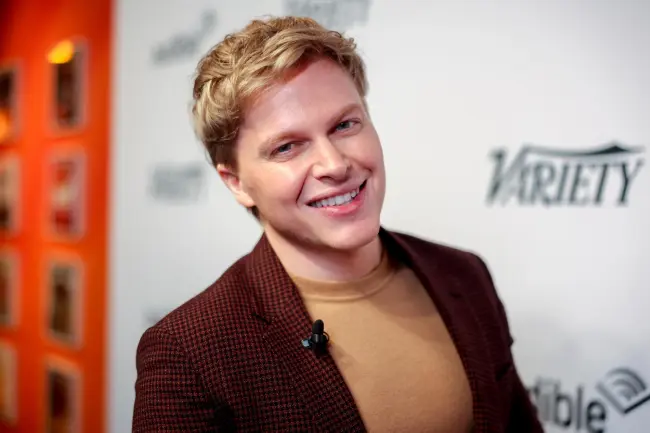
IndieWire’s “Screen Talk” podcast is headed to Tribeca Festival this June in New York City — and with Ronan Farrow as a special guest.
Co-hosts Anne Thompson and Ryan Lattanzio will moderate an exclusive conversation with Farrow about his two upcoming HBO documentary crime series, “Not a Very Good Murderer” and “The Palladino Files.”
As of Tuesday, IndieWire also exclusively announces all the programming for Tribeca‘s 2026 Storytelling Summit, which includes the 10th annual Creators Market and the Works in Progress Showcase. This year’s Tribeca runs June 3-14 in venues throughout New York, with its hub in lower Manhattan.


The 2026 Storytelling Summit “brings together filmmakers, creators, financiers, distributors, and executives for programming designed to develop projects, build careers, and shape the future of storytelling across film, television, audio, and emerging media,” per the festival. Full details are below. Passes are now available on Tribeca’s website.
The “Screen Talk” conversation will take place on Tuesday, June 9. We will sit down with Pulitzer Prize-winning journalist Farrow to not only talk about his upcoming series, but also his creative process and investigative approach. IndieWire’s “Screen Talk” podcast airs weekly on Fridays, covering the latest goings-on in Hollywood and with regular special guest interviewees including Judd Apatow, John Early, Jeremy O. Harris, Kate Winslet, Christopher Abbott, Rian Johnson, Tom Quinn, and more.
“At its core, the Storytelling Summit is about expanding access and creating a space where creators at every stage can connect directly with industry leaders, gain practical insight, and build relationships that truly move careers forward,” said Shayna Weingast, Tribeca festival programmer. “This year’s program brings together an incredible range of voices — from visionary filmmakers and showrunners to innovators across distribution, AI, and emerging platforms — offering an inside look at how storytelling is evolving in real time.”
The below language on Tribeca’s Storytelling Summit lineup comes courtesy of the festival.
The Summit’s Luminaries series features leading voices including Rebecca Miller and Josh Safdie, Zach Woods, Zach Braff, Myha’la, Lily Rabe and Hamish Linklater, Philip Barantini, Ron Perlman and Willie Morris, Dan Houser, Michael Sarnoski, and Ted Hope, offering firsthand perspective on navigating careers across independent and studio systems, evolving between mediums, and sustaining creative authorship.
The Summit’s Creativity Unbound track centers on the art and craft of storytelling, with in-depth sessions on casting, writing for late night, the architecture of suspense, and comedy. Featured participants include Award–winning casting directors Ellen Lewis and Ellen Chenoweth, alongside longtime “Late Night with Seth Meyers” writers Amber Ruffin, Alex Baze, and Sal Gentile. The track also brings together comedy writers and showrunners Dan Goor and Tracey Wigfield — the creative forces behind “Brooklyn Nine-Nine” and “30 Rock” — to unpack the decisions that shape performance, tone, and voice. Rounding out the program are “K-Pop Demon Hunters” co-writers Danya Jimenez and Hannah McMechan.
The Inside the Industry track tackles the mechanics of the business — from financing and distribution to exhibition, public media, and short-form storytelling — with speakers including Tim League (Founder, Alamo Drafthouse; Founder and CEO, Metro Cinema), Tabitha Jackson (Director, Film Forum), John Vanco (Head of Theatrical Programming, Netflix), Adam Goldman (Founder & Executive Director, The Necessary Foundation), Bill Guentzler (Co-Founder & Co-CEO, Obscured Releasing), Rob Williams (President, Sumerian Pictures), Munir Atalla (Head of Production & Acquisitions, Watermelon Pictures), Paul Moakley (Executive Producer, The New Yorker), Katya Ochagavia (Executive Producer, The Guardian), Alexandra Garcia (Executive Producer, The New York Times Op-Docs), John Gibson (VP, Public Affairs & Industry Relations, Motion Picture Association), Commissioner Rafael Espinal (Commissioner, NYC Mayor’s Office of Media and Entertainment), and an AMPAS-led panel on the Academy’s artist development programs. Together, these sessions provide a clear-eyed view of how projects move from idea to audience.
Looking ahead, the Summit’s Next Wave track explores the expanding landscape of storytelling across emerging platforms and technologies, with sessions focused on AI, content creation, and immersive media. Participants include Bryn Mooser (Co-Founder & CEO, Asteria Film Co.) and Cristóbal Valenzuela (Founder & CEO, Runway), offering insight into how new tools and formats are reshaping how stories are created, distributed, and experienced. Additional participants include Kareem Rahma (Creator, “Subway Takes,” “Keep the Meter Running”; Co-Writer & Actor, “Or Something”), Max Reisinger (CEO & Co-Founder, Creator Camp), Joana Vicente (Co-Founder & CEO, Open Cities), and Jason Kliot (Co-Founder & President, Open Cities).
A lineup of Special Events further expands access to the industry conversation, including live podcast recordings of IndieWire’s “Screen Talk” with Anne Thompson and Ryan Lattanzio featuring a special live-from-Tribeca episode with guest Ronan Farrow, who will be screening works at the 2026 Festival, as well as Entertainment Weekly’s “The Awardist” with Gerrad Hall. The Summit is also hosting a special screening of “The Hanging of Stuart Cornfeld” followed by a conversation with legendary producers Joan Bofill (Director & Producer, “The Hanging of Stuart Cornfeld”), Jack Lechner, Myette Louie, Mark Johnson, and Frida Torresblanco.
Beyond conversation, Tribeca’s industry programming is built to actively advance projects and create tangible opportunities for creators. The Tribeca Creators Market, now in its 10th year, is an invitation-only marketplace connecting selected filmmakers with leading studios, financiers, and production companies. This year’s Market features 39 projects across narrative, documentary, episodic, and audio, reflecting a cross-platform approach to storytelling and development.
Projects span short-to-feature expansions, audio adaptations, indie television, and work from Tribeca’s NOW program, highlighting how stories evolve across formats and platforms. Participants represent a mix of emerging voices and established creators, including Tribeca alumni returning with new work.
“We started the Creators Market back in 2016 in an effort to recognize and support online creators, and over the past 10 years, it has been an honor to welcome storytellers across disciplines and watch the program evolve into a true launching pad for feature films, episodic series, and audio storytelling,” said Tribeca Festival Senior Programmer Liza Domnitz.
The Market opens with the Works in Progress Showcase, spotlighting films in late-stage production and post-production — providing a critical moment for visibility, feedback, and momentum. Participants then engage in curated one-on-one meetings with industry leaders including Sony Pictures Classics, HBO, Cinetic Media, National Geographic, Slow Pony, and more — facilitating direct pathways to financing, completion, and distribution.
Tribeca’s investment in projects at this stage has led to meaningful, measurable impact. Recent Works in Progress alumni include: 2024 participant “Esta Isla (This Island),” which went on to win the Best New Narrative Director Award at the 2025 Tribeca Festival and the John Cassavetes Award at the 2025 Film Independent Spirit Awards; “Are We Good?,” the 2025 Marc Maron feature documentary; and “The Price of Milk,” a docuseries released in 2025. Other esteemed alumni include 2022 Works in Progress participants “The Gullspång Miracle,” winner of Best Documentary Editing at the 2023 Tribeca Festival; and “Off Fairfax,” a 2022 Tribeca Indie TV selection, now in development at Amazon MGM Studios.
This year’s Works in Progress participants continue that trajectory, with filmmakers including Pacho Velez (“The Reagan Show,” “Searchers”); Shaina Feinberg (co-author of The New York Times column SCRATCH); Sofian Khan (Emmy®-nominated “The Interpreters”); and CJ Hunt (“The Neutral Ground,” former “The Daily Show” correspondent). Additional participants include international filmmakers garnering attention and recognition for their latest projects, such as Toronto-based filmmaker Serville Poblete, Scottish-Algerian documentarian Carina NicHaouchine, and Brazilian filmmaking team Juliana Antunes and Camila Matos.
“As the industry continues to evolve, Tribeca remains focused on supporting storytellers not just at the moment of their films’ festival launch, but throughout the lifespan of their projects,” said Jose F. Rodriguez, Senior Film Programmer. “Our Works in Progress section reflects a dynamic global community of artists that are crafting bold and form-pushing works – and are resiliently undertaking new ways to develop, finance, and share their works with audiences.”
Celebrating its 10th anniversary, the Tribeca Creators Market has supported more than 250 storytellers since its launch in 2016, with alumni going on to premiere films, launch series, and secure major development deals across the industry. Alumni include Britt Lower (2020), Joe Penna (2016), Zackary Canepari (2018), Alex Goyette (2019), Steve Zahn and Rick Gomez (2021), Caleb Hearon (2020), Tallie Medel (2024), Rel Battle (2022), Alessandra Lacorazza and Daniel Tantalean (2021), Jenn Harris and Matthew Wilkes (2017), illustrating the breadth of talent and the program’s continued impact across film, television, and digital media. This year’s cohort reflects that ongoing commitment, bringing together returning alumni and first-time participants in a program designed not just to discover talent, but to sustain creative careers over time.
Together, the Storytelling Summit, Creators Market, and Works in Progress Showcase position the Tribeca Festival as more than an exhibition platform. They reinforce its role as a convening space, development engine, and launchpad for the next generation of storytelling, where ideas are refined, partnerships are formed, and projects move from concept to audience.
The full 2026 Tribeca Festival Storytelling Summit and Creators Market lineups, as well as the 2026 Works In Progress cohort, are detailed below.
To learn more about the Tribeca Festival programming team, visit TribecaFilm.com.For updates, follow @Tribeca and #Tribeca2026 on Instagram, X, Facebook, LinkedIn, and YouTube. Festival passes and ticket packages are now available at TribecaFilm.com.
ABOUT THE TRIBECA FESTIVAL
The Tribeca Festival, presented by OKX, brings artists and audiences together to celebrate storytelling in all its forms, including film, TV, music, podcasts, games, and immersive. With strong roots in independent film, Tribeca is synonymous with creative expression and entertainment. Tribeca champions emerging and established voices, discovers award-winning talent, curates innovative experiences, and introduces new ideas through exclusive premieres, exhibitions, conversations, and live performances. The Festival was founded by Robert De Niro, Jane Rosenthal, and Craig Hatkoff in 2001 to spur the economic and cultural revitalization of lower Manhattan following the attacks on the World Trade Center. The annual Tribeca Festival will celebrate its 25th year from June 3–14, 2026 in New York City. In 2019, James Murdoch’s Lupa Systems bought a majority stake in Tribeca Enterprises, bringing together Rosenthal, De Niro, and Murdoch to grow the enterprise.
2026 TRIBECA FESTIVAL PARTNERS
The 2026 Tribeca Festival is presented by OKX and with the support of our partners: 8am, 10 Lives Studios, AT&T, Bulleit Frontier Whiskey, CHANEL, City National Bank, DIRECTV, Don Julio Tequila, KLM Royal Dutch Airlines, NBC4 and Telemundo 47, NYC Mayor’s Office of Media and Entertainment, National CineMedia, Spring Studios New York, The Wall Street Journal, Variety, and Vulture.
PRESS CONTACTS
Tribeca Storytelling Summit + Creators Market: Jami O’Leary | joleary@tribecafilm.com
PMK: tribeca2026@pmkentertainment.com
2026 STORYTELLING SUMMIT PROGRAMMING
LUMINARIES
Luminaries: Lily Rabe & Hamish Linklater – Thursday, June 4
Creative partnerships are rarely linear, and for Lily Rabe and Hamish Linklater, collaboration has been as much about instinct and serendipity as intention. In this conversation, they reflect on the evolution of their work together—from being repeatedly cast opposite one another to actively creating projects built around their shared sensibility—offering insight into a process that is at once deeply collaborative and distinctly individual.
Luminaries: Myha’la – Friday, June 5
From her breakout role as Harper Stern in HBO/BBC’s Industry to a dynamic run across film and television, Myha’la has quickly emerged as one of the most compelling actors of her generation. In this conversation, she reflects on her rapid rise, navigating complex, high-intensity roles, and building a career across projects like Leave the World Behind, Bodies Bodies Bodies, Dead Man’s Wire and They Will Kill You. With Industry heading into its final season, Myha’la offers insight into the choices and creative instincts shaping her next chapter.
Luminaries: Zach Woods – Saturday, June 6
From Silicon Valley and The Office to his recent turn in A24’s How to Make a Killing, Zach Woods has built a career defined by sharp intelligence, emotional nuance, and a singular comedic voice. In this wide-ranging conversation, Woods reflects on his evolution across acting, writing, and producing, culminating in his feature directorial debut, The Accompanist—having its world premiere at this year’s Tribeca Festival—marking an exciting new chapter in his creative journey.
Luminaries: Rebecca Miller in Conversation with Josh Safdie – Saturday, June 6
Rebecca Miller—acclaimed filmmaker, author, and one of cinema’s most distinct voices—joins Josh Safdie (Marty Supreme) for a high-energy conversation on craft and process. From The Ballad of Jack and Rose to She Came to Me, and recent acclaimed Apple TV+ docuseries Mr. Scorsese, Miller reflects on a body of work shaped by emotional precision and a deep connection to character. In dialogue with Safdie, she’ll unpack how stories are built from instinct, how tone and tension are calibrated, and how Martin Scorsese’s influence—central to Miller’s portrait and deeply felt in Safdie’s own filmmaking—continues to shape their work.
Luminaries: Philip Barantini – Sunday, June 7
From his early career as an actor to his emergence as a BAFTA-nominated director, Philip Barantini has quickly established himself as one of the most dynamic voices in contemporary British filmmaking. Known for his distinctive use of the “oner”—a long, uninterrupted single-shot take that creates immersive, real-time intensity—he reflects on projects including Boiling Point, Malpractice, and his Emmy Award–winning work on Adolescence. In this conversation, Barantini will discuss his evolution behind the camera and how his signature style shapes performance, tension, and storytelling.
Luminaries: Zach Braff – Wednesday, June 10
From his breakout role on Scrubs to writing, directing, and starring in the beloved indie classic Garden State, Zach Braff has built a career that seamlessly bridges comedy, drama, and deeply personal storytelling. In this candid conversation, Braff reflects on his creative evolution across acting, writing, producing, and directing, alongside his latest project, Clean Hands—having its world premiere at this year’s Tribeca Festival—offering insight into his enduring connection to character-driven, emotionally resonant work.
Luminaries: Michael Sarnoski – Thursday, June 11
From his acclaimed breakout debut Pig to the studio scale of A Quiet Place: Day One, Michael Sarnoski has quickly established himself as a distinctive voice, blending intimate character work with expansive, high-stakes storytelling. In this conversation, he reflects on his evolution as a writer-director and the challenge of maintaining a singular creative vision across projects of vastly different scope. Looking ahead, he’ll also discuss his upcoming projects with A24: The Death of Robin Hood, a dark reimagining of the classic tale starring Hugh Jackman, and Death Stranding, the live-action adaptation of Hideo Kojima’s genre-defying video game.
Luminaries: Ted Hope – Friday, June 12
In this conversation, long-time producer Ted Hope unpacks his NonDē movement—a reimagining of independent filmmaking that challenges traditional industry models and prioritizes sustainability, creative freedom, and direct connection with audiences. Moving beyond the constraints of legacy systems, NonDē advocates for new pathways in financing, production, and distribution that empower filmmakers to retain ownership and build lasting careers. This discussion explores how the future of independent storytelling might be rebuilt from the ground up.
Luminaries: Dan Houser’s Absurd Ventures – Saturday, June 13
Dan Houser, co-founder of Rockstar Games and the creative force behind Grand Theft Auto and Red Dead Redemption, now leads the storytelling-driven company Absurd Ventures. Since its launch, Absurd has expanded across mediums with projects including the chart-topping audio series A Better Paradise, the bestselling comic American Caper, and new animation and video game worlds in development. In this conversation, Dan Houser and his longtime writing partner Lazlow explore their approach to worldbuilding and the evolution of storytelling beyond video games alongside several of Absurd’s key partners from Dark Horse and more.
INSIDE THE INDUSTRY
Taste Is the Strategy: How Bold Films Get Chosen, Shaped, and Made – Thursday, June 9
In a crowded marketplace, taste isn’t subjective, it’s a strategy. This conversation explores how leading film companies define their creative identity and translate it into the projects they develop and champion. Panelists will discuss what they look for in material and filmmakers, how they nurture projects from early development through production, and how a clear point of view can shape both the film itself and its path to audiences.
Featuring: Tyler DiNapolis (President, Bleecker Street), Lilly Riber (Chief Marketing Officer, MUBI)
Moderated by: Gabe Miller (Editor-and-Chief, The Industry)
How Media Companies Are Shaping Short-Form Storytelling – Thursday, June 4
As audiences increasingly turn to short-form content, leading media organizations are redefining how short films are developed, commissioned, and brought to audiences. This conversation explores how editorial vision, platform strategy, and creative risk-taking shape films that both stand on their own and extend the journalistic and cultural work of their institutions—sparking conversation, influencing discourse, and reaching global audiences.
Featuring: Katya Ochagavia (Executive Producer, The Guardian), Paul Moakley (Executive Producer, The New Yorker), Alexandra Garcia (Executive Producer, The New York Times Op-Docs)
Next Gen: Inside the Development Programs of the Academy of Motion Picture Arts and Sciences – Thursday, June 4
The Academy of Motion Picture Arts and Sciences is dedicated to inspiring young artists and creating opportunities for many communities to engage with the film world. Please join senior leaders from the Academy for a closed information session highlighting the organization’s global talent development programs—Gold Rising, the Nicholl Fellowships in Screenwriting, the Student Academy Awards, the Gold Fellowship for Women, and more. Presented by The Academy of Motion Pictures Arts and Sciences.
From Spark to Structure: Developing Nonfiction That Breaks Through – Friday, June 5
What does it take to get a documentary off the ground, and why do certain ideas ultimately break through? This conversation brings together filmmakers to explore the earliest stages of nonfiction storytelling — from the initial spark through the false starts, pivots, and long evolution that shape a project before it reaches an audience. Featuring Catapult Research Fellowship filmmakers alongside key collaborators, we’ll look at how ideas take hold, what sustains them over time, and how early creative, strategic, and financial support helps move projects deeper into development and financing. Presented by Catapult Film Fund.
Featuring: Tracey Jarrett (Director, Retrieval), Reid Davenport (Director, Life After), Jessica Harrop (Executive Director, Sandbox Films)
Moderated by: Megan Gelstein (Co-Director & Chief Program Officer, Catapult Film Fund)
From Grant to Greenlight: Financing Independent Film Today – Friday, June 5
Independent film financing is evolving rapidly and financing an independent film today means building a smart, flexible mix of grants, private equity, tax incentives, pre-sales, and beyond. This conversation offers a clear-eyed look at the opportunities, challenges, and creative thinking shaping indie film finance right now
Featuring: Adam Goldman (Founder & Executive Director, The Necessary Foundation), Sarah Flores (Co-Founder & Director of Programming, Anarchist United Studios and Foundation), Jon-Sesrie Goff (JustFilms, The Ford Foundation)
Moderated by: Bryce Norbitz (VP, Tribeca Studios & Artist Development)
Fostering the Next Generation of Creative Storytellers – Monday, June 8
How do we create meaningful pathways for the next wave of filmmakers to break through? This conversation brings together leaders across education, exhibition, and community-building to explore how mentorship, access, and alternative platforms are shaping emerging voices. From grassroots programs to global networks, panelists will share how they’re opening doors—and what it takes to sustain a more inclusive, future-facing creative ecosystem.
Featuring: Ché Chisholm (CEO, Ghetto Film School), Omarr Salgado (Chief Branding Officer, The Black Streaming Network), Patrice Francois (Co-Founder & CEO, Imagine This Women’s Int Film Festival), Lamonia Brown (Director, Essence Film Festival), Gabriel Alexis (Founder & CEO, Learn Filmmaking Network)
Moderated by: John Gibson (VP, Public Affairs & Industry Relations, Motion Picture Association)
Rethinking Distribution: New Pathways to Audiences – Monday, June 8
As traditional distribution models continue to shift, a new wave of platforms and companies is empowering filmmakers to take control of how their work reaches audiences. This conversation explores innovative, filmmaker-first approaches—from direct-to-audience releases to education-driven platforms—that are redefining ownership, access, and engagement. In a rapidly evolving landscape, panelists will discuss how these models are creating new pathways for independent films to be seen, shared, and sustained.
Featuring: Porschia Adler (Co-Founder, Tasting Menu) Marielle Huey (Consultant, Pijama), Teddy Kunhardt (Executive Director, Kunhardt Film Foundation & Life Stories), Matthew Henderson (Program Director & Producer, Kunhardt Film Foundation)
Made in NY: Filming in New York City – Monday, June 8
Presented by the NYC Mayor’s Office of Media and Entertainment, this conversation offers a behind-the-scenes look at what it really takes to shoot in New York City. From navigating logistics and locations to capturing the city’s ever-evolving energy, the discussion dives into the practical realities and creative opportunities of working on the ground in NYC. Whether you’re a filmmaker or a fan, a diverse selection of NYC’s creative voices offer an inside look at how stories come to life on the iconic and bustling city streets. Introduction by Commissioner Rafael Espinal, NYC Mayor’s Office of Media and Entertainment.
Featuring: Tony Yang (Producer, Rosemead, Bunnylovr), Celine Rattray (Producer, Happy Hours), Dena Ghieth (NYC Locations Manager, Survival of the Thickest, Superfakes) Aaron Hurvitz (Location Manager, West Side Story, The Irishman, Joker & Joker: Folie a Deux)
Moderated by: Teddy Au (UPM/Production Supervisor, And Just Like That…, The Chair Company)
Pitching: Winning over the Room – Wednesday, June 10
You’ve got a strong project and a solid logline—but when it’s time to pitch it out loud, does it actually land? This interactive workshop is designed to turn a flat pitch into one that feels confident, clear, and compelling, breaking down how to communicate story, character, stakes, and tone in the room. Participants will have the opportunity to share short elevator pitches and receive real-time feedback, leaving with practical tools to sharpen their delivery and make their story stick.
Featuring: Shayna Weber (Creative Executive, International Screenwriters’ Association), Felicity Wren (VP of Development, International Screenwriters’ Association)
The Next Wave of Independent Film Distributors – Thursday, June 11
As the traditional distribution landscape tightens, a new generation of indie distributors is emerging to fill the gap—bringing fresh strategies, bold curatorial voices, and alternative pathways to audiences. This conversation explores how these companies are navigating a crowded, evolving marketplace by blending financing, production, and distribution while championing films that might otherwise be overlooked. In a moment of disruption and opportunity, we’ll examine how this new wave is reshaping the ecosystem and redefining what it means to bring independent film to market.
Featuring: Bill Guentzler (Co-Founder & Co-CEO, Obscured Releasing), Rob Williams (President, Sumerian Pictures), Munir Atalla (Head ofProduction & Acquisitions, Watermelon Pictures)
The Art of Exhibition: The Future of Art House Cinemas – Thursday, June 11
As the theatrical landscape continues to evolve, art house cinemas remain vital spaces for discovery, community, and cultural exchange. This conversation explores how independent theaters are adapting—through innovative programming, audience engagement, and new business models—to meet the moment. From preserving the magic of the big screen to reimagining what exhibition can be, this conversation will explore what it means to steward these spaces for the next generation of audiences and filmmakers.
Featuring: Tim League (Founder, Alamo Drafthouse; Founder and CEO, Metro Cinema), Beth Gilligan (Executive Director & CEO, Coolidge Corner Theatre), Tabitha Jackson (Director, Film Forum), John Vanco (Head of Theatrical Programming, Netflix)
Moderated by: Allason Leitz (Founding Director, Art House New York)
Micro Content, Mega Impact – Saturday, June 13
An interactive panel discussion and case study on innovative models and partnerships for short film distribution using Level Forward impact campaigns and shorts distribution as case study – including Nazrin Choudhury’s Oscar-nominated Red, White & Blue, the community ownership model of We Ride for Her, and the formation of the forthcoming campaign for the Mother Justice series in partnership with Population Media Center. Presented by Level Forward.
Featuring: Dr. Regina Davis Moss (President & CEO, In Our Own Voice: National Black Women’s Reproductive Justice Agenda), Praise Odigie Paige (Director, Birdie & Vice President of Creative Studio, Sundial), Prairie Rose Seminole (Culture Bearer & Director, We Ride for Her)
NEXT WAVE
AI and the Future of Filmmaking – Friday, June 5
AI is rapidly transforming the filmmaking process, unlocking powerful new creative possibilities for storytellers. This conversation dives into how artist-driven, ethically trained models and cutting-edge tools are streamlining workflows—from concept to post—while enabling filmmakers to visualize and scale their ideas with unprecedented speed and control. As these technologies evolve, we’ll explore not just what they make possible, but how they’re reshaping the language of storytelling.
Featuring: Bryn Mooser (Co-Founder & CEO, Asteria Film Co.), Cristobal Valenzuela (Co-Founder & CEO, Runway), Simon Horsman (Co-Founder & CEO, Quilty)
Moderated by: Luke Arrigoni (Founder & CEO, Loti AI)
Open Cities: Building the Future of Independent Filmmaking – Sunday, June 7
As the independent film landscape continues to evolve, new models are emerging to support creators navigating an increasingly complex ecosystem. This conversation explores Open Cities, a new production company and accelerator designed to empower filmmakers through a combination of financing, mentorship, and ethically driven technology. From development to distribution, the discussion will unpack how global, artist-focused initiatives like this aim to reshape pathways for independent storytelling and expand what’s possible for the next generation of filmmakers.
Featuring: Joana Vicente (Co-Founder & CEO, Open Cities), Jason Kliot (Co-Founder & President, Open Cities)
Moderated by: Liz Nord (Head of Programs and Creative Development, NYU Production Lab)
From Feed to Feature: Creators Breaking into Filmmaking – Wednesday, June 10
A new generation of storytellers is making the leap from digital platforms to the big screen. This conversation explores how content creators are translating their voice, audience, and creative instincts into feature filmmaking—navigating scale, financing, and the shift from short-form to long-form storytelling.
Featuring: Max Reisinger (CEO and Co-Founder, Creator Camp), Luke Maxwell (Manager, 3Arts), Kareem Rahma (Creator, Subway Takes, Keep the Meter Running; Co-Writer & Actor, Or Something)
Pitching: Winning Over the Room – Wednesday, June 10
You’ve got a strong project and a solid logline—but when it’s time to pitch it out loud, does it actually land? This interactive workshop is designed to turn a flat pitch into one that feels confident, clear, and compelling, breaking down how to communicate story, character, stakes, and tone in the room. Participants will have the opportunity to share short elevator pitches and receive real-time feedback, leaving with practical tools to sharpen their delivery and make their story stick. Co-Hosted by the International Screenwriters’ Association
Featuring: Shayna Weber (Creative Executive, International Screenwriters’ Association) and Felicity Wren (VP of Development, International Screenwriters’ Association)
CREATIVITY UNBOUND
Inside the Late Night With Seth Meyers Writers’ Room – Friday, June 5
From monologues to “A Closer Look,” late-night writers are on the front lines of turning the day’s chaos into sharp, immediate storytelling. This conversation goes inside the writers’ room at Late Night with Seth Meyers—how ideas are generated, refined, and delivered at breakneck speed, and how humor, voice, and point of view shape what makes it to air. Along the way, they’ll unpack the craft of political comedy and what it means to write for an audience in real time.
Featuring: Amber Ruffin (Writer, Late Night With Seth Meyers), Alex Baze (head writer, Late Night With Seth Meyers), Sal Gentile (“Closer Look” Supervising Producer & Writer, Late Night With Seth Meyers)
Who Gets the Camera? New Voices in Documentary from Inside Institutions – Saturday, June 6
This conversation explores a growing shift in nonfiction storytelling as incarcerated filmmakers and creators within historically closed systems reclaim authorship over their own narratives. As access to tools, training, and platforms expands—through initiatives like prison-based film festivals and public media partnerships—stories about prisons, disability institutions, and other systems are moving from outsider observation to insider perspective. This panel examines how these voices are reshaping both the craft and power dynamics of documentary filmmaking. Presented by American Documentary Inc.
Featuring: Erika Dilday (Executive Director, American Documentary Inc; Executive Producer, POV & America ReFramed), Rahsaan “New York” Thomas (Executive Director of Empowerment Ave, Co-founder, San Quentin Film Festival; and formerly incarcerated filmmaker), Nathan Stenberg (Director, The Haunting of Pennhurst), Daniel Forkkio (CEO, Represent Justice), Megan Gelstein (Co-Director & Chief Program Officer, Catapult Film Fund)
The Art of Casting – Saturday, June 6
Casting is often the most intuitive—and least visible—force behind great storytelling, shaping performances and defining a project’s voice long before cameras roll. In this conversation, legendary casting directors pull back the curtain on their process, from discovering new talent to building unforgettable ensembles and forging creative partnerships with directors. Through stories from their careers, they’ll explore the instinct, taste, and deep collaboration that go into casting, and why the right actor can transform not just a role, but an entire film.
Featuring: Ellen Lewis, CSA (Goodfellas, Killers of the Flower Moon), Ellen Chenoweth, CSA (No Country for Old Men, Past Lives), Douglas Aibel, CSA (The Grand Budapest Hotel, Marriage Story), Destiny Lilly, CSA (The Color Purple, Only Murders in the Building)
Moderated by: Karlee Fomalont, CSA (A Complete Unknown, You Hurt My Feelings)
From Script to Screen: K-Pop Demon Hunters & Beyond – Sunday, June 7
In this conversation, the screenwriting duo behind Netflix’s animated mega-hit K-Pop Demon Hunters reflect on their creative partnership and evolving careers across film and television. Together, they’ll explore how ideas move from script to screen, collaborating across mediums, genres, and tones to build compelling stories. They’ll also discuss their upcoming slate—including projects with LuckyChap, Warner Bros., A24, and Legendary—and how they’re building a dynamic career at a remarkable place.
Featuring: Danya Jimenez & Hannah McMechan (Co-Writers, K-Pop Demon Hunters)
Moderated by: Nayeema Raza (Podcast Host, “Smart Girls, Dumb Questions”)
Adaptation Across Mediums – Sunday, June 7
Great stories rarely stay in one form. This panel explores the creative and practical process of adapting work across mediums—from books to film, film to stage, and beyond. With a focus on recent film-to-theater adaptations, the conversation will examine how creators translate narrative, tone, and audience experience while reimagining stories for entirely new formats.
Featuring: J Todd Harris (CEO & Founder, Branded Pictures) Thomas Pettinelli (VP of Development, Branded Pictures),Ken Davenport (Broadway Producer, A Beautiful Noise: The Neil Diamond Musical, upcoming: The Griswolds Broadway Vacation and Slumdog Millionaire), Alexander Slater (Manager, MediaScout, Ingram Content Group)
Running the Show: The Craft of Showrunning – Sunday, June 7
This conversation pulls back the curtain on the multifaceted role of the showrunner—where creative vision meets leadership, strategy, and execution. From shaping story in the writers’ room to navigating production, talent, and network demands, panelists share how they build worlds, lead teams, and sustain a series across seasons in an ever-evolving television landscape.
Featuring: Jason Fuchs (Co-Creator and Co-Showrunner, It: Welcome to Derry), Matt Wolpert (Co-Creator and Co-Showrunner, Star City, For All Mankind), Ben Nedivi (Co-Creator and Co-Showrunner, Star City, For All Mankind)
Reframing Reality: New Perspectives in Nonfiction Storytelling – Monday, June 8
From intimate character studies to searing portraits and rigorous investigative work, today’s filmmakers are expanding the scope and impact of nonfiction storytelling. This conversation explores how directors and producers are pushing the form forward—bringing new perspectives, rethinking authorship, and driving narrative innovation in documentary film. As the landscape evolves, this conversation will examine how these voices are reframing and reshaping the stories we tell and how they’re told.
Featuring: Liza Mandelup (Director, Jawline, The Grandmaster) Alexandria Stapleton (Director, Sean Combs: The Reckoning), Xan Parker (Producer, The New Yorker at 100, The Big Payback)
New York Loves Comedy – Monday, June 8
What does it take to create comedy that resonates—episode after episode, season after season? In celebration of NBC100, writers behind some of New York’s most iconic shows—from 30 Rock to Brooklyn Nine-Nine and beyond—this conversation goes inside the fast-paced, high-pressure world of writing comedy at the highest level. From the writers’ room to the finished episode, they’ll unpack how distinct voices are shaped, ensembles are built, and humor stays sharp, relevant, and deeply human in a city that never stops moving.
Featuring: Dan Goor (Co-Creator & Executive Producer, Brooklyn Nine-Nine), Tracey Wigfield(Co-Creator & Co-Showrunner, The Four Seasons)
Feeling Through: A New Model for Accessible Filmmaking – Wednesday, June 10
Using the Oscar-nominated short film Feeling Through as a case study, this conversation explores what it truly means to build accessibility into production from the ground up. This panel examines how the team partnered with the DeafBlind community to create an authentic and accessible production, reshaping assumptions about who gets to be seen on screen and how films get made—offering a blueprint for more inclusive, accessible storytelling.
Featuring: Doug Roland (Director, Feeling Through), Susan Ruzenski (CEO, Helen Keller Services), Christopher Woodfill (Executive Director, NY State Deaf, DeafBlind and Hard of Hearing Office)
Case Study: How to Feed a Dictator – Food, Power, and Control – Saturday, June 13
Ever wonder what it was like to serve dessert to a genocidal tyrant? The filmmaking team behind the documentary How to Feed a Dictator discuss their film, how food and power are inherently intertwined, and what parallels we can draw from the 20th century’s most notorious strongmen to the present day.
Featuring: Andrew Neel (Director & Producer, How to Feed and Dictator), Witold Szabłowski (Author, How to Feed a Dictator), Ruth Ben-Ghiat (Author and Historian), Ethan Palmer (Cinematographer, How to Feed a Dictator)
SPECIAL EVENTS
IndieWire Screen Talk Podcast – Live at Tribeca – Tuesday, June 9
Join IndieWire’s Screen Talk for a special live taping at the Storytelling Summit, hosted by Editor-at-Large Anne Thompson and Executive Editor Ryan Lattanzio. In this insightful conversation, they’ll sit down with Pulitzer Prize–winning journalist Ronan Farrow to discuss his two upcoming HBO documentary crime series with sneak peeks at this year’s Tribeca Festival—Not a Very Good Murderer and The Palladino Files. Together, they’ll explore his creative process, investigative approach, and how he translates complex, real-world stories into compelling screen narratives.
Hosted By: Anne Thompson (Editor-at-Large, IndieWire), Ryan (Executive Editor, IndieWire)
Featuring: Ronan Farrow (Not A Very Good Murder, The Palladino Files)
The Art of Producing Featuring The Hanging of Stuart Cornfeld – Friday, June 12
This special event features a screening of the feature documentary The Hanging of Stuart Cornfeld, an intimate portrait of the legendary producer that traces his life and career through candid conversations and artistic reflection. Following the screening, the program will continue with an extended conversation featuring the producer and director of the documentary alongside a group of acclaimed producers, using the film as a springboard to explore the invaluable—and often misunderstood—role of producing: what it takes to be a successful producer, how to build lasting creative partnerships, and the craft of bringing ambitious stories to life.
Featuring: Joan Bofill (Director & Producer, The Hanging of Stuart Cornfeld), Frida Torresblanco (Producer, Pan’s Labyrinth, Disobedience), Mark Johnson (Producer, Rain Man, The Holdovers), Mynette Louie (Producer, Rosemead, Swallowed), Jack Lechner (Producer, Blue Valentine, The Fog of War)
Entertainment Weekly’s The Awardist Podcast – Live at Tribeca – Friday, June 12
Join Entertainment Weekly’s The Awardist podcast for a special live taping at the Storytelling Summit, hosted by EW’s Editorial Director Gerrad Hall and Tribeca’s Festival Director and SVP of Programming, Cara Cusumano. In this dynamic, in-depth conversation, they’ll sit down with a special guest for a candid interview on craft, career, and the creative process behind their work.
Hosted By: Gerrad Hall (Editorial Director, Entertainment Weekly), Cara Cusumano (Festival Director, SVP of Programming, Tribeca Festival)
2026 TRIBECA CREATORS MARKET PARTICIPANTS
FEATURE NARRATIVE FILMMAKERS
NARRATIVE SERIES CREATORS
DOCUMENTARY FEATURE FILMMAKERS
DOCUMENTARY SERIES CREATORS
AUDIO STORYTELLERS
CREATORS MARKET KEY
>
>
The battle lines are drawn early and definitively in Jocelyn Bioh‘s School Girls; Or, The African Mean Girls Play. The cruelties come fast and cut deep in this Ghana school lunch room where all the unspoken rules of adolescent pick-or-be-picked-upon are as strict as they are in high schools the world over. Or in other plays and TV shows the world over, whether we’re talking Heathers or Carrie or Jawbreaker. And since Stephen King didn’t write this one, we can be pretty sure there won’t blood, but gruesome playground injuries of a more psychic and soul-crushing variety are entirely on the table.
Bioh, perfectly assisted by her sympatico director Whitney White and a no-weak-link cast, has done something quite amazing with this comedy-drama, opening tonight on Broadway at the Samuel J. Friedman Theatre in a first-rate Manhattan Theatre Club production. Bioh takes on the tropes and dramatic conventions of high school claustrophobia, its rebellions and savageries and tendernesses so familiar from ancestors like the franchise that gives this play its subtitle and right up through the newcomer that called John Proctor a villain, that we can only trust a writer of her depth and skills (she wrote Jaja’s African Hair Braiding, after all) to find a new path through the well-trod turf.
And she does. School Girls; Or, The African Mean Girls Play, might well come closest in approach to Kimberly Belflower’s urgent John Proctor Is The Villain in its insistence that homeroom sadism doesn’t just spring from hormones or reindeer game competition. There are larger forces at work, the stuff that hurts people who hurt people, and portraying that hurt (and its goal, escape) with understanding – not to say excuse-making – takes uncommon talent. Belflower showed it, and so does Bioh.
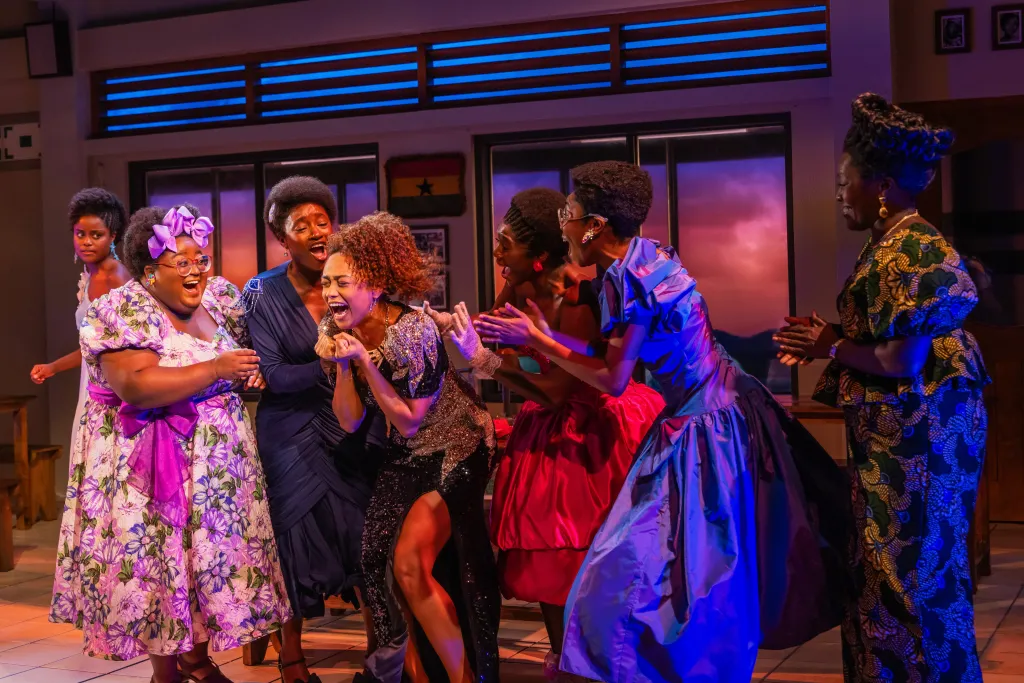
The set up is simple and immediately recognizable. The year is 1986 and the place is a girls boarding school in the Aburi Mountains of Central Ghana. Five of the students – two in their final year, three a year behind – busy themselves with the gossip and whatever else passes for crucial business in the day-to-day, mostly as defined by Paulina (The Gilded Age‘s Denée Benton), the self-anointed queen of the clique by way of her looks, her force of will, her cruel streak and her much admired (if very tenuous) connection to the longed-for America by way of an aunt who lives in New York City and works in a castle there that serves unimaginable culinary delights and who sends Pauline the odd piece of designer clothing that makes her the envy of the school.
We’ll learn that Paulina, far from confident, is so self-conscious of the darkness of her Black skin that she secretly uses toxic bleach products that necessitate frequent trips to the emergency room, that her home life is so impoverished that she unleashes her frustrations on her terrified acolytes. Poor Nana (Erin Morton) gets the worst of the abuse, her large body and constant eating a source of unending bullying from Paulina, who calls her “cow.” Even Paulina’s best friend – a phrase pretty much useless in this milieu – isn’t safe. Ama (Lucia Aremu) pays dearly for the occasional hint of independence, so threatening is free thinking to Paulina.
In the grand tradition of teen movies, the equilibrium of the status quo is disrupted with the arrival of a new student. And Ericka (Jasmine Amy Rogers, all done up in big ’80s hair and a school girl uniform that leaves her unrecognizable from her flapper look in Boop) is not just any new student. She’s lived in America. She has Bobby Brown’s autograph. She has real Calvin Klein fashions, not the Chinatown knock-offs that have fooled Paulina. And she knows White Castle isn’t a white castle – it isn’t even McDonald’s.
Denée Benton and Jasmine Amy Rogers
Matthew Murphy
And she has two other things going for her. She’s kind – the put-upon girls of the Aburi Girls Boarding School take to her like docile puppies to a calming stroke – and she’s naturally light-skinned. No harsh chemicals for her, much to the amazement and envy of her Ghanaian classmates. If the mixed-race Ericka doesn’t quite grasp the significance of her coloring – back home at her all-white school she was, to be sure, Black – the other girls certainly do.
And among the things all the girls seem to sense is that Paulina is no longer the shoo-in for the upcoming Miss Ghana try-outs, a realization driven home when the pageant’s recruiter – a former Aburi student who, 20 years previous, won Miss Ghana 1966 and who retains her own mean girl leanings, especially when in the company of the school’s Headmistress, a classmate from those long ago years. One of Bioh’s most telling bits of stage magic here is showing us just how long-lasting such formative role-playing can be. If the device can seem more than a little schematic in intention, its execution – a few lines of dialogue between the recruiter Eloise (Patina Miller) and the Headmistress (Heather Alicia Simms) – nonetheless conveys both the tenacity and bite of mean girldom. And did I mention School Girls is a comedy? And a very funny one at that?
Patina Miller and Heather Alicia Simms
Matthew Murphy
As School Girls builds to its denouement – that pageant try-out – rest assured that Bioh and director White will not deprive us of bearing witness, and the young actors who play the school girls, some in their Broadway debuts, meet the challenge and then some. As they take turns soloing Whitney Houston’s “The Greatest Love of All” – an inspired choice not only for the technical demands that few of these hopefuls could meet, but for Houston’s haunted ending that they couldn’t possible know – the cast members imbue each character with comic ineptitude that’s as poignant as it is laugh-out-loud funny. Even the cruel Paulina’s misplaced overconfidence and comeuppance merits our charity.
Because comeuppance she gets. When the new girl Ericka takes her turn at the solo, her glorious voice rivals that of Whitney herself (as she proved in the otherwise lackluster Boop, Rogers is a talent to watch and embrace). As the greedy recruiter sees something to exploit, and the proud headmistress hears something finally worthy of pride, and the downtrodden classmates have their ding dong the witch is dead moment, poor Paulina all but crumbles into herself (Benton is a marvel in this scene).
But bullies don’t often go away easy. Her face bleeding from the corrosive bleach, her dreams of escape from poverty dashed, Paulina lashes out with ill-gotten information that will take the talented, seemingly charmed Ericka down with her. In the battle that ensues, no one will go untouched by hard truth and the realization of just how stacked the odds against triumph remain in a system where everything from the shade of one’s skin, the geography of one’s home and the capricious nature of one’s parentage determine so much, and foster all sorts of bad behavior and ruthless survivalism.
The Manhattan Theatre Club has given this excellent play the production it deserves. Costume designer Qween Jean, riding high from her Tony-winning contributions to Cats: The Jellicle Ball, delivers the perfect visuals for this tale – the conformity of school uniforms, the explosion of ’80s prom styles for the pageant auditions, the proud African ethnicity of the Headmistress’ attire and the arriviste Americanism of the made-good recruiter – while Teresa L. Williams’ cleverly efficient school cafeteria set, with its large glass windows offering quick hallway peeks at characters in their privacy – gives these school girls ample room for all their towering ambitions and their outsized insecurities.
Not enough praise can be heaped upon the excellent cast (in addition to those mentioned above, there’s the terrific Nia Otchere-Sarfo and Jordan Rice rounding out the clique). Every one of the school girls is perfectly delineated (kudos to the casting team for an exactingly chosen group), with each actor finding the humor, the humanity and, when necessary, the acidity of characters doing their best in a hothouse not of their making. Or not entirely of their making, anyway. Even the most dehumanizing of systems, from high schools to pageants to poverty and racism, require some human complicity in the building and, if we’re lucky, the undoing. The School Girls; Or, The African Mean Girls Play all but hands us an instruction manual.
Title: School Girls; Or, The African Mean Girls Play
Venue: Broadway’s Samuel J. Friedman Theatre
Written By: Jocelyn Bioh
Directed By: Whitney White
Cast: Lucia Aremu, Denée Benton, Patina Miller, Erin Morton, Nia Otchere-Sarfo, Jordan Rice, Jasmine Amy Rogers, Heather Alicia Simms
Running Time: 1 hr 25 min (no intermission)
>
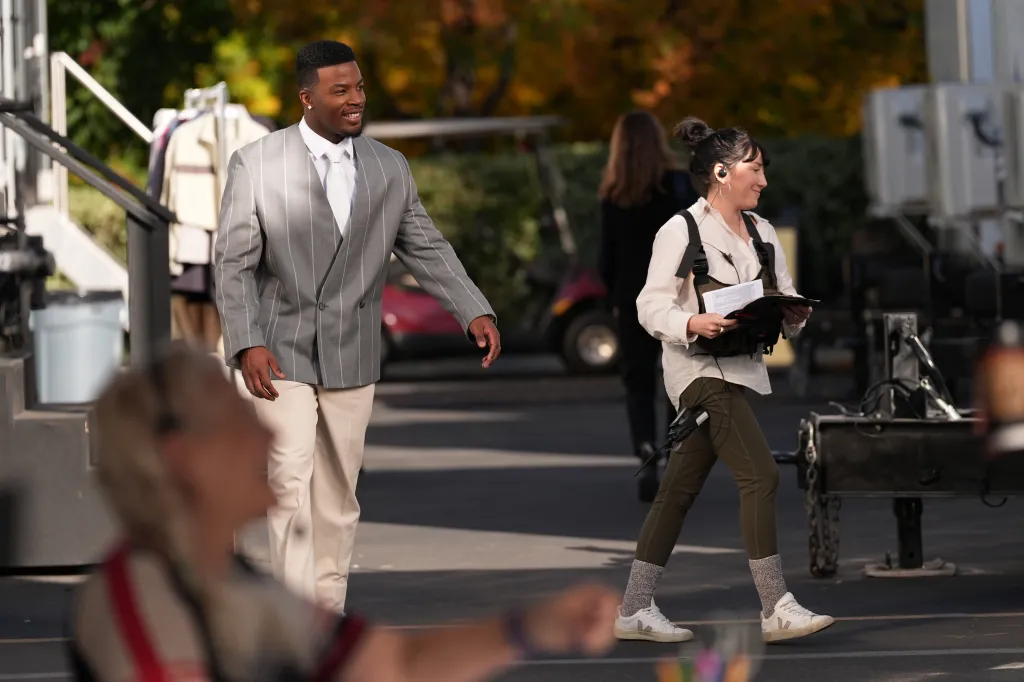
SPOILER ALERT! This post contains details from the series finale of The CW‘s All American.
That’s a wrap on All American.
The drama series, produced by Warner Bros. Television, ended its eight-season run on the CW on Monday with an emotional, moving episode directed by none other than Spencer James himself, Daniel Ezra. The rest of the Vortex had been trying to track Spencer down for the last few episodes, after Olivia (Samantha Logan) went into preterm labor with their twins. They’d thought he was tied up with a promotional photo shoot, but little did they know that Spencer was so hard to reach because he was fighting to bring his family back to Los Angeles.
He’s in a conference room urging his team’s general manager to allow his trade from New York to LA when he gets the news that his children are on the way. And, as Spencer James usually does, he finds a way. He not only makes it just in time to be there for the birth of the twins, but he also manages to persuade his team to let him go. With Jordan (Michael Evans Behling) realizing his purpose at South Crenshaw and Cassius (Osy Ikhile) sticking around Beverly, it looks like the whole family is finally back together again.
Fast forward six years, and Coop (Bre-Z) is getting sworn in as an attorney. Amina (Alexis Chikaeze) has just successfully run a political campaign to get her dad Preach (Kareem J. Grimes) elected as a local representative. Layla (Greta Onieogou) and Jordan have a daughter of their own, and the entire crew is about to go watch Spencer play in what we come to learn is his final Super Bowl before retiring — and he’ll share the field with KJ, whose made it to the NFL as well. Coming to Olivia’s aid set Khalil on a different path, and he’s now in medical school, and Tori (Lauryn Hardy) is an assistant coach for the Lakers’ dancers.
After eight years of fighting for their dreams, the series finale of All American gives the space for these characters to finally, fully realize them.
In the interview below, Ezra spoke with Deadline about directing the final episode of a series that he credits with completely changing his life and taking Spencer James with him wherever he goes next.
DEADLINE: The finale is extremely emotional. It really made me cry.
DANIEL EZRA: It was a strange experience. It was an amazing experience, but it was a strange, because I left in Season 6, and then I came back a few times. I don’t know. In my head, when I left, it was always still there. But this was the first time where we were all saying goodbye. So yeah, very emotional.
DEADLINE: I remember when you first started directing on All American, and NK really worked to find an episode that Spencer didn’t need to be in very much so you could pull it off. I know the 100th was very Spencer-heavy, but this was too. How do you feel like you grew as a director to juggle that?
EZRA: It was one of his biggest episodes, and I’m glad that this came later. The first couple episodes I directed, we were a little more successful in finding episodes that I was at least less in. NK was very realistic. She said, ‘There’s probably never going to be an episode that you’re not in, or not at least a significant part, but we can definitely find one that’s less.’ I think the first two were that. Our 100th episode wasn’t that, and we just kind of had to accept that. But this one always made sense. The way NK pitched it to me, she actually gave me a choice, and that was the only episode I felt like I wanted to do. I felt like that’s the one that felt right to do, and so I’m glad it came later. By that point, I had directed a chunk of episodes. I directed my own short film. I had had a bit more experience, and so I felt a lot more secure in myself and more confident, I think, in what I was able to do and the speed that you wish to work at, and all those things that I felt a bit more at ease with the demands of it.
DEADLINE: You spent so many years playing this character working toward a dream, and even in the Season 6 finale the dream is only just being realized. How was it to get those flash forwards at the end of the finale to actually get to live in the version of this character that had truly accomplished everything he dreamed of?
EZRA: It was weird. That scene, you’re talking about the one with me and Mike, right?
DEADLINE: That, and before that when he is talking to Nate about retiring. The twins growing up. Everything.
EZRA: I was so grateful that, even though I had stepped away, I still got a chance to come back and film those scenes. This scene with Mike — I remember in the read through, we couldn’t get through it, me and Mike couldn’t. We were just crying in the read through. We couldn’t get through it. When we got to set and to film it, we almost had to allow extra time, because we knew it was going to be tough for me and Mike. Just the way it was written, the things we were saying, and things we were talking about, it was Spencer and Jordan talking to each other and also a bit of Mike and Daniel talking to each other as well.
As an actor, I was just super grateful that we did get that moment, because we didn’t get that before I left. It was just real serendipitous of NK to write a moment like that in, because you could have ended before that. There was there was about three points in that episode where you could have ended, and it would have been great. You could have ended after he ran off into the tunnel. That was a beautiful ending. Before that, with the babies being born. There’s a couple almost false endings in the episode that all could have worked, but that one just felt like that made it perfect. I thought when I was leaving Season 6, my story was complete. I didn’t realize it wasn’t until we got to those scenes.
DEADLINE: You also had most of the original cast on screen again, plus the new cast. That scene in the hospital room, it’s pretty packed. How did you handle that?
EZRA: My job was to not think about it being a finale in any way, because once you get into that, everyone’s going to get emotional. Everyone’s going to start reminiscing. Everyone’s going to start talking and crying. As much as you want to allow for that, you can’t really allow for that during filming. Me and out AD Steve, we had to be very deliberately kind of, not mean, but a bit like ‘We don’t have time for that.’ You know what I mean?
That’s all gonna come. We knew there was gonna be a party. We knew there was gonna be a big moment of celebration at the end. We knew all of that was coming, but there’s just no space for that when you’re filming, because you still have to get these scenes. We’ve been doing this is eight years, so they know how these things work. They know we never have enough time, and so you keep moving.
DEADLINE: So, when you do think it really hit you that this was the end?
EZRA: I was the one that got to say ‘That’s a wrap on All American.’ We finished with just a perfect scene. It was actually one of the last scenes, where everyone’s going off to see Spencer play his last game, and so I wasn’t in that scene. I had already changed, and I had shot my last scene as Spencer, but I deliberately didn’t have any fanfare for my last scene. We just kind of did it and moved on, and then it was it was Mike, Sam, Osy, and Angel in the last scene, but everyone stayed. All the actors stayed. A bunch of the cast that wasn’t even working that day had showed up, and you could start to slowly feel everyone kind of gathering and waiting for it. So I knew I was like, ‘Okay, I’m gonna have to say something.’ And then it finished. I checked in with NK. I said, ‘Are you happy? I’m happy.’ And she said she was already gone. She just kind of nodded through tears. And I said to Steve, ‘So let’s have everyone come in.’ Just seeing that room so full of people that didn’t have to be there, that all chose to be there…we packed out the Baker house. I wrapped Osy. I wrapped Angel. I wrapped Sam and Mike. I wrapped NK and Jamie as showrunners, and it just got harder and harder and harder.
Then, I finally said, ‘That’s a wrap on All American.’ I think that’s the moment where it was. I remember after that, it took forever to get everyone off to set. No one wanted to leave. Everyone was hugging and crying, and then it was probably an hour before we emptied that stage. It was very funny, because no one just wanted to leave. I think NK was the last one to leave, which felt right. She wanted a moment to herself. So probably that moment when it was time to wrap everyone and say ‘This is a wrap,’ which was a real honor for me to get to do.
DEADLINE: My very last question for you: How are you going to carry Spencer and this experience with you throughout the rest of your career?
EZRA: Spencer, he will always, always, always be with me. There’s some characters that, you know, it’s it’s a time. This is a job. At the end of the day, there’s some characters that you enjoy for a moment, and then you kind of move on. There’s a handful of characters that I think will stay with you forever. Maybe less than a handful. Maybe two or three. But Spencer’s definitely at the apex of that pyramid. I’m such a different person from when I started this to now. Every single aspect of my life has changed, and I like to think that playing him fed into that in a really, really big and profound way. It was a real honor. It changed my life in every way. I think the idea of showing up for your people, the idea of showing up the people you love and the people you care about, chasing dreams, all those things — I think he really hammered home a lot of those lessons, and he was just so fun. He’s just such a fun, real, multi-dimensional character to play. So yeah, he’ll be with me forever.
>


Search For Canadian TV Actor Stewart McLean Now Homicide Investigation


These ’90s fashion trends are making a comeback in 2017
According to Dior Couture, this taboo fashion accessory is back
Model Jocelyn Chew’s Instagram is the best vacation you’ve ever had
Emily Ratajkowski channels back-to-school style
9 Celebrities who have spoken out about being photoshopped


Rurouni Kenshin: Hokkaido Arc Manga Takes 1-Issue Break – News


HIDIVE to Stream English Dubs for The World Is Dancing, The Forsaken Saintess and Her Foodie Roadtrip in Another World, The Dangers in My Heart: The Movie Anime – News