
‘Widow’s Bay’ creator Katie Dippold and cast/crew accept the Outstanding Comedy Series Awardduring the 78th Primetime Emmy Awards on September 14, 2026
Kevin Winter/Getty Images)



When NBCUniversal addresses Madison Avenue next week for its annual upfront presentation, it will have much to celebrate.
Among the major milestones that the Comcast-owned media company will tout are its 100th anniversary, the 20-year anniversary of the launch of the Housewives franchise and the 75th anniversary of NBC’s “The Today Show.” It also recently scored a victory in Nielsen’s Media Distributor Gauge in February, notching 13% of TV viewership for the month across its various platforms, primarily driven by its Super Bowl and Winter Olympics coverage. About 3% of that figure came from cable networks that were spun off into Versant in January.
“This is a fun year for us,” global advertising chairman Mark Marshall tells TheWrap’s Office With a View. “We’re proud of our legacy, but you don’t hang around 100 years unless you’re driven by innovation and evolution. So we’re excited to get to tell the story of what we what got us here and then what’s going to get us going forward into the next century.”
In early conversations with advertisers, Marshall says the major trend emerging is a “return to trying to find scale.”
“So many advertisers had really tried to start to use their data to get very narrow and I think they started to see that was fine for retention, but it wasn’t bringing in new consumers. So you saw this push back to bigger: Broadcast was bigger, sports were bigger, bigger streaming events as well live events,” he said. “We’ve seen categories like insurance, financial, tech that have all been very strong and they’ve gone into those big events. It wasn’t just about the Super Bowl or Olympics. We really started to see this about eight months before the Super Bowl and Olympics happened for us. So we see that trend continuing.”

Also looming large over the industry and upfront conversations is the $110 billion Paramount-Warner Bros. Discovery merger, which is slated to close by the third quarter. The deal is poised to give the combined entity more leverage to siphon off ad dollars, which are increasingly shifting away from linear TV and towards streaming and social media.
Marshall, who is no stranger to industry change, got his start in Chicago at the cable network Family Channel in 1992, which would go on to become Fox Family, ABC Family and then Freeform. In 2013, he joined Turner Broadcasting, where he would serve in a variety of positions, including advertising senior vice president and national sales manager, and oversee clients relationships for the NBA, MLB, NASCAR, PGA Championships and the NCAA Men’s Basketball Tournament in Chicago, Detroit, Los Angeles and Atlanta.
“When I was at Turner, we were purchased by AOL, which then eventually was purchased by AT&T, eventually purchased by Discovery and now purchased by Paramount. Change has always happened and, at the moment, it always feels like it’s a seismic change. But when you look at Warner Brothers, it’s traded four times in 25 years,” he said. “I don’t think [the Paramount merger will] be material, that it’ll change the [ad] industry dramatically. What probably changes more materially is how people aggregate scale.”
Since 2014, Marshall has served in various roles at NBCUniversal, including senior vice president of portfolio sales, executive vice president of entertainment, president of advertising and partnerships and global advertising and partnerships chairman. He noted that the company now reaches 268 million people across platforms every month, with over 100 million unique users at Peacock.
“That’s part of the secret sauce that we do have and what everyone is chasing,” he said. “Marketers need to be looking at who has the advertising reach, instead of just pure reach.”
Read on for the full conversation with Marshall below.

Comcast executives recently said that Peacock is “approaching” profitability. How do you see advertising helping the streaming service make it across that threshold and fueling its growth in the quarters and years ahead?
It’s funny because Peacock is only a portion of our total streaming. Everyone likes to focus on Peacock, but we also have all of our other digital assets and then linear. So we try to look at it as what we call one platform, all of it together. But I think Peacock has probably not gotten the credit it has deserved over time, because we’ve taken a little different approach.
We came fully with advertising when we first started it. It also looks more like a broadcast network in the sense that you have originals, sports, news, Telemundo, all of these different assets. So it’s not just focused on one genre. The monthly reach is over 100 million unique users and part of the secret sauce is it brings in all of these different consumers throughout the week.
The strategy we’ve always had is that dual revenue strategy of subscription as well as the advertising piece. So advertising has played a huge role in growing it to where we are today and we need to continue to do the things we’re doing moving forward.

This is also the first upfront since the Versant spinoff, though you’re still partnering with them in this cycle. What does advertiser demand look like in broadcast and cable? Are there customers looking solely at streaming or linear versus buying both?
There are absolutely people who would rather just buy one piece or the other and those are discussions that we have with all of them. But what I say is, if someone’s only buying streaming and if you add these linear networks, you can increase your reach by 43%. So we’re stopping the bifurcating of the two of them and starting to piece them together. What we want to be able to show them is a path where they can increase the reach.
People use broadcast differently. Even though the ratings aren’t what they were when there were only three networks and no streaming and all of that, it’s still delivering instantaneous reach, whereas on cable a lot of people have shifted to really driving against data-driven linear. Sometimes we forget cable was the original targeting way back when before we had all these tools.
There are very specific audiences that still exist. The MS Now audience is a big audience of people that are loyal to that network. CNBC is the same thing. Bravo has their fan base. So that’s why we try to make it easier for clients and say you shouldn’t have to decide between linear or digital or even if you want to buy USA Network versus E! or whatever it might be. You should get all of it in one package and we should be able to measure it together.
One of the things we’ve previously announced is the performance insights hub. It’s linear and digital on the same dashboard. You’ll be able to look at reach on both of those and you’ll be able to look at how do you increase reach. For most people, dashboards are typically only on the streaming side. The fact is, if 70% to 80% of all the ad impressions are on the linear side, you’re actually missing all of those impressions. So this will be the first thing that aggregates everything together.

Speaking of measurement, I wanted to get your thoughts on the recent methodology changes with Nielsen’s monthly Gauge reports, especially as you notched a major viewership win in February?
It’s a challenge for all of us right now because we don’t really feel like we have consistency as an industry of how everything is being measured. So while something might look more positive one month, it will change.
One of the things that has been a challenge is a lot of people will refer to the Gauge as an idea of consumption. But the fact is, the Gauge really shouldn’t be used for advertising, because it includes areas of YouTube that are ad free, Netflix has ad-free pieces in there. It doesn’t include the new DASH numbers. So I think we were confusing the marketplace overall.
I know they’re pulled back and they’re going to try to reformulate what they’re doing. We look forward to getting some consistency in these numbers and I think we, more than anything, have to make it easier for our agencies and our clients to have a single source of truth. What we’re trying to work with Nielsen on is to get a a real consistency of how we’re reporting what is for advertising and what isn’t. So we’re really looking at things apples to apples.
The fact is, when you look at the numbers from the Gauge, between 70% and 86% based on what number you’re reading of all ad impressions are still on linear television. When you look at the Gauge, it does not look like that. And so there’s a dramatic disparity between what an iSpot is saying versus what a Nielsen is saying. And so if you’re a client, you’re just confused. So we’ve got to make it easier for everyone.

What do you make of increased competition from big tech players like YouTube and Amazon’s Prime Video in the media & entertainment space and how do you see that impacting your upfront conversations with advertisers?
They’re a little bit different propositions. The majority of YouTube’s ads are biddable short form ads. They’ve increased some of their content investment, but they don’t invest a whole lot in content, whereas Amazon is investing more in content, but their model is using their [demand-side platform] to drive more people into their ecosystem to try to package together more shopper marketing and bring some of those budgets together as well. So all of them are different.
For us, the unique sauce is we get we don’t need to play in any other pool other than produce great content and measure it in brand new ways, provide full transparency of where every single unit runs, which you don’t get on some of the platforms we discussed, and letting the clients decide what’s working best for them, and do it in a fully transparent way.
One of the things we will be rolling out on this front that’s in early testing is Live Total Impact. We’ve always talked about these big live moments and you hear many of the tech platforms trying to get in this business of big live events, because it does create an immediate impact for a brand. This live total impact capability we have is we can look at the live exposure and follow the advertiser across linear and digital and retarget them to show what impact that big live event did to your every day moments and bring that all back together. We haven’t had that capability as an industry and that’ll be a trend that more people will jump on.
What are some of the major takeaways from your career that helped you get to where you are today? What is your advice for professionals looking to level up in their career or young people looking to break into the industry?
Part of it is a willingness to move and get outside your comfort zone. Leaving existing clients and relationships and going to a completely different market was a big challenge at the time, but I think it is beneficial in the long run.
I always say to people, if you can have the opportunity to move to a different market, it’s a great opportunity because you typically learn about different ad categories. Chicago is a big for package goods and insurance. Then you move to the West Coast and it’s tech and movie studios, and then East Coast is more financial. So the nice part is I’ve really got to touch almost all the categories from a client perspective.
Wherever you end up to go to work, I would make sure of two things. One is make sure you respect the people that you work for. And two is, I would have some scale at the company you’re going to work for. In this time of aggregation, your scale is going to be more important than ever. For young people, what I usually will say is we’re very lucky to work where we are, but the one thing you have 100% control over is how hard you work and how you show up. Those will be the two things that usually will differentiate who is the person who moves ahead in their career.

>
SPOILER ALERT! This post contains details from the series finale of The CW‘s All American.
That’s a wrap on All American.
The drama series, produced by Warner Bros. Television, ended its eight-season run on the CW on Monday with an emotional, moving episode directed by none other than Spencer James himself, Daniel Ezra. The rest of the Vortex had been trying to track Spencer down for the last few episodes, after Olivia (Samantha Logan) went into preterm labor with their twins. They’d thought he was tied up with a promotional photo shoot, but little did they know that Spencer was so hard to reach because he was fighting to bring his family back to Los Angeles.
He’s in a conference room urging his team’s general manager to allow his trade from New York to LA when he gets the news that his children are on the way. And, as Spencer James usually does, he finds a way. He not only makes it just in time to be there for the birth of the twins, but he also manages to persuade his team to let him go. With Jordan (Michael Evans Behling) realizing his purpose at South Crenshaw and Cassius (Osy Ikhile) sticking around Beverly, it looks like the whole family is finally back together again.
Fast forward six years, and Coop (Bre-Z) is getting sworn in as an attorney. Amina (Alexis Chikaeze) has just successfully run a political campaign to get her dad Preach (Kareem J. Grimes) elected as a local representative. Layla (Greta Onieogou) and Jordan have a daughter of their own, and the entire crew is about to go watch Spencer play in what we come to learn is his final Super Bowl before retiring — and he’ll share the field with KJ, whose made it to the NFL as well. Coming to Olivia’s aid set Khalil on a different path, and he’s now in medical school, and Tori (Lauryn Hardy) is an assistant coach for the Lakers’ dancers.
After eight years of fighting for their dreams, the series finale of All American gives the space for these characters to finally, fully realize them.
In the interview below, Ezra spoke with Deadline about directing the final episode of a series that he credits with completely changing his life and taking Spencer James with him wherever he goes next.
DEADLINE: The finale is extremely emotional. It really made me cry.
DANIEL EZRA: It was a strange experience. It was an amazing experience, but it was a strange, because I left in Season 6, and then I came back a few times. I don’t know. In my head, when I left, it was always still there. But this was the first time where we were all saying goodbye. So yeah, very emotional.
DEADLINE: I remember when you first started directing on All American, and NK really worked to find an episode that Spencer didn’t need to be in very much so you could pull it off. I know the 100th was very Spencer-heavy, but this was too. How do you feel like you grew as a director to juggle that?
EZRA: It was one of his biggest episodes, and I’m glad that this came later. The first couple episodes I directed, we were a little more successful in finding episodes that I was at least less in. NK was very realistic. She said, ‘There’s probably never going to be an episode that you’re not in, or not at least a significant part, but we can definitely find one that’s less.’ I think the first two were that. Our 100th episode wasn’t that, and we just kind of had to accept that. But this one always made sense. The way NK pitched it to me, she actually gave me a choice, and that was the only episode I felt like I wanted to do. I felt like that’s the one that felt right to do, and so I’m glad it came later. By that point, I had directed a chunk of episodes. I directed my own short film. I had had a bit more experience, and so I felt a lot more secure in myself and more confident, I think, in what I was able to do and the speed that you wish to work at, and all those things that I felt a bit more at ease with the demands of it.
DEADLINE: You spent so many years playing this character working toward a dream, and even in the Season 6 finale the dream is only just being realized. How was it to get those flash forwards at the end of the finale to actually get to live in the version of this character that had truly accomplished everything he dreamed of?
EZRA: It was weird. That scene, you’re talking about the one with me and Mike, right?
DEADLINE: That, and before that when he is talking to Nate about retiring. The twins growing up. Everything.
EZRA: I was so grateful that, even though I had stepped away, I still got a chance to come back and film those scenes. This scene with Mike — I remember in the read through, we couldn’t get through it, me and Mike couldn’t. We were just crying in the read through. We couldn’t get through it. When we got to set and to film it, we almost had to allow extra time, because we knew it was going to be tough for me and Mike. Just the way it was written, the things we were saying, and things we were talking about, it was Spencer and Jordan talking to each other and also a bit of Mike and Daniel talking to each other as well.
As an actor, I was just super grateful that we did get that moment, because we didn’t get that before I left. It was just real serendipitous of NK to write a moment like that in, because you could have ended before that. There was there was about three points in that episode where you could have ended, and it would have been great. You could have ended after he ran off into the tunnel. That was a beautiful ending. Before that, with the babies being born. There’s a couple almost false endings in the episode that all could have worked, but that one just felt like that made it perfect. I thought when I was leaving Season 6, my story was complete. I didn’t realize it wasn’t until we got to those scenes.
DEADLINE: You also had most of the original cast on screen again, plus the new cast. That scene in the hospital room, it’s pretty packed. How did you handle that?
EZRA: My job was to not think about it being a finale in any way, because once you get into that, everyone’s going to get emotional. Everyone’s going to start reminiscing. Everyone’s going to start talking and crying. As much as you want to allow for that, you can’t really allow for that during filming. Me and out AD Steve, we had to be very deliberately kind of, not mean, but a bit like ‘We don’t have time for that.’ You know what I mean?
That’s all gonna come. We knew there was gonna be a party. We knew there was gonna be a big moment of celebration at the end. We knew all of that was coming, but there’s just no space for that when you’re filming, because you still have to get these scenes. We’ve been doing this is eight years, so they know how these things work. They know we never have enough time, and so you keep moving.
DEADLINE: So, when you do think it really hit you that this was the end?
EZRA: I was the one that got to say ‘That’s a wrap on All American.’ We finished with just a perfect scene. It was actually one of the last scenes, where everyone’s going off to see Spencer play his last game, and so I wasn’t in that scene. I had already changed, and I had shot my last scene as Spencer, but I deliberately didn’t have any fanfare for my last scene. We just kind of did it and moved on, and then it was it was Mike, Sam, Osy, and Angel in the last scene, but everyone stayed. All the actors stayed. A bunch of the cast that wasn’t even working that day had showed up, and you could start to slowly feel everyone kind of gathering and waiting for it. So I knew I was like, ‘Okay, I’m gonna have to say something.’ And then it finished. I checked in with NK. I said, ‘Are you happy? I’m happy.’ And she said she was already gone. She just kind of nodded through tears. And I said to Steve, ‘So let’s have everyone come in.’ Just seeing that room so full of people that didn’t have to be there, that all chose to be there…we packed out the Baker house. I wrapped Osy. I wrapped Angel. I wrapped Sam and Mike. I wrapped NK and Jamie as showrunners, and it just got harder and harder and harder.
Then, I finally said, ‘That’s a wrap on All American.’ I think that’s the moment where it was. I remember after that, it took forever to get everyone off to set. No one wanted to leave. Everyone was hugging and crying, and then it was probably an hour before we emptied that stage. It was very funny, because no one just wanted to leave. I think NK was the last one to leave, which felt right. She wanted a moment to herself. So probably that moment when it was time to wrap everyone and say ‘This is a wrap,’ which was a real honor for me to get to do.
DEADLINE: My very last question for you: How are you going to carry Spencer and this experience with you throughout the rest of your career?
EZRA: Spencer, he will always, always, always be with me. There’s some characters that, you know, it’s it’s a time. This is a job. At the end of the day, there’s some characters that you enjoy for a moment, and then you kind of move on. There’s a handful of characters that I think will stay with you forever. Maybe less than a handful. Maybe two or three. But Spencer’s definitely at the apex of that pyramid. I’m such a different person from when I started this to now. Every single aspect of my life has changed, and I like to think that playing him fed into that in a really, really big and profound way. It was a real honor. It changed my life in every way. I think the idea of showing up for your people, the idea of showing up the people you love and the people you care about, chasing dreams, all those things — I think he really hammered home a lot of those lessons, and he was just so fun. He’s just such a fun, real, multi-dimensional character to play. So yeah, he’ll be with me forever.
>
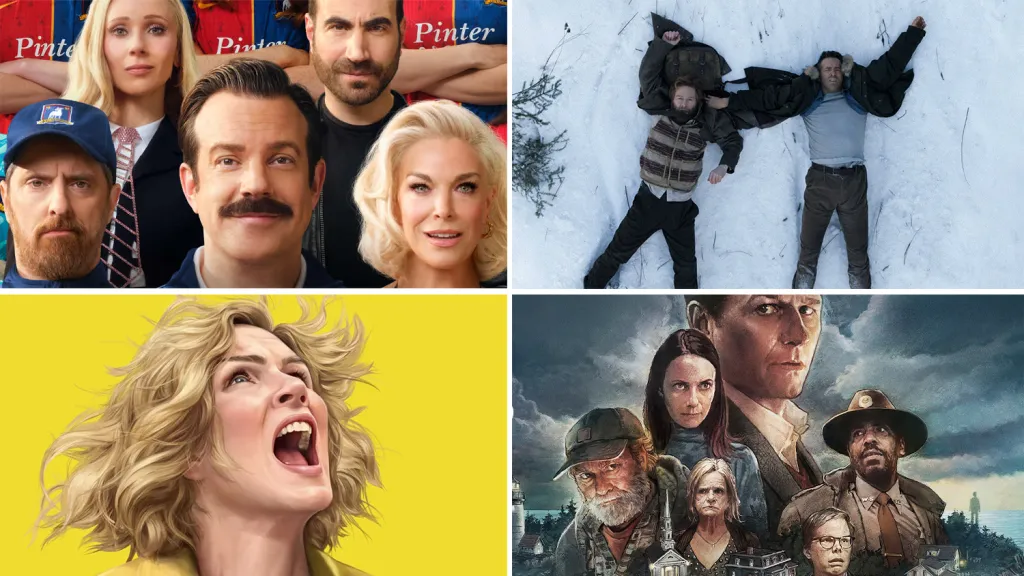
Apple TV had a record-breaking 2026 Emmys with 28 Emmys (29 if you include the commercials win), the most for the streamer ever and the most for any platform this year. Apple TV’s big night at the Emmys on Sept. 14 was followed by a big week — the biggest in the streamer’s seven-year history, the company said Monday.
No, hell has not frozen over, and Apple did not release hard viewership numbers, just qualitative data and year-to-year and week-to-week increases. They still provide a glimpse into the streamer’s performance, especially when compared to existing third-party ratings information.
Per Apple, fueled by strong deliveries from the Cold War buddy comedy Mayday, starring Ryan Reynolds and Kenneth Branagh, Season 4 of Ted Lasso, and a post-Emmy viewership surge for big winners Widow’s Bay and Pluribus, the service had its highest weekly viewership ever for the week of Sept. 14, rising by +67% year-over-year.
Released straight-to-streaming on Sept. 4, Mayday has become Apple TV’s biggest film debut on the platform to date over its first 18 days, the company said. In the U.S., Mayday opened at No. 1 in Luminate’s Sept. 4-10 weekly rankings with 8.7M views. It remained strong in Week 2, placing at No.2.
Freshman horror comedy Widow’s Bay, the biggest winner at the Emmys with 14 trophies — the most ever for a comedy series in a single season — saw a massive halo effect as its viewership skyrocketed +280% week-over-week in the post-Emmys week of Sept. 14, per Apple, with the US, UK, Canada, Australia, Brazil, Mexico, Germany, India, Poland, and Spain, leading the charge.
Luminate data corroborates that claim. For the week of Sept. 4-10, Widow’s Bay was outside of the Top 50. For the week of Sept. 11-17, which includes the first three days after the Emmys where Widow’s Bay was crowned Outstanding Comedy Series, it jumped to No. 13.
‘Widow’s Bay’ creator Katie Dippold and cast/crew accept the Outstanding Comedy Series Awardduring the 78th Primetime Emmy Awards on September 14, 2026
Kevin Winter/Getty Images)
Pluribus, Apple TV’s second biggest Emmy winner with six statuettes, including Outstanding Lead Actress in a Drama Series for Rhea Seehorn, experienced +200% surge in viewership week-over-week following the ceremony, per Apple.
Since the sci-fi drama from Emmy winner Vince Gilligan wrapped its run back in December while Widow’s Bay, starring Emmy winner Matthew Rhys, was a more recent entry that didn’t launch until end of April, for Pluribus, the increase was likely off a small base as the series did not reenter Luminate’s Top 50 the week of Sept. 11.
‘Slow Horses’
Apple TV
Slow Horses, winner of one Emmy, also got a bump, getting back into Luminate’s Top 50 the week of Sept. 11-17 at No. 43 after missing the cut the prior week. The spy thriller also posted a rare season-to-season viewership increase for a show so deep into its run, with Season 6 up +25% over Season 5 based on the first seven days of release, maintaining its position as Apple TV’s #1 UK title, per the company.
Nielsen’s reporting is delayed; its figures for the week of Sept. 14 will be released this Thursday.
The most recent Nielsen weekly streaming report for the week of Sept. 7 has one Apple TV titles in the overall Top 10, Ted Lasso at No. 7 with 734M minutes viewed. (Comedies are at a disadvantage in Nielsen’s ranking which are based on overall watched time vs. number of views.)
With that, Jason Sudeikis’ soccer comedy was a major contributor to Apple TV’s year-over-year viewership jump in the post-Emmys week. Its fourth season, which stumbled creatively a bit before finding its footing in the second half, marks the most viewed seasons for a returning Apple TV comedy over the first 54 days, according to the streamer.
Also possibly factoring into the year-to-year gains is the iCloud+ expansion launched by Apple on Sept. 15, which rolled out access to Apple TV at no additional cost for paid iCloud+ subscribers across more than 170 countries.
>
>


Search For Canadian TV Actor Stewart McLean Now Homicide Investigation


These ’90s fashion trends are making a comeback in 2017
According to Dior Couture, this taboo fashion accessory is back
Model Jocelyn Chew’s Instagram is the best vacation you’ve ever had
Emily Ratajkowski channels back-to-school style
9 Celebrities who have spoken out about being photoshopped


Rurouni Kenshin: Hokkaido Arc Manga Takes 1-Issue Break – News


HIDIVE to Stream English Dubs for The World Is Dancing, The Forsaken Saintess and Her Foodie Roadtrip in Another World, The Dangers in My Heart: The Movie Anime – News