
Sports
Brighton’s Luka Vuskovic: ‘I look forward to playing in the Premier League, but it was not my biggest dream’

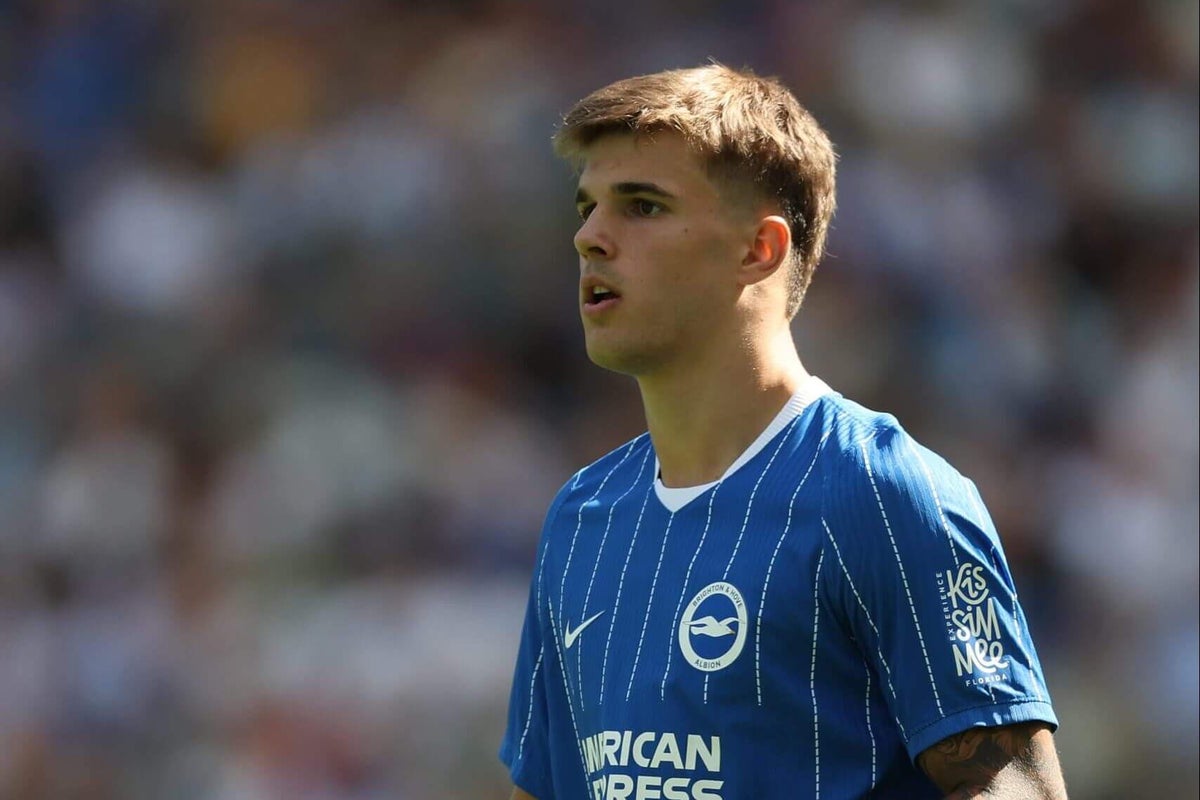
Most of the tattoos on the left arm of Luka Vuskovic relate to family members and special dates in his young life, but they also include a drawing of Hajduk Split’s Poljud Stadium.
“This is the first stadium I played in and it’s my favourite stadium,” explains the teenage Croatian international central defender of his first club’s 47-year-old home. “It’s collapsing a bit now. It needs a bit of rebuilding, but it’s really nice.”
Vuskovic, at just 19 years of age and over 6ft 3in (191cm) tall, is the imposing pillar of a summer rebuilding project by Brighton & Hove Albion in the centre of defence.
Jan Paul van Hecke left for Tottenham in June in a £52million ($70.3m) move. Vuskovic moved in the opposite direction in July — without kicking a ball for Spurs in a competitive fixture — breaking Brighton’s club transfer record with his £46m switch.
“(The fee) doesn’t matter so much, because it’s just a number. I have to prove myself and I have to do my best and I will try to do it,” says Vuskovic, speaking to a small group of media outlets including The Athletic after his debut in Saturday’s 3-0 friendly win against Roma at the Amex.

Luka Vuskovic was hugely popular at Hamburg (Selim Sudheimer/Getty Images)
Tougher tests lie ahead for Vuskovic than a comfortable 45-minute introduction in the first half against Roma before making way for 34-year-old captain Lewis Dunk. Not least commanding a regular spot amid competition from Dunk, Olivier Boscagli, and fellow summer arrivals Pascal Struijk (signed from Leeds United), and Michael Svoboda (Venezia). Igor Julio and Eiran Cashin are also still on the books, although they are likely to leave before the end of the summer.
“It’s been really easy, because my team-mates and the coaching staff and all the club have been helping me since I came here,” says Vuskovic of his early taste of the environment at Brighton. “Whoever is the best in games, in training, will start. It’s great to have competition. In my position we have a lot of good players and who is best will play, it’s simple as that.”
It will not be quite as simple as that for Fabian Hurzeler, since the head coach has to factor in squad rotation after qualifying for the Europa Conference League after a second successive eighth-place finish under the German last season. A tie over two legs in the play-offs round, almost certainly against Tromso, takes place either side of the visit of Aston Villa on the opening weekend of the Premier League on August 23.
Hurzeler pointed out upon the completion of Vuskovic’s move — on a five-year deal with an option for a further year — that he is “still a young guy who will need time to adjust to the demands of playing for Brighton and to the Premier League”.

Vuskovic makes his Brighton debut against Roma (Steve Bardens/Getty Images)
Vuskovic is confident that he has chosen the right destination for the next phase of his development, given Brighton’s reputation for improving young talent. “I think it’s the best step for me in my career,” he says. “It’s one of the biggest machines in the world for producing young players, as we could see in the last years, and that we will see in the future. I think it’s a top club, they showed me a top project and it was very simple.”
Vuskovic speaks with self-assured maturity for his tender age. He has grown up fast and he is unlikely to be overawed by the Premier League. Asked if it is a league he always wanted to play in, Vuskovic delivered a surprising response that hints at an ambition to play in La Liga in the future.
“I look forward to playing in (the Premier League), but it was not my biggest dream,” he says. “It’s the best league in the world, of course, and I’m more than happy to play my first game really soon. I’m really happy and let’s say in some way proud.” His biggest dream? “I never think of it as that,” he adds. “Maybe Spain, because it’s the most similar life to Croatia.”
Vuskovic is more advanced than most players at his age, despite the absence of any Premier League pedigree. He already has a World Cup appearance on his CV. That came in June against England, marking Harry Kane in Croatia’s opening group fixture of the tournament in the United States.
Kane scored twice, his first goal a penalty, in the first half of that 4-2 defeat in Arlington before Vuskovic was substituted after 66 minutes of his sixth senior outing for his country. He did not feature in Croatia’s other three matches, which concluded with a 2-1 exit against Portugal in the last 32.
What did he learn from facing Kane and his World Cup experience in general? “That every small mistake costs a lot,” Vuskovic says. “He’s obviously one of the best strikers in the world so it was very difficult. It was nice, because I have really good team-mates in Croatia, although we were obviously not happy with the result.”

Luka Vuskovic in World Cup action against England (Paul Ellis/Getty Images)
Vuskovic has seen plenty of Europe during his pathway to the Premier League. While at Tottenham, he spent the second half of the 2023-24 season on loan to Polish side Radomiak Radom. He moved on loan to Belgian Pro League outfit Westerlo in 2024-25, then impressed in a third loan spell with Hamburg last season, scoring six goals in 28 league appearances in Germany’s Bundesliga.
“My time in Poland helped me as a player a lot,” says Vuskovic. “Then Westerlo, then Hamburg. All those moves were very important and I’m very happy that I went through it all. I’m just 19, so there’s so many things to work on, so much room for improvement. I will try to work as much as possible to unlock all of them.”
Whether that includes external self-analysis alongside the expertise Brighton provide remains to be seen. Vuskovic has been working with Smart 11, a Netherlands-based self-analysis app, as revealed by The Athletic in July. Those preparations often happen close to kick-off before matches.
“I will speak with them (Smart 11),” Vuskovic says. “They are really amazing, I would recommend them to anybody. I started to work with them two years ago. They really helped me a lot, but now at Brighton we also have a lot of analysis, so we will see what happens.”
Van Hecke was seen as a natural successor to Dunk as Brighton’s skipper before moving to Tottenham. Struijk and Svoboda both captained their former clubs and Vuskovic’s leadership qualities were noted during his spell last season with Hamburg. “I’ve been trying to do that since I came here and I will always try to do it,” he says. “It’s how I am as a person.”
If Vuskovic grows into a Premier League regular and leader at Brighton, that club-record fee will turn into a smart piece of business.
>
Sports
F1 Q&A: Liam Lawson, sprint races, drivers who can challenge for title in inferior cars and Leonardo Fornaroli
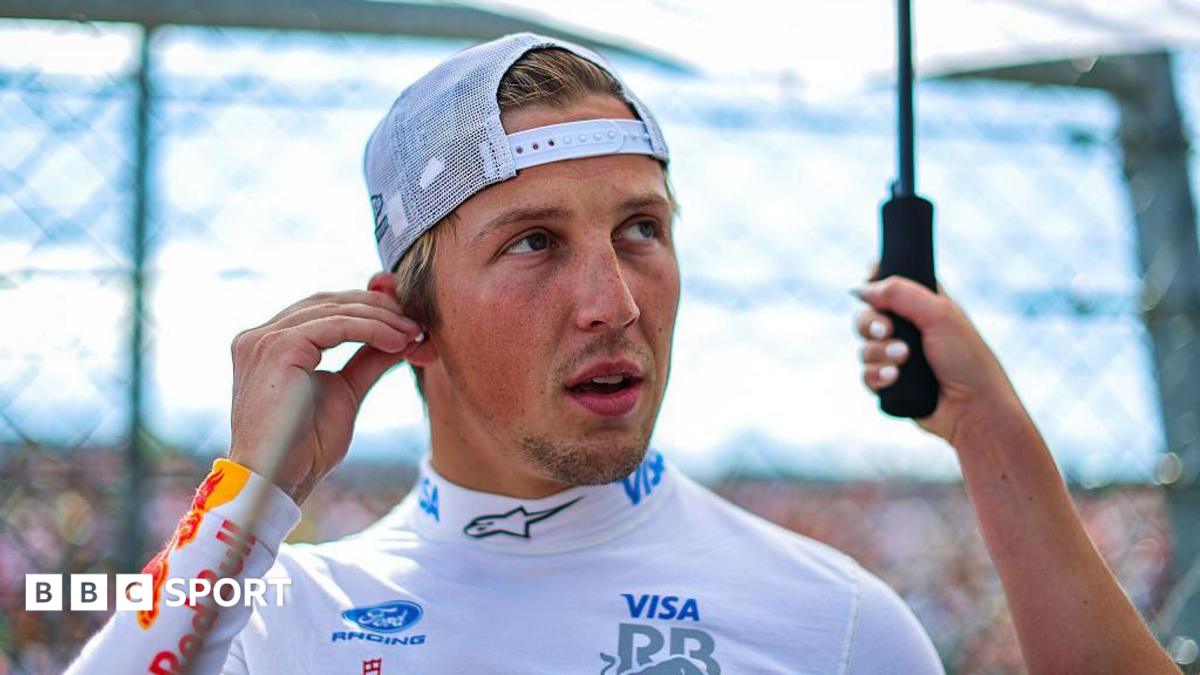
Which F1 drivers could consistently challenge for a world title in inferior cars? My wife and I can only come up with four: Ayrton Senna, Michael Schumacher, Fernando Alonso and Max Verstappen. Do you agree? – Martin
It’s very hard to challenge for a title in an inferior car, and the number of drivers who can do it are limited as a result. Essentially, it is only the very best.
At first glance, your list looks decent, but you have left out two huge names – Lewis Hamilton and Alain Prost.
Prost’s most exceptional season was in 1986, when he beat the two Williams drivers – Nigel Mansell and Nelson Piquet – to win his second world title in what was clearly an inferior McLaren.
There is also a very strong case that Hamilton did not have the best car with McLaren in 2008 (or he and Alonso in 2007), given what was learned subsequently about the relative performance of Ferrari drivers Felipe Massa and Kimi Raikkonen when they were team-mates to Alonso.
The point being that Hamilton and Alonso were extremely closely matched, while Alonso comfortably beat both Massa and Raikkonen, so if Ferrari could compete for a title against McLaren in those years, it could only be because their car was better.
Even in 2017 and 2018, when Hamilton won, the Ferrari was the better car for a large part of both those seasons before Mercedes hit their stride.
The stand-out year relevant to this question is 2012, when Alonso drove his best season and took the title fight to the final race in what was statistically the fourth quickest car.
That was an absolutely extraordinary achievement, and it is rightly celebrated. Even more so when you realise that had only one of two incidents for which Alonso was entirely blameless not happened, he would not have lost out to Red Bull’s Sebastian Vettel.
That’s a reference, of course, to Alonso being taken out at the start of the Belgian and Japanese Grands Prix by collisions with Lotus drivers – Romain Grosjean in Spa and Raikkonen in Suzuka.
Alonso also arguably won in 2005 in an inferior car, but then it depends what “inferior” means. The Renault was not as fast as Raikkonen’s McLaren on balance, but it was certainly more reliable.
As for the rest, no argument with Max Verstappen after coming so close against Lando Norris and McLaren last season, which was Alonso 2012-esque.
Senna won the title in 1991 in a McLaren that was inferior to the Williams FW14 being driven by Nigel Mansell, although the Williams suffered significant reliability problems that helped him.
And he also probably did it in 1990 – in his McLaren compared to Prost’s Ferrari – given Senna’s pace advantage over Prost when they were McLaren team-mates in 1988 and 1989.
Schumacher? Arguably the Benetton was an inferior car to the Williams in 1995, but then he was consistently a superior driver to Damon Hill and David Coulthard, both of whom made a bit of a hash of that season.
Williams also probably had an advantage for the second half of 1994, once they had got on top of the aerodynamic problems that thwarted the start to their season.
But would Schumacher have beaten Senna in 1994 had the Brazilian not been killed at Imola? Unlikely.
And it’s hard to argue any of his Ferrari titles were won in an inferior car.
Beyond that, there are not many obvious cases when the champion did not have the best car.
Exceptions would be years massively skewed by circumstance.
One example is the tragic 1982 season, when it was a toss-up between Ferrari and Renault for the best car. After Gilles Villeneuve died and team-mate Didier Pironi suffered horrendous injuries, and with Renault afflicted by reliability issues, Keke Rosberg came through to take the title for Williams despite winning only one race.
Or 1979, when the championship scoring system was a bizarre split calculation when only the best four scores from the two half-seasons could be counted, and the Williams FW07 made its debut too late for Alan Jones to challenge Jody Scheckter and Villeneuve in the generally inferior Ferrari 312 T4.
Leonardo Fornaroli looks like another Russell/Leclerc/Piastri calibre driver based on his F3 and F2 performances. If he was to land an F1 seat, where is the most likely place he would end up? – Harry
Fornaroli is the reigning F2 champion, and won F3 the previous season. He has been a member of the McLaren driver development programme since the end of last year.
The Italian has done two practice sessions for McLaren – in Barcelona and Austria this year – as well as two what are known as ‘TPC’ tests – in older cars – for McLaren in Portimao, and Haas in Jerez.
There are not that many seats up for grabs next year and the driver market is on hold for a large part until it becomes clear whether Max Verstappen is going to leave Red Bull.
If Fornaroli is to get a seat, though, it seems most likely it would be at Haas, where Esteban Ocon’s place is under threat.
Haas, however, already have Toyota-contracted Ryo Hirakawa and former Alpine driver Jack Doohan on their books.
>

Welcome to our special cricket edition of our Who am I? game.
The rules are simple. Each day of The Hundred there’s a new cricketer, taking part in the tournament, who we want you to guess in as few attempts as possible.
After each wrong guess you unlock a new clue. Guess the answer after as few clues as possible to score more points.
Three is a good score, four or five points is exceptional.
So take part and return for more tomorrow.
Today’s player and clues set by BBC Sport’s Henry Cowling.
After more quizzes? Go to our dedicated Sports Quizzes page and sign up for notifications to get the latest quizzes sent straight to your device.
>
Sports
Gianni Infantino: Donald Trump warns of ‘terrible mistake’ if FIFA replaces under-pressure president | Football News

US President Donald Trump has warned FIFA would be making a “terrible mistake” if it got rid of Gianni Infantino as head of world football’s governing body.
Infantino has come under pressure following his doomed plan to sell off stakes in the men’s World Cup to private investors.
But in a post on his Truth Social social media site early on Tuesday, Trump said removing the FIFA president would be a costly move.
The US president wrote: “FIFA would be making a terrible mistake if, for any reason, they even considered replacing president Gianni Infantino.
“He is fantastic, having just presided over the most successful World Cup, by four times, ever presented.
“If he is gone, it will never be as successful or profitable again!”
Infantino apologised for his proposal to create FIFA Forward Enterprise (FFE), a company to run the commercial and operational aspects of FIFA’s tournaments, with an idea to sell off around 20 per cent to private investors.
But UEFA, CONCACAF and AFC hit out at “deception” and a “fundamental breach of trust” around Infantino’s botched plan, the three continental associations each signing a new open letter to the “football family” on Monday, without naming Infantino specifically but referring to a leader who “abandoned their duty” by breaking trust “through deception”.
In the three-page document they again criticised the president’s World Cup sale plans and rejected FIFA’s claim that they had been a “mistake”, adding: “There remains no recognition that attempting to sell an interest in the FIFA World Cup was a profound failure of judgment – not just a procedural misstep, but a fundamental breach of trust with the very institutions FIFA exists to serve.”
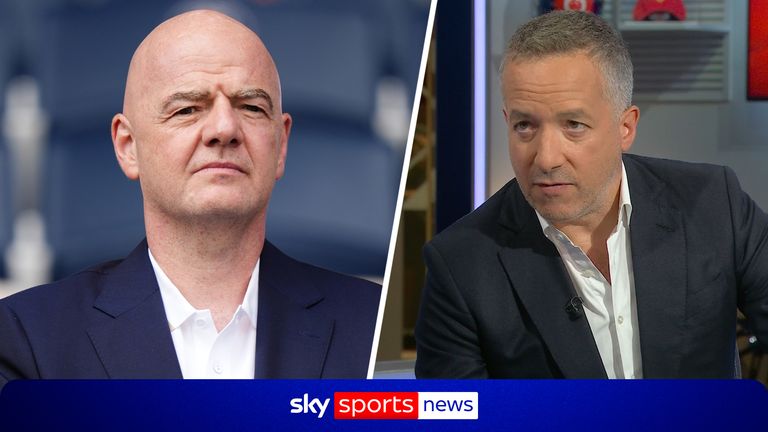
Sky Sports News’ chief correspondent Kaveh Solhekol on whether Infantino can continue as the president of FIFA
UEFA, CONCACAF and AFC had been the three confederations to reject Infantino’s plan before it was scrapped, while UEFA went further and announced a boycott of FIFA competitions – and last week confirmed the threat remained while Infantino is still in post.
The associations also hit out at the manner of a FIFA management committee meeting held in Morocco last Wednesday – a meeting which ended with a statement publicly backing Infantino – for not instead addressing FIFA’s wider senior leadership at its base in Switzerland.
“It is not the conduct of a custodian of the game, but of one who believes the game is answerable to him,” the letter read. “There is silence where there should be accountability, distance where there should be openness.”
US Soccer and Canada Soccer – two of the three federations which hosted the World Cup – also called for meaningful change.
A US Soccer statement read: “US Soccer, Canada Soccer, CFU (Caribbean Football Union) and UNCAF (Central American Football Union) stand together, along with our colleagues around the world, in calling for meaningful change that strengthens FIFA’s governance, transparency and accountability.”
The UEFA, CONCACAF and AFC letter came around 24 hours after FIFA itself had hit out at “a concerted and ongoing effort by some to undermine” the governing body and president Infantino over claims surrounding his conduct at UEFA.
UEFA confirmed on Saturday a “departure payment” was made to a female employee alleged to have been in a relationship with Infantino when he was the European organisation’s general secretary.
The Daily Telegraph reported the woman received a six-figure sum and UEFA confirmed a payment was made along with covering the fees for an MBA course, adding it was “in line” with regulations at the time.
The allegations intensified the position of Infantino, who worked at UEFA for 16 years and was its general secretary between 2009 and 2016 before being elected FIFA president, following his aborted plan to sell off stakes in the World Cup to private investors.
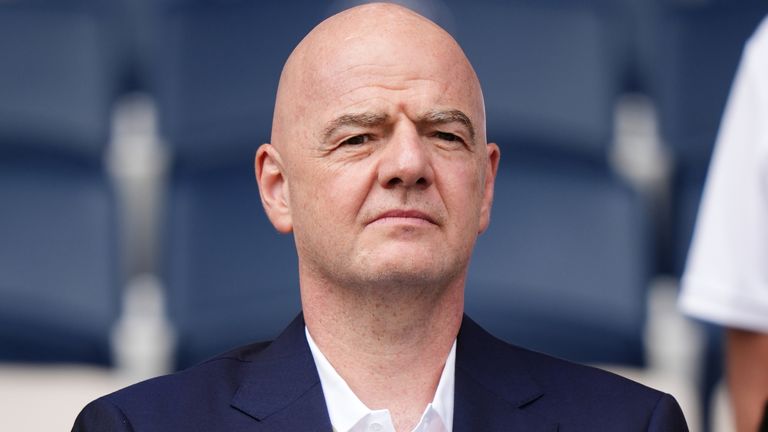
FIFA president Infantino
While not directly referencing UEFA’s statement, FIFA accused Infantino’s critics of trying to weaken his authority and have him removed from his role without a due re-election process.
A statement said: “It is increasingly evident that there is a concerted and ongoing effort by some to undermine FIFA and its president.
“Those who do not have the support of FIFA’s member associations should not seek to achieve through allegation, insinuation or misinformation what they cannot achieve through FIFA’s established democratic processes.
“Recent reporting has included unsubstantiated assertions and demonstrably false claims concerning FIFA and its president. Speculation and insinuation should not be presented as fact, and repetition does not make an allegation true.
“The FIFA president has dedicated more than 30 years of his professional life to European and world football, contributing to significant change in the game and, in particular, to broadening access, resources and opportunity across world football
“Change inevitably challenges established interests, but disagreement with that change cannot justify efforts to undermine the democratic mandate of FIFA’s president or the institution he was elected to lead.
“FIFA welcomes legitimate scrutiny. But scrutiny is not a licence to distort facts, amplify unsubstantiated allegations or manufacture distractions designed to undermine progress. Where reporting is inaccurate or misleading, FIFA will challenge it directly and vigorously.
“FIFA’s responsibility is to its 211 member associations and to football around the world. We will not be distracted or diverted from strengthening the organisation, delivering for our member associations and continuing the work of making football truly global. Through the FIFA president and the FIFA administration, our focus remains firmly on that mission, and we are more determined than ever to fulfil it.”
>

F1 Q&A: Liam Lawson, sprint races, drivers who can challenge for title in inferior cars and Leonardo Fornaroli

BBC Sport quiz: Who am I? Guess The Hundred star cricketer No 22

Gianni Infantino: Donald Trump warns of ‘terrible mistake’ if FIFA replaces under-pressure president | Football News
-

 movies3 months ago
Search For Canadian TV Actor Stewart McLean Now Homicide Investigation
-

 Fashion9 years ago
These ’90s fashion trends are making a comeback in 2017
-
Fashion9 years ago
According to Dior Couture, this taboo fashion accessory is back
-
Fashion9 years ago
Model Jocelyn Chew’s Instagram is the best vacation you’ve ever had
-
Fashion9 years ago
Your comprehensive guide to this fall’s biggest trends
-
Fashion9 years ago
Emily Ratajkowski channels back-to-school style
-
Fashion9 years ago
9 Celebrities who have spoken out about being photoshopped
-
Fashion9 years ago
A photo diary of the nightlife scene from LA To Ibiza