
Anime
Splatoon Raiders Game Review – Game Review

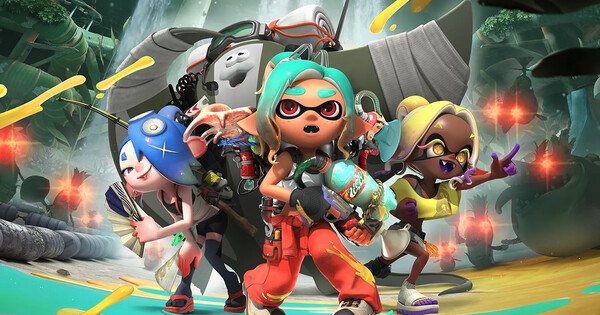
Splatoon was always a series that I had a fleeting interest in. With each new entry, I’d play it for a week or two before never coming back again. Granted, it’s mainly because I’m not a multiplayer person, not because the games were bad or anything.
But Splatoon Raiders is the first single-player-focused entry, taking the best aspects of the series like the shooting and weapons to create a fun mission-focused campaign mowing down tons of enemies. But some parts that made Splatoon initially stand out are missing here, namely visual customization. Still, Splatoon Raiders is a gnarly experience.

© Nintendo.
The story reads more like window dressing than anything. When you’re hanging with the Deep Cut trio consisting of Shiver, Frye, and The Big Man (talking sting ray), you get to learn a bit more about their personalities. However, don’t come in expecting any profound lesson from Splatoon Raiders. The real hook is in the gameplay.
The gameplay mechanics here are pretty much the same as the other Splatoon games. You shoot ink at your opponents, and the splattering colors the ground. While your running is incredibly slow, diving into colored ink dramatically increases your movement speed. This allows you to maneuver around the arena more easily and flank your enemies.
There are also different mission types and levels, such as longer linear missions that involve both shooting and platforming, as well as other ones that require you to collect orbs before time runs out. The map provides plenty of variation to keep the experience feeling fresh.

© Nintendo.
Splatoon Raiders also places much more emphasis on buildcrafting than its usual multiplayer-centric brethren. It’s partly because multiplayer games have to balance player skill and loadouts, so build customizations are kept somewhat minimal. But with the single-player focus here, you’re free to become as powerful as you want against NPCs. It’s so much fun tinkering with all the different gadgets and weapons to make your character unique.
My favorite gadget ended up being the Shot Pot, an automatic turret that provided additional firepower while I went around smacking enemies with the Splatana at close range. You can also augment parts to your gadgets to give them additional attacking properties. Within a certain number of slots, you can increase parameters like their attacking range, fire rate, and damage.
As you clear more islands, you’ll unlock Relics that give your character powers. For example, one is called Lifesaver, which increases your HP recovery rate, and the Ink Pro, which reduces the amount of ink consumed when you fire your weapons. Altogether, weapons, gadgets, and Relic powers give a high level of customizability that always encourages you to experiment with various builds.
Splatoon Raiders isn’t entirely single-player, though. You can engage with its co-op mechanics by joining two additional players online to tackle the harder levels in the campaign and post-game. There’s a surprising amount of replayability with each level getting “Spicy” and “Super Spicy” variations with more difficult enemies. While I did experience a singular instance of my teammates dropping mid-level due to connection issues, the co-op functionality worked smoothly and quickly.

© Nintendo.
The most disappointing aspect of Splatoon Raiders is the limited fashion customization compared to previous games. You can’t individually pick out your shirt, pants, or headwear here. Instead, you’ll unlock various whole costumes to equip. Splatoon Raiders trades cosmetic customization for a more gameplay-centric build personalization. It’s quite a shame that the game doesn’t have both when it could’ve easily done so.
Despite its faults, Splatoon Raiders is my favorite entry so far, even if it’s because of the genre switch from multiplayer to single-player. The addition of co-op was a clever approach to retaining some of that teamwork that Splatoon is known for, however. The engaging customization was just the ink I needed to sign over my time to this series for a long time.
>

I have played a lot of visual novels before, but this is the first time I’ve played one structured like Sweet Hamster Days. Unlike others that use stock art or animations to set up interactive scenes with the player, this game is 90% live-action, using real filmed footage of the Shiratori sister actresses. There is a novelty to this approach, and the different camera angles really emphasize Kota’s size, the character that you play as. The video quality is also incredibly crisp, so if staring at Japanese women is one of your general interests, then this game is tailor-made for you.

©Kodansha Ltd.
Ironically, the problem with this presentation is that it creates a game that feels less interactive than your standard visual novel. Unlike other visual novels that can branch out into other scenarios while still using the same library of sprites or animations, this game offers far more limited interactivity because the scenes needed to be shot on film before being edited into the game. Making decisions and choices that affect the overall narrative trajectory of the game is, in a lot of ways, the main appeal of playing a visual novel. However, most of the choices that occur in this game are ultimately superfluous. It comes down to the fact that, production-wise, increasing the number of choices in branching paths would mean more footage would’ve needed to be recorded, which might not have been possible.
The other issue is that the main character Kota is a hamster for most of the game. He has no clear way of communicating with the sisters outside of squeaking, and his small stature makes it hard for him to do anything besides react. I do think that contributes to some of the game’s charm, but the problem is that the outcome isn’t really that different because the dialogue choices sound the same to the sisters. So if you’re looking for a game where every choice you make matters, this is not for you.

©Kodansha Ltd.
The game sometimes struggles to create new forms of interaction. There is a hamster icon in the bottom left corner that lets you express a variety of moods in real time while the live-action cutscenes are playing. This is encouraged in order to get an idea of what Kota is thinking at the moment, but all it does is spam sound effects and stock reactions over the screen. I tried utilizing these reactions during dozens of scenes only for it to ultimately not matter. It was the visual equivalent of dangling keys on screen, which also felt counterintuitive since doing it too much ultimately blocked the live-action footage. The game does have some occasional cute overlays that also pop up from time to time, but they are incredibly basic even at their best.
Don’t worry though; there is still a game here. While most of your choices ultimately don’t matter, that doesn’t mean that all of your choices don’t. The game is divided into multiple routes, each focusing on a sister. It’s your job to follow each sister around, see what troubles are going on in their day-to-day life, and do what you can to cheer them up, even if it is limited. It’s usually the final choice in each story segment that ultimately matters, even if the game doesn’t always make it clear. Worst-case scenario, you’re still allowed to go back to replay that same story section right away. Plus, the game has a very handy skip feature so you can skip all the cutscenes to make the right choice in a short amount of time. The funny thing is that if you make the wrong choice in a story segment, then the game classifies that as an ending, which means there are technically dozens of “endings” in this game. But it’s not like a hard Game Over; you just didn’t make the right choice to advance the specific story that the game wants to tell. Some of these “endings” are a little fun while others can literally result in your death. It was sometimes very random, but there was a little bit of amusement in the challenge of trying to “collect” all of these endings.

©Kodansha Ltd.
There are technically a few other collectibles in this game, like background information on all of the different women that isn’t revealed in the cutscenes or hints on how to acquire very specific endings. However, the draw is the eye candy segments. Finishing specific routes unlocks full videos that run for about one minute of the sisters changing or wearing different outfits. It’s nothing overly explicit; it could be Himari posing in a teacher’s outfit on a bed or Futaba slowly putting on her stockings. You don’t see anything like nudity or a panty shot. In a lot of ways, this is the most basic of voyeurism, but at least the music during these moments is relaxing.
Now the women aren’t strictly eye candy, even if I’m pretty sure their attractiveness is supposed to be one of the main appeals of the game. All of the sisters do have their own stories, whether it’s Himari struggling with her job or Miyu struggling with her inferiority complex. I do feel for these characters because it’s clear that all of them are working really hard just to live their lives. Their struggles were very relatable, and having an affectionate pet nearby does help alleviate that pressure. The way they talk to Kota as a hamster feels very similar to the way that I might talk to my dog when I get home after a long day. There is some genuine emotion here that I can’t ignore. It’s clear that Kota was put into the body of this hamster with a mission to make sure that the sisters can live their best lives, and while I didn’t feel like the game had me by the heartstrings, I did want to see them get their happy ending.

©Kodansha Ltd.
Going through all the routes of the game will take you a couple of hours. I commend the presentation and the commitment to the live-action elements, even if it ultimately renders a lot of the gameplay elements superfluous. I also feel like the perverse wish-fulfillment angle clashes a bit with the genuine sweetness the game is trying to have at times. But there is a lot of novelty that is worth checking out if you find yourself in the right mood. If you’ve never tried a game like this before, it’s worth a peek and the occasional emotional moments, but you’re not missing out if you would rather prioritize something a bit more involved and narratively enriching.
>
Anime
‘Shin Tennis no Oujisama: U-17 World Cup Kesshou Member Ketteisen’ Reveals Additional Cast, Staff, First Promo
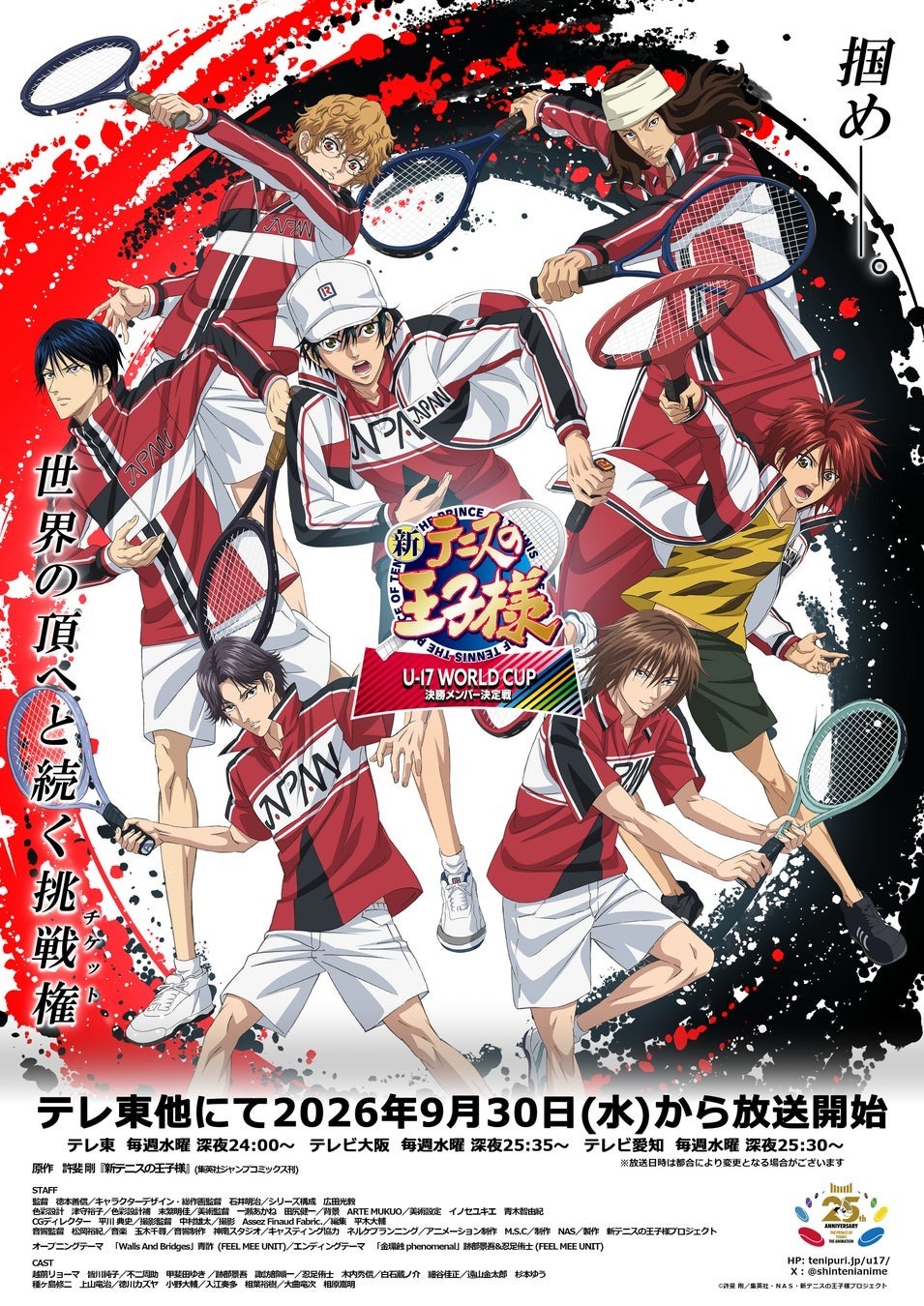
 The official website for the Shin Tennis no Oujisama: U-17 World Cup Kesshou Member Ketteisen television anime series revealed additional cast, new staff, a key visual (pictured), and the first promotional video on Friday. The sequel anime is scheduled to premiere on October 1 at 12.00 a.m. on TV Tokyo, followed by TV Osaka, and TV Aichi.
Cast
Julio Roman: Tasuku Hatanaka (Boku no Hero Academia)
Mars de Colon: Reiji Kawashim (Kill Ao)
Silva Serra Banbieri: Ryuuho Nagaoka (Tamon-kun Ima Docchi!?)
Sedah: Megumi Han (Medalist 2nd Season)
New staff includes Kenichi Tajiri (Turkey!) and Akane Ichinose are replacing Jinya Kimura (Shaman King (2021)) as art director. ARTE MUKUO and Norifumi Hirakawa are joining the staff as background and CG director, respectively.
Music group Aosu is performing the opening theme “Walls And Bridges,” while Junichi Suwabe (Ensemble Stars!! Road to Show!!) and Hidenobu Kiuchi (Everyday Host) are performing the ending theme “Kinkanshoku phenomenal.” The opening theme is previewed in the promotional video below.
Returning staff includes Yoshinobu Tokumoto (Darwin’s Game) as director at animation studio M.S.C. Mitsutaka Hirota (Edens Zero) is serving as series composition, while Akiharu Ishii (Shin Tennis no Oujisama) is credited as character designer and chief animation director. Chihiro Tamaki (Shin Tennis no Oujisama: U-17 World Cup) is composing the music.
Produced by Studio Kai and M.S.C, the U-17 World Cup television anime aired in 13 episodes in Summer 2022, followed by latest season, titled U-17 World Cup Semifinal in Fall 2024. Crunchyroll simulcast the anime with subtitles and subsequently streamed an English dub.
The original sports manga was serialized in Weekly Shounen Jump between 1998 and 2008 and compiled into 42 volumes. The sequel manga began in Jump SQ, the following year and ended serialization in the September 2026 issue. Shueisha published the 47th volume on June 4 with the 48th and final volume scheduled to be released on September 4.
PV1
Source: PR Times
News submitted by Safuan12616
>
Anime
The Prince of Tennis II: U-17 World Cup Kesshō Member Ketteisen Anime Reveals Promo Video, More Cast, September 30 Premiere – News
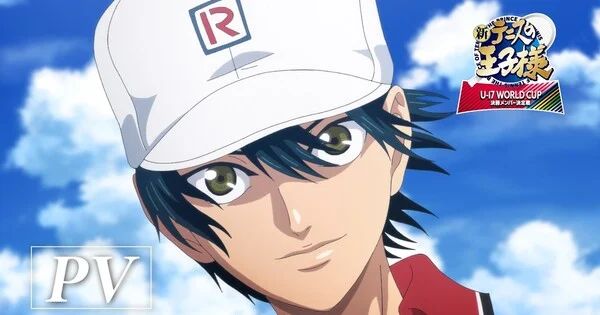
The staff for Shin Tennis no Ōji-sama U-17 World Cup Kesshō Member Ketteisen (The Prince of Tennis II: U-17 World Cup Finals Members Decisive Match), the sequel anime to The Prince of Tennis II: U-17 World Cup Semifinal (Shin Tennis no Ōji-sama U-17 World Cup Semifinal) anime, unveiled a new promotional video, visual, four cast members for Spain’s national team, and September 30 premiere on Friday. The trailer previews the opening theme song “Walls And Bridges” by four-member unit Aozu.

© 許斐 剛/集英社・NAS・新テニスの王子様プロジェクト

© 許斐 剛/集英社・NAS・新テニスの王子様プロジェクト
The newly announced cast includes (pictured above from left to right):

©許斐 剛/集英社・NAS・新テニスの王子様プロジェクト
The anime will premiere on TV Tokyo on September 30 at 12:00 a.m. JST (effectively, October 1) and will also air on TV Osaka and TV Aichi.
The sequel anime will depict the battle to decide who will represent Japan in the finals match against Spain. Film actor Yū Shirota (Kunimitsu Tezuka in The Prince of Tennis live-action film) voices the character Romeo Fernandez from Spain.
The four-member unit Aozu composed of Ryōma Echizen (voiced by Junko Minagawa), Kunimitsu Tezuka (voiced by Ryōtarō Okiayu), Syusuke Fuji (voiced by Yuki Kaida), and Shuichiro Ōishi (voiced Takayuki Kondō) is performing the opening theme song “Walls And Bridges.” Keigo Atobe (voiced by Junichi Suwabe) and Yūshi Oshitari (voiced by Hidenobu Kiuchi) are performing the ending theme song “Kinkanshoku phenomenal” (Annular Eclipse phenomenal).
The Prince of Tennis II: U-17 World Cup premiered on TV Tokyo in July 2022. Crunchyroll streamed the anime as it aired in Japan, and also streamed an English dub. The anime was the first new television anime in the franchise in about a decade.
Crunchyroll describes the series:
When tennis phenom Ryoma Echizen is kicked out of Japan’s elite U-17 training camp for breaking the rules, he’s despondent. But a stroke of good luck hits when he’s able to try out for the U.S. team. Proving himself against their hardened veterans isn’t going to be easy, and if he is accepted, he’ll have to play against his former friends. Can he help his new brothers smash their way to victory?
The Prince of Tennis II: U-17 World Cup Semifinal debuted in October 2024. The anime centers on the Japan vs. Germany semifinal, and is itself a sequel to The Prince of Tennis II: U-17 World Cup anime series.
Takeshi Konomi serialized the original manga in Shueisha‘s Weekly Shonen Jump magazine from 1999 to 2008. The manga follows middle school tennis player Ryōma Echizen as he battles rivals to reach the national tournament. The manga inspired a 2001-2005 television anime, two anime feature films and a theatrical short, various video anime projects, a live-action film, a live-action television series in China, and a popular stage musical series.
Konomi launched The New Prince of Tennis sequel manga in Shueisha‘s Jump Square magazine in 2009. Shueisha published the manga’s 47th compiled book volume on June 4. Konomi announced in July 2025 that he plans to end the serialization of The New Prince of Tennis within a year.
Sources: The Prince of Tennis anime’s website, Comic Natalie
>

‘Romy And Michele 2’ Cast Adds Wendi McLendon-Covey (EXCLUSIVE)

‘Hockey Night in Canada: Punjabi Edition’ ends after 18-year television run

How ‘Wednesday’ Turned an Old Seminary Into a House of Horrors
-

 movies3 months ago
Search For Canadian TV Actor Stewart McLean Now Homicide Investigation
-

 Fashion9 years ago
These ’90s fashion trends are making a comeback in 2017
-
Fashion9 years ago
According to Dior Couture, this taboo fashion accessory is back
-
Fashion9 years ago
Model Jocelyn Chew’s Instagram is the best vacation you’ve ever had
-
Fashion9 years ago
Your comprehensive guide to this fall’s biggest trends
-
Fashion9 years ago
Emily Ratajkowski channels back-to-school style
-
Fashion9 years ago
9 Celebrities who have spoken out about being photoshopped
-
Fashion9 years ago
A photo diary of the nightlife scene from LA To Ibiza