
Entertainment
Morning Joe Slams Trump’s Foreign Policy Priorities

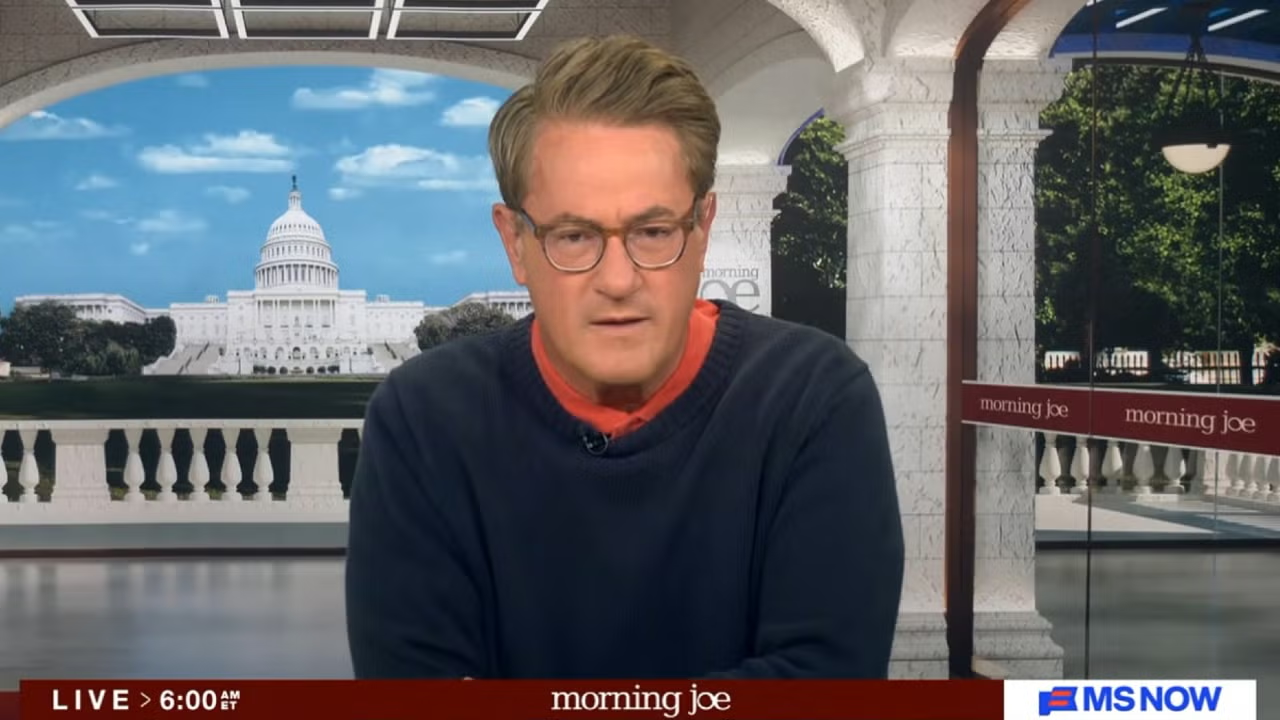
“Morning Joe” host Joe Scarborough slammed the series of “jagged” foreign policy decisions that President Trump has made throughout his second term, concluding that the commander-in-chief “just wants a monument to himself.”
On Sunday, Trump ordered the Pentagon to scale back America’s annual military exercises with South Korea because of the country’s alleged refusal to help with denuclearization efforts involving Iran. Scarborough slammed that decision, characterizing it as part of an ongoing pattern of Trump alienating America’s allies and helping its enemies.
“You have the president deciding, because he likes a couple of love letters to and from [North Korea Supreme Leader] Kim Jong Un, that that’s going to replace 80 years of North Korea’s tyranny,” Scarborough said Monday. “Suddenly he’s okay with that.”
“He doesn’t have a good call with the leader of Switzerland, so again, a jagged move, he decides he’s going to raise tariffs on Switzerland,” Scarborough continued. “Canada, smoke comes over the border in natural forest fires? Jagged move. He decides he’s gonna [implement tariffs], or gonna talk about Canada being the 51st state.”
You can watch part of the “Morning Joe” segment yourself in the video below.
Scarborough went on to note that he could list “1,000 different things” Trump has done that has hurt America’s global standing and only seemingly benefitted the president himself.
“[He decides to] blow up the greatest alliance in history with NATO,” Scarborough said. “If you just look at what NATO has done from 1947 through 2026. [Trump wants to] blow that up because he decides he wants to take over Greenland.”
The “Morning Joe” host subsequently linked these foreign policy decisions to Trump’s ongoing renovations in Washington, D.C., categorizing it all as part of the president’s obsession with cementing his legacy before he has even left office.
“In the same way he wants to build an arch, in the same way that he wants his name on the Kennedy Center, he just wants a monument to himself,” Scarborough concluded Monday.

>

Apple TV’s Your Friends and Neighbors has been nominated this year in the marquee Emmy category of Outstanding Drama Series. It marks the first-ever Emmy nomination for the series, and it has been achieved in just its second season. It also made a kind of Emmy history as becoming only the second series to score the prestigious nomination without being nommed in any other category in the same season (the first was Big Love in 2009). That indicates the series, which will be heading into its third season in 2027, is becoming a word-of-mouth hit, not just with audiences but also with Television Academy voters.
It is well deserved, and creator/showrunner/writer/executive producer Jonathan Tropper joined Deadline’s Contenders Television: The Nominees Studio to talk about how it got to this point and how much might have had to do with the wild second season. Joining him was co-star Hoon Lee, who plays series star Jon Hamm’s cohort Barney Choi.
Watch the conversation below and scroll down for photos from the event.
The series sees Hamm, back in a suit a la Mad Men’s Don Draper, being fired as a hedge fund manager, dealing with a recent divorce, and trying to pick up the pieces in wealthy Westchester’s Westmont Village, where he turns to stealing from his neighbors’ homes only to discover a host of secrets and affairs hidden within those compounds. In the second season he continues the practice only to be confronted by a new neighbor (James Marsden) who threatens to expose him, an act that once again could put his whole family at risk.
“I’m not sure what it is about the second season specifically that made it catch on. I think in some cases, it’s just the fact that we came after the first season. You know, if I sat down and thought about it, second seasons are generally a little denser,” Tropper mused. “There’s more character complexity because we’ve already built the world. And so I think in the binge culture, the fact that people can sit down and watch 19 episodes as opposed to just the first nine episodes probably gave us a little more staying power. And I think it’s one of those shows that just had a wonderful word-of-mouth spread.”
RELATED: Contenders Television: The Nominees Studio – Deadline’s Complete Coverage
Indeed. And was he surprised by that single Emmy nomination? It WAS surprising and surreal. “We were in Europe, so it was the end of the day for us. We had no idea they were being announced that day and my phone just started to blow up. And, you know, I couldn’t really wrap my brain around it until I really started hearing from a lot of friends in L.A. who in real time were learning with the nomination. And then I began to realize that we were in that conversation [which] was really exciting. It’s really great,” he said.
As for his initial desire to tackle this particular world, it was something that had been on his wish list. “This is a show I really wanted to do for a long time. I just had to get to a point where people would let me make this show. Due to a handful of circumstances. I came up more on the side of television action shows, but I had been writing novels that were more set in worlds like this, and that dealt with these types of situations and journeys,” he said. “And I think I was just biding my time till somebody trusted me enough to do a show like this. I lived in Westchester for 15 years. I knew this world really well, and I know it’s really right to me for exploration, and I think it was just a combination of my own maturation and the ideas coinciding to to bring this show forward.”

Jonathan Tropper
Anthony Avellano for Deadline

Hoon Lee
Anthony Avellano for Deadline

Jonathan Tropper
Anthony Avellano for Deadline
As for the casting, and notably getting Hamm, as Andrew Cooper, to return to world later than but still in the universe of a Don Draper? “I mean having Jon Hamm in that role is interesting because you really can’t shake the specter of Don Draper. I think that follows him the minute you put him in a suit, you see. And the way I viewed it is kind of a deconstruction of that character. Or, you know, as John likes to say, you know, ‘Don Draper sold the American Dream and Andrew Cooper bought it.’ And I think we started from there,” Tropper said.
Lee is just one of a sterling cast of supporting players getting rich roles, Barney Choi being one of the buzziest. What did Lee think of the opportunity?
“I think the great appeal of it is being able to give voice to sort of all of your inner turmoil and your inner chaos,” he said. “A lot of the times I’ve been asked to play characters for Jonathan that are sort of organizers of the world or as fixers or operators, and that necessitates a kind of level-headed approach, so to be able to let fly with neuroses after neuroses and sort of allow the character to really spin out was incredibly fun for me to start to, to dabble in, And now that’s just building as the stakes go up for the entire situation, as it becomes more invested in Coop’s world, he starts to really unfurl. And that’s proven both fun but also challenging. And that challenge is always interesting. Like the general feel of the show, it’s incredibly fun to do.”
>
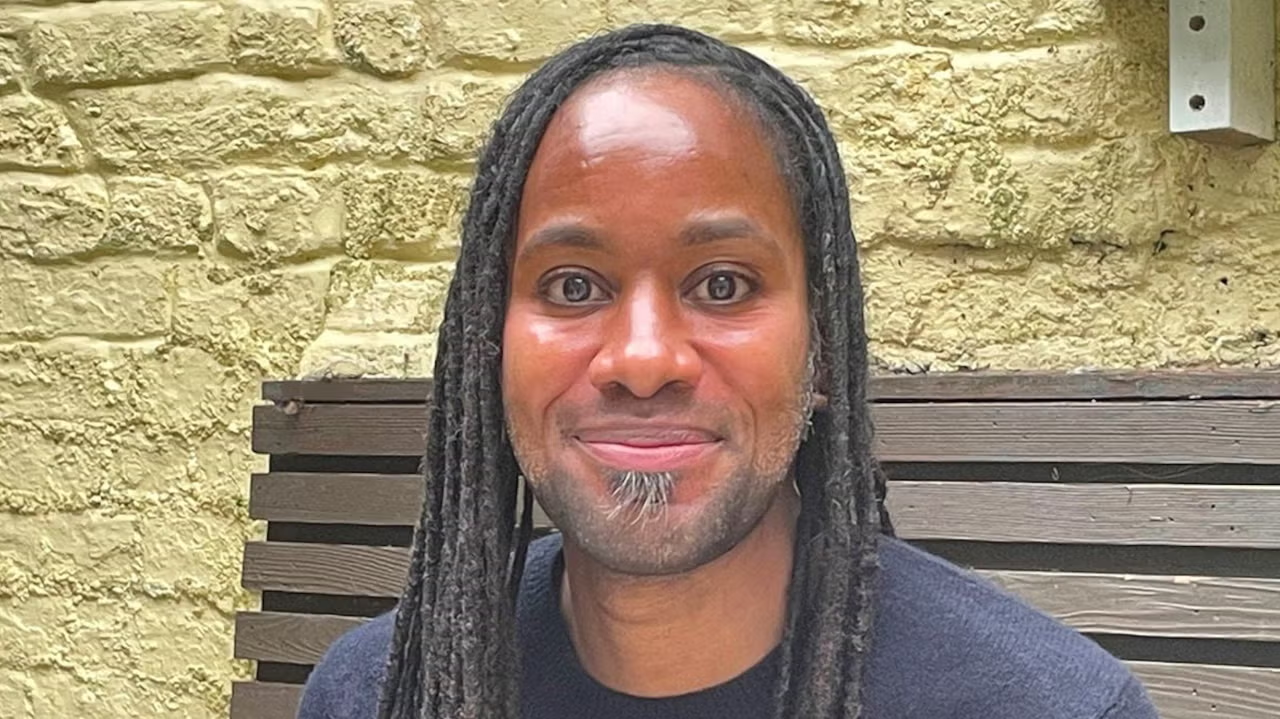
I can’t stop thinking about Jason Arday.
He is the British-Ghanaian professor at Cambridge University who was credibly accused of plagiarizing academic work and embellishing his life story in a storm of controversy in the past month, countered by accusations of racism that fell flat and ended suddenly with his resignation from the university in early August and his death by suicide a week after that.
It’s a tragedy, a nauseating one, drawn in the red ink of our hyper-charged identity politics.
Arday was not simply an apparent fabulist or fraud. He was an attention-seeking comer lacking the credentials for the top of academia where he was perched, supported by a university too eager to embrace a diverse candidate. When appointed at age 37, Arday was the youngest Black professor at Cambridge in its 800 year history. He died at 41.

The New York Times pointed out on Saturday that Cambridge was mostly to blame for this travesty.
“If, in hindsight, elements of Dr. Arday’s story seemed too good to be true, Cambridge ignored repeated warning signs,” the Times wrote. “In addition to passing over more experienced candidates for the job, administrators gushed publicly about Dr. Arday’s scholarship and privately disregarded complaints about his work. They declined to investigate plagiarism concerns and accused his critics of a ‘vile campaign’ to discredit him.”
When questions arose from both conservative activists with agendas and journalists without agendas, Cambridge doubled down. Arday even called the police on one journalist who asked questions. As scrutiny continued, Arday’s story spiraled swiftly to a Shakespearean end, driven by the social media mob and the public shame that can simply crush a person.
This story reflects the ugliest aspects of our culture wars in media. As I keep reading details of Arday’s supposed life journey — how he didn’t speak until age 11 or read until 18, yet earned his doctorate in his early 20s, how he ran 30 marathons in 35 days — I keep thinking about who will take this on as a Hollywood script and how.
It’s certainly stranger than fiction and too tempting to ignore. I’m sure the right will want to tell the Jason Arday story as a cautionary tale of too-much-woke: Here’s what happens when we put race ahead of merit. A left-wing version might make Arday a victim of the relentless desire to keep minorities down: A white person with autism would never have been hounded to death in this way.
Even bereft of a political slant, this is an irresistible ripped from the headlines story that may end up on a Dick Wolf show or a Netflix limited series.
Writing in The Atlantic, Tyler Austin Harper nailed the politics:
“Arday was fetishized in his ascendancy by white liberals, for whom he served as a mirror in which they could see their own goodness. And he was fetishized in his downfall by white conservatives who saw him as a test case for their own obsessions with an academic apparatus that they believe is not meritocratic enough — which is to say, not white enough.”
But haven’t we learned anything? The Arday story makes me think of all the other stories of fabulists who were enabled by good intentions surrounding race and gender.
That includes the infamous Jayson Blair, the overambitious young New York Times reporter who in 2003 turned out to be using drugs while inventing and plagiarizing news stories. His journalistic malpractice was enabled by a well-meaning top editor Howell Raines. Raines spent 25 years at the Times and stepped down over the Blair scandal.
It reminds me of the 2014 Rolling Stone “Rape on Campus” feature about the supposed gang rape of a woman named “Jackie” by fraternity bros at a party at the University of Virginia. The Washington Post exposed wild holes in the story, while the writer Sabrina Rubin Erdely admitted she didn’t want to ask the accuser too many questions so as not to retraumatize her. Turned out the fraternity members named did not exist or match records, no party took place as described and police found no credible evidence that the event occurred. The article was retracted, and Erdely and Rolling Stone were both found guilty of defamation with malice.
And of course there’s Janet Cook, who in 1980 won a Pulitzer Prize at the Washington Post under the tutelage of legendary Watergate reporter Bob Woodward. Cook wrote about an eight-year-old heroin addict named Jimmy who turned out to be invented. She resigned, returned her Pulitzer Prize and left journalism forever.
It turns out that academic and journalistic power brokers who are too eager to be the agents of social justice and racial or gender equality can be tripped up by their good intentions.
The Arday story isn’t just ugly, it has broad repercussions. It undermines the accomplishments of legitimate scholars of color and makes their journey harder. For those looking for proof that Black people are intellectually inferior, it feeds a toxic, false narrative.
In The Atlantic, writer Harper (a former professor) offered this searing insight:
“I have written, in this magazine and elsewhere, about what it is like to be the beneficiary of affirmative action in elite spaces. I have seen, firsthand, the way a specific kind of white progressive treats Black men who have overcome obstacles. They cannot conceal a certain blend of pity and glee when they learn, for example, that my biological father left before I was old enough to walk, or that I was raised for a time by a single mother. It is a look that says, How far you’ve come, and how kind I am for helping you go further.”
It is fascinating to go back a few short years, no more than five, and see how our own framing has shifted from Woke 1 to Trump 2. Just a few years ago we were called upon to greet every day as anti-racists, to post our pronouns in our email signatures, to offer land dedications at our regular gatherings. The goal was to make our society better, more equal, more compassionate.
Those days are long gone, replaced by shrinking spaces for people of color, the end of affirmative action and actual punishment by law enforcement for DEI. And in Hollywood we are facing significant backsliding in hiring women, in greenlighting stories of Blacks, Asian Americans and Latinos and in portraying gay and trans characters on screen.
Arday’s story lands in the middle of all this, with a lesson to be learned. There’s a great satire to be written here, once the tragedy of this personal loss fades away. And as I think about Jason Arday I yearn for the sharp pen of “American Fiction” writer Cord Jefferson and its originator Percival Everett, who saw all the absurdity in the culture wars of publishing and academe, and made it hilarious art. The film told of a Black university professor who adopted the persona of a felon-turned-writer, to the delight of his publisher. The Jason Arday story, when it is told, deserves our deepest reflection.

>

The autopsy on Hayden Panettiere has been completed and it shows no signs of trauma, according to the Greenville County Coroner’s Office as reported by TMZ.
“No signs of trauma were discovered that would have contributed to the death,” the statement read. “The cause and manner of death remain pending further investigation and the completion of additional studies.”
As we reported earlier, a friend of Panettiere’s called 911 at around 1:50 p.m. on Sunday reporting an “unresponsive female.” On the audio, medics were heard discussing an “overdose” and “cardiac arrest” around the time of her death. Paramedics attempted to resuscitate Panettiere using “advanced cardiac life support,” but she was pronounced deceased at the scene.
Panettiere had been open about her decades-long struggle with addiction, which was intertwined with severe postpartum depression, childhood trauma, and industry pressure. The actress was cast in Heroes at 16, and graduated to drinking and occasionally taking opioids. “My saving grace is that I couldn’t be messy while on set and working,” she said. “But things kept getting out of control [off set]. And as I got older, the drugs and alcohol became something I almost couldn’t live without.”
RELATED: Hayden Panettiere: Her Life & Career In Photos
In May, just three months before her death, she published her raw tell-all memoir, This Is Me: A Reckoning, detailing her ultimate fight for sobriety and the profound physical toll of her addiction.
Known best for her starring roles on Heroes and Nashville, Panettiere was a child star who appeared in commercials and had a four-year run as Sarah Roberts on One Life to Live (1994-97), and then on The Guiding Light as Lizzie Spaulding. She made her feature film debut at age 9 with a voice role in A Bug’s Life, and that same year appeared in The Object of My Affection. She went on to appear in the Denzel Washington starrer Remember the Titans in 2000, and in 2004, was cast in her first starring role as the daughter of actor Bill Pullman’s character in Tiger Cruise on The Disney Channel. Her final film Sleepwalker, a psychological thriller about a mother who has fightening visions after losing her daughter in a car accident, was released in January. Panettiere was 36.
>

How to watch Wings vs. Valkyries: TV channel and streaming options for August 17

France’s Top Court Blocks Under-15 Social Media Ban

‘Your Friends And Neighbors’ Creator On Making Emmy History
-

 movies3 months ago
Search For Canadian TV Actor Stewart McLean Now Homicide Investigation
-

 Fashion9 years ago
These ’90s fashion trends are making a comeback in 2017
-
Fashion9 years ago
According to Dior Couture, this taboo fashion accessory is back
-
Fashion9 years ago
Model Jocelyn Chew’s Instagram is the best vacation you’ve ever had
-
Fashion9 years ago
Emily Ratajkowski channels back-to-school style
-
Fashion9 years ago
9 Celebrities who have spoken out about being photoshopped
-
Fashion9 years ago
Your comprehensive guide to this fall’s biggest trends
-
Fashion9 years ago
A photo diary of the nightlife scene from LA To Ibiza