
Tech
Spotify’s new Playlist Notes let users and editors explain their song picks

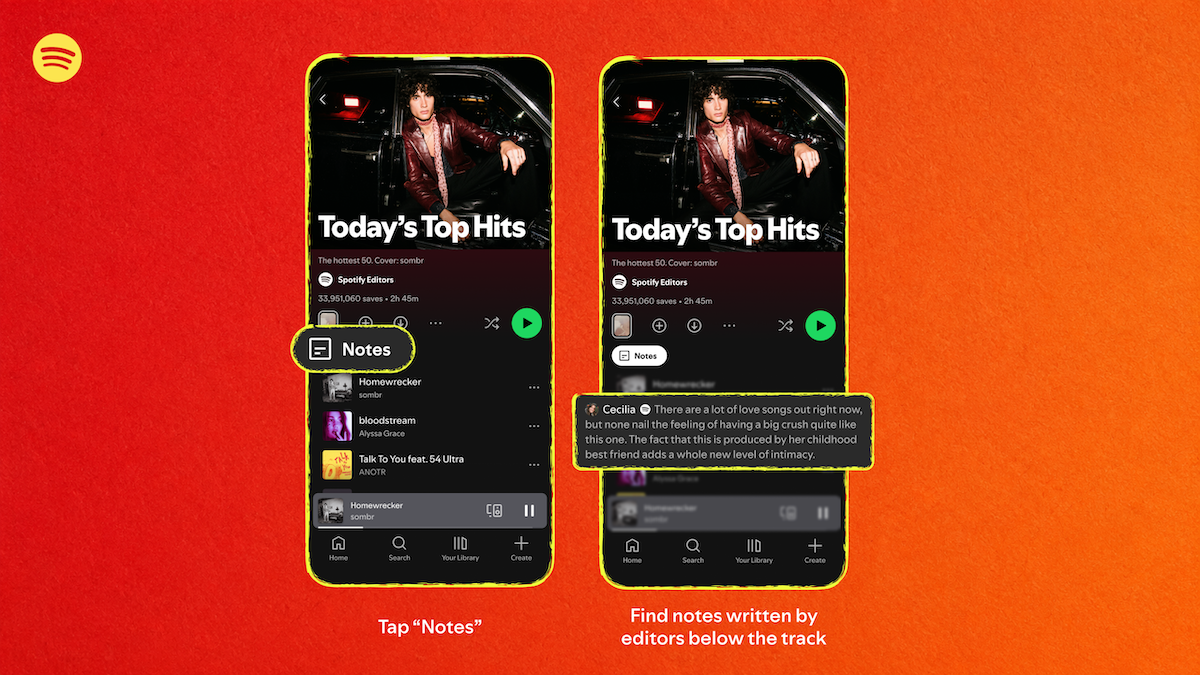
Spotify announced Monday the launch of “Playlist Notes,” a new feature that lets listeners add their thoughts to the playlists they make. The feature builds on “User Notes,” which the streaming giant debuted last month, allowing people to add personal notes to individual tracks.
With Playlist Notes, users can add context to songs, podcast episodes, and audiobooks in their playlists. Maybe a song reminds you of someone, brings back a specific memory, or is simply a track you think everyone should hear.
To add a note, go to the mobile app, then open a playlist that you either own or collaborate on, tap the three dots next to a track, podcast episode, or audiobook, choose “add note,” and save it. Anyone who can view the playlist can see the note.
Spotify is also bringing the idea to its own editorial playlists. Now, Spotify’s editors can add notes explaining why they picked certain songs. To start, listeners will see the feature on some of Spotify’s biggest playlists, including Today’s Top Hits, RapCaviar, Hot Country, All New Pop, and Fresh Finds Hip-Hop.
There’s a new profile feature for those editors, too. Editor Profiles show an editor’s top tracks and albums, along with the playlists they work on. It gives listeners a bit more insight into the people behind Spotify’s curated recommendations.
User-created notes are rolling out on iOS and Android devices in more than 100 markets. Editor notes and profiles are rolling out to free and premium users ages 16 and older in the U.S., Canada, the U.K., Ireland, Australia, and New Zealand.
While it’s arguably a small feature, it fits into Spotify’s bigger push to make the app feel more social and personal, giving users a chance to explain the stories and reasoning behind their favorite music.
It also gives Spotify another way to stand out from rivals Apple Music and YouTube Music. The company recently reported its Q2 earnings, touting that it surpassed 300 million subscribers for the first time. It also reached 777 million monthly active users.
When you purchase through links in our articles, we may earn a small commission. This doesn’t affect our editorial independence.
>

Relay, an AI-powered workflow automation tool that was launched in 2021 with the goal of becoming the new Zapier, is shutting down, and some of its staff — including its top executive — are joining Google’s Chrome team.
Jacob Bank, Relay’s founder and CEO, shared a company announcement Monday that reveals the app will be shutting down access for paying customers on September 14. Free customers would have already lost access as of August 15. The app’s closure was initially announced in July.
Bank, who previously spent a little over six years at Google, revealed that he would now be rejoining the tech giant as VP of Product for Google Chrome, where he will lead the product and developer relations teams for Chrome, according to his LinkedIn.
“I’ve spent my whole career doing one thing: building tools that help people get more done with AI, without sacrificing their personal creativity or insights,” said Bank in a post on X. “And joining the Chrome team is an ideal opportunity to bring those experiences to many, many more people.”
“We have some really ambitious plans to help you work with AI in Chrome to get things done, and I’ll have more to share soon,” he added.
Bank originally joined Google in 2015 after his previous startup, a scheduling app called Timeful, was acquired by the search giant. At Google, he worked in a number of different areas, including as product lead for Gmail, Google Calendar, and Google Chat, before eventually leaving to launch Relay.
Similar to Timeful, Relay offered users productivity upgrades via workflow automation, allowing businesses to streamline repetitive tasks like document drafting and copyediting, as well as various project management tasks. TechCrunch reached out to Google and to Relay for more information.
Just how Bank and others plan to further integrate AI into Chrome is a hanging question, though Bank calls Chrome “a perfect place to collaborate with agents.”
The move follows a steady path of AI integration into Google’s user experience. The integration of Gemini into search has fundamentally altered Google’s front end — not to mention the rest of the internet. Gemini has also been integrated into Chrome, where it serves as an optional in-browser assistant.
Overall, users seem to be responding well to these integrations, as Google recently reported that Gemini had crested 1 billion users.
When you purchase through links in our articles, we may earn a small commission. This doesn’t affect our editorial independence.
>
France’s Finance Ministry has confirmed that a cyberattack on the country’s tax authority resulted in the theft of personal and professional taxpayer data, potentially putting the information of hundreds of thousands of people at risk.
The ministry said Thursday that a “malicious actor” claimed to have broken into the Directorate General of Public Finances (DGFiP) in late June. An investigation confirmed that attackers had gained access to the agency’s systems and were able to consult and extract taxpayer information.
French officials are still trying to determine what exact information was taken and how many people were affected, with the precise scope of the breach still under investigation. The ministry said people whose information was compromised will be notified directly and informed about which data may have been exposed and what precautions they should take.
The number of potential victims could be substantial. The specialised cyberattack monitoring platform, FrenchBreaches, said that about 678,000 records were stolen, including roughly 393,000 individuals and 286,000 professionals.
Reuters noted that the French Finance Ministry has not confirmed those figures.
What taxpayer information was exposed?
The reported stolen information could give criminals plenty of material for targeted scams and identity theft.
According to reporting by Brussels Signal, the potentially exposed information includes names, addresses, dates of birth, reference tax income, withholding tax rates, family circumstances and some property-related information. The dataset also allegedly contained internal tax identifiers, information about dependents and records of previous interactions with the tax administration.
That combination is particularly concerning because tax records can provide attackers with a detailed profile of an individual or business. Such information could potentially be used to facilitate identity theft, targeted phishing campaigns or other forms of fraud.
FrenchBreaches also reported that the stolen information was being offered for sale for several thousand euros. Those details came from the alleged attackers and have not been independently confirmed by French authorities.
Attack reportedly went undetected
There are also unanswered questions about how the attackers managed to extract data without the data theft being detected.
Le Monde reported that the unauthorized access was identified and cut off at the end of June during a routine security check. However, the agency apparently did not detect that data had already been extracted at the time. The incident only became public after the alleged attacker claimed responsibility on a cybercrime forum and offered stolen data for sale.
The alleged attacker, operating under the name ZeroBytes, claimed to have accessed an internal DGFiP tool through a virtual private network using stolen professional credentials. The DGFiP has not confirmed the account of the attack.
The DGFiP has since strengthened its access controls, while the French Ministry said it will report the incident to France’s data protection regulator, the CNIL, and file a formal complaint. The investigation is being carried out with help from France’s national cybersecurity agency, ANSSI.
Must-read security coverage
Another cybersecurity challenge for France
The incident is the latest in a growing list of cyberattacks targeting French government institutions in recent months.
In February, the French Finance Ministry disclosed that an attacker had gained unauthorized access to information associated with approximately 1.2 million bank accounts in the country’s FICOBA registry by using stolen official credentials. Authorities said there was no known connection between that incident and the latest DGFiP breach.
Later in April, France’s National Agency for Secure Titles (ANTS), which handles documents such as identity cards, passports and driving licenses, disclosed a breach affecting potentially 11.7 million accounts. That incident prompted Prime Minister Sébastien Lecornu to announce a €200 million ($232 million) cybersecurity initiative funded through the France 2030 investment program.
Lecornu said France had been seeing roughly three data theft incidents per day since the beginning of 2026.
French authorities have not yet established the full scope of the DGFiP breach, meaning the reported figure of nearly 700,000 affected records remains unconfirmed.
Until investigators determine exactly what was stolen, taxpayers notified by the agency may need to treat convincing tax-related emails, calls and other requests with additional caution — particularly when they contain personal information that would normally make a message appear legitimate.
Other Security News: Microsoft is pushing Entra ID users toward passkeys as it moves away from SMS and voice-based authentication methods that are more vulnerable to phishing and interception.
>
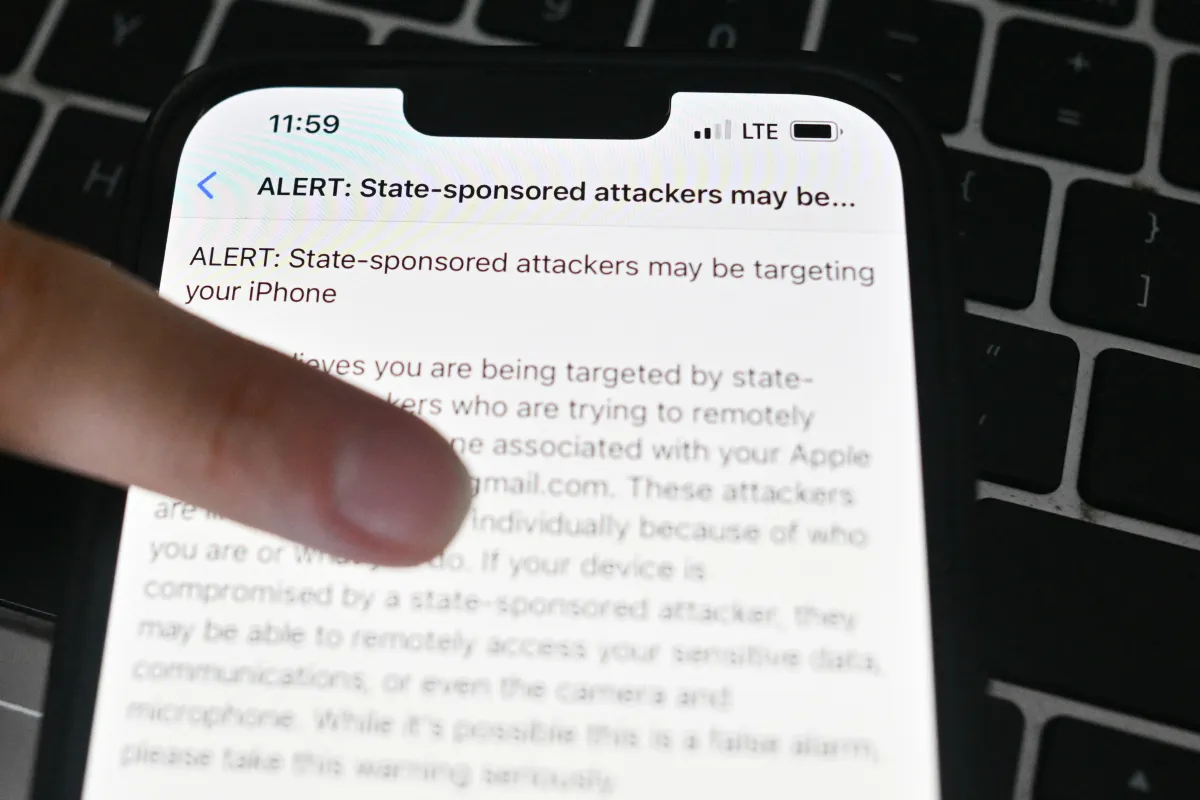
An unprecedented number of Apple customers have reported receiving a recent threat notification alerting them to suspected spyware attacks targeting their devices, according to experts who investigate these types of incidents.
Several people publicly and privately reported receiving Apple’s spyware alerts over the weekend, after Apple sent out a new wave of notifications on Friday alerting customers in 110 countries that they had been targeted with powerful spyware.
From time to time, the technology giant sends these types of alerts in batches to customers that it believes have been either targeted or compromised with malware normally used by governments, which the company refers to as “mercenary spyware.” In the last few years, Apple says it has alerted people in more than 150 countries.
The latest batch appears to have been the largest yet, per one of the digital rights groups that Apple suggests victims of spyware reach out for help.
Mohammed Al-Maskati, the director of the Access Now team of investigators who review and investigate reports to the helpline, told TechCrunch that since Friday, they have received a record high number of people reaching out for help. This includes people who had already received threat notifications in the past.
Al-Maskati said the number is around 30% to 40% more than the nonprofit’s investigators usually receive after Apple sends out new notifications.
An unusually large number of people have also publicly reported receiving these notifications over the weekend as well, according to several social media posts.
Contact Us
Have you received a notification from Apple about being targeted with mercenary spyware? Or do you have information about spyware makers? We would love to hear from you. From a non-work device, you can contact Lorenzo Franceschi-Bicchierai securely on Signal at +1 917 257 1382, or via Telegram and Keybase @lorenzofb, or email.
One of them is a Ukraine Armed Forces soldier who said he is fighting the war against Russia. The soldier, who asked to remain anonymous to protect himself, said that he initially thought it was a scam, until he verified it with Apple.
“I was a bit surprised to be honest, I wouldn’t have thought I was important enough for them to target me like this. I am flattered though,” the soldier told TechCrunch.
The soldier also said that he is aware of other people in Ukraine’s military who have received the same notification. “They were a bit worried,” he said.
The Computer Emergency Response Team of Ukraine (CERT-UA) did not respond to TechCrunch’s request for comment, asking whether it was aware of other Ukrainians, particularly soldiers, receiving these notifications.
John Scott-Railton, a senior researcher at The Citizen Lab, a digital rights group that has investigated government spyware attacks for more than 15 years, told TechCrunch that the reports show that spyware attacks may be more prevalent than people realize.
“The scale and geographic diversity of public posts about receiving notifications are pretty unprecedented,” said Scott-Railton. “For every public notification like this, you can imagine there’s a huge notification iceberg that the public will never learn about. This is a clear indication that something bigger is going on.”
Both Al-Maskati and Scott-Railton said that the volume of people receiving the alerts could also be attributed to Apple’s new methods of alerting users.
Starting this year, Apple now notifies users on their iPhone lock screen, in their Settings app, via the email associated with their Apple account, and when users log in to their Apple Account on the web.
“Apple’s new notification method has helped raise awareness of the issue’s importance, making it harder for users to ignore,” Al-Maskati said.
Apple did not respond to TechCrunch’s request for comment.
If you’ve received one of these notifications, take it seriously. If you are not a journalist, dissident, or human rights defender, there are other organizations that can help you investigate.
If you haven’t already, as Apple and experts suggest, turn on Lockdown Mode, a special security feature designed to make it harder to hack iPhones, iPads, and Mac computers. Apple has said that it is not aware of anyone who had Lockdown Mode enabled getting hacked.
When you purchase through links in our articles, we may earn a small commission. This doesn’t affect our editorial independence.
>

‘Ghost Rider’ Sets July 2028 Release; Other Disney 2028 Pic Dates From D23

Jack Whaley: Emotional golfer credits dad for US Amateur glory

Chris Hansen Questions Motive of Robert Pattinson’s Primetime
-

 movies3 months ago
Search For Canadian TV Actor Stewart McLean Now Homicide Investigation
-

 Fashion9 years ago
These ’90s fashion trends are making a comeback in 2017
-
Fashion9 years ago
According to Dior Couture, this taboo fashion accessory is back
-
Fashion9 years ago
Model Jocelyn Chew’s Instagram is the best vacation you’ve ever had
-
Fashion9 years ago
Emily Ratajkowski channels back-to-school style
-
Fashion9 years ago
9 Celebrities who have spoken out about being photoshopped
-
Fashion9 years ago
Your comprehensive guide to this fall’s biggest trends
-
Fashion9 years ago
A photo diary of the nightlife scene from LA To Ibiza