
Tech
GitHub Copilot Coding Agent Can Now Use Microsoft Teams Conversations

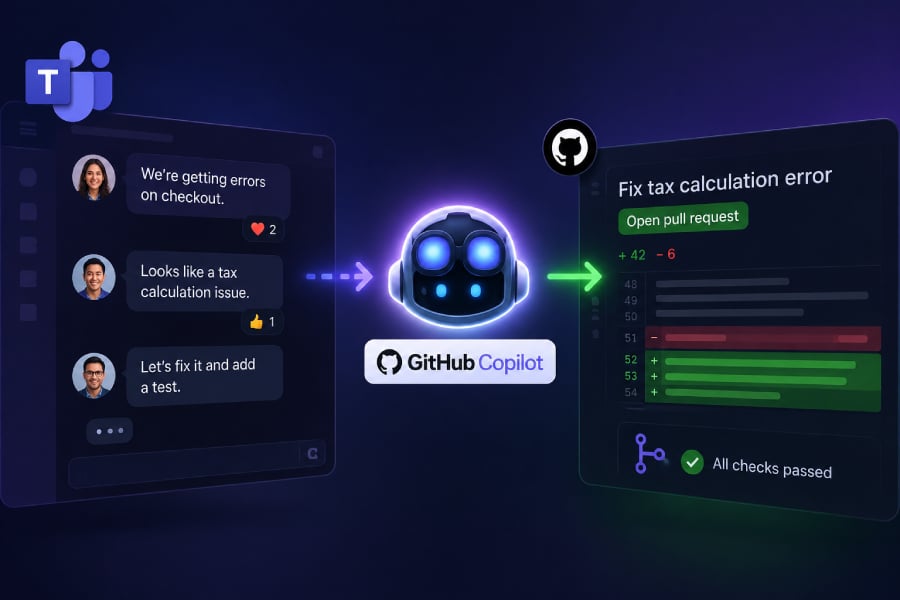
GitHub is removing a tedious step from AI-assisted coding: explaining to the coding agent everything the team already discussed.
The Copilot coding agent can now use Microsoft Teams conversations as context for a software task, combining what developers have discussed with information from the connected GitHub repository.
That allows the agent to investigate an issue, implement changes, and create a pull request without requiring a developer to first reconstruct or summarize the team’s conversation as a new coding prompt.
The result is a shift from context transfer to a different kind of context access. Consider a typical development conversation:
A development team might discuss an application error in Teams, identify the affected component and agree on a possible fix. Instead of copying that discussion into a new prompt, a developer can @mention GitHub’s coding agent in the conversation.
The agent can then use the Teams discussion alongside the connected repository to investigate the issue, make changes and open a pull request for review.
While Copilot in Teams was introduced in September 2025, the latest development builds on that foundation by making the conversation itself a more direct source of context for the coding agent.
The workflow also remains tied to GitHub’s existing development controls. Copilot’s output is not simply pushed from a casual chat straight into production. The workflow remains subject to GitHub’s existing repository permissions and pull-request controls, meaning Copilot’s changes can still be reviewed before they are merged.
That makes the change less about adding another AI interface to workplace chat and more about reducing the distance between where software decisions are made and where those decisions are implemented.
More must-read AI coverage
Why Teams Context Matters for Copilot
At the center of this change is context. Enterprise AI vendors have increasingly connected their assistants to the documents, messages and business systems employees already use. There is another enterprise concern that could be behind this push: shadow AI.
The term generally refers to employees using AI systems that have not been approved by their organization, often because the sanctioned tools do not fit the task or are harder to use.
Keeping the AI workflow inside tools an organization already manages can reduce some of that pressure. Instead of a developer copying a private code fragment or internal project discussion into an unsanctioned chatbot because it works for them, the company can provide an approved agent within the workplace environment where the work is already happening.
Taken together, the integration could reduce the back-and-forth involved in transferring requirements from workplace conversations into coding tools.
Availability and pricing
Microsoft says the Teams integration is currently available in public preview through the desktop and web apps. Developers will need access to the relevant Teams environment, GitHub repository and Copilot coding agent capabilities.
The bigger shift is where the coding prompt begins. Instead of developers repeatedly translating workplace discussions into instructions for an AI agent, the conversation itself can increasingly become part of the agent’s working context.
Other News: Microsoft is removing the legacy WMIC command-line tool from Windows 11 beta builds, pushing administrators toward PowerShell and other newer management tools.
>
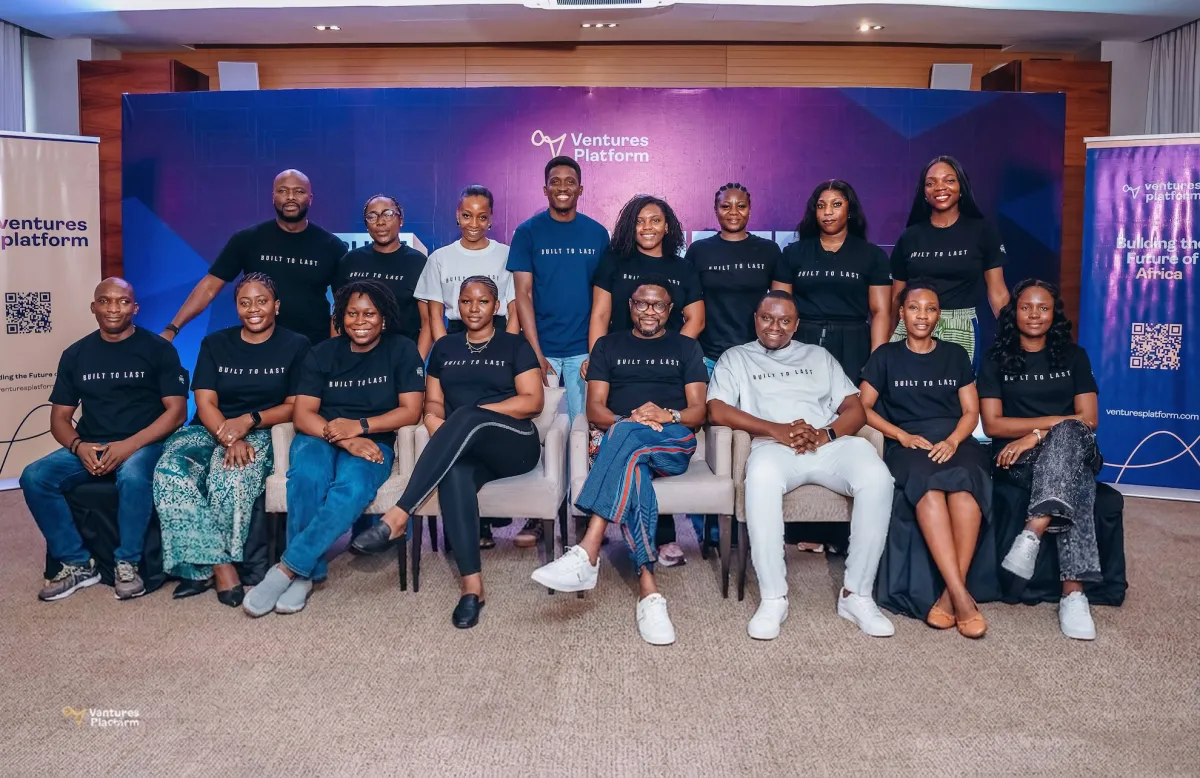
Ventures Platform has raised an oversubscribed $83 million second fund as the Pan-African venture firm expands beyond its home market of Nigeria with a strategy shaped by a tougher, more selective venture market.
The firm plans to back early-stage founders across a range of sectors, including fintech, healthcare, SaaS and other areas “where technology can address essential needs and build large, enduring businesses,” Kola Aina, the firm’s founding partner, told TechCrunch.
Of course, AI is part of that thesis.
“We’re particularly interested in where AI changes the economics of serving African markets,” he said, pointing to its potential to reduce the cost of delivering services and help overcome labor shortages. “For us, AI is most interesting when it is not simply a feature, but an enabler of an entirely different cost structure, business model or market.”
Ventures Platform, which is headquartered in Nigeria, previously raised a $46 million Fund I in 2022 with a similar, albeit more limited scope. The first fund focused primarily on pre-seed and seed rounds.
“It allowed us to demonstrate that our approach to early-stage investing in Africa could work at an institutional scale and laid the foundation for Fund II,” Aina said.
Now, Ventures Platform is back with a larger fund and wider geographic mandate.
The firm is expanding its focus beyond Nigeria and has already written checks from Fund II to five companies based in Kenya, South Africa, and Egypt. Check sizes will be up to $3 million, and the firm hopes to deploy the capital over the next three to four years.
“We are particularly interested in markets where technology can expand access to essential products and services, address critical infrastructure gaps, and create entirely new categories of consumption,” Aina said.
The fundraising process took about a year and a half, with Aina describing the environment as more “selective,” than it was when Ventures Platform raised Fund I.
“LPs are asking harder questions about performance, portfolio construction, liquidity, manager discipline, and differentiation,” Aina said.
From his perspective, the market is still cautious, as LPs demand more evidence that managers can turn portfolio value into realized returns. Capital is no longer assumed to be unlimited, especially after many LPs felt burned by the venture bust a few years ago.
“The result is a much greater appreciation for capital efficiency, stronger fundamentals, governance, regulatory engagement, and the importance of building businesses that can survive different funding cycles,” he said. “There is a much clearer understanding that building valuable companies and generating venture returns require more than simply raising successive rounds of capital.”
This year, African startups have raised around $930 million across more than 200 deals. Last year, startups on the continent raised $1.16 billion across 447 deals.
As TechCrunch previously reported, the venture market is now a barbell — with LPs giving capital to a handful of firms at the top and to emerging managers with a track record they can trust.
“Three years ago, there was still a significant amount of curiosity around the African opportunity. Today, LPs expect proof,” Aina said, adding that this discipline is actually healthy for the market.
“The conversation has moved from ‘Why Africa’ to ‘Why you and how exactly are you going to generate returns,’” he said, adding that simply being a pan-African fund is no longer a strategy. LPs want to know more about access to top talent, how funds are navigating individual markets, and “why you have the right to win,” Aina said. “That combination of local depth and global connectivity is increasingly important as the ecosystem matures.”
In fact, he said that is the biggest edge his firm offers. This latest generation of founders and fund managers has seen what it is like to deal with both an abundance of capital and hardly any at all. He said it’s more important than ever to understand the institutional and market realities founders face while also connecting companies to regional and global networks as they scale.
That pitch seems to have resonated with existing investors: 70% of Fund I’s LPs returned for Fund II. Backers include the European Bank for Reconstruction and Development, Norfund (Norway’s development finance institution), and Ghana’s Ashesi University Foundation.
“We don’t take that for granted,” he said.
When you purchase through links in our articles, we may earn a small commission. This doesn’t affect our editorial independence.
>
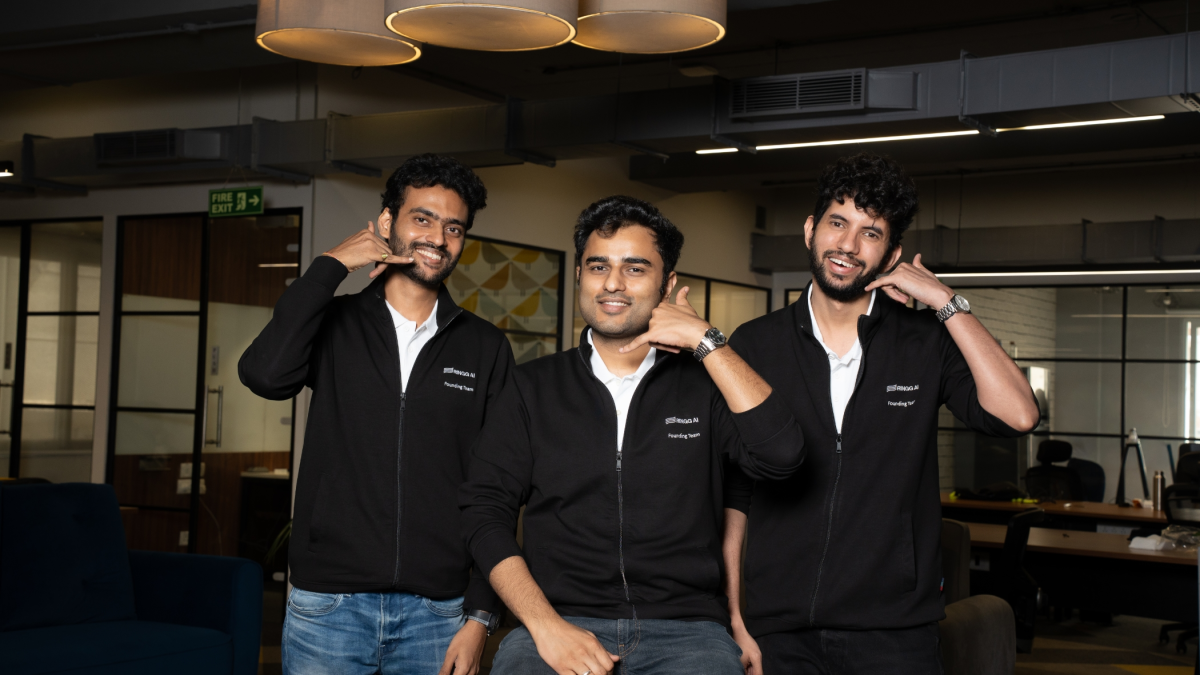
More than 76% of consumers in India prefer talking to businesses over a phone call, according to a recent study from Truecaller. Since voice is still consumers’ preferred way to communicate, that leaves a big opportunity to automate support and outreach calls using voice AI in the country. Voice AI startup Ringg, which already processes 20 million call attempts a month, is betting that volume keeps climbing over the coming months, and it just raised more money on that belief.
The company said today it has landed $10 million from Peak XV Partners as an extension of its Series A. It had previously raised $5.5 million in a Series A round earlier this year, bringing the round’s total to $15.5 million.
Ringg started life as a text-to-speech startup called DesiVocal, but training its own speech models proved expensive, so the founders moved up the stack — building voice AI agents for enterprises instead. Indian fintech Cred became its first customer, and Ringg has since signed Indian startups like Flipkart, Practo, Groww, and PolicyBazaar.
“At the start, we were doing high-volume, low-complexity use cases like outbound calling, lead qualification, loan collection, and more. We quickly realized these are not sticky use cases, and so it’s always going to be a price game,” the startup’s co-founder Siddharth Tripathi told TechCrunch.
Ringg still serves some of those simpler use cases, but it has set its sights on more complex workflows: appointment booking for healthcare clinics, abandoned-cart recovery for e-commerce sites, and onboarding/KYC (“know your customer”) checks for fintech apps.
Tripathi said Ringg’s voice agent now runs across 1,200 clinics for the healthcare app Practo, helping patients book visits or follow up on next steps post-visit.
Voice calls still make up over 70% of Ringg’s business, but the startup has started branching into other channels, including chat and WhatsApp. For some clients like Shell, it’s also automating browser-based support requests.
“We are trying to position ourselves as a platform for agents that bring outcomes or get things done rather than voice agents for enterprises,” Tripathi said.
Most of Ringg’s customers are based in India, with a handful in the Middle East and the U.S. But the startup isn’t trying to sell directly to U.S. companies; instead, it wants to partner with so-called Global Capability Centers in India — the offshore hubs multinationals increasingly lean on for back-office and support work — to sell automation capacity alongside human support.
Tripathi said the company builds its own speech recognition and generation models, and would eventually like to own the full voice stack, including infrastructure and deployment. For now, though, that remains too costly, so the product works as an orchestration layer, routing tasks to different models depending on the use case.
Rishen Kapoor, a principal at Peak XV, said that because Ringg started as a research lab building its own models, that technical depth shows up in the complex use cases it’s now tackling.
“Because of the technical capabilities, they can actually do these hard-won enterprise workflows end to end. They can complete these higher-value tasks like merchant onboarding, like L1 and L2 support, with quality and with consistency,” Kapoor told TechCrunch.
Voice AI in India is a crowded field. Model makers including Deepgram, ElevenLabs, Cartesia, and local players like Sarvam and Smallest.ai, are all jockeying for pole position. Orchestration-focused startups like Bolna and Blue Machines are chasing the same layer Ringg occupies, while sector-focused players like Gnani and Arrowhead concentrate heavily on finance.
That layered stack — model makers, orchestrators, and application-layer players all trying to lock in enterprise workflows — is itself the story. The money and the defensibility increasingly sit with whoever owns the customer relationship and the outcome.
Ringg currently has 40 employees, with more than 15 hired in the last three months. The startup is hiring for forward-deployed engineer roles that combine technical chops with product management skills, along with researchers focused on bringing down the cost of running its models.
When you purchase through links in our articles, we may earn a small commission. This doesn’t affect our editorial independence.
>

Generalist, a robotics startup, is now valued at $3 billion after raising additional capital led by 8VC, according to two people with knowledge of the funding.
The fresh capital totals nearly $200 million according to a regulatory filing. That additional capital is an extension of a $400 million Series B led by Radical Ventures that the company announced in June at a $2 billion valuation, the people said. The new capital brings the round’s total funding to $600 million.
Generalist and 8VC didn’t respond to a request for comment.
Generalist was founded in 2024 by former Google DeepMind researchers Pete Florence and Andy Zeng, along with former Boston Dynamics engineer Andrew Barry. It received early backing from 8VC and Radical Ventures as well as Nvidia, Union Square Ventures, Bezos Expeditions, and AI researcher Fei-Fei Li.
Until recently, the startup operated quietly and with little publicity.
Generalist is developing an AI foundation model that can work with various robots. It claims its newly released Gen 1.5 model enables robots to master new tasks from video demonstrations as short as 3 to 12 seconds long.
The startup is working with a handful of customers, using their feedback to tailor the model for specific use cases, according to one source.
Generalist isn’t alone in its pursuit of building a brain for a broad range of robots. Other competitors include Physical Intelligence, which is reportedly valued at $11 billion, and SoftBank-backed Skild AI, valued at $14 billion, as well as Genesis AI, which was in talks as of last month to raise capital at a $3 billion valuation.
The funding surge reflects a bet from some investors that robotics may soon reach its own “ChatGPT moment,” meaning that robots will be able to perform general tasks without being explicitly trained for each one. However, because robots cannot be trained on the entirety of the internet’s data the way LLMs can, some VCs warn that a truly general robotics model may still be years away.
When you purchase through links in our articles, we may earn a small commission. This doesn’t affect our editorial independence.
>

Southampton 1 – 4 West Ham

Omar Marmoush to undergo Tottenham medical ahead of loan with obligation move from Manchester City

Raheem Sterling charged with dangerous driving after crash on M3 in Hampshire
-

 movies3 months ago
Search For Canadian TV Actor Stewart McLean Now Homicide Investigation
-

 Fashion9 years ago
These ’90s fashion trends are making a comeback in 2017
-
Fashion9 years ago
According to Dior Couture, this taboo fashion accessory is back
-
Fashion9 years ago
Model Jocelyn Chew’s Instagram is the best vacation you’ve ever had
-
Fashion9 years ago
Emily Ratajkowski channels back-to-school style
-
Fashion9 years ago
9 Celebrities who have spoken out about being photoshopped
-
Fashion9 years ago
Your comprehensive guide to this fall’s biggest trends
-

 Anime3 months ago
Rurouni Kenshin: Hokkaido Arc Manga Takes 1-Issue Break – News