Connect with us

Sports

The T206 Honus Wagner: Latest historic sales and why he objected to the card

Published

on

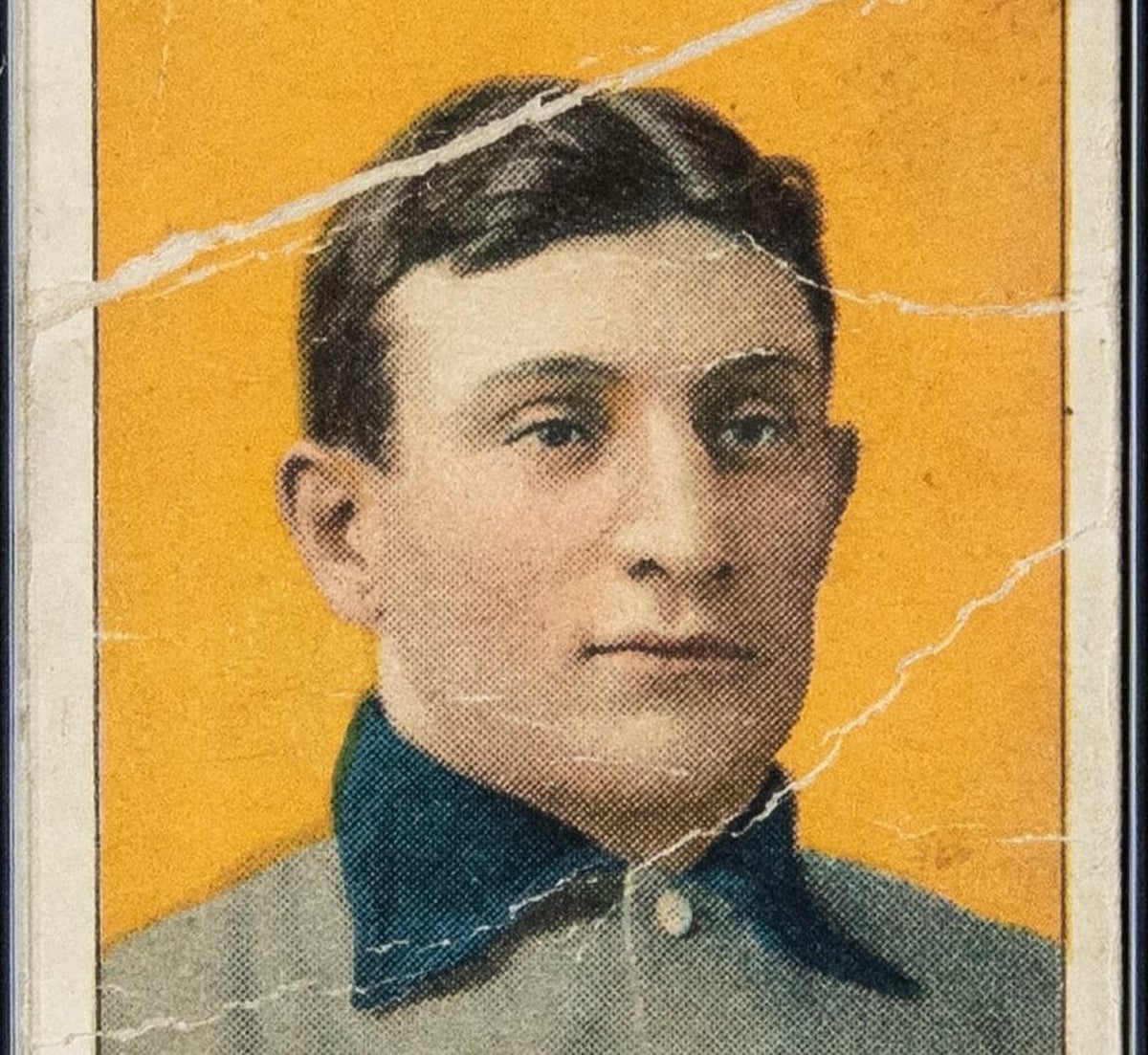
Only a T206 Honus Wagner trading card can look like it was half-eaten by a dog and still sell for nearly $500,000 in 2022 and carry an estimated value of nearly four times that price today. Only a T206 Honus Wagner can be cut with a scissors around the outline of the player and be reconstructed with bones of other cards and still sell for more than $1 million.

No athlete in the history of sports card collecting truly carries the same weight as Wagner and his rare, expensive and almost mythical T206 card, first produced in 1909. Even though more modern athletes like Michael Jordan, Kobe Bryant, Shohei Ohtani and LeBron James appear on cards that have now sold for at least $10 million, there’s still only one “Holy Grail” card — the T206 Wagner, which took the top spot in The Athletic’s list of the 10 most important baseball cards of all time earlier this year.

“You’ve got the rule of Wagner,” said Chris Ivy, director of sports auctions at Heritage. “I’ve never seen any collector lose money on one.”

The general consensus among experts is that there are around 60 T206 Wagner cards in existence, bringing scarcity without the help of serial numbers and purposefully limited manufacturing used with modern cards.

“(Wagner) has just become the symbol for baseball card collecting,” Ivy said. “Given how popular the T206 set is from the American Tobacco Company, distributed multiple brands over a multi-year period, but only about 60 people in the world have the capability to complete the set because it requires Honus and (Eddie) Plank and the (Sherry) Magee error.
This (Wagner) card is that missing link for anyone that’s trying to collect the set.”

An example of the T206 Honus Wagner card with a Sweet Caporal back passed down through the Shields family over more than 100 years before it was sold at auction earlier this year for $5.1 million. (Photos courtesy of Goldin Auctions)

Former ESPN and news anchor Keith Olbermann, who’s owned five different T206 Wagners in his lengthy time as a baseball card collector, said the mystique is the simplest part of the story for the T206 Wagner.

“It was rare from the moment it came out,” said Olbermann. “The real explanation for why there is a mystique about this card is from what was certainly in the first century of sports memorabilia the most famous baseball card set and the card set that was the nostalgia point for every collector before probably 1940, and became this revered American touchstone for every collector before 1980, is simply it has always been scarce and it has always been a mystery.”

Olbermann said the topic of added value to the T206 Wagner card because of its scarcity first became a talking point almost accidentally while the vast T206 set was still being produced.

“There is a ‘letter to an editor’ kind of column about serious stuff in an Atlanta paper in 1911 that asks, ‘Is there an extra value to a Honus Wagner cigarette card?’ 1911! So this has been going on forever,” Olbermann said.

But why was there talk of the Wagner card carrying extra significance even then? The T206 set was produced between 1909 and 1911 by the American Tobacco Company, with the sprawling set’s more than 500 cards going into packs of cigarettes and tobacco across 16 brands owned by the company. (It didn’t get its name until well-known collector Jefferson Burdick devised a catalog system for his 1939 book “The American Card Catalog.” The “T” in T206 stands for “tobacco,” as there were also designations for cards made by bakeries, ice cream makers, publications, etc.) While most T206 cards were printed in such numbers that they are still plentiful today, more than 100 years later, production of the Wagner card was stopped early on.

“I have always thought, looking at what we have from the papers at that time, that perhaps, although it may not have been planned, at some point they might have turned this into (what) nowadays would have been called the ‘chase’ card,” Olbermann said. “They saw the value in having a Honus Wagner that was impossibly scarce, and then there suddenly was some sort of hullabaloo about it being withdrawn and the kids would still be out there trying to get it.”

Wagner was a Pennsylvania-born shortstop who played most of his 21-year, Hall-of-Fame career for Pittsburgh, where he won eight batting titles and a World Series. But the legend of Wagner’s refusal to be displayed on a cigarette card will forever accompany his rare T206 card.

Within Wagner’s chapter of The Athletic’s “Baseball 100,” author Joe Posnanski wrote that in 1909 the American Tobacco Company paid $10 to John Gruber, Pittsburgh’s most-read and influential sportswriter, to secure Wagner’s permission. The payday didn’t convince Wagner, though, spurring the Pirates star to pen this letter to Gruber:

Dear John,

I don’t want my picture in cigarets, but I don’t want you to lose the $10, so I’m enclosing my check for that sum.

Hans Wagner

The ATC had already printed some Wagner cards — estimates range from 50 to 200. But after getting word from Gruber, they immediately stopped. Posnanski wrote that baseball card historian Scot A. Reader estimated there were 370 million T206 cards printed from 1909 to 1911. That would be about 700,000 copies per card.

“The assumed answer for at least 60 years was that it was a simple question of his not wanting to have his picture associated — or his image or his reputation associated with cigarette cards or with cigarettes,” Olbermann said. “
And he refused to give permission and they printed the card anyway and had to withdraw it and had to literally send agents into the street to get the ones back that had been released.

“Whether or not that’s true, whether it was more about whether or not Honus got paid enough, it’s hard to say.”

In 1914, a letter written by Wagner with the headline “Wagner’s Advice To Boy Friends” appeared in the Pittsburgh Press. The first piece of advice? “I don’t think you could use a better line of talk than to tell a boy not to use tobacco and to let drink and lies alone; keep good hours, take plenty of exercise and not over-exert,” Wagner wrote.

But maybe the most concrete indication that Wagner’s disdain for cigarettes played the primary role for his desire to be excluded from the T206 set came within a newly resurfaced 1909 newspaper interview.

Paul Reiferson, an investment banker and photography collector, is working on a book about celebrated baseball photographer Charles Conlin. Reiferson began digging into the Wagner smoking/tobacco topic after seeing a Conlin 1914 photo of Wagner where the former Pirates shortstop wore “a little bit of tobacco juice” at the corner of his mouth.

“It just made me wonder whether we had all the facts about Wagner and his feelings about tobacco, given this legend,” Reiferson said. “I just followed that question into the newspaper archives.”

Reiferson sent The Athletic a Sept. 21, 1909 article published in the New Orleans States (originating from the Cincinnati Times Star) he discovered while researching for the book.

The reporter described Wagner’s reaction to being asked for his consent to appear in the T206 set as one that “showed that he had given the matter some thought before he made (his) answer.”

Wagner then said, “Not a chance in the world for me to allow myself to be used for advertising. Not that I think it makes any difference one way or the other, as I don’t amount enough to cut any ice in a matter of this kind. But I am opposed to the use of cigarettes, and if I can help it I would never have a person who smokes one within forty feet of me.

“If having my picture would help the sale of those cigarettes, I’d feel pretty mean about it, and so I must refuse to permit my picture to be used. If it were for a cigar or something else that looked worthwhile, I wouldn’t object. But cigarettes — never.”


As evidenced by the last few months, any T206 Wagner card in any condition that hits the open market sells for at least $1 million, and that’s typically a very conservative baseline.

Case in point, the T206 Wagner that just came off the block at Heritage Auctions.

The even rarer variation of the card (it’s one of three known with Piedmont cigarette advertising on its back — most have Sweet Caporal branding), which only carries the lowest condition grade of “Authentic” from SGC, sold for $5.86 million in an auction ending last weekend. It broke the record for the highest publicly known sale of an “Authentic” T206 Wagner by more than $2 million. The previous record occurred in February 2026 when the “Garagiola Wagner” (a Sweet Caporal) — once owned by famed former MLB player and broadcaster Joe Garagiola — sold for $3.599 million. This same copy fetched $2.52 million five years earlier.

The recently sold “FrankenWagner,” previously owned by Olbermann is also known as the “Die-Cut Wagner,” because the card was literally cut around the face and torso of the player and then pieced back together with parts of other T206 cards to create a restored version of one of the most famous trading cards ever produced. With a “restored” tag from grading service CGC, the card sold for $1.34 million via auction through Love of the Game earlier this month.

“The entire hobby and the structure of values of cards in this crazy hobby, the Wagner sits at the top and every other value of every other card is driven by what is the value of a Wagner,” Olbermann told The Athletic leading up to the auction.

In February 2022, a T206 Wagner with nearly half the card torn off and given a “Genuine” grade from PSA sold for nearly $475,960 through SCP Auctions. Online card sales database Card Ladder places that card with a current value of $1.83 million.

Overall, there have been more than 20 publicly known sales of a T206 Wagner north of $1 million. It was reportedly the first sports card to sell for more than $1 million in 2000. In 2016, it became the first publicly known $3 million sale of a sports card.

The T206 Wagner with the highest grade by some distance is the PSA 8 (on a scale of 1-10) owned by Arizona Diamondbacks owner Ken Kendrick. It was the first card ever graded by PSA, which now dominates the grading industry, but the edges of the card were trimmed before it was graded to make it appear to be in better condition than it actually was. Trimming is a major sin in the card world and enough to prohibit a card from getting a numbered grade in the modern landscape. But as Kendrick told Sports Card Investor in an interview last year, he believes that the card being the subject of wrongdoing makes it more valuable, like John Dillinger’s gun.

Top 5 publicly known T206 Wagner sales to date

  1. $7.25 million — SGC 2 grade; best offer; private sale; Aug. 4, 2022
  2. $6.61 million — SGC 3; auction via REA; Aug. 15, 2021
  3. $5.86 million — SGC authentic (Piedmont); auction via Heritage; Aug. 21, 2026
  4. $5.12 million — PSA 1; auction via Goldin; Feb. 21, 2026
  5. $3.72 million — PSA 1.5; auction via Goldin; Oct. 9, 2022

Sales data via Card Ladder

Cards like Topps’ one-of-one Superfractors and Rookie Debut Patches will continue to be produced with the intended purpose of maximizing scarcity and values, with top stars of today likely reaching the heights of the prices for a T206 Wagner. But with so many twists and turns in the plot of the T206 Wagner’s lifespan, none of them will ever carry a story quite like it.

“You’ve got trophy hunters out there that want the best of the best.” Ivy said. “The Wagner card, it’s the ultimate trophy piece.”

The Athletic maintains full editorial independence in all our coverage. When you click or make purchases through our links, we may earn a commission.

>

Continue Reading

Sports

Former Astros pitching coach Brent Strom rejoins staff as pitching consultant

Published

on

NEW YORK — With their pitching staff sputtering amid a playoff push, the Houston Astros are turning to a familiar face in search of a spark.

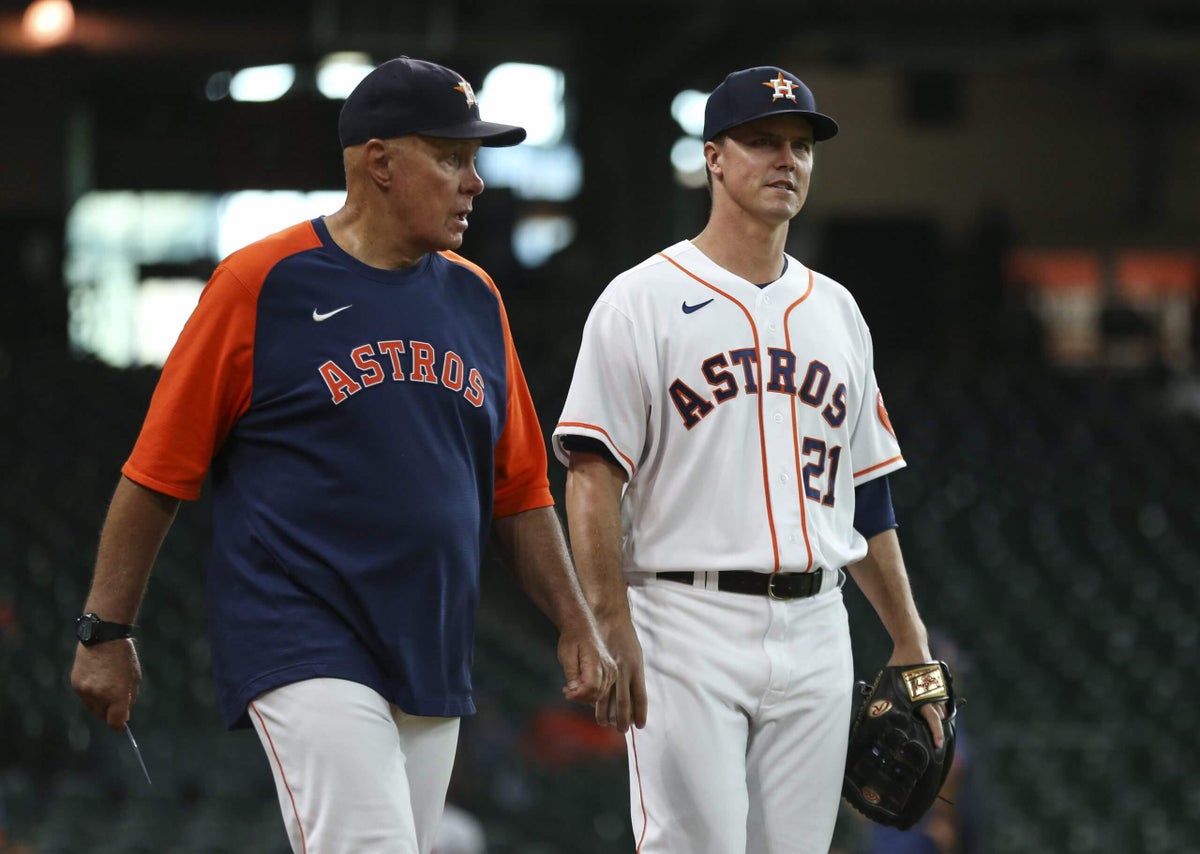
Longtime Astros pitching coach Brent Strom will rejoin the organization as a pitching consultant for the season’s final 29 games, manager Joe Espada announced on Thursday. Strom is expected to be in uniform and in the dugout for Houston’s series opener against the New York Mets on Friday at Citi Field.

“Strommy is one of the architects for this organization on the pitching side of things,” Espada said before Thursday’s game at Yankee Stadium. “I’m excited to bring him back, listen to his perspective, his experience. I feel like there’s a value in having him around right now as we make this push here to win the division.”

Houston entered Thursday with a half-game lead over the Texas Rangers atop the American League West despite a 4.68 ERA. Only five teams have a higher one. Dismissed general manager Dana Brown’s inability to fortify the staff — especially Houston’s struggling starting rotation — during the trade deadline frustrated many in the Astros’ clubhouse. That Brown’s six major-league, offseason additions have produced a 5.51 ERA didn’t help matters, either.

Who the Astros should hire as their next GM

Keith Law

Just two starting rotations have a higher ERA than Houston’s 5.17 mark. The team has received just 10 starts of at least seven innings across the season’s first 132 games.

“Sometimes, we can spend a lot of time looking at things that are not particularly important right now during this stretch,” Espada said. “It’s about competing, me against him and my experience with Strommy has been that. It’s something we can all use during this stretch.”

Strom, 77, spent eight seasons as the Astros’ pitching coach from 2014-21, a stretch in which Houston separated itself as one of the premier pitching organizations in the sport. From 2015-21, no American League team posted a lower ERA than the Astros and only one — the Cleveland Guardians — had a lower WHIP.

Following his Astros tenure, Strom had coaching stints with both the Pirates and Arizona Diamondbacks. In 2023, Strom oversaw the Arizona pitching staff that captured the National League pennant. Pittsburgh did not renew Strom’s contract after last season.

Under Strom’s watch, the Astros produced two American League Cy Young Award winners — Dallas Keuchel and Justin Verlander — and a runner-up in Gerrit Cole. Strom earned industry-wide acclaim for his part in helping to turn around the careers of Cole, Verlander, Collin McHugh, Charlie Morton and Ryan Pressly.

Strom has worked with multiple members of the Astros’ existing pitching staff, including setup man Bryan Abreu, starter Cristian Javier and offseason trade acquisition Mike Burrows, whom Strom coached with the Pittsburgh Pirates.

“He’s got this presence about him (to) connect with younger pitchers (and) older pitchers,” Espada said. “Also, (he is) very simple in how he teaches things. He can go outside the box, but he also stays on: ‘This is what you need to compete during the stretch.’ There is that experience that I think is needed.”

Strom left the Astros after the 2021 season. At the time, he described the decision as an opportunity for him to reset and for Houston to enjoy the work of his two proteges — Josh Miller and Bill Murphy — who had assisted him throughout the season. Miller remains the Astros’ head pitching coach. Murphy left the organization this winter to become the Pirates’ pitching coach. Ethan Katz replaced Murphy and now assists Miller.

“It’s a fresh (set) of eyes. He’s going to be in our meetings. He’s going to be helping in the throwing programs, video analysis,” Espada said. “I just feel like this is something we will benefit from having around.”

>

Continue Reading

Sports

Judge rules Deion Sanders must be available to testify — but after Georgia Tech opener

Published

on

Head coach Deion Sanders of the Colorado Buffaloes speaks with the media.

While the Colorado coach must be available, it is unlikely he will have to testify because of the limited scope of the trial. Stacy Revere / Getty

A judge in Colorado bankruptcy court ruled on Thursday that Colorado head coach Deion Sanders must be available to potentially testify in the upcoming bankruptcy trial of his son, Shilo.

In a virtual hearing on Thursday, Judge Michael E. Romero informed Sanders’ attorney, Harvey Steinberg, that Sanders should make himself available virtually on the afternoon of Friday, Sept. 4, one day after Colorado plays its 2026 season opener on the road at Georgia Tech. Romero told Steinberg that Sanders must be available at 1:30 p.m. MT.

Steinberg initially asked if Sanders could be available virtually later in the day Friday, but Romero said it had to be earlier in the day because the trial, which is scheduled to begin Monday, is expected to last only five days. Colorado’s Thursday game in Atlanta kicks off at 8 p.m. ET.

However, it’s unlikely that Sanders will have to testify after Romero ruled that it would only be on a rebuttal-basis should Victor Vital, who is representing Shilo in the case, open the door to Sanders’ previous testimonies in a previous civil case. Steinberg told The Athletic after the virtual hearing Thursday that he does not expect Shilo’s defense team to revisit Deion Sanders’ previous testimonies.

In the virtual hearing Thursday, Vital informed Romero that he does not intend to go that route in next week’s trial.

Shilo Sanders is trying to discharge more than $11 million he owes to John Darjean after a 2022 default judgment in a Texas civil trial for which Shilo failed to appear. Darjean is a former high school security guard who sued Shilo Sanders following a physical altercation in 2015 when Shilo was 15. Darjean argued that the altercation left him with lifelong debilitating physical issues.

The lawyers representing Darjean recently attempted to subpoena Deion Sanders on the morning of Aug. 11 while the Buffaloes were participating in a preseason scrimmage on campus. Steinberg told The Athletic that Sanders was never physically served the papers and that he instead finally accepted them on behalf of Sanders on Thursday.

Colorado had no comment.

Romero said that Shilo Sanders’ trial would be open to the public and the transcripts would be publicly available.

Connections: Sports Edition Logo

Connections: Sports Edition Logo

Connections: Sports Edition

Spot the pattern. Connect the terms

Find the hidden link between sports terms

>

Continue Reading

Sports

Caleb Williams’ growth continues during Bears-Titans joint practice

Published

on

NASHVILLE, Tenn. — Temperatures topped out at 87 degrees Thursday afternoon. But there was some real Tennessee humidity smothering the Vanderbilt Health Football Center as the Chicago Bears and Tennessee Titans met for a joint practice. This felt like one of those old-school days of training camp. High heat. Intense competition. A session that went well over two hours.

Count Bears defensive tackle Grady Jarrett among the enthusiasts of what went down at the Titans’ facility — tacked on to the work the Bears got done in Cincinnati with the Bengals last week.

“You can’t finish training camp without a good burner,” Jarrett said. “Today we had one. It was fun to come out here and compete against them, man. It was an awesome day.”

Bears still looking for starters at left tackle, safety

Dan Wiederer and Kevin Fishbain

The Bears felt good about their work across all three phases. And now they’ll have a Saturday preseason finale at Nissan Stadium followed by the 53-man roster deadline on Sunday evening.

Before we get there, here’s a snapshot review of all we saw and heard during Thursday’s practice and interviews.

Player in the spotlight

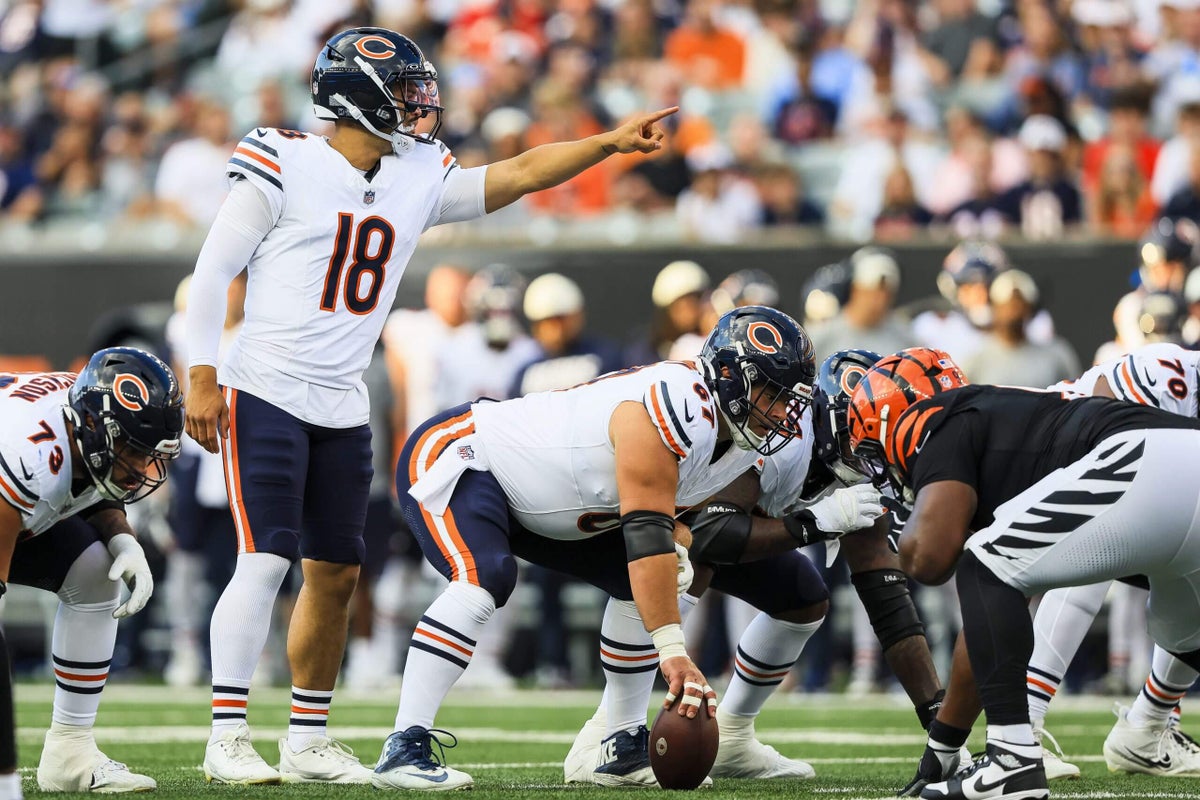
Caleb Williams’ final pass of practice was an end zone interception, a dice roll late in an end-of-game, touchdown-to-win situation. Williams said he lobbied for a play call and was ultimately looking for tight end Colston Loveland on a shot from the 20-yard line with 12 seconds remaining. But Titans safety Tony Adams cut in front of the pass near the goal line for the takeaway.

In retrospect, Williams said after practice, he wished he had trusted Bears coach Ben Johnson more in that situation “to be the magician of a play caller that he is.”

“I was pushing for a specific play, trying to feel it, trying to get a matchup,” the Bears’ quarterback said. “But we were super far out compared to the play (design). And (it’s) just trusting him. He’s done it for a while now. So it’s just being able to trust him with the play call, go through our reads and get the ball to the right spot.”

That was another bankable learning experience during a camp that has been filled with positive development for Williams, who is approaching his third NFL regular season with his confidence building and with the push from his coaches as intense as it’s ever been.

“Shoot,” Johnson said before Thursday’s practice. “There is no end line here. This is a continual process that we started well over a year ago now. And we’re just continuing to build on things we see that he’s doing well and (pointing out) things that we feel he can get better at.”

One of the most emphasized improvement areas right now for Williams is accelerating his growth when it comes to coverage recognition and folding that into his understanding of the Bears’ playbook. That may be using safety alignment or his identification of certain defensive looks to find shortcuts within plays to help his decision-making.

“It’s just being able to process those things faster,” Williams said Thursday. “And it’s just being faster or more comfortable with the plays and being able to not necessarily think about the plays anymore.

“Now I’m more or less getting up there and trying to figure out what I can fix to make sure this play works.”

It seems unlikely that Williams will play Saturday in the preseason finale. So his next under-the-spotlight performance will likely come on Sept. 13 at Carolina.

Pressing question

What’s the latest with Darnell Wright’s right elbow?

It’s still encased inside a bulky brace during practice and still causing him discomfort at times. And after persevering through much of 2025 after a torn ulnar collateral ligament — Wright only missed one full game — the All-Pro offensive tackle left practice Tuesday with what Johnson described as “a reaggravation of some things that went on last year.”

Still, Wright continues to display his toughness. He was back for a light practice Wednesday at Halas Hall, then locked in for Thursday’s much more demanding outing.

That is the kind of heart and perseverance that energizes Bears coaches and players.

“It’s not just Darnell,” Johnson said. “He’s a great example of it, but we have almost the entire roster fighting their tails off to get back on the field. They do not like missing time. They want to be out there competing. They want to be out there with their teammates. And to me, that’s a sign we’re moving in the right direction. I get a lot of positive vibes from that.”

Quote of note

Johnson praised rookie safety Dillon Thieneman for his growth, pleased with his daily approach to his transition to the NFL. Thieneman is a bit soft-spoken by nature. “I don’t even know what his voice sounds like really,” Johnson quipped.

But Johnson understands that Thieneman’s play style and work habits speak volumes.

“He just comes into work and gets after it. (He’s) a little bit robotic like that — in a good way. I’m saying that as a compliment. He just puts his head down and grinds. And what you’ve seen is slow and steady progress throughout (camp).”

Keep an eye on …

The biggest skirmish of Thursday’s practice came between the Bears defense and Titans offense after veteran safety Xavier Woods drilled receiver Wan’Dale Robinson on a downfield pass. It was the kind of hit that evoked a loud “oooh” from the grandstands — and then some ill will from Robinson’s teammates.

Most notably, center Austin Schlottmann went after Woods, and before long a brief melee ensued with the whistles from the officials howling. Robinson, Titans coach Robert Saleh said, was being evaluated for a possible concussion and called the hit by Woods “cheap.”

From the sounds of it, however, the Bears defense wasn’t planning a condolences note.

“We practice a certain way,” Jarrett said. “We’ve got a way we want to play ball. Nothing is done with malice. But we have to play our style of defense the way we want to at all times. Sometimes things happen. That was just one of those things that happen.”

Quick hits

— The Bears defense came up with its biggest splash play Thursday when quick pressure from defensive end Montez Sweat contributed to an errant throw by quarterback Cam Ward to tight end Gunnar Helm. Safety Cam Lewis was there to collect the reward with a diving interception.

— Thieneman found himself on the wrong end of two Titans highlights, the first a ridiculous one-handed snatch by Helm, who had a five-inch, 30-pound size advantage on the play. Later in the afternoon, running back Tony Pollard beat Thieneman for a 50-50 deep ball down the left sideline.

— Arguably the prettiest throw of Thursday’s practice came during a team red zone period when the Bears twisted the Titans defense into a knot with multiple backfield play fakes. Tight end Cole Kmet, meanwhile, slipped into the clear into the right side of the end zone and hauled in a beautiful touch pass from Williams. A potential runner-up candidate: Williams to receiver Rome Odunze for an explosive completion on a left-to-right crossing pattern during a move-the-ball period.

— Defensive tackle Gervon Dexter (hamstring) did not make the trip to Tennessee. Defensive end Austin Booker (groin) did but did not participate in practice.

— The Bears defense was banged up frequently through practice. Cornerbacks Jaylon Johnson and Tyrique Stevenson did not finish practice after coming up injured. That left rookie Malik Muhammad and Terell Smith as the outside corners during a team period late in practice. Linebackers Jack Sanborn and D’Marco Jackson also came off the field late in the session. Those appeared to be cramping situations.

>

Continue Reading

Trending

Copyright © 2017 Zox News Theme. Theme by MVP Themes, powered by WordPress.