
Sports
What you can and can’t bring to 2026 World Cup games: water bottles, horns and more


Fans will be allowed to bring empty, reusable water bottles into 2026 World Cup games, but a wide array of other items, including most bags, will be barred from stadiums throughout the tournament, which will be held from June 11 to July 19 at locations in the United States, Canada and Mexico.
FIFA, which runs the World Cup, spells out the semi-specific rules in a “Stadium Code of Conduct” that was published months ago and recently finalized, a FIFA spokesman confirmed to The Athletic.
The 35-page document, which is written in three languages, includes an extended list of prohibited items and behavior.
Among the banned items are obvious ones, such as weapons, but also items such as balloons and “devices that produce noise or other excessively loud sounds, such as vuvuzelas, whistles, air horns, loudspeakers, etc.”
Some of the rules are specific. Others are vague and leave subjective enforcement in the hands of several different entities. The code of conduct states that it can be enforced by FIFA, by any of its U.S., Mexican or Canadian subsidiaries, and by stadium management, “including their officers, employees, representatives, volunteers, security personnel, stewards and administrators, or any third parties contracted to provide services to the stadium.”
The requirement for water bottles to be emptied may come into particular focus during games played in high summer temperatures.
The following is a look at what will and won’t be allowed in stadiums during the World Cup.
Bag policy
FIFA, as is common for organizers of major sports events these days, will tightly restrict the type of bags fans can bring into stadiums due to security concerns.
The “approved bags,” according to the code of conduct, “must be clear and made of plastic, vinyl, or PVC material” so as “to allow security personnel to easily see the contents inside without having to open them.” The bags “must not exceed 12 inches x 6 inches x 12 inches (30 cm x 30 cm x 15 cm).”
This essentially equates to a small, clear pouch. “Additionally, small clutch purses or wallets approximately the size of a hand are allowed, even if not clear and no larger than 4.5 inches x 6.5 inches (or 11cm x 16.5cm),” the document adds.
It later confirms, for the avoidance of doubt: “Non-transparent bags, backpacks, large purses, camera bags, seat cushions with pockets, zippers, compartments or covers, and other similar items are generally prohibited.”
If a fan arrives at the stadium with such a bag, they may be able to deposit it at a nearby locker-type storage facility and then pick it up after the match, as was possible at some Club World Cup matches last summer.
In general, the 2026 World Cup code of conduct is similar to the 2025 Club World Cup version. At matches last year, the basic rules were posted at stadium entrances. Similar signage is likely to be installed this summer, and the policies will be communicated to fans in each of the 16 host markets.

Organizers posted signs listing prohibited items at the entrance to games at the 2025 Club World Cup. (Henry Bushnell / The Athletic)
Prohibited items
The broader list of prohibited items covers all sorts of potential threats, including “any other object which could be used as a weapon, to cut, or to stab, or as a projectile, or any object which could in the opinion of the Event Organisers endanger the safety of others, including golf umbrellas or beach umbrellas, motorcycle helmets, hard hats and other similar objects.”
It also covers seemingly innocuous items, such as “significant quantities of paper or any rolls of paper.” Selfie sticks, tripods and video cameras are also prohibited.
The most relevant articles address items that are frequent features at soccer matches in some parts of the world, such as drums or flares.
The latter is strictly banned. The lengthy list of prohibited pyrotechnic paraphernalia includes: “Any materials, articles or objects (including self-made items), the use of which can result in the generation of smoke, heat and/or flames including lighters, matches, fireworks, flares, smoke bombs and other smoke-emitting articles, compressed and liquefied gases, combustible solids, poisonous or noxious or pungent substances, oxidising substances and organic peroxides.”
Musical instruments, on the other hand, may be allowed but will often need to be approved by FIFA and stadium authorities on a case-by-case basis.
“Any musical instruments (mechanical or manual) that cannot be fully visualized by security or that are larger than 12 cm x 12 cm x 12 cm (4.7 inches x 4.7 inches x 4.7 inches)” will be “subject to preapproval of the Event Organisers and security screening,” the document states.
It also adds that organizers “may require” attendees “to stop using musical instruments if the sound emitting from the respective device interferes with event operations or the enjoyment of other [attendees].”
Similarly, large banners, such as tifos, will need to be coordinated with FIFA in advance. Among the prohibited items are “flags, banners and posters except those that do not exceed 2 meters x 1.5 meters (78 inches x 60 inches) or unless approved in advance by the Event Organisers in writing.”
The code of conduct adds: “All such items must be presented at the stadium entrance for inspection by the event organisers.”
FIFA has not yet opened the formal process for fans to submit instruments or banners for pre-approval. A spokesman said that will happen over the coming weeks.
Banners and flags will also be subject to a lengthy, open-to-interpretation policy that prohibits “any materials, including but not limited to banners, flags, fliers, apparel and other paraphernalia, that are of a political, offensive and/or discriminatory nature, containing wording, symbols or any other attributes aimed at discrimination of any kind against a country, private person or group on account of race, skin colour, ethnicity, national or social origin, gender identity and expression, disability, language, religion, political opinion or any other opinion, birth, wealth or any other status, sexual orientation or on any other grounds.”
Additionally, a fan can, of course, wear a team jersey or scarf, or another clothing item that doubles as sports memorabilia, but “sports equipment items such as inflatable balls, regardless of size, darts, and frisbees” are not permitted.
What you can bring to World Cup games
In theory, anything not covered by the lengthy code of conduct could be permitted, although the document also states that “event organizers reserve the ultimate right to make a final decision on whether any item brought to or into the stadium is prohibited and any decision must be respected.”
One of the few items it explicitly permits is an empty bottle, the type that can be refilled at a water fountain or dispenser. “For the avoidance of doubt,” the document states, “empty, transparent, reusable plastic bottles, up to [1 liter in] capacity, may be brought into the Stadium.”
But water itself — and “any other liquids exceeding 100ml/3.38 oz.” — cannot be brought in, with the exception of “baby milk and sterilised water in containers” or liquids that a fan requires for medical reasons.
The same goes for “food items of any kind.”
Additionally, any “bottles, cups, jars, cans or any other form of closed or capped receptacle that may be thrown or cause injury” are banned. So are “other objects made of glass or any other breakable material or especially hard packages or hard thermal boxes.”
One part of the code notes that “cigarettes and electronic smoking devices” can be carried into a stadium and “may be possessed,” but cannot be used. The code states that fans must not “smoke, vape or use any tobacco products as well as any electronic smoking device anywhere other than within outdoor designated smoking areas if they have been made available at the stadium.”
Among the other permitted items are smartphones, watches and eyeglasses.
The document also specifies that cultural or religious headwear and medical masks are permitted.
>
Welcome to Connections: Sports Edition Coach — a spot to gather clues and discuss (and share) scores.
>
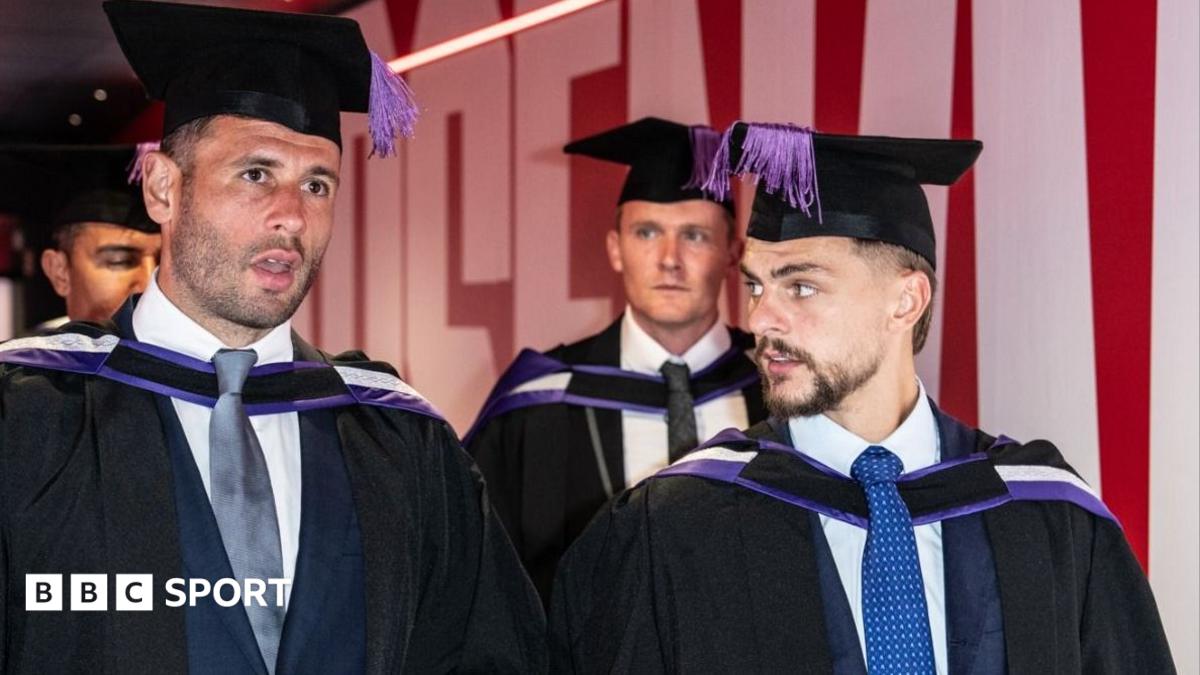
Awoniyi points to the “ups and downs” he has experienced as a footballer, referencing the serious injury he suffered in May 2025 when he was placed in a medically induced coma after rupturing an intestine in a collision with a goalpost when playing for Nottingham Forest against Leicester City.
To him, it is important to keep improving and to recognise there is more to life than football, which is where the Professional Footballers’ Association course comes in.
Awoniyi says: “It’s not like a 9-5 job in football. We go in and sometimes finish quite early and, although it’s challenging, I think every footballer has time in the evening for something like this business school.
“Of course, it demands a lot from you and it’s all about how willing you are to do it. I say to people there are a lot of things that are bigger than football.
“Yes, football is our passion, but we are normal human beings as well and maybe that’s something the world doesn’t always see.”
The graduates certainly appear no different from anyone else celebrating an academic achievement, exhibiting their pride.
Awoniyi has brought members of his extended family to the ceremony, while Dewsbury-Hall seeks out former Everton midfielder Tim Cahill, now working in Qatari football, to discuss the art of scoring goals.
“Obviously there are stereotypes around footballers,” Dewsbury-Hall says.
“But in every industry there are smart people and there are people who aren’t so smart. You’d be surprised how many intelligent people there are in football.
“Maybe some players just don’t want to do things like this, but they easily could. It’s just not their passion.
“I’m not saying this is my passion, but it’s something I’ve done to show that footballers can complete these kinds of courses while they’re still playing. Who knows where it will lead?”
The course is designed to run alongside a football career. Seminars are scheduled to minimise clashes with matches and training sessions.
Players can study in their own time, although Dewsbury-Hall says he has had some “weird looks” while studying on an iPad during journeys home from away games.
Every graduate has a different story.
For Wycombe Wanderers defender Steve Cook, who captained Bournemouth in the Premier League earlier in his career, the course marked a return to formal education for the first time since his school days. Having already obtained coaching badges, he knows he is approaching the end of his playing career.
Some may not actively use their newly gained expertise for many years. All will benefit in some way, though, believes Azpilicueta.
“It’s not only about preparing for life after football. It’s about becoming a better version of yourself in your football career as well,” the former Spain defender, who retired from playing at the end of last season, tells BBC Sport.
Education has been part of his life and is what helped him become a leader on and off the pitch.
Azpilicueta built a career after turning professional with hometown club Osasuna at the age of 17.
He had continued studying until that point and, after abandoning his degree when he became a professional footballer, he later returned to complete an MBA at Harvard University in the United States during his nine-year spell at Chelsea.
The desire to study before playing the biggest match of his club career, Chelsea’s Champions League final triumph five years ago, indicates how he balanced his two interests.
“Normally I’d have a nap after lunch if the game was later in the day, but that day it was impossible. You could hear the fans and you knew a big game was coming up. Having my studies also helped me focus and improve myself away from football,” he explains.
After ending his playing days with Atletico Madrid and Sevilla, Azpilicueta says he will not be rushing into his next role.
The PFA course includes sessions from prominent figures, such as Brighton chief executive Paul Barber, designed to help students understand how different areas of the football industry operate.
For now, many remain focused on playing football. But among this year’s graduates might be future coaches, executives and sporting directors who go on to influence the game in different ways.
>
Sports
NFL Week 4 fantasy football rankings, starts, projections: Braelon Allen, Darren Waller and more
Looking for start/sit help for your fantasy lineups? Jake Ciely has you covered with his always-updated player rankings for Week 4.
>
Connections: Sports Edition today: Hints and answers for Sept. 30, 2026, puzzle No. 737

Tom Cruise, Alejandro G. Iñárritu Talk Digger at Academy Museum

The Premier League footballers studying to be sporting directors
-

 movies4 months ago
Search For Canadian TV Actor Stewart McLean Now Homicide Investigation
-

 Fashion9 years ago
These ’90s fashion trends are making a comeback in 2017
-
Fashion9 years ago
According to Dior Couture, this taboo fashion accessory is back
-
Fashion9 years ago
Model Jocelyn Chew’s Instagram is the best vacation you’ve ever had
-
Fashion9 years ago
Emily Ratajkowski channels back-to-school style
-
Fashion9 years ago
9 Celebrities who have spoken out about being photoshopped
-

 Anime4 months ago
Rurouni Kenshin: Hokkaido Arc Manga Takes 1-Issue Break – News
-

 Anime3 months ago
HIDIVE to Stream English Dubs for The World Is Dancing, The Forsaken Saintess and Her Foodie Roadtrip in Another World, The Dangers in My Heart: The Movie Anime – News