
The 1986 World Cup quarterfinal match between England and Argentina.
FIFA footage courtesy of FIFA. All rights reserved. ©FIFA.


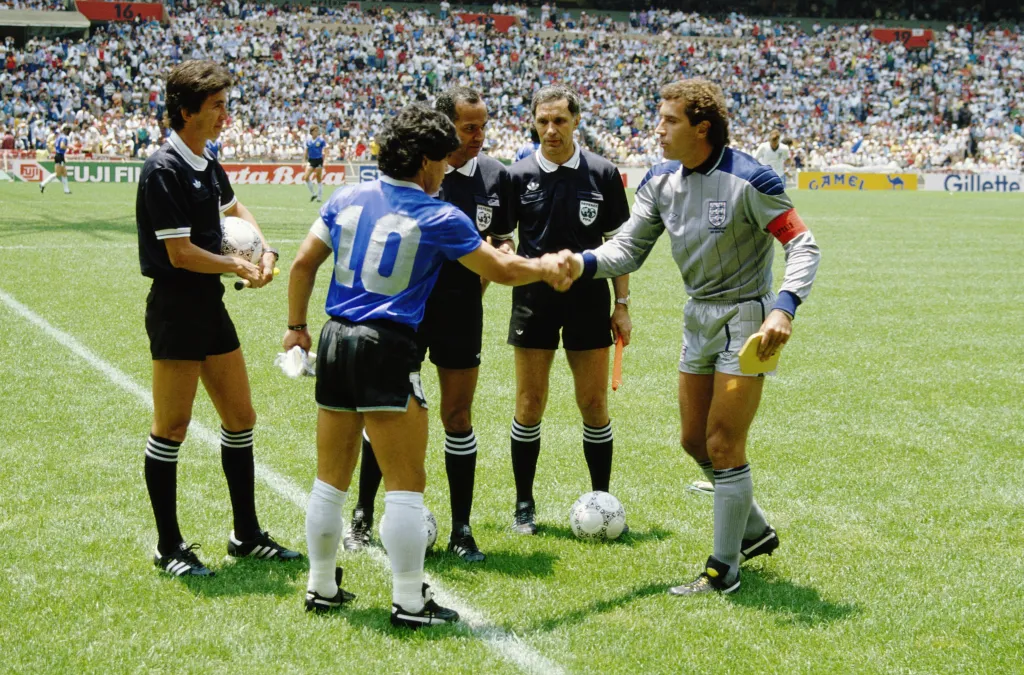
EXCLUSIVE: The World Cup kicks off in Mexico City in less than a month, promising enough moments of athletic brilliance, excitement and tension to grip a global audience. But for sheer drama and importance, it will be hard if not impossible for any single World Cup match to equal one played 40 years ago.
In 1986, England and Argentina squared off in the quarterfinals of the World Cup in what has gone down as the most iconic contest in tournament history. That riveting encounter, which featured two of the most memorable goals ever scored in a World Cup, is reexamined in The Match, premiering later today at the Cannes Film Festival.
The documentary is directed by Argentinian filmmakers Juan Cabral and Santiago Franco. We have your first look at it in the exclusive trailer above.
The 1986 World Cup quarterfinal match between England and Argentina.
FIFA footage courtesy of FIFA. All rights reserved. ©FIFA.
That quarterfinal of 1986 unfolded with two of football’s biggest stars on the pitch – Gary Lineker for England and Diego Maradona for Argentina. But the significance of the match wasn’t so much about the players as the historical context – only a few years before, Britain had gone to war with Argentina over the Falkland Islands (known as Las Malvinas to Argentinians).
“It’s only football. Period,” Maradona insisted in pre-game interviews. But politics hung over Azteca Stadium in Mexico City, where the match was played, like a persistent layer of smog.
The directors, though Argentinian, take a balanced approach to the story, interviewing surviving members of both teams, including Lineker (Maradona died in 2020).
“It was very important to shed light in a very neutral way, acknowledging that we are Argentinians,” Cabral tells Deadline. “There’s always a small kind of bias because of just knowing what you know. But I lived for 10 years in London, and some of my best friends are from there, and I felt very welcomed.”
Franco wasn’t born when the 1986 match was played. Cabral still has childhood memories.
“I was in third grade. My grandmother used to take care of me in the afternoon because my parents were working. And I remember one day I got back from school; it was 2 p.m. And my grandmother was watching TV, a football match. And I was like, ‘That’s strange. My grandmother watching football, that’s not normal,’” Cabral recalls. “And she says, ‘This is the World Cup.’ ‘What is the World Cup?’ [I ask]. ‘The best players from each team from each country play against the best players of another country.’ And my mind exploded like, ‘Oh, so we can play a game around the planet, like a championship.’ And it was really mind-blowing for me.”
Gary Lineker in ‘The Match’
Courtesy of THE MATCH by JC & SF
The documentary is narrated by Lineker and Jorge Valdano, an important player for Argentina’s 1986 squad. The filmmakers took a distinctive visual approach to the interviews, reuniting the teams on neutral ground – in Spain. They shot the players in a sort of black box – lighting each man cinematically so they “looked like Clint Eastwood,” Cabral notes.
Franco continues, “We thought about that space as a special place where the match will live forever. That space in black and white where we shoot, we show the images [on screen] and the footage of the match. It’s like kind of a museum, a place when we do an homage of the match.”
Maradona, as the author of the two Argentinian goals (including the infamous “Hand of God” tally) and perhaps the greatest footballer to ever live, occupies a big place in The Match. But just as soccer is a team sport, this is a collective enterprise, drawing on the memories of Oscar Ruggeri, Peter Shilton, John Barnes, Jorge Burruchaga, Ricardo Giusti, and Julio Olarticoechea, as well as Lineker and Valdano.
“It’s a choral piece,” Cabral notes. “In fact, we really wanted people in the audience to be like, ‘Why am I watching this? What’s going on? But I cannot get enough of this.’ It should be like history, but at the same addictive.”
Labhouse/Industria del Milagro/Buena Vista International
A sequel to the 1986 match could happen this year as England and Argentina are considered among the favorites to win the World Cup, along with Spain and France. Argentina is the defending champion.
“It’s part of our culture in a way. In Argentina, the soccer — football — is so important,” Franco affirms. “It’s part of our everyday conversations and it’s part of who we are. And especially that team [of 1986] and especially this match was iconic and incredibly significant for us in all sorts of ways. So that’s kind of the thing that we want to share in this documentary.”
The 40th anniversary of England vs. Argentina falls on June 22. After the Cannes world premiere, Cabral and Franco will take The Match to Argentina for a major screening on May 22.
“We want to do the premiere [in Argentina] before the World Cup starts,” Franco says, acknowledging reality. Once the tournament begins, the eyes of football fans around the world will not veer from the pitch.
Watch the trailer for The Match above.
>

“I was very successful since I was a kid,” Tom Cruise told a full house at the Academy Museum’s 945-seat David Geffen Theater following a screening of Digger. That stardom has led him in search of ever bigger challenges, learning new skills and finding opportunities to apply them.
As he put it: “OK, the door’s open. Now I want to push it again.”
He has certainly done that with Digger, Alejandro G. Iñárritu’s wildly ambitious, deeply weird and extravagantly mounted comedy, in which Cruise plays a Texas oil tycoon forced to face the music after an environmental disaster puts the world at risk.
The Warner Bros. release, arriving just as Paramount nears its takeover of Warner Bros. Discovery, carries a reported $125 million production budget.
At 64 and 63, respectively, Cruise and Iñárritu are near-exact contemporaries taking this leap together. Cruise has ventured into similarly offbeat territory before, memorably in an Oscar-nominated turn in Paul Thomas Anderson’s Magnolia and beneath the prosthetics of Ben Stiller’s comedy Tropic Thunder.
But he has spent much of his recent career delivering increasingly elaborate Mission: Impossible spectacles, taking extraordinary physical risks within a franchise whose appeal he understands intimately. Digger requires a different leap of faith, both from Cruise and from the audience he hopes will follow him.
Among critics, the film has proved wildly divisive, with some reviews positively savage, The Hollywood Reporter’s among them. I understand the objections to Digger; I was also quite happy to have seen it. There is something invigorating about watching this much talent and money committed to a movie this peculiar, even when its considerable parts refuse to cooperate.

Tom Cruise talks to the audience at Academy Museum’s ‘Digger’ screening.
Seth Abramovitch
Iñárritu offered a remarkably candid account of the challenges during the discussion. Making this trompe-l’œil of a film required a constant negotiation between theatricality and the camera. What felt inspired on set could look very different the following morning.
“We were laughing all day,” the four-time Oscar-winning Mexican filmmaker said. Then he would watch the dailies: “Oh my God,” he recalled thinking. “This is not working. This is shit.” Adjusting the performance could send it too far in the other direction: “It’s too naturalistic. It’s not so funny.”
In sharing that, Iñárritu was describing the search for the film’s highly unusual tone, not conceding that the finished movie had failed. But the anecdote gets at the precariousness of the enterprise. The actors had to find that tone in their bodies and voices, he explained. “Nothing can be written in tone. It doesn’t exist,” he said.
Iñárritu compared the precision of Cruise’s acting to the “micro decisions” he makes during a dangerous stunt, when “one second is the difference between life and death.” On set, the director watched that attention extend to where Cruise placed his hands, when he winked and when he stayed silent. “Every take he’s just present and observing naturally,” he said.
Cruise, meanwhile, seemed delighted by the company he was keeping. He repeatedly jumped in to praise his fellow actors, recalling how difficult it was to stop laughing around John Goodman. Of Sandra Hüller, he said, “What an extraordinary actress,” before settling on a succession of wows.
His enthusiasm was considerably easier to pin down than his acting techniques. After Cruise gave a drawn-out answer about a life spent observing humanity to explain his character work, Iñárritu teased him: “He keeps the secret. He don’t answer.”
Tom Cruise and Alejandro G. Iñárritu at the Academy Museum’s ‘Digger’ screening.
Seth Abramovitch
By the end of the conversation, Cruise was making a broader argument about what audiences want, and what filmmakers should give them. “This film is handmade,” he said. He described stopping on set with his colleagues to look around and appreciate the skill that had gone into the physical world surrounding them. “People want to see real things,” he said. Then, a little later: “People want real things and they want real experiences.”
Cruise never mentioned artificial intelligence, but the repeated emphasis on “real things” and “handmade” filmmaking could readily be heard as an implicit rejoinder to it. His remarks placed the value in the people doing the work, the skills they had acquired and the pleasure of being together to make something. “It was never handed to any of us,” he said.
For all his confidence, there was also an acknowledgment that the opportunity to keep doing this depends on people buying tickets. “My hope is always that the films would do enough that I’d have that opportunity to do it again,” Cruise said.
Whether audiences follow him into Digger remains to be seen. For now, he seemed grateful to have made the leap. “It’s not like I don’t have challenges, we don’t have challenges,” he said. “But I really choose to be joyful about creating.”
After posing for a cast and crew photo, Cruise, ever the audience pleaser, spent 15 minutes mingling with fans who rushed the stage for selfies and a few words with a movie legend. Four decades into his career, he’s still finding new ways to make it in this risky business.
He clearly loves the job.
>
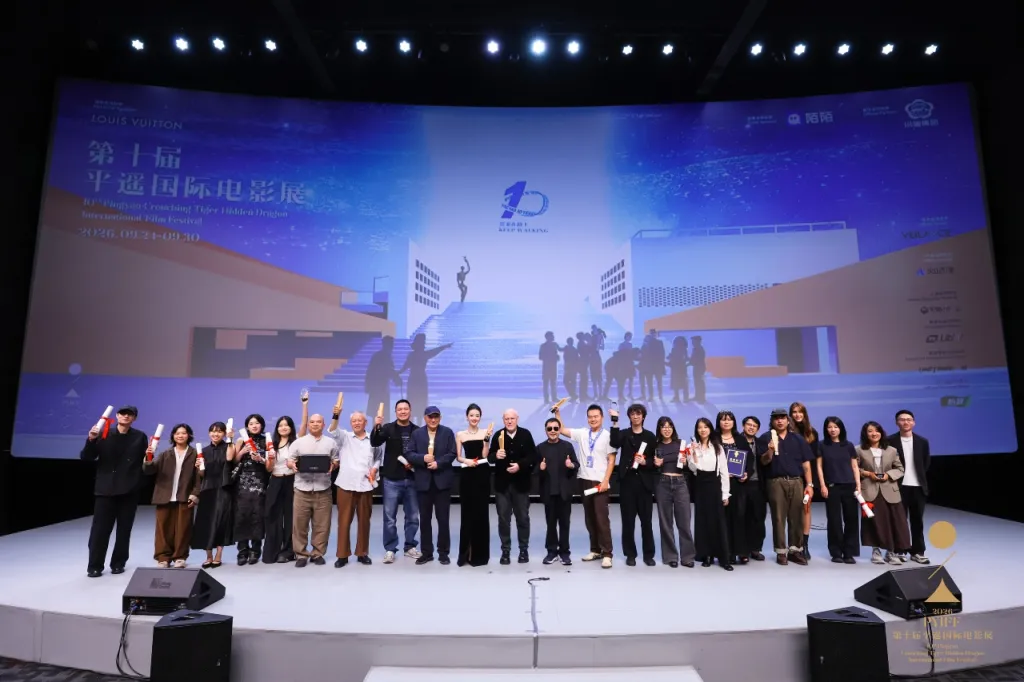
Chinese director Niu Niu’s Final Payment scooped the Best Film Award in the Fei Mu Awards of this year’s Pingyao International Film Festival (PYIFF), while Rafiki Fariala’s Congo Boy won Best Film in the festival’s Roberto Rossellini Awards.
Final Payment, which also won Best Actor for Niu Jianrong’s performance, revolves around a homeowner clashing with a contractor over the final payment following a set of renovations on his home. PYIFF’s competition jury stated: “Tearing through a very small rip, the film leads us into a reality and emotional landscape so expansive, where we sigh, lament, and reflect. The director’s approach is concise, unpretentious, and masterful, earning the wholehearted recognition of the entire jury.”
The Best Film award came with a cash prize of $150,000 (RMB1m) with half given to the director for the development of their next film, and half given to the distributor in China. Niu Niu previously directed Mr Junjun, which was awarded with the Jury Award and Youth Jury Award at PYIFF in 2023.
Also in the Fei Mu Awards, Xu Zao won Best Director for Light Pillar, while Best Actress went to Sun Yi for Wang Xiaozhen’s A Joke. The Jury Award was presented to Dong Jie’s Zoom In, Zoom Out, which had its world premiere in Venice Critics Week, while a special mention went to Cai Chengjie’s Suzhou Quartet.
The Fei Mu awards are focused on the festival’s Hidden Dragons section, which selects first, second and third films from emerging directors making Chinese-language films, while the Roberto Rossellini Awards focus on the Crouching Tigers section for emerging international directors.
Congo Boy, which took Best Film in the Roberto Rossellini Awards, also won Best Actor when it premiered in Un Certain Regard at this year’s Cannes film festival. The PYIFF award came with a cash prize of $20,000, with half given to the director for the development of their next film, and half given to the distributor in China.
The PYIFF jury stated: “The Jury unanimously has been moved by this autobiographical story, told in a simple style that echoes the great tradition of neorealism. For a film focusing on a character that confronts his world with optimism despite dark times and takes on his shoulders the destiny of his entire family.”
Also in this section, the Philippines’ Rafael Manuel won Best Director for Filipiñana, while the Jury Award went to Ben’imana, directed by Marie-Clémentine Dusabejambo, which won the Camera d’Or at this year’s Cannes. The jury also awarded Rakan Mayasi’s Yesterday The Eye Didn’t Sleep a Special Mention.
Hong Kong filmmaker Ann Hui received the Crouching Tiger Hidden Dragon East-West Award, shortly before she receives the Camellia Award at Busan International Film Festival next week.
Pingyao’s International Contribution To Chinese Cinema Award went to Marco Müller, who founded the festival with Chinese auteur Jia Zhangke and currently serves as Artistic Director of the Film Art Research Centre at Shanghai University, and veteran producer, director and former chairman of China Film Group Han Sanping. Hello Group chairman Tang Yan was presented with a 10th Anniversary Award.
This year’s PYIFF opened on September 24 with a screening of the 4K restoration of Fei Mu’s Spring In A Small Town; closed with Good Trip, co-directed by Hong Kong filmmakers Norris Wong and Hoi Wong, and also screened Jia’s short film Torino Shadow, which premiered at this year’s Cannes.
PINGYAO INTERNATIONAL FILM FESTIVAL 2026 AWARDS:
FEI MU AWARDS:
Best Film: Final Payment, dir: Niu Niu
Best Director: Xu Zao, Light Pillar
Best Actress: Sun Yi, A Joke, dir: Wang Xiaozhen
Best Actor: Niu Jianrong, Final Payment, dir: Niu Niu
Jury Award: Zoom In, Zoom Out, dir: Dong Jie
Special Mention: Suzhou Quartet, dir: Cai Chengjie
ROBERTO ROSSELLINI AWARDS:
Best Film: Congo Boy, dir: Rafiki Fariala
Best Director: Filipiñana, dir: Rafael Manuel
Jury Award: Ben’imana, dir: Marie-Clémentine Dusabejambo
Special Mention: Yesterday The Eye Didn’t Sleep, dir: Rakan Mayasi
>
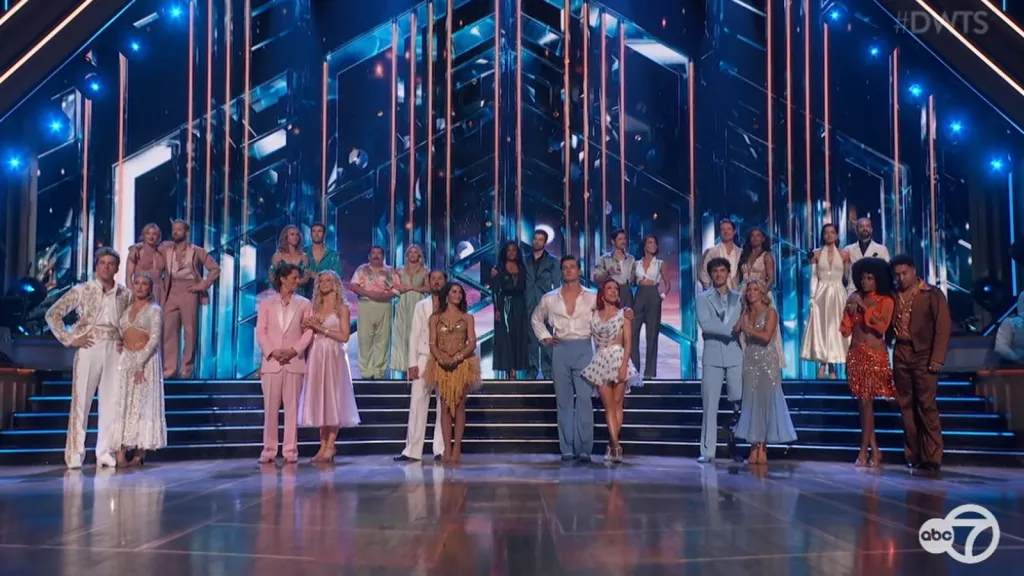
SPOILER ALERT! This post contains details from Tuesday night’s episode of Dancing with the Stars.
It’s another exciting night in the ballroom as 13 contestants are still eyeing the Len Goodman Mirrorball Trophy during Week 3 of Dancing with the Stars.
Last week, the judges reinforced just how tough they are going to be this season, once again declining to score anyone above a 7. Still, three couples — Jenna and Val, Ezra and Daniella, and Amber and Pasha — walked away tied for the top of the leaderboard with 21 points. We also said goodbye to Alan Bersten and chef Giada De Laurentiis.
Week 3 is Yacht Rock night, so the remaining couples are performing to hits from artists including Fleetwood Mac, The Doobie Brothers, and Luther Vandross.
Here is how the night went.
Olympian Amber Glenn with Pasha Pashkov danced a Foxtrot to “Hold the Line” by Toto. SCORE: 24
Actress Julia Stiles with Ezra Sosa danced a salsa to “I Can’t Go for That (No Can Do)” by Daryl Hall & John Oates. SCORE: 19
Late-night sidekick Guillermo Rodriguez with Whitney Carson danced a Foxtrot to “Escape (The Piña Colada Song)” by Rupert Holmes. SCORE: 15
Actress Tatyana Ali with Jan Ravnik performed a Quickstep to “Maneater” by Daryl Hall & John Oates. SCORE: 21
Actor Harry Shum Jr. with Jenna Johnson performed a jive to “You Make My Dreams Come True” by Daryl Hall & John Oates. SCORE: 24
Musician Taylor Hanson with Britt Stewart danced a Foxtrot to “What a Fool Believes” by The Doobie Brothers. SCORE: 18
Reality star Maura Higgins with Mark Ballas danced a Quickstep to “Turn Your Love Around” by George Benson. SCORE: 22
Reality star Ciara Miller with Brandon Armstrong performed a Cha Cha to “Never Too Much” by Luther Vandross. SCORE: 18
Savannah Bananas midfielder Jackson Olson with Emma Slater performed a paso doble to “Easy Lover” by Philip Bailey and Phil Collins. SCORE: 18
Comedian and podcaster Connor Wood with Rylee Arnold danced a Foxtrot to “Everywhere” by Fleetwood Mac. SCORE: 20
Actress Jenna Dewan with Val Chmerkovskiy danced a samba to “Africa” by Toto. SCORE: 21
Reality star Tyler Cameron with Sharna Burgess danced a jive to “Still the One” by Orleans. SCORE: 17
Paralympian Ezra Frech with Daniella Karagach danced a Foxtrot to “Just the Two of Us” by Grover Washington Jr. featuring Bill Withers. SCORE: 21
Who goes home?
The competition is now down to 12 as Taylor Hanson and Britt Stewart were sent home. Next week is all about Mariah Carey, so the couples will perform a variety of the pop superstar’s biggest hits.
>


Search For Canadian TV Actor Stewart McLean Now Homicide Investigation


These ’90s fashion trends are making a comeback in 2017
According to Dior Couture, this taboo fashion accessory is back
Model Jocelyn Chew’s Instagram is the best vacation you’ve ever had
Emily Ratajkowski channels back-to-school style
9 Celebrities who have spoken out about being photoshopped


Rurouni Kenshin: Hokkaido Arc Manga Takes 1-Issue Break – News


HIDIVE to Stream English Dubs for The World Is Dancing, The Forsaken Saintess and Her Foodie Roadtrip in Another World, The Dangers in My Heart: The Movie Anime – News