
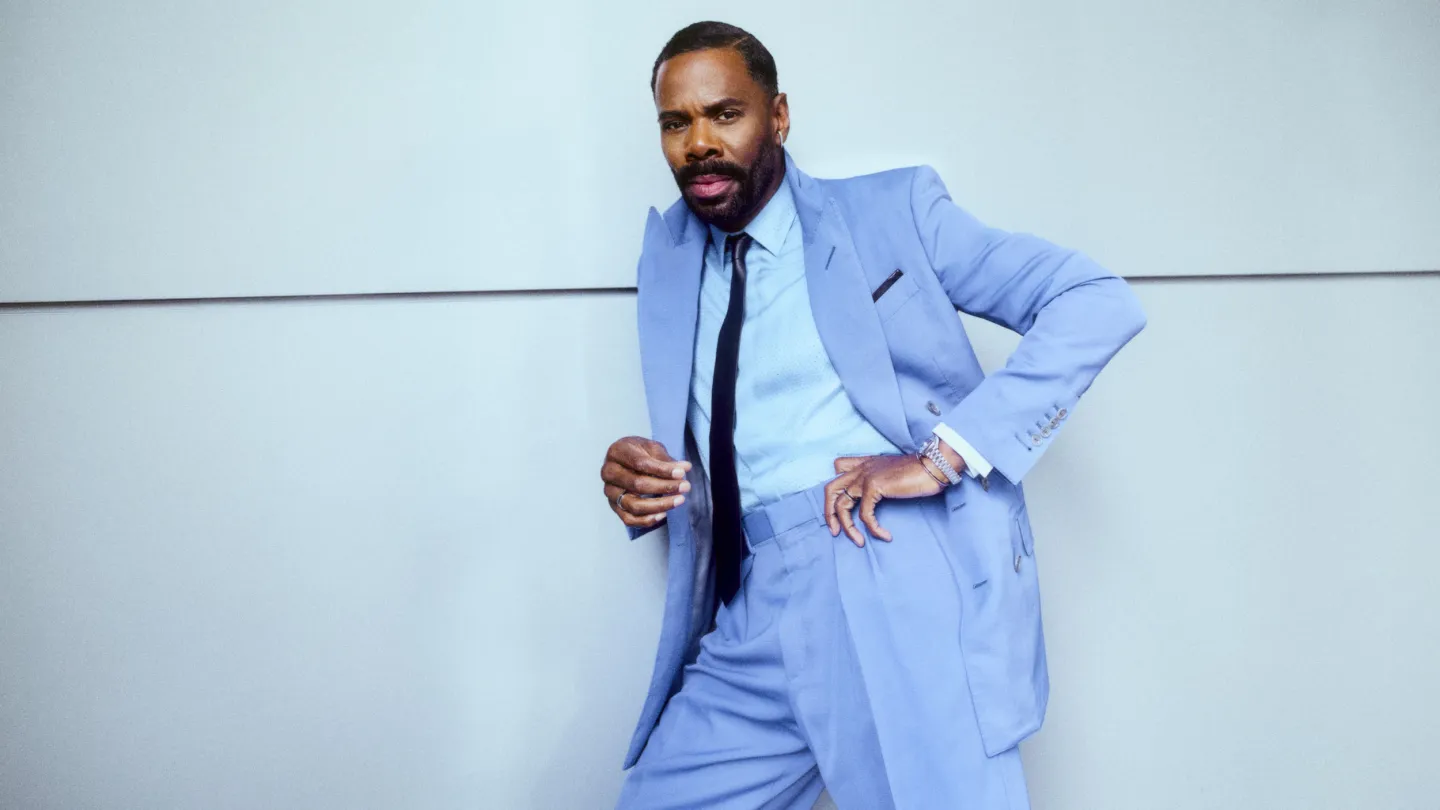
Jacquemus suit, shirt, tie; Boucheron jewelry; Omega watch.
Photographed by Emman Montalvan


After the 2024 Golden Globes, Glen Powell found himself on a plane that also happened to be transporting an entire girls soccer team. After blowing through what he estimated to be 30 selfies over the course of a 15-minute boarding process, Powell lowered his baseball cap over his eyes and attempted to decompress. A few seconds later, two hands came out of nowhere and shook him.
“I’m like, ‘What is happening?’ ” he remembers. “I look up and I was two inches away from his face, and he goes, ‘You sexy son of a bitch!’ ”
This is how Powell first met Colman Domingo.
Jacquemus suit, shirt, tie; Boucheron jewelry; Omega watch.
Photographed by Emman Montalvan
The introduction was not unwarranted — they had just been cast to star alongside each other in the remake of The Running Man. Domingo asked Powell to have dinner together that evening, or at least the best approximation of a dinner that can be offered at 30,000 feet. Crowded in the galley with the flight attendants, they ate airline food and drank tequila.
“We just chatted about his husband and his affinity for throwing parties and this run he’s on at this point in his life,” recalls Powell. “I fell in love with Colman Domingo on that flight.”
Audiences’ introduction to Domingo isn’t terribly dissimilar. Domingo, 56, is a force who seemingly came out of nowhere, quickly endearing himself to audiences to the point where it’s hard to remember a time when he wasn’t on our screens.
He owes his current ubiquity to the release of two studio tentpoles — the Michael Jackson biopic Michael and, in June, Steven Spielberg’s latest, Disclosure Day — plus the hotly anticipated final season of the HBO drama Euphoria and the second season of the cozy Netflix comedy The Four Seasons, for which he also serves as a director.
If Hollywood is well and truly in a period of contraction, no one has told Domingo.
It may seem uncharacteristic for a two-time Oscar nominee, Emmy winner and a perennial best-dressed-list designee to suggest a Starbucks in a Malibu strip mall (albeit a strip mall with an ocean view) as a meeting spot to discuss these many projects. But Domingo says he wanted to talk “somewhere I actually go.” (For the record, Domingo’s Starbucks order is a 1971 dark roast with a splash of oat milk.)
Much of the narrative that has surrounded Domingo thus far has been about the hustle — the decades spent as a theater fixture and character actor before Hollywood turned its long overdue attention his way.
When asked whether he would have welcomed success earlier, he laughs, “I think my finances would have wanted it, yeah.” And then he earnestly offers: “Maybe I’m saying this now because of the way things have been mapped out, but I feel like I wouldn’t change a thing. I really wouldn’t.”
Whether or not recognition came at the right moment, one thing is certain: Now that it is here, Domingo is having a damn good time.
He moves effortlessly between drama and comedy, blockbuster and indie, prestige and populist. One weekend, audiences can watch him running through a cadre of memorable eccentrics on Saturday Night Live, and the next sitting opposite Zendaya dispensing wisdom in Euphoria, and the next as a snarling Joe Jackson in Michael. In between, he pops up in unexpected places, like a Sabrina Carpenter music video or as the voice of the Cowardly Lion in Wicked: For Good.
“Maybe it’s because I’m sort of leaning into the third act of my career,” says Domingo. “For a long time, as artists, we’re in our ‘planting seeds’ phase. I feel like I’m in an incredible harvest period.”
“Sometimes you have to move the needle yourself before the industry moves it for you,” says Domingo. Jacquemus suit, shirt, tie; Boucheron jewelry; Omega watch; Kurt Geiger shoes.
Photographed by Emman Montalvan
****
“I think people from Philadelphia have a really finely tuned bullshit sensor. Colman can tell when something’s bullshit, in the best way,” says Tina Fey, who cast Domingo in her Netflix dramedy The Four Seasons and quickly found a kindred spirit in her fellow Philly native.
What’s something Domingo calls bullshit on? “Anyone who says they don’t have time for love, they don’t have time for this or that, that’s bullshit,” he says of the importance of creatives experiencing life outside of their work. “Because you need all of that to sustain you and to pour into your work.”
Hollywood may love underdog stories, but it prefers them onscreen, not off. Look no further than our current nepo-obsessed moment. Because at a time of industry retrenchment, what is more risk-tolerant than the progeny of the proven profitable A-list?
Domingo’s road to the top has been rockier: A methodical rise — filled with false starts, would-be’s, big breaks and setbacks — delivered him to the highest echelons of the entertainment industry as he was entering his 50s.
There’s a patina to his performances.
Audiences don’t just see a character, says Domingo, “they see a life. They see somebody who’s fully engaged in living. People can see it, I know they can see it.”
Domingo, born and raised in West Philadelphia, characterizes his younger self as “a little shy and very awkward,” spending his time at the local library and playing the violin on the front porch of his family’s row house. The first in his family to go to college, Domingo attended Temple University as a journalism major. After taking an acting class, his creative ambitions took root. But working two jobs while juggling schoolwork left him struggling to keep his grades up. His mother assured him that he could always go back to school if he needed to take a break. At the behest of an old fraternity brother, he made a cross-country move with $75 of borrowed money.
“I knew that [California] was a place where I could be separate from who I was in Philadelphia, whether it was as someone’s son, someone’s brother, someone’s friend,” he says. “I went to San Francisco to reinvent myself” — “pre-dot-com boom” San Francisco, he specifies. He was one of four tenants in a studio apartment in the Mission District when it was still predominantly occupied by lesbians and Latino families.
And his reinvention, Domingo will tell you with a smile, started off with a lie. He responded to a help-wanted ad from The Kennel Club, a Divisadero Street haunt that hosted early performances from Jane’s Addiction and Nirvana. “They were looking for dancers. Just regular dancers, not strippers. I never had the body of a stripper. I go in, and they’re like, ‘Oh man, we hired all our dancers. But we are looking for a bartender.’ ” He was not a bartender, but he bought books on bartending from the nearby Barnes & Noble, studied hard and showed up for his first shift.
If all else failed, he figured, “As long as I make them strong, no one’s gonna care. It was that type of bar.”
He took acting classes and then taught acting classes while serving as the artistic director for Bay Area theater companies like New Conservatory Theater Center. He had other side jobs — taking headshots, working as a baker’s assistant and dancing at bar mitzvahs — and he participated in as many film and television productions as the Bay Area offered at the time, which meant he has appeared in four episodes of Nash Bridges.
“I just made my life as an artist. This is what an artist’s life looks like,” he thought then. “It looks like teaching and acting and bartending shifts.”
At the same time, he was racking up small but memorable parts in films from Hollywood’s biggest directors. Several decades into his career, he had worked with Steven Spielberg (Lincoln), Ava DuVernay (Selma), Steven Soderbergh (The Knick) and Lee Daniels (The Butler). It was after working with Barry Jenkins on the James Baldwin adaptation If Beale Street Could Talk that Domingo decided that, from then on, he would be an offer-only actor. He recalls thinking, “I’ve been working for a long time, and I have a body of work. If you want to work with me, you will give me an offer and you’ll have a meeting with me. But I’m not going to bend over backwards with 10 pages of sides to try to prove something.”
Rowen Rose shirt, pants; Boucheron jewelry; Willy Chavarria shoes.
Photographed by Emman Montalvan
Domingo says, “Sometimes you have to move the needle yourself before the industry moves it for you.”
Around this time, he was first invited to the Motion Picture & Television Fund’s Night Before party, one of the starrier annual events among an always overstuffed Oscars weekend. Domingo, who was living in New York at the time, remembers, “I finally got one of these major invitations. I was like, ‘I gotta go out there!’ ”
He arrived at the party at the same time as Chadwick Boseman, then on the high of the first Black Panther movie grossing more than $1 billion at the box office.
“We did a couple of play readings together, so we knew each other, but not super well,” says Domingo of Boseman, who on that night was surrounded by a small flotilla of agents and other Hollywood types. “I’m like, ‘Hi, hi, Chad. It’s Colman. Do you remember me?’ I said, ‘I’m so proud of all your success and everything you’re doing. It’s so beautiful to watch your ascension.’ He literally looked at me like this —” Domingo looks up and down and motions over his shoulder to get the attention of an invisible entourage — “[and he] said, ‘Y’all need to know this guy right here. This guy is the truth.’ I was like, ‘Oh no, no.’ He said, ‘No, I’m telling you, know Colman Domingo’s name. I know this man. Keep your eye on him.’ ”
Domingo ended up onscreen with Boseman for what would become the actor’s final role in Ma Rainey’s Black Bottom, playing a trombone player who clashes with Boseman’s ambitious trumpeter. On the first day of production, Boseman walked over to Domingo. “He had huge hands,” Domingo recalls, “and he would point his finger at me and say, ‘I can‘t wait to dance with you. Oh, we’re gonna dance. We’re gonna dance.’ ”
It was the first summer of the COVID pandemic, and Domingo was outside grilling burgers when he received a text from playwright Robert O’Hara about Boseman’s death from colon cancer. Boseman was 43.
“Of my contemporaries who really come from my experience, whether it’s growing up in the inner city or just being an African American man, there’s not a lot of men who hold that space in this rare air,” says Domingo. “Not many who you can ask, ‘When I go through this part, what should I look out for? How should I advocate for myself? Or, for others?’ Chadwick had been one of them.” As of late, Domingo has been forming a bond with Jamie Foxx and name-checks Denzel Washington as a mentor, but Boseman left an indelible impact.
He adds, “I really feel like [Boseman]’s been lifting people like me and Michael B. Jordan up from the other side,” says Domingo. “I do believe I have a little, beautiful angel in my friend Chadwick.”
At some point, Domingo concluded that a leading man career was likely not in the cards for him. “I had a lot of experiences where I was doing good work, and the work was being respected and seen, but I wasn’t getting the shine. So, I started to make the agreement with myself that maybe the shine wasn’t for me. That’s just not part of my story. I show up, and I’m the one who will be next to David Oyelowo — the one to support him. Or, I’ll be the one in an ensemble with Chadwick Boseman and Viola Davis.”
Like a psychic that takes a commission, an early agent told Domingo he was “a character actor in a leading man’s body,” and it would take a while for Hollywood to catch on.
By the time Domingo received back-to-back best actor Oscar nominations — for the Bayard Rustin biopic Rustin in 2024 and the indie drama Sing Sing in 2025 — joining a group that includes Washington, Russell Crowe, Johnny Depp and Tom Hanks, Hollywood had heard the message loud and clear.
***
Domingo in Steven Spielberg’s Disclosure Day (left) and as Joe Jackson in Michael.
Niko Tavernise/Universal Pictures and Amblin Entertainment; Glen Wilson/Lionsgate
Spielberg told Domingo to give it his all. To lay it on thick. Hold nothing back. So, Domingo grabbed the pull cord for the horn of the shiny red fire truck he was perched in and let loose.
“I get out, and Steven is delighted. And he says, ‘I’ve always wanted a fire engine in a film!’ ” Domingo is pretty sure the scene didn’t end up in the final edit of Disclosure Day, but that wasn’t the point. He says, “[Spielberg] allows time for fun, these childlike moments.”
The film, out June 12, is Spielberg’s latest foray into his Close Encounters of the Third Kind and E.T. territory, with Domingo playing one-time government operative Hugo Wakefield, who formerly helped shield the public from the truth about alien visitation and is now aiding and abetting the effort for full disclosure.
It was in 2010 that the director first cast Domingo in a film about George Gershwin, where Domingo would have headlined the cast of the film’s version of Gershwin’s Porgy & Bess. The film was shelved, but Spielberg remembered Domingo when he was preparing his Civil War epic Lincoln. For years, the legendary director called Domingo “Private Green,” the name of his character in that movie.
At the 2023 Golden Globes, Domingo presented Spielberg with the best director award for his last film, The Fabelmans. Getting to the stage, before he grabbed the award, Spielberg took Domingo’s face into his hands. “He said, ‘I can’t believe I’m getting this from you. To get this from you means everything,’ ” remembers Domingo of the moment. “He feels like a big brother to me.”
Spielberg calls Disclosure Day an “overdue reunion,” writing in an email: “Since that time, I have marveled at his eclectic choices, playing so many different kinds of people, playing so many different characters.”
As Disclosure Day is readying for release, Euphoria is continuing the rollout of its third season. The HBO sensation, in which Domingo plays AA sponsor Ali, debuted in 2019, a very different time in his career. “I still consider myself a journeyman actor,” he says, but concedes, “When I started Euphoria, yes, my career was in a much more modest place, and now it has a bit more eyes on it.”
While HBO has not yet confirmed this season will be the series finale, creator Sam Levinson has alluded to its conclusion. If the curtain falls on Euphoria, Domingo, whose Ali features prominently in the season’s final two episodes, is satisfied. Levinson, Domingo says, “would always tell us, let’s treat each season as if it’s the last one. So he’s written every season as if it would be the last one, so you give your all. So, if it’s the end, I know that I gave it my all.”
“Anyone who says they don’t have time for love, they don’t have time for this or that, that’s bullshit. Because you need all of that to sustain you and to pour into your work.” Amiri jacket, shirt, pants; Boucheron jewelry; Omega watch; Manolo Blahnik shoes.
Photographed by Emman Montalvan (2)
After the Euphoria season premiere came Michael, the Michael Jackson biopic, in which Domingo plays the visionary and abusive Jackson patriarch. The movie had a fraught journey to the screen, including more than 20 days of reshoots and a retooling of the story that resulted in the removal of all mentions of child abuse allegations leveled at Jackson and the splitting of a story into two potential films, as opposed to the planned one.
“This was not an easy shoot, I will not shy away from that,” says Domingo, who donned heavy prosthetics, including colored contact lenses, and shaved his mustache to a pencil-thin line to play Joe Jackson. Though not a method actor, Domingo tried to stay in character as Joe when shooting with the younger cast.
As the movie was being revised, producer Graham King would call Domingo to talk through the updates. “Every time the film was changing in some way, shape or form, there were discussions with me just to make sure that we’re clear about the story we’re telling,” the actor says. In reshoots, filmmakers leaned into the father-son friction as the film’s central conflict, making Domingo even more integral to the film’s story.
In spite of the protracted production, Domingo is proud of how Michael turned out. “[The movie] has become an examination of how Michael became Michael, before we deal with anything else. Everyone thinks there’s one way to tell his story, and there isn’t. One can’t deny Michael’s genius and his extraordinary legacy in the music industry.”
Michael has been a hit, earning a Marvel-like debut with $217 million globally in its opening weekend with a current global haul of $577 million. Lionsgate has indicated a hope to shoot the follow-up later this year, but sources have told THR that a final screenplay for the sequel is not yet locked.
“I will want to know what story we will be telling in part two,” says Domingo of a follow-up.
Ahead of the months-long bedlam of press and premieres, Domingo signed on to host Saturday Night Live.
Heading into the week of his SNL show, he got a text from Fey. “Good morning,” starts Domingo, reading directly from his phone. “I want to be helpful to you this week, if I can. Would you like me to come sit in the back of a meeting today to see what they pitch you? Or would that be a bummer, like taking your mom with you to the prom? Either answer is OK.”
With Tina Fey in The Four Seasons and as Ali in Euphoria.
Emily V. Aragones/Netflix; Patrick Wymore/HBO
Domingo texted Fey for advice and feedback on sketch ideas throughout the week, and she was in the room for the table read as well as the live taping. But the SNL alum was never worried about Domingo. Trained theater actors and soap opera stars are the people who fare best on SNL, she says. It should also be noted that among Domingo’s many onscreen credits is the early aughts sketch comedy series The Big Gay Sketch Show, on which he debuted a standout impression of Maya Angelou doing a dramatic reading of a Craigslist personals ad that is well worth a Google.
Domingo directs Fey in the season two opener of Four Seasons, which premieres May 28 on Netflix. “He’s wonderful with the crew in its entirety,” says Fey of Domingo the director. Domingo made it a point each morning to introduce the day players to the cast and crew before filming started. She adds, “He really understands how much everyone on set is doing.”
As a director, Domingo is trusting of others’ talents, saying, “I don’t want to have to move people around.” In 2020, he started his company, Edith Productions (named after his mother), in part to have control over how his productions are run. He explains, “I have my own structure and the way I work, and it’s very efficient and it’s loving and it’s kind.”
The shingle is headed by Domingo’s husband of more than a decade, Raúl Domingo. They met in 2005 after spying each other outside a Walgreens in Berkeley and, when Domingo resolved to write a Craigslist Missed Connections in an attempt to find him, he saw that Raúl had already written one about him. Says Domingo, “It’s been the most joyous six years creating and developing with Raúl because he really is someone who has impeccable taste.”
Domingo with his husband, Raúl, in Venice, Italy, in 2025.
Earl Gibson III/Deadline/Getty Images
They keep their slate intentionally small. Domingo estimates they only have about 12 projects in development. Still, Edith has had outsized successes, including the Oscar-nominated Sing Sing and the horror comedy It’s What’s Inside, which sold to Netflix for $17 million out of Sundance.
Under Edith, Domingo will soon tackle one of the few roles he has yet to play: feature film director.
Domingo will helm a Nat King Cole movie musical, which he co-wrote and also plans to star in as the singer. “Not all revolutionaries are wearing berets and have their fists up in the air and are on the front line,” says Domingo, who co-wrote the play Lights Out: Nat ‘King’ Cole that premiered at the Geffen Playhouse, of his long-standing interest in the singer. “Some are on television wearing a suit and tie, being invited into people’s homes every day, knowing that that power can change the minds and hearts of people who may not think like him, or people who are very much against his very existence.”
Having landed a coveted California tax credit that allows them to film in Los Angeles, they are eyeing a shoot at year’s end. But Domingo understands better than most the ebb and flow of the film industry, and if he needs to punt the film to next year, that is fine by him. He’d rather do it right, even if it takes a little longer.
“I’m a very patient person,” he says. “I’ve longed to be in that space where there’s nothing really that I want for. I’m not in a place where there’s pressure to do something or make a date happen. I’m just not interested in pushing like that.”
One of the first films Domingo was ever cast in was Clint Eastwood’s 1999 legal thriller True Crime. A young actor just at the beginning of his career, he has a single scene in which he pokes Eastwood’s hardened Oakland journalist in the chest. “His greatest direction to me was, ‘Do what you do,’ ” Domingo remembers. “I wanted to know, am I doing it right? Is that OK? He said to me, ‘Do what you do.’ ”
And Domingo’s done just that.
Tom Ford suit, shirt, tie; Boucheron jewelry; Omega watch
Photographed by Emman Montalvan
>
EXCLUSIVE: Power Couple seller Dori Media is heading to Cannes with the largest unscripted slate in its history.
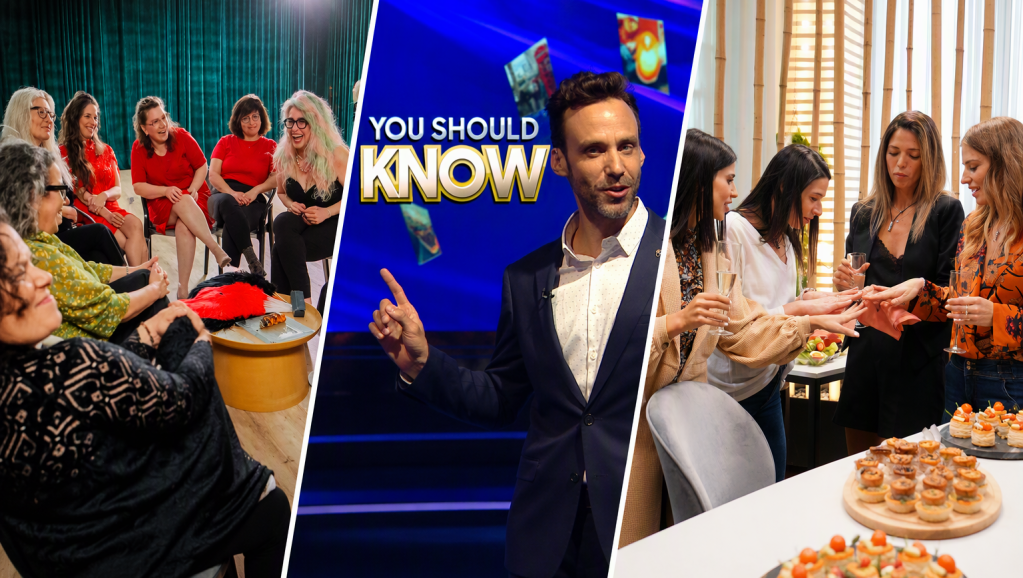
At MIPCOM, the Israeli company will debut the likes of games shows The Hive and You Should Know, docu-series My Hottest Years and primetime reality format New Love, which is from Power Couple maker Abot Hameiri.
Also on the slate is Paraiso Tropical, a doc exploring a mysterious Panamanian plane crash, and Seekers, which looks at humans’ search for meaning.
“We have been listening to our clients across the globe, many who are looking for affordable content that can help them break through with their local audiences and we are headed to MIPCOM with our largest slate of unscripted programming, a slate that features many new offerings that we believe can do just that,” said Dori Media Group CEO Nadav Palti.
Studio quiz show The Hive comes from and is from United Studios Productions and channels Kan 11 and Makan. The show’s USP is that knowing the right answer isn’t enough: Contestants need to know when to take a risk, when to block an opponent, and how to build a strategic play.
You Show Know is another quiz, this time from Shenhar Productions. Questions are tailored specifically to each contestant, drawing from their social media feeds, meaning they should, in theory, know the answers.
Doc series My Hottest Years comes from Drucker-Goren Communications and is for Kan 11, looking at what happens when women’s hormones change, while New Love is a dating reality show for Reshet 13. The format sees women live with a carefully-selected stranger for 72 hours, before they decide whether to stay for another three days or replace them with someone new.
Paraiso Tropical is a co-production from Apertura Films and Ajimolido Films in which filmmaker Abner Benaim reopens the case of a passenger plane that exploded over Panama, killing all 21 on board, including his under. Seekers, meanwhile, runs to six parts and follows the human experience through the eyes of an Amazonian chief, an Advaita monk, an African healer, a Hindu sage, a Native grandmother and a Buddhist psychologist. Édgar Ramírez, Riley Keough and Jamie-Lynn Sigler all feature.
>
SPOILER ALERT: This post contains spoilers for Ted Lasso Season 4, Episode 9, titled “Mae Rides The Bus,” now streaming on Apple TV.
The title of the second-to-last episode of Ted Lasso Season 4 hints at a goodbye to a beloved character who has been around since the first season.
Episode 9 bids farewell to Richmond’s own Mae Green (Annette Badland) who dies doing what she loves: supporting the Lady Greyhounds at their away match against Bristol City in the stands.
“That’s what happens. You’re involved with folks, and they disappear. They go, and she loved her life,” Annette Badland told Deadline. “She made the very best of her life and really relished it. So she went, I suppose, for her, in the very best way.”
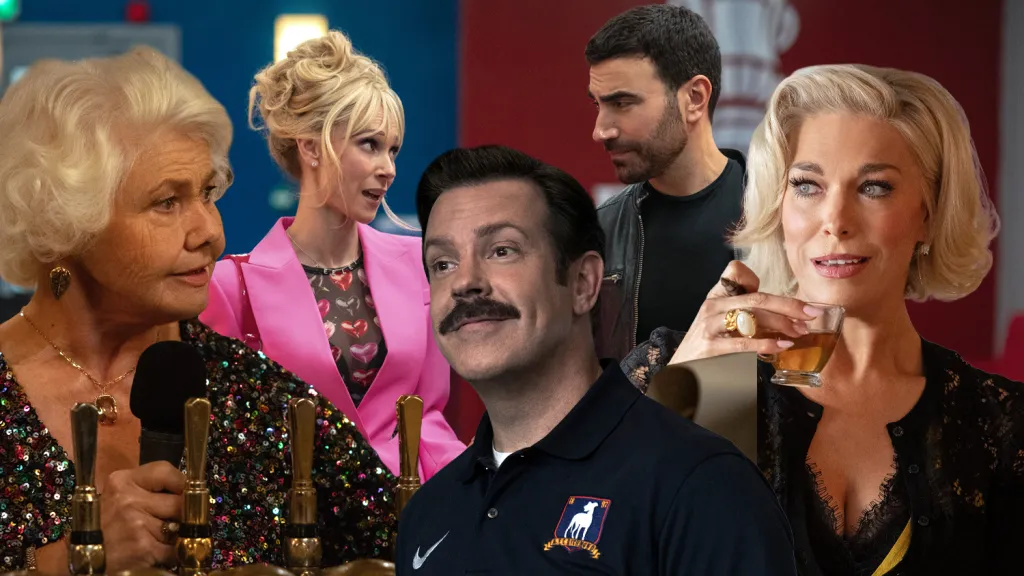
The Crown & Anchor pub owner was invited to take the team bus to the away game after she had hinted that it would be difficult for someone with her “level of seasoning” to make the two and a half hour drive. Thus, Ted (Jason Sudeikis) and Coach Beard (Brendan Hunt) invite her on the shuttle with all of the players, and they embrace Mae as one of their own on the drive.
RELATED: ‘Ted Lasso’ Episode 6 Recap: Phil Dunster Returns & New Believe Sign Debuts On New Year’s Eve
“I love the Lionesses, so I was thrilled when [Season 4] happened, and the girls are tremendous and effervescent and glorious to be around. The pub quiz scene took a couple of days to shoot, but that was like a tidal wave coming,” Badland said. “They are just so full of energy and life. So that was just something wonderful to be involved in, and just enhanced all the feelings and the camaraderie. And Mae couldn’t play football, wasn’t allowed to play football, I’m sure she’s had a lot of bad stuff in her life, but she just carries on and defies the odds and just keeps on pitching. That’s an excellent story to tell.”
In the below interview, Badland unpacks Mae’s legacy left on the series, transitioning from the men’s team dynamic of the first three seasons to the Lady Greyhounds and how Mae might come up in the finale episode.
DEADLINE: Did you know about this episode for Mae when you signed on for Season 4? How did you react when you found out what would happen for her in Episode 9?
ANNETTE BADLAND: No, I didn’t know, and I didn’t know till about, I suppose, maybe November. We were only an episode away filming that. I was shocked, but I’m very proud being in the show, and I admire Jason [Sudeikis]. I think the series is so successful because people smell it’s very genuine. The audience know it’s not made cynically. It’s not a product. It’s something Jason wants to say about the world and how we are, so you have to trust that.
I don’t know when I’ll die. You just don’t know. So, being told that it was going to happen quite close to it being filmed, you just have to go. ‘Well, that’s [that]. He told me in the storyline, so he started at the beginning [with] “I invite her to come, and blah blah, and she won’t drive, and then she comes to the grounds and she goes in the bus,” and I’m going, “Oh wow, this is…” and then “She passes.” [Gulps.] But hopefully that’s what will happen for the audience too.
DEADLINE: How did you want to approach the speech you gave in the locker room before the game? There’s the moment in the bus before where they’re like, “We’re gonna grill you about your whole life and everything you know. How did you approach those scenes with the end of the episode in mind? What you wanted to leave on the field, for lack of a better way to put that?
BADLAND: I think not giving in. She’s very outspoken. She’s a lioness who will defend you till the nth degree once you’ve got her heart and respect. Being an older woman, where you do become invisible, Mae’s never going to be invisible. She will not allow that to happen. I get ignored. You’ll stand at a counter, and people won’t bother, or they’ll walk into you. “You’ve had your time, move aside.” And Mae would not allow that, and was still in there pitching and relishing.

L-R: Jason Sudeikis and Annette Badland in Season 4 of ‘Ted Lasso’
Apple TV
DEADLINE: What does it say about her that she wants to sit in the audience stands or the supporters side versus the box with Rebecca and everyone?
BADLAND: Yeah, not her people, and she might have felt constrained. “Well, I’m not going to sit and behave myself or feel the fool because I’m sitting with you.” I’ll go where the folk that really scraped together to get the money, who are dedicated, [are sitting]. Even although it was her pub, she’s not part of a hierarchy. Everybody’s judged on how they are. Just not her style. Go and be with the real fun.
DEADLINE: There’s the hint of the shares and the battle that’s going on there. And Mae has shares, and she was like protecting her patrons at the pub. Can you tease anything about how could she could leave an impact that way too on the team?
BADLAND: Well, she had a very large pile of shares. I mean, they were about “yay high” (gestures to table height she sits at.) She uses them to good effect. Her instructions are for them to be used in a particular way that is quite good.
DEADLINE: I love her relationship with Ted’s son this season too. I was hoping you could talk about working with Grant and any wisdom she maybe has left with him?
BADLAND: He is a delight. He’s a beautiful young man, and bright. We got on terribly well, and I shall miss him. Really, it was great having that element in the pub too. Another side of her. I can’t tease you with anything, I don’t think, but he knows what he’s doing now with a tea towel.
DEADLINE: Keeley’s pregnancy is revealed in 409, and I’ve heard some people talk about the cycle of life and how someone passes and then a new life comes into the world. So I was curious if you had any thoughts on those themes for episode nine?
BADLAND: Oh yes, well it’s absolutely true, isn’t it? We move along. We’re here for a very short time, and the next wave, the next group of people comes in. I’m delighted for Keeley, just delighted, and poor old Roy.
DEADLINE: This episode felt like such a great send off for Mae, but could we still see a funeral or something in the finale?
BADLAND: You could, maybe. I guess, or it’s like, “Oh well, that’s it.” [They could forget about her.]
DEADLINE: What do you think she would want as a celebration of her life? Have you thought about that at all?
BADLAND: Oh, she’d have asked for a tremendous party at The Crown and Anchor. Everyone invited. Jason did modify some of 410. We talked after he told me about her passing, and he did, because that’s how he is. He’s responsive and collaborative. So he did change some of the stuff in 10, or incorporated what we talked about. She doesn’t just [go away]. She has, not an appearance, but she is still within the context.
DEADLINE: I’m also worried-not worried, but the pub was her thing. So I hope it’s in good hands in the future.
BADLAND: So does she. Oh yes.
DEADLINE: Anthony Head gets an acknowledgement in 409, and Rupert gets his mention too. How did that all weave together with Mae also leaving? What are your thoughts on that? You had scenes with Anthony in the past.
BADLAND: He came in the pub. The darts, and we were around. He came in more than that, but that was the main one. He was a beautiful man, and he will be much missed. He was charming and funny and generous, and we’d have naughty little sort of asides. And I had wondered why we weren’t — I assumed he would be in this last [season] and didn’t know, as I think very few people knew, he was ill and just couldn’t do it.
So we will miss him, and I respect him, and I think it’s a great honor to be in the episode that is dedicated to him.
DEADLINE: How did it feel embarking on this new chapter of the show after the previous three seasons with the men’s team, and how much do you think it meant to Mae? Could you talk about that transition and leaving the show behind?
BADLAND: Well, when we finished [Season 3], we didn’t think there would be another. Jason had said, “I’ve got a three series arc, that’ll be it.” And then to go back and to take, it’s very exciting because it’s a risk, isn’t it?
A female team [is] quite quite different, and the men have come with it. The male audience have gone with it, like they do with the genuine footballers. And there’s good stories, different stories in there, different tales to tell. So, I’m absolutely thrilled that it seems, in England, certainly, to have taken off this year. People don’t know what to do. They don’t know whether to watch it episode by episode or to binge watch it. They can’t wait to binge it. So that’s thrilling, absolutely thrilling. I’ve had a great time. I’m privileged to have been part of it, and I’ll just have to be in the stands, won’t I? And see how they progress.
Or there is a film called Wonderful Life, where an angel [comes down.]
Annette Badland in ‘Ted Lasso’ Season 4
Apple TV
DEADLINE: I could see them incorporating it. I love that movie. We watch it every Christmas. She would be such a great Clarence-esque character.
BADLAND: Yeah, popping up in someone’s conscience and tearing them off a strip or whatever. Or giving them information.
DEADLINE: I feel like Beard may need some of that for some reason. Because we don’t see his reaction, at the end of the episode. We see it’s Rebecca’s telling Ted, you don’t see the words pass, but just from his actions, you know that she’s died. But yeah, I guess curious to see what will happen with him. I love that idea. I hope you’ve pitched that and that it comes to light in the future.
BADLAND: As soon as he said she passed, I said, “Oh, can I come back as an angel?” So we did talk about it.
But he doesn’t do the predictable, does he? That’s what’s so delightful.
DEADLINE: That’s all I had, unless you wanted to add anything else about what fans come up to you and say when they recognize you from the show, or any last words before we go.
BADLAND: Ah, encountering them is terrific, and I’m very proud to have been in this because I still get messages from people saying, you know, things like “My mom’s very ill with cancer. She comes home from her treatment. We all pile on the bed. We put Ted on. We believe. We laugh.” So that’s a just tremendous thing to have in the world, and to be connected to it, and feel you’ve done that for folk. No bad thing, eh?
>
SPOILER ALERT: The story includes details about Episodes 408 and 409 of Apple TV’s Ted Lasso.
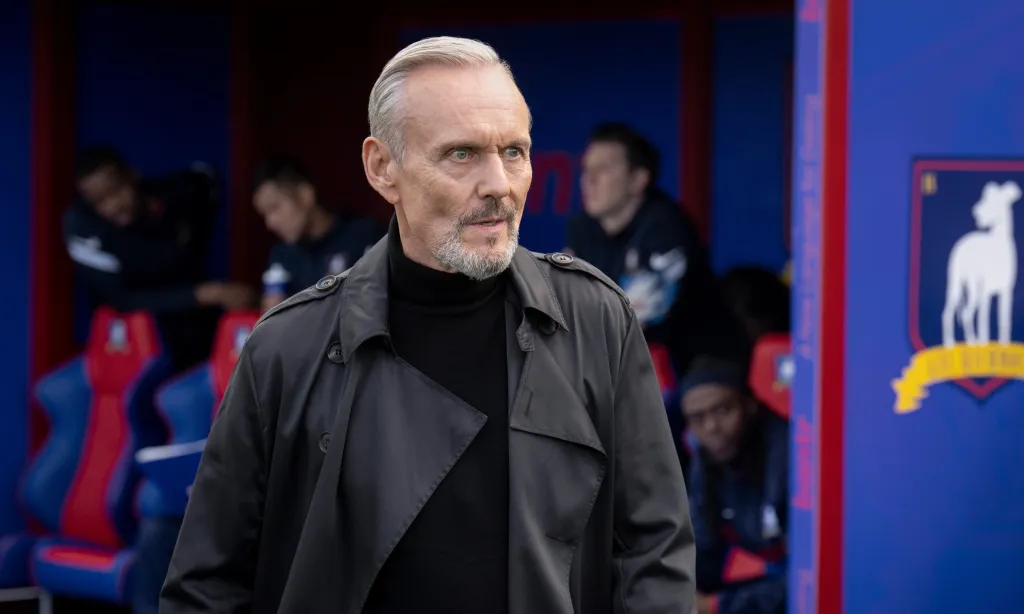
A very emotional Ted Lasso episode that included the death of a beloved original character, The Crown & Anchor pub owner Mae Green, played by Annette Badland, also acknowledged the death of the series’ popular recurring cast member Anthony Head, who played the villainous Rupert Mannion in the first three seasons.
A card, In Memory of Anthony Head, ran at the end of Season 4’s penultimate episode, “Mae Rides the Bus.” (You can see it below.)
“He was a beautiful man, and he will be much missed,” Badland told Deadline during an interview about Mae’s shocking death, reminiscing about famous Season 1 darts scene between Rupert and Jason Sudeikis’ Ted Lasso at the pub. “He was charming and funny and generous, and we’d have naughty little sort of asides.
Ted Lasso was always expected to pay tribute to the veteran British actor who died on June 1 at the age of 72. When that was not done in the Season 4 premiere, many thought that Head would be honored in an episode he appears in as the season had wrapped production in January, months before his passing.
“I assumed he would be in this last [season], and didn’t know, as I think very few people knew, he was ill and just couldn’t do it,” Badland said.
Barely referenced in the first seven episodes, Head’s Rupert, ex-owner of AFC Richmond and ex-husband of the club’s current owner Rebecca (Hannah Waddingham), came back into the forefront in Episode 8, when Higgins (Jeremy Swift), with the help of Mae and her “Follow the anger” advice, deducted that Rupert had been secretly buying shares to regain control of Richmond.
That remained a story thread in Episode 9 until the surprise twist at the end that revealed it was not Rupert but Tracey Ullman’s Zelda Southport who was behind the shady operation and on the verge of becoming a majority owner of the club.
The move raised questions whether Ted Lasso had pivoted from Rupert to Zelda as the culprit — and away from a potential Rebecca vs. Rupert battle for control of Richmond — in light of Head’s death (or leading into it). According to sources, no Season 4 storylines were changed following Head’s passing, there had been no formal plans for Head to be in Season 4 and no official approach to him about appearing.
It is unclear whether that was related to Head’s health issues which had been kept private. (His cause of death was listed by his daughters as complications due to pneumonia.) Head’s last acting credits were Season 3 of Ted Lasso, which came out in 2023, and the 2024 Prime Video movie Upgraded.
It is a longstanding TV tradition for characters to mirror the death of the actors who played them by passing away in the show. Because of the timing of Head’s passing after Season 4 had been completed, that will likely happen in Season 5.
The eccentric ultra-wealthy entrepreneur and sports investor Zelda — a polarizing and largely disliked new character introduced in Season 4 — had long been suspected by fans to be the season’s secret villain.
Zelda, who had become involved in Richmond’s women’s team with Keeley’s (Juno Temple) enthusiastic support over Rebecca’s serious reservations, was present when Higgins told Rebecca in Season 8 that Rupert was behind the buyouts. In fact, Zelda looked rather nervous for a moment when Higgins announced that he had solved the mystery before he dropped Rupert’s name and she chimed in with “Never underestimate the power of anger as fuel.” (We will likely find out more about her motives in the Season 4 finale.)
In Episode 9, Zelda also happened to be there any time Higgins and Rebecca discussed the matter. That included him telling his boss in the office that Rupert’s lawyers were “denying knowing anything about people selling shares but since there has been a pause in buying” and that Rebecca won’t lose control of the club regardless, as long as the Milk sisters, who no one had been able to get ahold of, don’t sell their shares. The three also were together on board the Richmond private jet when Higgins told Rebecca that even without the Milk sisters, the mystery buyer they believed to be Rupert can get 49% of the shares.
That may prove a moot point as Zelda was later seen giving her henchman, who had located the sisters, instructions to go as high as needed to secure their shares.
With the mystery solved, the producers felt it made sense to run an end card honoring Head in Season 9. Rupert had his Season 4 moment in 408 and 409, so paying tribute to Head following the close of his character’s two-episode arc felt most appropriate. (Running the card at the end of Episode 8 likely also would’ve spoiled the surprise that it wasn’t Rupert who was buying the shares.)
Head recurred on the first two seasons of Ted Lasso, becoming a series regular in Season 3. His character Rupert, Rebecca’s vindictive and philandering former husband who lost Richmond to her in the divorce, was the original three-season installment’s main antagonist. He subsequently bought another Premiere League team — West Ham United — and recruited Ted’s kitman turned assistant coach Nathan Shelley (Nick Mohammed) to work with him, before losing it in the Season 3 finale.
“We will miss him, I respect him, and it’s a great honor to be in the episode that is dedicated to him,” Badland said. Here is a video of her comments.
>


Search For Canadian TV Actor Stewart McLean Now Homicide Investigation


These ’90s fashion trends are making a comeback in 2017
According to Dior Couture, this taboo fashion accessory is back
Model Jocelyn Chew’s Instagram is the best vacation you’ve ever had
Emily Ratajkowski channels back-to-school style
9 Celebrities who have spoken out about being photoshopped


Rurouni Kenshin: Hokkaido Arc Manga Takes 1-Issue Break – News


HIDIVE to Stream English Dubs for The World Is Dancing, The Forsaken Saintess and Her Foodie Roadtrip in Another World, The Dangers in My Heart: The Movie Anime – News