
Tech
Social Media Bans for Kids Need Smarter Safety Design



Even before France approved legislation banning social media for children under 15 last January, 13-year-old Benjamin was already wondering what life without social media would look like. “If we want to play football, we won’t be able to organize it. What will we do? Send letters instead?” he joked in an interview for Le Monde.
His reaction captured the central challenge behind the growing wave of youth social media bans: Removing access is one thing; understanding what those platforms mean in children’s lives is another.
Within weeks of Australia’s similar ban, the country’s eSafety Commissioner reported that platforms had restricted access to 4.7 million under-16 accounts. Two months later, though, one in five Australian teenagers under 16 was still using TikTok and Snapchat, according to a parental-control data company. But even if all children’s social media accounts were to disappear, do such bans actually make children safer online?
Governments are moving ahead without answering that question as they follow Australia’s lead. Indonesia’s child safety framework, which took effect in March, bars children under 16 from holding accounts on “high-risk” platforms. The UK government has announced plans to ban social media for under-16s, add default overnight social media curfews for 16- and 17-year-olds, and extend child-safety rules to cover risky AI features. And on 17 September, the European Commission proposed the EU KIDS Act, which would bar children under 13 from social media, set 15 as the EU-wide minimum age for opening an account independently, and require platforms to show that their services are age-appropriate and safe by design.
But based on my experience working on Child Online Protection initiatives with the International Telecommunication Union (ITU) across Southeast Asia and the Pacific, I know the bans don’t address the real problems. Instead, we should be paying more attention to the systems that generate harm in the first place—namely, recommender algorithms, engagement-maximizing design, opaque moderation, and extractive data practices.
Account removals are not the same as online child safety
My experience working on protecting children’s online safety has taught me three main lessons:
First, the public institutions responsible for child online protection often lack the staff, budget, or technical capacity to enforce complex online safety policies.
Indonesia is illustrative. A 2026 UNICEF evaluation found capacity constraints among service providers, long-term funding uncertainty, and a need for specialized personnel. At the local level, some staff lacked digital skills, while budget constraints left some areas reliant on external support.
Second, many children, and often their parents, lack the digital literacy and critical thinking skills needed to navigate online risks safely. My policy research on child online protection in Indonesia, published earlier this year in Digital Society, found substantial gaps that account removals cannot repair: Many children lacked guidance on navigating the internet safely, and large numbers did not know how to report harmful experiences.
And third, the platforms have limited independent oversight as they identify underage users, design age-verification systems, and report their own compliance. In Indonesia, platforms themselves are responsible for carrying out age verification, while the Ministry of Communication and Digital Affairs oversees compliance. TikTok’s appeals process for users flagged as underage, for instance, can require a government-issued ID and selfies, which is a problem because it involves collecting the additional personal data on an ID card, beyond that needed to confirm age. Will government regulators ensure that TikTok handles that data responsibly?
The privacy paradox of proving age
Every age-based ban creates an engineering problem: How can a platform reliably determine that a user is old enough, without intruding on other information? Governments and companies may use identity documents, parental authorization, app-store checks, or facial age estimation. Each approach has trade-offs between accuracy, privacy, accessibility, and resistance to circumvention.
There are also technical issues. One tool, facial age estimation, draws on enormous databases but it is probabilistic, not exact, because people vary so much. It’s also been shown to misclassify both children and adults.
The challenge should not merely be to “verify age.” It should be to prove that someone is above a threshold, without disclosing their identity, birth date, or other information third parties might use to create a marketing profile. The European Commission’s age-verification blueprint challenges companies to verify ages without collecting all that additional information.
Privacy-preserving technologies offer promising ways to achieve this. Zero-Knowledge Proofs (ZKPs) can confirm that someone meets an age threshold without revealing their identity or exact date of birth. W3C Verifiable Credentials are cryptographically verifiable digital claims that can disclose only the information needed, such as “over 16.” And device-based age signals can allow a phone or app store to share an age range without revealing a user’s exact birth date. But these methods still require rigorous security testing, common standards, independent oversight, and clear limits on data retention. Otherwise, poorly designed child-safety policies risk creating permanent identity infrastructures in which businesses, not people, control personal data.
Where connection goes when a platform closes
Blocking access to a platform redirects some young people, but not always where expected. Early anecdotal reports in Australia pointed to teenagers migrating to smaller, less-regulated platforms like Yope, a pattern the Cato Institute flagged as a “whack-a-mole” problem for regulators. But industry data collected two months later found no broad-based shift of that kind, aside from a small uptick in WhatsApp use. Many teens simply found a way to stay on the banned platforms.
This points to a deeper gap in current society: the erosion of youth “third places“ physical spaces where young people have room to socialize and build identity outside home and school. As those spaces have diminished, commercial communications platforms have absorbed that role.
For many teenagers, social media workarounds are merely inconvenient. But for isolated, marginalized, disabled, or LGBTQ+ youth who depend on online communities for support that’s otherwise unavailable, displacement can mean losing certain kinds of belonging, or having to move to a platform with even weaker oversight.
How to design safer online systems for children
If blanket social media bans don’t work, then what will? The platforms have created many of the conditions that governments are now trying to contain: engagement-optimized recommenders, intrusive data practices, weak safeguards against unwanted contact, and features such as infinite scroll, autoplay, streaks, and persistent notifications.
These design patterns increasingly face regulatory scrutiny, including under the European Union’s Digital Services Act. A 2026 study from the 5Rights Foundation that tracked children’s device use minute by minute found that the user interfaces shape children’s attention, sleep, and well-being in real time.
A more durable response would regulate those interfaces directly, treating children as legitimate users whose privacy, agency, and well-being are required protections, not afterthoughts. That means designing for safety from the outset. One example would be for children’s apps to have high-privacy defaults, such as private accounts and location sharing switched off for minors. They could also have recommender systems that explain the main factors shaping a feed and give young users more control over personalization. The European Commission has published age-appropriate interaction guidelines that limit unsolicited contact and prevent minors from being added to groups without consent. Rules could also prohibit engagement-maximizing features that demand users’ attention, such as autoplay, infinite scroll, usage streaks, read receipts, and push notifications, by disabling or limiting them by default.
Governments should define measurable outcomes and fund independent evaluation, platforms should give researchers meaningful data access, and engineers should audit age-assurance systems for bias and data leakage. Schools, parents, and children themselves need a seat in designing the technology that’s designed to protect children.
If policymakers still decide to remove an infrastructure for youth connection, they should offer something better in return. Social media bans may reduce some forms of exposure to harmful content and may be justified for particular ages, services, or risks. But they are just one tool, not a comprehensive substitute for safer design, accountable platforms, digital literacy, institutional capacity, and non-commercial digital “third places”—moderated communities, creative spaces, and public-interest platforms designed for youth participation rather than profit.
The first wave of social media restrictions isn’t enough to keep children safe. Governments are still measuring what’s easiest to count, while neglecting harder-to-measure outcomes such as children’s access to safe third places and meaningful social connection, both online and offline. Until governments can show evidence that harm has actually declined, they will keep mistaking account removal for safety.
From Your Site Articles
Related Articles Around the Web
>

In December 2025, about a month before the U.S. invaded Venezuela and captured its president, Nicolás Maduro, President Trump had a secret meeting with Elon Musk, Time magazine reports. This was roughly seven months after Musk left his role in the Trump administration at the Department of Government Efficiency (DOGE).
During this meeting, Trump “spent hours” talking to Musk’s Grok chatbot, including asking how Venezuelans would respond to the capture of their president, a source told Time. Just a few months earlier, in September, Trump began ordering U.S. military strikes against Venezuelan boats that Trump alleged were involved in drug trafficking.
People had apparently been turning to Grok asking about the boat strikes and political climate in Venezuela, as the Atlantic reported at the time. So Grok told Trump that Maduro was a “deeply unpopular dictator and that many Venezuelans would likely celebrate his downfall,” Time reported.
When such celebrations indeed happened after the U.S. invaded on January 3, Trump apparently “came away thinking Grok was ingenious,” that source told Time.
So perhaps it should come as no surprise that in June of this year, the Pentagon’s head of AI said that the military used Gov Grok to deploy and strike targets during the Iran War.
While Grok isn’t the only AI model serving the DoD (OpenAI also has an agreement and Anthropic has been in a back-and-forth over how its models can be used for military intelligence and in modern warfare), Grok may become an even bigger favorite under this administration. Earlier this week, the Pentagon announced that Musk and Anduril’s Palmer Luckey have been tapped to co-lead a study about how advanced technology is, and can be, used in battlefields.
>

When Igor Dobrianskyi looks at a car dealership lot, he sees a wasted opportunity.
“Millions and millions of used cars are sitting on parking lots, depreciating and losing value,” Dobrianskyi said in a recent interview, adding that there are 76,000 dealerships in the United States. “At the same time, there are people who need a car for a few months, but the options are actually very limited and expensive.”
Dobrianskyi’s new startup, MyMonthlyCar, aims to connect both sides of that equation through an online platform that offers flexible month-to-month rentals from local dealerships. MyMonthlyCar was selected for the 2026 Startup Battlefield 200, a cohort of promising early-stage startups that have earned a spot to exhibit at this year’s TechCrunch Disrupt, taking place October 13 to 15 in San Francisco.
MyMonthlyCar, which is registered in Delaware and based in Florida, was co-founded by Dobrianskyi; CPO Kostiantyn Gitko; and CTO Vadym Zotov. All three are from Ukraine, said Dobrianskyi, who moved to the U.S. with his wife and young daughter after the Russia-Ukraine war began.
MyMonthlyCar does what its name suggests, with one twist: The startup only rents used cars on a month-to-month basis; no short-term options here. But it does give dealerships the chance to offer customers a rent-to-own option.
“So we don’t bring them only customers to rent on a monthly basis; we basically bring them the clients who potentially can buy this car as well,” he said.
MyMonthlyCar doesn’t charge dealerships to list cars on its website. Instead, MyMonthlyCar charges dealers 10% of each transaction. It also charges the customer a separate 10% fee.
The idea for MyMonthlyCar stems from Dobrianskyi’s previous experience in the industry. The founder owned a car rental company in Ukraine, but the lack of financing options there limited his ability to scale. In 2016, he launched a peer-to-peer car marketplace called SizeCar, where owners rent their cars to other drivers, much like Turo does today. SizeCar eventually spread to 40 European cities.
The startup has signed on seven dealerships to test the service and is working with an insurance broker to finalize its own insurance program, which will let customers choose among different types of coverage.
“Insurance is the key for this business, and you need to have your own insurance as a platform,” he said, noting that the No. 1 question from dealers was about insurance and liability coverage.
Despite its early-stage status, the founders have bullish projections for the startup. They plan to sign on 100 dealerships with 2,000 monthly rentals and $300,000 in revenue in the company’s first year of operation, which will kick off later this year once the insurance program launches. Over the next five years, the goal is to generate $42 million in revenue, Dobrianskyi said.
The startup has yet to raise venture capital and is currently bootstrapped. But Dobrianskyi said the plan is to raise a seed round, with the funds helping the company hire more developers to build out the platform, including an AI tool to help dealers identify which cars are best to rent out at any given time.
To check out MyMonthlyCar and the other startups that are part of TechCrunch’s Startup Battlefield competition (as well as to network with the folks funding them), join us next month at Disrupt.
When you purchase through links in our articles, we may earn a small commission. This doesn’t affect our editorial independence.
>
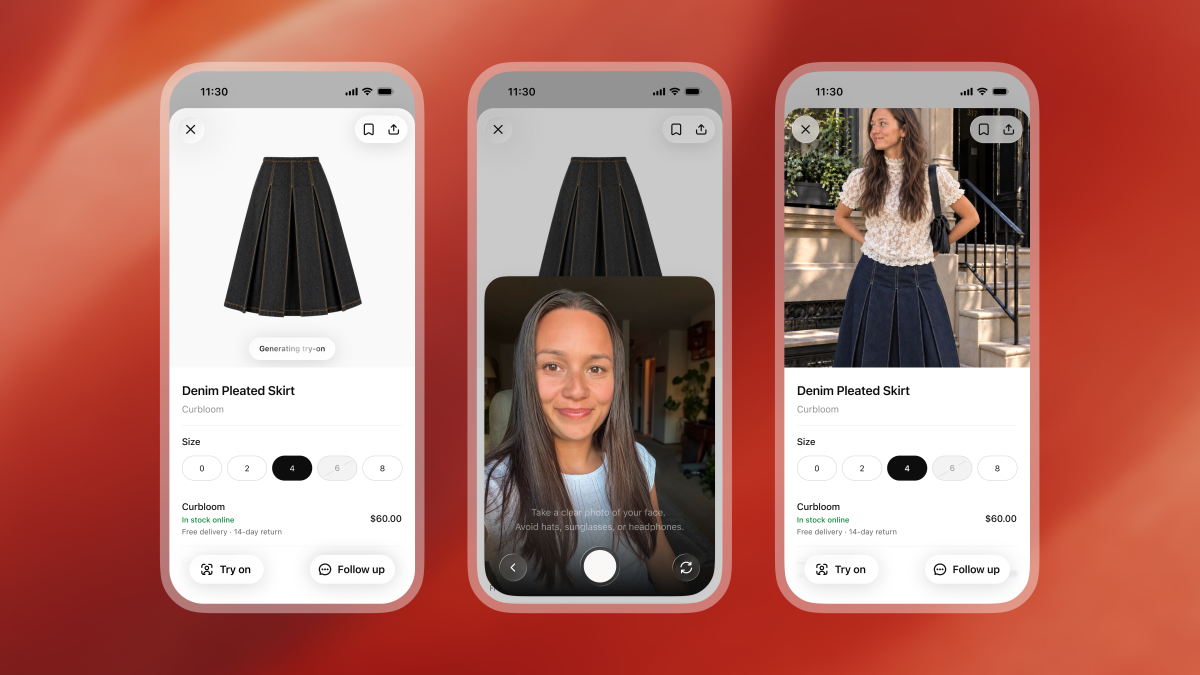
OpenAI is again experimenting with how its conversational AI assistant, ChatGPT, can help users as they shop online. On Thursday, the company announced the global launch of two new shopping features, including a way to virtually try on clothing and accessories and a new favoriting function that can help users save products they like for later reference.
The updates arrive at a time when AI assistants are exploring consumer use cases around shopping. OpenAI already had to pivot from one of its earlier ideas in this space, an instant checkout feature that ended up not performing well. More recently, agentic AI startup Instinct began pushing product recommendations to users, but some felt that the proactive recommendations were an overreach, more akin to ads than helpful suggestions.
OpenAI said its new shopping features leverage the newly launched ChatGPT Images 2.5 model, which the company claims produces more natural lighting and richer textures, follows editing instructions more reliably, and reduces image generation latency.
To start, virtual try-on allows ChatGPT users to upload a selfie or a full-body photo in order to visualize how an article of clothing or an accessory might look on them. This option will appear as a new “try on” button in ChatGPT’s shopping results. You can also upload an image of an item, like a web screenshot, and ask ChatGPT to try it on for you.
The other new option, Favorites, lets you save products you discover to a Library in the app so you can come back to them later. (These items will be saved alongside your try-on images, the company notes.)

OpenAI said that ChatGPT can help users shop in other ways, too.
For instance, you could describe a style that you’d like to try, then ask it to shop for the pieces needed to complete the look. Or, you could upload photos of celebrities’ outfits and ask it to find the items they’re wearing that are available for purchase.
The latter sees the assistant moving into areas that Pinterest and Google have dominated in recent years as sources for fashion inspiration and discovery that can convert to sales for online retailers.
Whether ChatGPT will become people’s first choice for this type of activity, however, remains to be seen — especially given that Google launched virtual try-on last year.
When you purchase through links in our articles, we may earn a small commission. This doesn’t affect our editorial independence.
>
Phillies vs. Braves live updates: MLB playoffs Wild Card Game 3 predictions, odds and latest

Musk’s AI chatbot Grok reportedly encouraged Trump to capture Venezuela’s president

Ynon Kreiz Paramount-Warner Bros. Co-CEO $5 Million Base Salary Revealed
-

 movies4 months ago
Search For Canadian TV Actor Stewart McLean Now Homicide Investigation
-

 Fashion9 years ago
These ’90s fashion trends are making a comeback in 2017
-
Fashion9 years ago
According to Dior Couture, this taboo fashion accessory is back
-
Fashion9 years ago
Model Jocelyn Chew’s Instagram is the best vacation you’ve ever had
-
Fashion9 years ago
Emily Ratajkowski channels back-to-school style
-
Fashion9 years ago
9 Celebrities who have spoken out about being photoshopped
-

 Anime4 months ago
Rurouni Kenshin: Hokkaido Arc Manga Takes 1-Issue Break – News
-

 Anime3 months ago
HIDIVE to Stream English Dubs for The World Is Dancing, The Forsaken Saintess and Her Foodie Roadtrip in Another World, The Dangers in My Heart: The Movie Anime – News