
Anime
Episode 5 – Go For It, Nakamura-kun!!


©Nakamura-kun!! Animation Project
Wow, this episode sure gave me a lot of whiplash. On the one hand, I think this episode might’ve had the best build up and pay off to a joke in the entire show so far. I was genuinely wondering what was going on during the first half of this episode revolving around Takeuchi getting touchy with Hirose. I think the humor was supposed to be derived from Nakamura getting progressively more petty and frustrated with seeing the exact type of friendship he wanted to have with Hirose. Granted, a lot of what Takeuchi was pushing was explicitly not casual friendship stuff like holding hands and sitting on each other’s laps. Hirose was also regularly making it clear that he wasn’t totally on board with some of the things that were going on. But he went along with it anyway.
I thought the joke was going to be something along the lines of bodybuilding or something, but having the punchline to the joke explicitly be gay-baiting was actually kind of brilliant. I don’t understand what leaps in logic you have to go through to think that being overly physically affectionate with your friend of the same sex is a great way of engaging with someone of the opposite sex, but I guess it worked out in the end, right? I loved Hamaoka’s response saying that she will go out with Takeuchi as long as he keeps flirting with his male friends so she can continue her boys’ love fantasies with her friends. I hope I see more of this couple in future episodes, because this strange yet unique dynamic could warrant a show all on its own.
Where the episode begins to lose me is in the second half when the teacher, Mr. Otogiri starts to get involved. Now, I am very well aware of the fact that there were a lot of statements made by the original mangaka of the series both prior to and during this anime airing. Originally I was coming down a lot harsher on the second half of this episode because at the very least, I was confused with regards to how I was supposed to interpret a lot of the actions between Otogiri and Hirose. Hirose does seem to hold a level of respect for Otagiri as a cool role model. I don’t have that strong of a grasp on Hirose’s character much because the most I’ve seen him is through the lens of Nakamura, who definitely glorifies him more than he is willing to admit. But Hirose definitely seems to act a little bit differently around Otagiri compared to how I’ve seen him interact with the other students. The show almost seems to skirt this line between it being just student admiration and it being some kind of crush. Students get crushes on their teacher all the time, so that on its face isn’t really bad, but what could be bad is how specifically the show handles that student-teacher dynamic.
Syundei, the original mangaka, has made it clear that they do not endorse any behavior that could be potentially problematic in these works of fiction. In fact, my interpretation of Syundei ‘s statements seem to be that they might express a little bit of regret over portraying certain dynamics in their stories so casually, like significant age gaps in adult/minor relationships. Again, I have not read all of their other works so I can only judge the anime as it is being presented to me right now, but I do think it is commendable that a writer is willing to reflect on what type of stories they are telling and is at least open-minded as to why some people might not be such a fan of those types of story beats. Does this mean that I don’t think those ideas should be used at all? No, I am personally of the opinion that you should be able to tell a story about pretty much anything, but there does need to be a certain level of care in these stories. After all, you don’t want to accidentally give the wrong impression on how certain situations should be handled or accidentally glorify something that could have real world consequences on the very people who are consuming your media.
My problem with the second half of the episode, though, and how this specific situation was handled is that it’s very clunky at best and arguably doesn’t really fix the issue at worst. The main sticking point of this episode is that Hirose straight up asks Otogiri for his contact information. The comedy is supposed to be in how Hirose is progressively trying to get closer to Otogiri, and Nakamura is losing his mind witnessing all of this in a way similar to how he was in the first half of the episode. The funny thing is that Otogiri explicitly makes it clear that it would be going too far for them to exchange personal information. But then, literally ten seconds later, they exchange contact information and it’s not really addressed again. In fact, Nakamura is going on a ranting monologue about how inappropriate the relationship is. So…what exactly was fixed about this scene?
Just because you draw attention to a problematic situation doesn’t really make it better that you just do the thing anyway. If anything, I would almost argue that makes it worse because you’re explicitly drawing attention to it. Plus, if the idea is for the anime to scale back or tone down a lot of the questionable content of the original manga, and why is the scene even in the episode at all? The only thing I can think of is that it’ll potentially be an important plot point later on? But I feel like you could’ve written around that, since it is not uncommon for a teacher to have a student’s contact information since that could be filed away. It’ll be especially weird if this plot point just never gets brought up again, because it could have easily been cut from the episode and it wouldn’t really change a thing.
I’m not really laughing at Nakamura’s over the top reactions, even when the voice actors are putting their soul into it because he’s right, this isn’t really appropriate. It’s just sort of happening and I’m left sitting there feeling really uncomfortable. What is all of this supposed to lead to? If anything, I am curious about that. I’m curious if Nakamura’s actually going to draw attention to it or if this is going to come up again at all. This episode definitely was one that I didn’t think I’d end up writing so much about, but considering all of the thought that went into portraying this stuff, I feel like it was only fair that I gave it as thorough of a breakdown as I could.
Rating:
Bolts also streams regularly on Twitch as the indie VtuberBolts The Mechanic where they talk about and play retro media!
Go For It, Nakamura-kun!! is currently streaming on
Crunchyroll.
The views and opinions expressed in this article are solely those of the author(s) and do not necessarily represent the views of Anime News Network, its employees, owners, or sponsors.
>
Shinoblade SHINOBI BLADE debuted on September 25
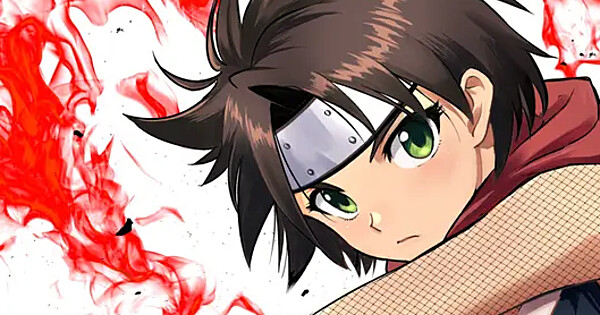
Kadokawa announced on Friday Shinya Murata launched a new manga series with Daichi Matsuse titled Shinoblade SHINOBI BLADE in Kadokawa and Kakao Piccoma‘s “Manga BAR” e-manga magazine on the same day. Murata will write and storyboard the series while Matsuse will provide the art.

© Shinya Murata, Daichi Matsuse, Kadokawa
The story follows the strongest female ninja, who operated in Hattori Hanzō’s shadow. At the moment she died, she instead found herself transported to another world.
Murata launched the Akujo Ranking (Villainess Ranking) manga with Wakata Wakuta in Kadokawa‘s Monthly Dragon Age magazine on March 9.
Murata and Kazasa Sumita launched the Killing Bites manga in Monthly Hero’s in March 2017, although it now runs on the Comiplex website. Hero’s Inc. published the manga’s 27th compiled book volume on June 29. A television anime adaptation premiered on the Animeism programming block on MBS and TBS in January 2018. The anime’s unaired “director’s cut” streamed worldwide on Amazon Prime Video. The anime had 12 episodes.
Murata and Sumita launched the Saikyō Skill “Inochigoi” de Kuyashii kedo Musō Shichau Moto Ōsama no Sekai Seifuku Katsudō (The Activities of the Former Demon King Whose Strongest Skill is the Embarrassing “Begging for Her Life” and Yet She Will Use it to Run Wild and Conquer the World) manga on Comiplex in June 2023. The manga ended with its fourth volume in December 2025.
Kumo Kagyu and Matsuse launched the Goblin Slayer: A Day in the Life manga in Square Enix‘s Monthly Big Gangan magazine in December 2022, and ended the series in November 2024. Square Enix shipped the the manga’s third and final volume in February 2025.
Matsuse also drew the I Wish I Could Meet You Again on the Hill Where That Flower Blooms manga with storywriter Natsue Shiomi. Seven Seas Entertainment will release the manga in English starting in December. Matsuse has also drawn the Re:ZERO -Starting Life In Another World- Chapter 1: A Day in the Capital and Re:ZERO -Starting Life in Another World- Chapter 3: Truth of Zero manga, both of which Yen Press has released in English.
Source: Kadokawa
Disclosure: Kadokawa World Entertainment (KWE), a wholly owned subsidiary of Kadokawa Corporation, is the majority owner of Anime News Network, LLC. One or more of the companies mentioned in this article are part of the Kadokawa Group of Companies.
>
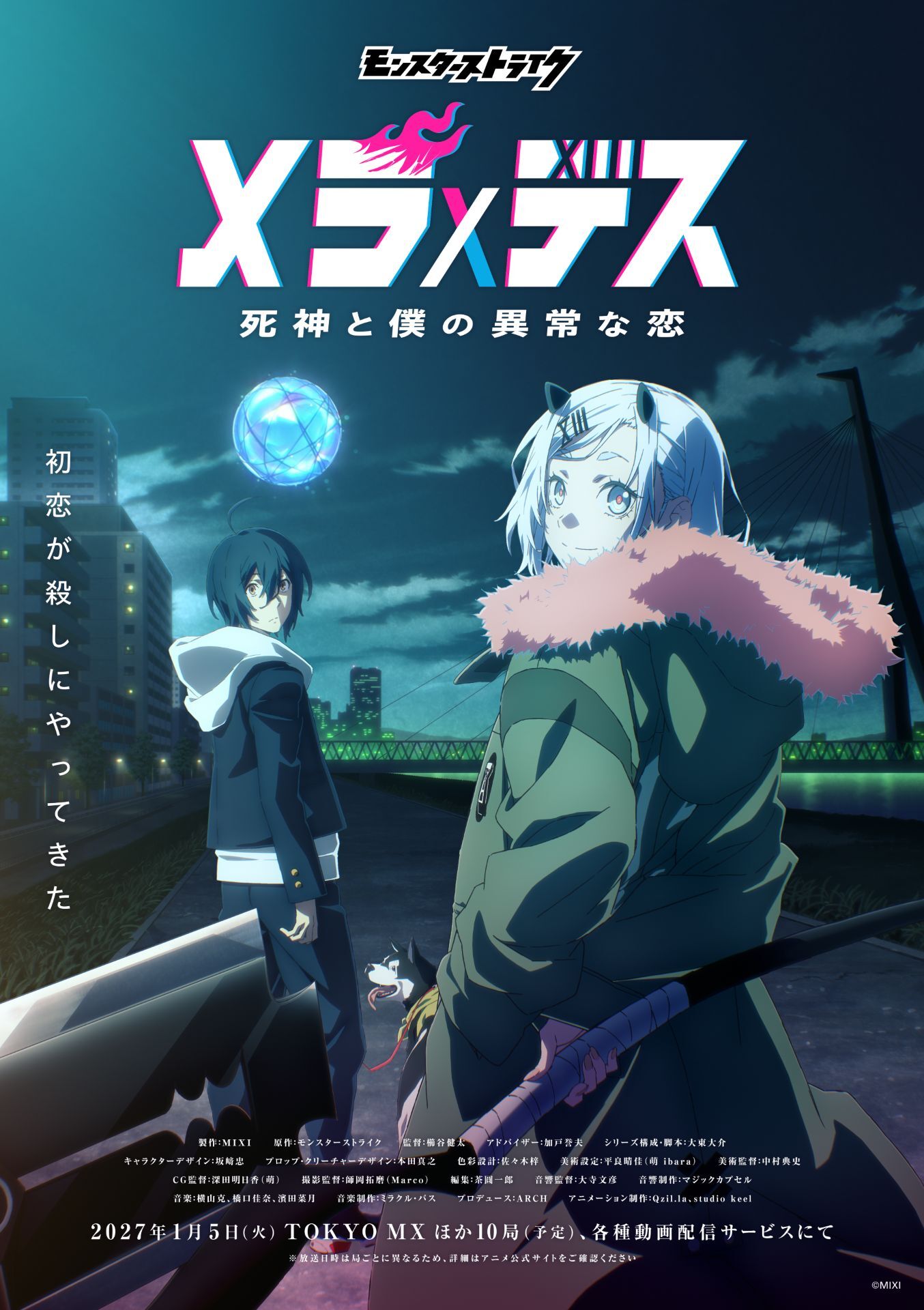
 Game publisher and developer Mixi announced a new television anime adaptation for the Monster Strike smartphone role-playing game, subtitled Monster Strike: Mera×Death: Shinigami to Boku no Ijou na Koi (Mera×Death: The Unusual Love Between Me and the Grim Reaper) on Sunday. The official website also revealed the production staff, a key visual (pictured), and the first promotional video. The anime series is scheduled to premiere on Tokyo MX and other stations on January 5, 2027.
Staff
Director: Kenta Kushiya (Kaijuu 8-gou episode director)
Advisor: Takao Kato (Fuufu Ijou, Koibito Miman. director)
Series Composition, Screenplay: Daisuke Oohigashi (Fate/strange Fake)
Character Design: Tadashi Sakazaki (Tensei Kizoku, Kantei Skill de Nariagaru)
Prop/Creature Design: Masayuki Honda (Ao Ashi character design[/i])
Color Design: Azusa Sasaki (Lycoris Recoil)
Art Setting: Haruka Taira (Shichisei no Subaru)
Art Director: Norifumi Nakamura (Kono Kaisha ni Suki na Hito ga Imasu)
CG Director: Asuka Fukada (Romantic Killer episode director)
Director of Photography: Takuma Morooka (Watashi ga Koibito ni Nareru Wake Nai jan, Muri Muri! (※Muri ja Nakatta!?))
Editing: Ichirou Chaen (Kanojo ga Koushaku-tei ni Itta Riyuu)
Sound Director: Fumihiko Ootera (Tamon-kun Ima Docchi!?)
Sound Production: Magic Capsule (Dr. Stone: Science Future Part 3)
Music: Masaru Yokoyama (Mikadono Sanshimai wa Angai, Choroi.), Kana Hashiguchi (Otome Game Sekai wa Mob ni Kibishii Sekai desu), Natsuki Hamada (Nigashita Sakana wa Ookikatta ga Tsuriageta Sakana ga Ookisugita Ken)
Music Production: Miracle Bus (Sousou no Frieren 2nd Season)
Producer: Arch
Studio: Qzil.la (Champignon no Majo), Studio Keel
Developed by Mixi, Monster Strike was released under its brand XFLAG on iOS in Japan in September 2013 and on Android in December 2013. A North American version debuted in October 2014 but was discontinued in August 2017. The game has over 55 million downloads worldwide.
The first anime series debuted in 51 episodes from October 2015 to December 2016. A second season streamed in 23 episodes from April 2017 to September 2017, followed by the 13-episode third season, Kieyuku Uchuu-hen (The Fading Cosmos), from October 2017 to January 2018. A fourth series streamed in 63 episodes from July 2018 to December 2019.
The first anime movie, Hajimari no Basho e (To The Place of Beginnings), premiered in theatres in Japan in December 2016, serving as a prequel to the first net anime. The third and latest movie in the franchise, Lucifer – Zetsubou no Yoake, opened in Japan in November 2020.
Synopsis
Six years ago, a massive explosion occurred in the town of Ouma, but miraculously, there were no fatalities.
In this city where a mysterious sphere called “Glass Sun” floats in the sky, a boy named Mera Kagari, who feels out of place and lives a boring life, meets a mysterious girl named Thirteen on his 16th birthday.
Her encounter with her brings vibrant colors to Mera’s previously monochrome life, but at the same time, strange occurrences begin to unfold in the city.
PV 1
Official site: https://anime.monster-strike.com/meradeath/
Source: Comic Natalie
>
Anime
One Peace Books Adds ‘My Life Turned Around: After I Was Betrayed and Framed, I Won the Heart of the Most Beautiful Girl at School’ Manga – News
Manga launches in English on July 20, 2027

© Ei Ikaguchi, D, Higeneko, Kadokawa
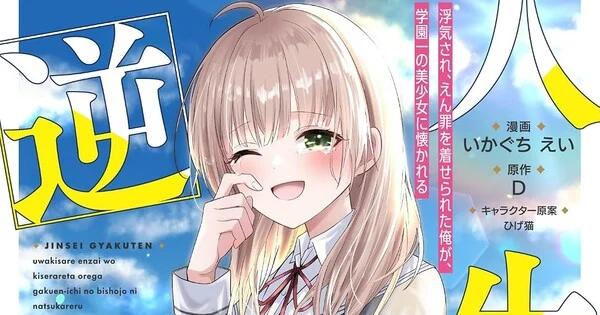
The Behind the Manga website reported on Friday that One Peace Books has confirmed it will release Ei Ikaguchi‘s My Life Turned Around: After I Was Betrayed and Framed, I Won the Heart of the Most Beautiful Girl at School (Jinsei Gyakuten: Uwakisare, Enzai o Kiserareta Ore ga, Gakuen Ichi no Bishōjo ni Natsukareru) manga in English starting with the first volume on July 20, 2027.
One Peace Books describes its story:
The day he lost everything was the day he met her. At the end of summer, Eiji Aono witnesses the unthinkable: his childhood friend and girlfriend, Miyuki Amada, cheating on him with Kondo, the ace of the school’s soccer team. Betrayed by the girl he loved, Eiji is left emotionally shattered. As if that weren’t enough, he soon becomes the target of vicious rumors and relentless slander for crimes he never committed. With nowhere left to turn, he flees to the rooftop of his school…there, at his lowest point, he meets a mysterious girl who will change his life forever.
The manga adaptation launched on Kadokawa‘s Comic Newtype website in June 2025. The first book volume of the manga shipped in November 2025. The second compiled volume launched on June 10.
The manga is based on author D and illustrator Higeneko‘s light novel series that launched on Kakuyomu in September 2023. The novel series won two awards in the 9th Kakuyomu Web Novel Contest. Kadokawa began releasing the series in print in November 2024, and shipped the fourth volume on May 29.
Source: Behind the Manga (WinterVenom)
Disclosure: Kadokawa World Entertainment (KWE), a wholly owned subsidiary of Kadokawa Corporation, is the majority owner of Anime News Network, LLC. One or more of the companies mentioned in this article are part of the Kadokawa Group of Companies.
>
David Pastrnak named Boston Bruins captain: Why 'Pasta' was the right choice

Manchester City charges: What punishment could club face after Premier League verdict and will they appeal?

Netball World Cup: Scotland & Northern Ireland qualify for 2027 event
-

 movies4 months ago
Search For Canadian TV Actor Stewart McLean Now Homicide Investigation
-

 Fashion9 years ago
These ’90s fashion trends are making a comeback in 2017
-
Fashion9 years ago
According to Dior Couture, this taboo fashion accessory is back
-
Fashion9 years ago
Model Jocelyn Chew’s Instagram is the best vacation you’ve ever had
-
Fashion9 years ago
Emily Ratajkowski channels back-to-school style
-
Fashion9 years ago
9 Celebrities who have spoken out about being photoshopped
-

 Anime4 months ago
Rurouni Kenshin: Hokkaido Arc Manga Takes 1-Issue Break – News
-

 Anime3 months ago
HIDIVE to Stream English Dubs for The World Is Dancing, The Forsaken Saintess and Her Foodie Roadtrip in Another World, The Dangers in My Heart: The Movie Anime – News