
Tech
How AI Will Change Chip Design


The end of Moore’s Law is looming. Engineers and designers can do only so much to miniaturize transistors and pack as many of them as possible into chips. So they’re turning to other approaches to chip design, incorporating technologies like AI into the process.
Samsung, for instance, is adding AI to its memory chips to enable processing in memory, thereby saving energy and speeding up machine learning. Speaking of speed, Google’s TPU V4 AI chip has doubled its processing power compared with that of its previous version.
But AI holds still more promise and potential for the semiconductor industry. To better understand how AI is set to revolutionize chip design, we spoke with Heather Gorr, senior product manager for MathWorks’ MATLAB platform.
How is AI currently being used to design the next generation of chips?
Heather Gorr: AI is such an important technology because it’s involved in most parts of the cycle, including the design and manufacturing process. There’s a lot of important applications here, even in the general process engineering where we want to optimize things. I think defect detection is a big one at all phases of the process, especially in manufacturing. But even thinking ahead in the design process, [AI now plays a significant role] when you’re designing the light and the sensors and all the different components. There’s a lot of anomaly detection and fault mitigation that you really want to consider.
 Heather GorrMathWorks
Then, thinking about the logistical modeling that you see in any industry, there is always planned downtime that you want to mitigate; but you also end up having unplanned downtime. So, looking back at that historical data of when you’ve had those moments where maybe it took a bit longer than expected to manufacture something, you can take a look at all of that data and use AI to try to identify the proximate cause or to see something that might jump out even in the processing and design phases. We think of AI oftentimes as a predictive tool, or as a robot doing something, but a lot of times you get a lot of insight from the data through AI.
What are the benefits of using AI for chip design?
Gorr: Historically, we’ve seen a lot of physics-based modeling, which is a very intensive process. We want to do a reduced order model, where instead of solving such a computationally expensive and extensive model, we can do something a little cheaper. You could create a surrogate model, so to speak, of that physics-based model, use the data, and then do your parameter sweeps, your optimizations, your Monte Carlo simulations using the surrogate model. That takes a lot less time computationally than solving the physics-based equations directly. So, we’re seeing that benefit in many ways, including the efficiency and economy that are the results of iterating quickly on the experiments and the simulations that will really help in the design.
So it’s like having a digital twin in a sense?
Gorr: Exactly. That’s pretty much what people are doing, where you have the physical system model and the experimental data. Then, in conjunction, you have this other model that you could tweak and tune and try different parameters and experiments that let sweep through all of those different situations and come up with a better design in the end.
So, it’s going to be more efficient and, as you said, cheaper?
Gorr: Yeah, definitely. Especially in the experimentation and design phases, where you’re trying different things. That’s obviously going to yield dramatic cost savings if you’re actually manufacturing and producing [the chips]. You want to simulate, test, experiment as much as possible without making something using the actual process engineering.
We’ve talked about the benefits. How about the drawbacks?
Gorr: The [AI-based experimental models] tend to not be as accurate as physics-based models. Of course, that’s why you do many simulations and parameter sweeps. But that’s also the benefit of having that digital twin, where you can keep that in mind—it’s not going to be as accurate as that precise model that we’ve developed over the years.
Both chip design and manufacturing are system intensive; you have to consider every little part. And that can be really challenging. It’s a case where you might have models to predict something and different parts of it, but you still need to bring it all together.
One of the other things to think about too is that you need the data to build the models. You have to incorporate data from all sorts of different sensors and different sorts of teams, and so that heightens the challenge.
How can engineers use AI to better prepare and extract insights from hardware or sensor data?
Gorr: We always think about using AI to predict something or do some robot task, but you can use AI to come up with patterns and pick out things you might not have noticed before on your own. People will use AI when they have high-frequency data coming from many different sensors, and a lot of times it’s useful to explore the frequency domain and things like data synchronization or resampling. Those can be really challenging if you’re not sure where to start.
One of the things I would say is, use the tools that are available. There’s a vast community of people working on these things, and you can find lots of examples [of applications and techniques] on GitHub or MATLAB Central, where people have shared nice examples, even little apps they’ve created. I think many of us are buried in data and just not sure what to do with it, so definitely take advantage of what’s already out there in the community. You can explore and see what makes sense to you, and bring in that balance of domain knowledge and the insight you get from the tools and AI.
What should engineers and designers consider when using AI for chip design?
Gorr: Think through what problems you’re trying to solve or what insights you might hope to find, and try to be clear about that. Consider all of the different components, and document and test each of those different parts. Consider all of the people involved, and explain and hand off in a way that is sensible for the whole team.
How do you think AI will affect chip designers’ jobs?
Gorr: It’s going to free up a lot of human capital for more advanced tasks. We can use AI to reduce waste, to optimize the materials, to optimize the design, but then you still have that human involved whenever it comes to decision-making. I think it’s a great example of people and technology working hand in hand. It’s also an industry where all people involved—even on the manufacturing floor—need to have some level of understanding of what’s happening, so this is a great industry for advancing AI because of how we test things and how we think about them before we put them on the chip.
How do you envision the future of AI and chip design?
Gorr: It’s very much dependent on that human element—involving people in the process and having that interpretable model. We can do many things with the mathematical minutiae of modeling, but it comes down to how people are using it, how everybody in the process is understanding and applying it. Communication and involvement of people of all skill levels in the process are going to be really important. We’re going to see less of those superprecise predictions and more transparency of information, sharing, and that digital twin—not only using AI but also using our human knowledge and all of the work that many people have done over the years.
From Your Site Articles
Related Articles Around the Web
>

Waymo’s commercial robotaxi ramp-up looks expansive, both in geographic reach and in ridership. And by almost every measure, it is — until you pay attention to where the bulk of those robotaxis are actually showing up.
The numbers over the past two years reflect the kind of commercial rollout you’d expect from a deep-pocketed company like Waymo, which spun out of Google and still counts Alphabet as its majority owner. In September 2024, Waymo was operating in just three cities — Phoenix, Los Angeles, and San Francisco. Today, it offers robotaxi service in 15 U.S. cities, with most of those commercial launches occurring in the past year. Ridership has skyrocketed, too with Waymo now averaging 500,000 paid robotaxi rides every week.
But a closer look at its fleet shows a company concentrating its efforts in just two states. About 80% of Waymo’s roughly 4,000 robotaxis are in California and Texas, and Texas is where the action is now: Waymo’s fleet there has grown by nearly half in the past three weeks, fueled by a new Chinese-built minivan the company is betting will help it scale, even as tariffs drive up its costs.
The other 800 or so vehicles are spread across cities in other states, including Arizona and Florida, another burgeoning hotspot. Most are the familiar white Jaguar I-Pace electric SUVs, but a growing share are that new minivan — a modified Zeekr RT that Waymo has branded “Ojai.”
Waymo’s focus on California is no surprise. It is headquartered in Silicon Valley, and much of its early testing and development work was conducted there. Plus, a segment of the population there is inclined to adopt tech at its earliest stages.
The recent growth in Texas is more interesting. Waymo has increased its Texas fleet by 49% in the past three weeks, according to state vehicle registrations and data from the Texas Autonomous Vehicle Fleet Tracker. As of September 24, Waymo had 1,102 autonomous vehicles registered in the state.
Waymo first launched in commercial service in Austin through a partnership with Uber in March 2025, letting riders hail its robotaxis through the uber app. Since then, the company has expanded its robotaxi services in Dallas, Houston, and San Antonio.
Waymo’s Texas fleet remained relatively static for most of the summer, inching up from about 600 vehicles in June to more than 700 by the end of August. Then came September, when the he fleet surged, driven by an influx of new Ojai minivans, which now make up about a third of Waymo’s Texas fleet.
Expect that share to grow.
The Ojai robotaxi, equipped with Waymo’s sixth-generation self-driving system, is supposed to help Waymo reach mass scale. Its interior is built to withstand heavy use, and it comes with an upgraded rider interface and Google’s Gemini AI, which acts as an in-car assistant for riders.
Strip away that technology, though, and the Ojai is a minivan made by Zeekr, a brand owned by China’s Geely Holding Group (which also owns Volvo). The Ojai is built on Zeekr’s SEA-M platform, a shared vehicle platform designed for uses like robotaxis and delivery vans. The base Zeekr vehicles are shipped to the U.S. without any Chinese connected-car technology on board. Once they arrive, the vehicles are sent to Waymo’s Arizona factory, where they are outfitted with Waymo’s self-driving system.
The Ojai is supposed to drive down costs and ultimately help Waymo reach profitability. For now, though, tariffs are cutting any savings. Under current U.S. trade policy, vehicles built in China face steep import tariffs, raising Waymo’s costs for every Ojai it brings into the country.
Waymo appears willing to absorb that cost. New York-based research firm MoffettNathanson, which tracks Ojai imports using detailed shipping records, said in its September report that Waymo is on track to bring 5,100 of the vehicles into the U.S. by the end of the year.
Where will all those Ojai vehicles go? Texas is certainly on the list. But Florida, where Waymo operates in three cities, and newer markets like Las Vegas will likely see an influx as well.
When you purchase through links in our articles, we may earn a small commission. This doesn’t affect our editorial independence.
>
Lindsey Elliott is big into bolts. At last year’s Bolting Symposium — the 13th annual — she said the highlight was playing “Bolting Bingo” against the many self-proclaimed “torque dorks” who were in the room.
A former engineer and planner at ExxonMobil, Elliott has spent years thinking about how to improve the infrastructure that moves oil, gas, and petrochemicals. Bolts are what she landed on. Specifically, the bolts that connect sections of pipe (technically called “bolted flange joints”). These bolts require hard, physical work to loosen and tighten, and are the source of many pipefitters’ injuries. Like many trade industries, there’s also a labor shortage.
“Those people get really tired when they’re asked to work 12 hours a day for three months in a row,” she told TechCrunch. “I’ve talked to pipefitters across the U.S. across Canada, and just repeatedly have been told North American pipefitting productivity is notoriously low.”
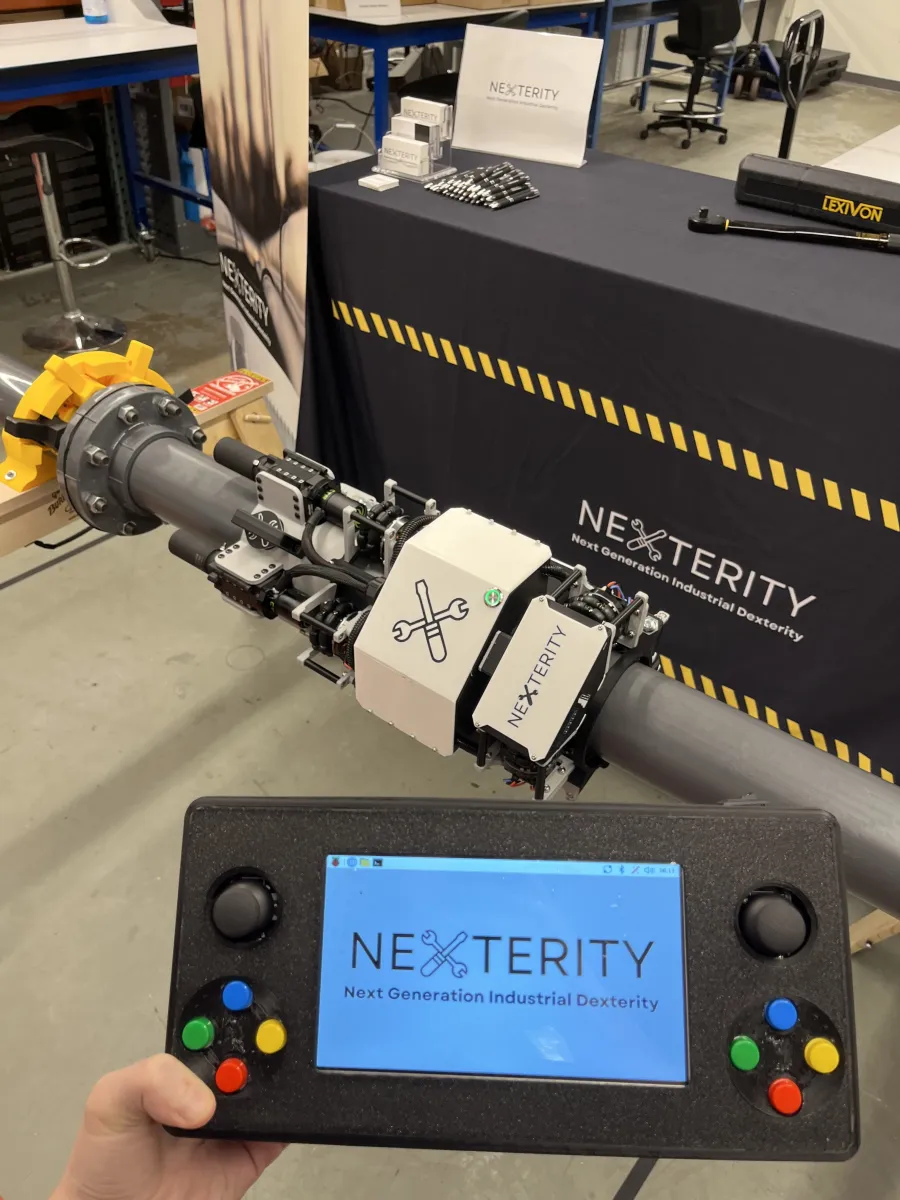
The solution Elliott came up with at her startup Nexterity, which is one of the Startup Battlefield 200 selected to participate in TechCrunch Disrupt, is a remote-controlled robot that can handle this part of the job. It’s the kind of idea that could fundamentally change this particular blue collar job if widely adopted, making the workers safer and more productive.
Think: more dork, less torque.
The robot comes in two main pieces that fit around a pipe. Powered by batteries, the robot can slide across the pipe once it’s attached and quickly loosen and tighten four bolts at a time.
Elliott said Nexterity has developed a few different configurations of the robot to fit different standard pipe sizes, but they’re all small enough to fit in a Pelican case and be carried by a single worker. That makes them easy to deploy to new sites — flexibility that is crucial to Nexterity’s business model of treating the robot like rental construction equipment.
Elliott said she arrived at this particular design as a result of conversations she’s had over the last few years — not just at the Bolting Symposium, but also with members of the Pressure Vessels & Piping Division of the American Society of Mechanical Engineers.
“What I learned from the people, the torque dorks per se,” she said, “is that 80% of our pipes are between two to eight inches in diameter, or what they call NPS2 to NPS8. And so when you have that much repeatability, you have a fantastic candidate for automation.”
It’s a pretty straightforward idea, but one that Elliott believes has a lot of upside.
“I think it would shock a lot of people just how big this market is,” she said. “I mean, day to day, most of us don’t think about piping infrastructure, but even water, wastewater, water treatment, food and beverage, mining, nuclear, any kind of green and sustainable manufacturing facility — they all use the same kind of piping.”
When you purchase through links in our articles, we may earn a small commission. This doesn’t affect our editorial independence.
>

In Guadalajara, Mexico, many high schools have motivated teachers and talented students with an interest in science, technology, engineering, and mathematics, but they lack access to advanced tools such as robotics laboratories. The resources shortfall limits the students’ opportunities for hands-on learning on cutting-edge applications.
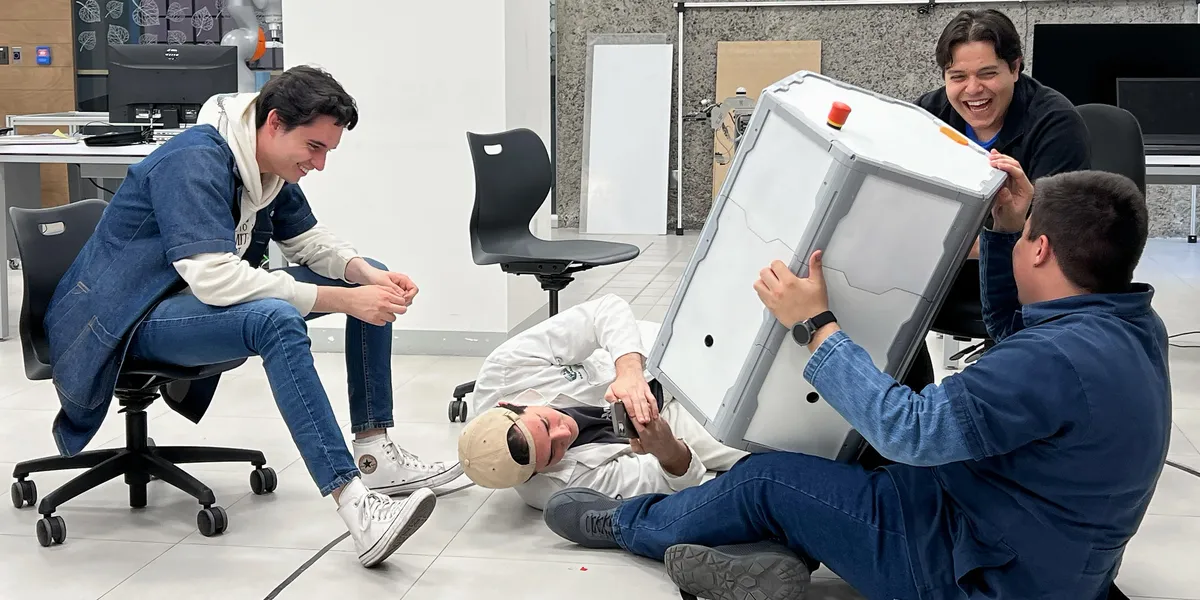
A team from ITESO, Universidad Jesuita de Guadalajara, is working to change that. Through the EPICS in IEEE initiative, a multidisciplinary group of 15 engineering students, faculty advisors, and IEEE Guadalajara Section volunteers developed RoboMeshA. The portable, self-contained educational platform brings robotics and AI experiences into classrooms.
EPICS is administered by IEEE Educational Activities and funded by the IEEE Robotics and Automation Society.
A mobile laboratory
Rather than requiring a school to build a dedicated computer lab or install complex software, RoboMeshA operates as an all-in-one mobile learning network.
“RoboMeshA brings robotics and AI to students who don’t have access to specialized facilities or preinstalled software,” says team member Fernando Vidal Luna, an IEEE student member and a mechatronics engineering major at ITESO.
Students connect directly to the platform from a user-friendly web browser. They can interact with the robot manually or use its control modes to watch it move and detect and avoid obstacles.
“The project combines mechanical design, embedded systems, control engineering, computer vision, and AI into a single robotic system that functions as a mobile learning laboratory,” says faculty advisor Jorge A. Lizarraga.
The team says young students are interested in technology, programming, and robotics but don’t have an opportunity to work with systems that combine mechanics, electronics, software, and control.
“RoboMeshA allows students to see how all these disciplines work together in a tangible and understandable way,” says team member José S. González, who also is studying mechatronics engineering.
The team has built two units and is developing a modular coupling framework to expand the system’s capabilities for research and classroom demonstrations. The structured system design approach connects independent software components while minimizing internal dependencies, enabling four RobotMeshA robots to operate together.
Overcoming design challenges
The team faced significant hurdles while designing the project.
“One key challenge involved the robot’s structural design,” Luna says. “It wasn’t only about making a chassis where all the components fit and the design had sufficient stability, rigidity, and weight distribution. It was also about ensuring that the electronics were protected while still being accessible for maintenance, testing, and modifications.”
“It was also challenging to design a platform that could be used by students with different levels of experience,” González adds.
“When students realize the technology they develop can inspire others and improve lives, engineering becomes far more meaningful.” —Luis Fernando Luque-Vega
The team partnered with the CETI Colomos and Prepa ITESO high schools to validate the platform in classroom settings.
“We wanted the first interactions with the robot to be simple and intuitive,” González says, “such that students could simply power the robot, connect to its network, and begin interacting with it, rather than having to deal with software installation, extensive configuration, or troubleshooting.”
Engineering with social impact
Many of the students who participated were from ITESO’s applied professional projects program. The experience offered them practical training in project management, system integration, and user-centered design.
The team also presented a research paper and a project poster in May at the Engineering Congress of the Jesuit University System.
“Seeing a design move from a digital model to a physical system was invaluable,” González says. “Working with students from different backgrounds taught us to listen to end users and design for their actual needs.”
Project lead Luis Fernando Luque-Vega, an IEEE member, says he’d like the venture to serve as a blueprint for engineering education.
“I hope RoboMeshA is adopted by schools, universities, and IEEE student branches across Mexico and internationally as a model for integrating technical innovation with community engagement,” Luque-Vega says.
By pairing engineering talent with community service, initiatives such as EPICS in IEEE demonstrate how targeted support can turn academic concepts into real-world solutions.
“When students realize the technology they develop can inspire others and improve lives, engineering becomes far more meaningful,” Luque-Vega says.
For more information on service-learning opportunities, visit the EPICS website.
From Your Site Articles
Related Articles Around the Web
>

Lili Reinhart Says Hollywood Is “Afraid To Make” Her Lesbian Vampire Film
Minnesota Twins, assistant GM Daniel Adler mutually part ways: Sources

Richard S. Reisberg Dead: TV Executive At Viacom, MGM/UA & Lionsgate Was 86
-

 movies4 months ago
Search For Canadian TV Actor Stewart McLean Now Homicide Investigation
-

 Fashion9 years ago
These ’90s fashion trends are making a comeback in 2017
-
Fashion9 years ago
According to Dior Couture, this taboo fashion accessory is back
-
Fashion9 years ago
Model Jocelyn Chew’s Instagram is the best vacation you’ve ever had
-
Fashion9 years ago
Emily Ratajkowski channels back-to-school style
-
Fashion9 years ago
9 Celebrities who have spoken out about being photoshopped
-

 Anime4 months ago
Rurouni Kenshin: Hokkaido Arc Manga Takes 1-Issue Break – News
-

 Anime3 months ago
HIDIVE to Stream English Dubs for The World Is Dancing, The Forsaken Saintess and Her Foodie Roadtrip in Another World, The Dangers in My Heart: The Movie Anime – News