
From left: Obsidian co-founders Louis Gheysens and Wes Walker.
Courtesy Obsidian Studio



Wes Walker has a golden rule about the use of artificial intelligence in his creative process — one that speaks volumes about how quickly the technology has morphed from curiosity to everyday tool.
“Already we are at the stage where the thinking is that if it’s AI-detectable, you’ve failed,” says Walker of a technology that has only been in serious use since around 2023.
As co-founder of Obsidian Studio alongside Louis Gheysens, Walker has been at the forefront of both exploring and integrating AI alongside live action and CGI in content creation. The studio has offices in five cities across the globe, including New York, Paris and Brussels. It has worked on campaigns for the likes of French luxury giants Longchamp and a campaign for the Beyond Noise multimedia brand with the agency Baron & Baron. And it has already expanded the notion of what’s possible with the technology — precisely, Walker argues, because AI is being used as a tool rather than a replacement.
It’s a philosophy captured in one of the studio’s own banners: “Humans over Hype.”
“It’s starting with the artists and doing what we already do at a world-class level before we come to AI, and then using AI as an extension of our abilities, not as any kind of shortcut, essentially,” he says. “We truly believe that AI won’t be a one-man show in the future. We still need those different talents that join forces because they have specific strengths, specific talents. Teams are very different from what they used to be, but by bringing their talent together on those tools, that’s how you create the best pieces out there.”
The traditions of cinematic craft — including storyboarding with noted artists such as Marc Vena (Logan) and Tani Kunitake (Black Panther) — remain central to the process, helping the team “understand the intelligence of the scene” before exploring what AI can contribute under the guidance of creative partners.
“AI is a wild thing,” Walker says. “So more than control, how do you get it to reflect the spirit of the director, the spirit of the production designer, the spirit of the cinematographer?”
From left: Obsidian co-founders Louis Gheysens and Wes Walker.
Courtesy Obsidian Studio
Since its founding in 2025, Obsidian Studio has worked closely with Chinese technology company Kling AI, while a partnership with Ron Howard and Brian Grazer’s Imagine Entertainment has further expanded its creative landscape. For co-founder Gheysens, the alliance reflects shared ambitions.
“The very first elements that stood up when we launched the company was that we’re going to we want to understand what exists in the minds of the directors and use those [AI] tools at the service of the directors, not the other way around,” says Gheysens.
Those ideas will get a wider airing at Cannes on May 18, when Kling AI hosts a panel titled From Creative Possibility to Production Reality: Kling AI in Cinematic Workflow. Joining the conversation will be Wonder Project’s Jon Erwin, the filmmaker behind Netflix’s AI-driven series House of David; China’s Li Wei, associate director on the animated feature Big Fish and Begonia (2016); and South Korea’s Yang Eekjun, director of Mateo AI Studio/MBC C&I (the AI feature-length film Raphael).
“What we are bringing is our most updated native 4K model capabilities,” explains Zeng Yushen, head of operations at Kling AI. “We will showcase how this hybrid model is working for Hollywood, and that’s basically through live action plus AI, as well as AI-generated animation, and then we have fully AI-generated film. We really want to show how AI is able to enable content creators to really test the boundaries of their creativity.”
Major studios and platforms that once held reservations are now exploring the technology’s possibilities. Netflix has been linked to a reported $600 million deal targeting Ben Affleck’s production house InterPositive, while Amazon is said to be building its own internal AI departments with film and TV production in mind.
“AI adoption has been really increasing, people are starting to understand it, they test it, and then they start to see how best to incorporate it in their workflow,” says Zeng. “People are learning to understand how to use the tool, then just to really how to test and explore how it can help them to create the content they want to have. You can use zero percent, you can use 10 per cent, you can use up to 100 percent. It really depends on how you want to tell the story.”
Underpinning the confidence of companies like Kling AI are some striking industry figures. China’s State Council Information Office has claimed more than 6,000 companies are now working across an industry estimated to be worth over $172 billion domestically, while global projections put AI’s value at $14.1 billion by 2033.
For Obsidian Studio, the arrival of AI’s 4K model capabilities represents another leap forward. The technology was rolled out globally last month via Kling Video 3.0 series, with Kling AI claiming the new product “meets rigorous production standards required for high-end use cases such as broadcast television, theatrical cinema and high-end advertising.”
It’s an advance Gheysens says Obsidian will move quickly to explore — without abandoning the process they’ve built.”
“I think on every piece of work, every job that we do, we always take the time to revise our pipeline, understand those new functions,” he says. “We ask ourselves how do we need to adapt, how do we need to understand better, and go to the next step, and we’re inventing new roles along the way.”
The feeling, says Walker, is one of liberation rather than disruption: “For us as directors, it helps us actually feel quite free to dream. And I think that’s what we’re really jazzed by. But the work speaks for itself — little by little, we’re just like, just let the work talk.”
>

EXCLUSIVE: Here’s one for the history buffs. The newly-formed Radar Studios is teaming with British broadcaster and historian Tony Robinson for a suite of content.
Tony Robinson Rewrites History will launch as a YouTube channel later this year, with an initial 12 half-hour episodes. Meanwhile, Radar Studios will debut a six-part, hour-long TV series to international buyers at MIPCOM Cannes next month.
The series will see popular British personality Robinson, who is known for his role in sitcom Blackadder, revisiting defining events of the past, from ancient history through to the modern era, and explore how things might have gone differently if a single pivotal moment had gone differently. The events will range from the Spanish Armada to the advent of Covid-19.
Robinson has worked with Radar Studios parent WTFN Group in Australia for more than 15 years on TV shows such as Tony Robinson’s Time Walks and Tony Robinson’s Tour of Duty, so today’s news extends that pact.
As we revealed last week, Radar Studios came into being when WTFN merged its digital arm Radar with its distribution business Fred Media. It aims to bring content creation, channel management and international distribution together under one roof, and already operates Robinson’s dedicated history channel Time Travels on YouTube, where it has more than 40,000 subscribers.
The new pact will see a new pipeline on original shows and digital content from Robinson roll out.
“I’ve known the team at WTFN for more than 15 years and we’ve made some terrific television together, so the opportunity to do something genuinely new with Radar Studios was irresistible,” said Robinson in a statement to Deadline.
“History is about the way things were, isn’t it? It’s written in stone and it couldn’t have happened any other way. Well, no. It’s actually full of tiny moments where everything hung in the balance. One different decision, one mistake, even a gust of wind and you have to rewrite history.
“And the great thing about this partnership is that we’re no longer thinking about history as something that has to fit into one particular television slot. We can tell stories in different ways, for different audiences and across different platforms. There is an enormous amount to explore and I’m hoping these first six hours are just the beginning.”
Radar Studios’ Chief Commercial Officer, Derek Dyson, added: “There could hardly be a better partner than Tony to lead off our originals strategy. He is one of the most recognisable and trusted faces in popular history, with an extraordinary ability to make the past entertaining, accessible and relevant to audiences around the world.
“Significantly, Tony Robinson Rewrites History demonstrates exactly why we created Radar Studios. Instead of making a series and then deciding where it might live, we are developing IP from the outset with multiple audiences, platforms and distribution opportunities in mind. We are creating original content for a dedicated, managed YouTube channel; developing additional digital opportunities around that content; and producing a standalone six-part television series for international buyers.
“One creative partnership and one piece of IP can therefore generate a whole ecosystem of content and commercial opportunities. By bringing content creation, channel management and international distribution together within Radar Studios, we can manage that entire journey ourselves.”
>
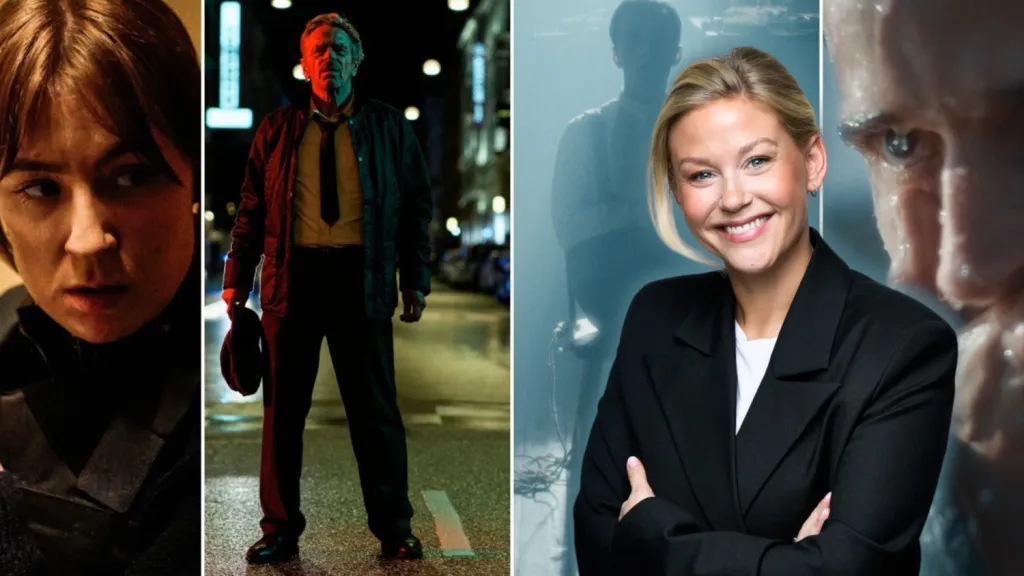
Prime Video‘s push into Danish originals began this year with Pilou Asbæk-starring Snake Killer, which is now serving as a milestone in a charge across the Scandinavian region, according to Amazon MGM Studios Nordics originals chief Emilia Widstrand.
“We’re really trying to build on that psychological thriller and crime vibe, doing it with strong creators and within established Nordic genres,” she told Deadline in an interview. Looking further ahead, Widstrand will be seeking to more directly target women and younger viewers too, as the service expands.
Snake Killer launched in January, with the four-parter followings a notorious Copenhagen narcotics police unit, Uropatruljen, a heavy-handed force that operated with relative autonomy between 1965 and 2001. The story sees Brian “Smiley” Petersen (Asbæk) leading his unit in a desperate war against a brutal heroin baron. Anders Ølholm is the writer and director.
Over in Norway, drama series Rinnan, about the infamous Norwegian traitor and Gestapo agent Henry Rinnan, is also set to launch. A co-production with Norwegian broadcaster TV2, the Miso Film show points to how Amazon is willing to share rights and window originals to bolster budgets.
Both series appeal to men, who have formed the backbone of viewing on Prime Video in the Nordics, but recent successes with unscripted shows will see the content mix changing in the future.
“Moving forward, we’ll have a more feminine point of view,” said Widstrand. “When we started out, we had a very broad audience, and we’ve really seen the appeal of female-led stories through global hits like The Idea of You and Pretty Little Liars, as well as unscripted shows like LOL: Last One Laughing. We’re really building on that, alongside our crime audience.”
As such, new original out of Denmark, Murder in the Dark, a four-part series from SAM Productions and Amazon MGM Studio based upon influential Danish literary icon Dan Turèll’s book series, is designed to appeal to a broad audience. It follows a retired and hard-bitten “nameless journalist” played by Michael Falch and his daughter Sophie (Katinka Lærke Petersen), who is an ambitious police detective.

The first shot from production of ‘Murder In the Dark’
Prime Video
Widstrand became Prime Video and Amazon MGM Studios Head of Nordic Originals in August last year, as we revealed at the time, to replace Karin Lindström, who later joined HBO Max. The two are credited internally with building Prime Video’s local originals team from scratch, making her the natural choice for the top post when it came available.
In May, this year, she added acquisitions duties following a restructure that saw the departure of Prime Video Nordics head Andreas Hjertø, and recently ordered a Swedish original, Sarek, a four-part psychological thriller based Ulf Kvensler’s debut novel about a group of friends on a hiking tripe that takes a dangerous turn.
That, Widstrand said, talks to a desire to age down the audience, with a cast led by Felix Sandman, Kitt Walker Johansson, Alva Bratt and Nora Rios, and to focus on well-known IP. “It really speaks to that strategy,” she added.
We sat down with Widstrand to pick her brains on the future for Prime Video Nordics and its originals slate.
DEADLINE: Emilia, you spoke at the Copenhagen TV Festival in August. What was your message to producers and the industry about what Amazon needs and is looking for from the Nordics?
Emilia Widstrand: We’ve been expanding our drama slate. It takes a long time to develop, and we wanted to take that time. Our first Danish original was Snake Killer, which was very successful, so we’re really trying to build on that psychological thriller and crime vibe, doing it with strong creators and within established Nordic genres.
Moving forward, we’ll have a more feminine point of view. When we started out, we had a very broad audience, and we’ve really seen the appeal of female-led stories through global hits like The Idea of You and Pretty Little Liars, as well as unscripted shows like LOL: Last One Laughing. We’re building on that, alongside our crime audience.
DEADLINE: Can you give us an example?
EW: We have Murder in the Dark, which is based on 1980s cult movies and books that we’re bringing back for Christmas Day. That has a much more female point of view than previous drama series. We’re leaning into both the female young-adult genre, looking for local versions of the kinds of stories that have found an audience globally, as well as Nordic crime, suspense and psychological thrillers. We’re trying to find strong local IP. Sometimes, we do co-productions where we sell international rights, but the focus is very much local right now.
DEADLINE: What kinds of international co-productions are you looking at and how flexible can you be?
EW: We’re very flexible. It’s a case-by-case decision about how we can get something done, but IP is important. We’re building on existing IP or true stories, which also helps us connect locally. Obviously you work with the best local talent, and the Nordics is such an amazing place to do that – It’s really special.
DEADLINE: Sarek is based on IP and with big producers. That feels like an example of what you’re talking about.
EW: Definitely, it really speaks to that strategy. I was just back on set on the show. It’s spectacular because it’s so Nordic. We’re shooting it up in Kiruna, and the environment is really a character in the story. There, we also decided to go a bit younger with the cast.
DEADLINE: In terms of your own role, Emilia, you’ve added some responsibilities, taking on unscripted along with scripted. How has that changed what you’re doing and has it impacted the overall shape of Prime Video Nordics?
EW: Strategy and programming are still separate, but I took on the overall responsibility for our Nordic local originals. I’ve found looking after the unscripted slate, which I wasn’t familiar with before, very intriguing. We work with very talented people across both unscripted and scripted, so we can really see synergies in both the talent and the content. It’s a big responsibility, but you get a fantastic overview.
DEADLINE: What would you say you’ve learned so far? It’s been a few months since you’ve taken on the expanded role.
EW: There are differences between the territories, both in Norway and Denmark, and there are different focuses in scripted and unscripted. Denmark, for example, is very strong in comedy, and it’s very easy to find strong unscripted comedy formats there.
Norway has really surprised me with the amount of great talent. We’ve found so many strong and interesting projects that we’re developing with local talent. That’s been overwhelming in a good way, with some really good projects coming out of Norway.
‘Snake Killer’
Prime Video
DEADLINE: With that in mind, what’s a realistic number of shows that will make it onto the screen?
EW: We have a slate of around 20 to 25 local originals per year, scripted and unscripted. It’s big, but we’re still trying to grow sustainably and not take on too much, while making sure we compensate the audience for the production.
DEADLINE: When we’re looking at LOL, which has been popular in the Nordics and pretty popular all over the place, is there any difference in how it’s received across the territories you’re overseeing?
EW: LOL works really well across territories. It’s a format that’s worked in so many countries across the world, huge in Mexico and Germany. It kind of works everywhere. The local versions are very different. We have local creatives on each project, because comedy is so local – it’s very hard for someone from another territory to develop it. We have other examples of programs that work better in one territory than another, but LOL is really delivering across the region, which I’m happy to see.
DEADLINE: When you’re looking at the Nordic region at the moment, what’s the biggest challenge for you as a commissioner? Obviously, you have the Amazon machine behind you, which means there is money, but it’s not an endless pot. Is it a case of funding, or talent identification?
EW: I would say both. Talent has had a few tough years, and I think it’s hard for talent to navigate what commissioners want to commission and what their creative vision is. I’m really interested in working with creators who have a strong vision and fight for that – they don’t just deliver everything you ask for. I really value creators who want to tell you something, because that delivers the best projects.
The other thing is, of course, funding. Budgets have been kind of the same, even though there’s been inflation, so it’s really hard to adapt to that. It’s also been a challenge with the tax rebates locally, and a lot of production is shooting abroad.
‘Rinnan’
Prime Vide
DEADLINE: Where are people shooting?
EW: Eastern Europe. It’s tougher to finance locally. That’s why we try to be open. If we’re going to get something big made, we need to be collaborative with local broadcasters and find synergies.
We’ve had a fantastic collaboration with TV2 in Norway with Rinnan, a project we’re launching this fall. It’s a World War II series we’re doing with Kenneth Karlstad, and it is a fantastic example of what we can do with a local broadcaster.
They benefit from their deep understanding of the local audience, while we bring the Amazon package and the premium feeling of doing high-end drama. We do it together. We’re in the room together and we’re reacting together.
DEADLINE: It comes to you first and then TV2?
EW: Yes.
DEADLINE: Is that always the case when you do those partnership shows? I see this in lots of different territories – it tends to be the streamer goes first with an exclusive window, and then the broadcaster takes it however many months later.
EW: Yes, that’s always how we do it, because we’re also much smaller than a TV2, so it makes sense for us to go first.
DEADLINE: Broadcasters and distributors have become more and more open to these types of collaborations. That probably wasn’t the case a few years ago.
Amelia: I think we’re moving into a much more collaborative space with financing.
>

CNN, MS NOW and Politico are warning that the Trump administration will reimpose a “complete ban” on their access to the White House without a judge issuing a preliminary injunction.
Last week, U.S. District Judge Timothy Kelly granted a temporary restraining order, forcing the White House to restore access to the White House to the outlets as he more fully considers the legal arguments. The TRO lasts for 14 days.
In a filing in federal court on Monday, attorneys for the three news outlets argued that the Trump White House actions since then “leave little doubt that it will immediately reinstitute a complete ban of CNN, MS NOW, and Politico if allowed the opportunity.”
The outlets’ legal team, led by Theodore Boutrous Jr., pointed to the White House’s restriction on CNN from access to State Dinner arrivals on Thursday evening. The network then was barred from serving as TV pooler on Air Force One on Trump’s trip to Tennessee on Saturday, with no replacement stepping in, and leaving a dearth of TV images from the trip.
“Because the ban is an unlawful assault on the most fundamental First Amendment freedoms and will inflict irreparable harm on Plaintiffs and the public if not restrained, this Court should preliminarily enjoin its enforcement pending the resolution of this case,” the news outlets’ attorneys wrote.
Kelly cited a lack of due process by the White House when it pulled dozens of credentials of reporters from the three outlets. While the Trump DOJ has cited standards of “professionalism and decorum” and national security concerns, the media outlets’ legal team called that reasoning that “pretextual” and “post hoc,” as well as vague.
In the latest brief, CNN, MS NOW and Politico also again cited violations of the First Amendment. They noted that Trump has explained the ban by blaming their coverage as “Purposely … negative,” among other things.
“His statements also make clear he implemented the ban to coerce more favorable coverage from CNN, MS NOW, and Politico, and to deter other journalists and news organizations from newsgathering and reporting that the President might view as negative,” the news outlets’ legal team wrote. “And his administration has continued to retaliate against Plaintiffs even after the temporary restraining order, only underscoring that Defendants’ motive is to punish and chill journalism they dislike.”
The outlets are asking the judge to prohibit the Trump team from pulling hard pass credentials, or to ensure the reporters of the White House access they had before Sept. 18. In contrast to a TRO, a preliminary injunction would sideline Trump’s ban until a trial is held, or if an appeals court rules otherwise.
Trump initially banned the three outlets on Sept. 18. When the judge granted a TRO last early Thursday, it meant that the White House had to restore hard passes, with reporters not gaining reentry until around noon that day.
The issue of whether the White House can also restrict CNN from the pool is a slightly different, but related issue. It’s also one at the center of another case, involving the Associated Press after it was banned from the pool and other White House events. That case is currently on appeal.
That said, in the latest brief, the three outlets cited the White House’s continued prohibitions on CNN as an example of White House retaliation over protected speech.
For much of last week, there was no TV network pool, meaning that there was little video coverage of Chinese President Xi Jinping’s visit to the White House. The four other networks in the pool — CBS News, ABC News, Fox News and NBC News — initially suspended their participation in protest of the exclusion of CNN. The networks resumed the TV pool coverage this week, but it will be put to the test again on Thursday, when CNN is assigned to that duty.
“Every day, critically important news is breaking at the White House, and the ban will substantially interfere with Plaintiffs’ ability to cover it,” the outlets brief stated. “The ban also inflicts an injury on all news media organizations—which now risk a similar fate if they engage in fact-based, independent reporting the President deems insufficiently favorable.”
The DOJ’s brief in response is due by Friday.
>


Search For Canadian TV Actor Stewart McLean Now Homicide Investigation


These ’90s fashion trends are making a comeback in 2017
According to Dior Couture, this taboo fashion accessory is back
Model Jocelyn Chew’s Instagram is the best vacation you’ve ever had
Emily Ratajkowski channels back-to-school style
9 Celebrities who have spoken out about being photoshopped


Rurouni Kenshin: Hokkaido Arc Manga Takes 1-Issue Break – News


HIDIVE to Stream English Dubs for The World Is Dancing, The Forsaken Saintess and Her Foodie Roadtrip in Another World, The Dangers in My Heart: The Movie Anime – News