
movies
‘The Devil Wears Prada 2’ Review: Meryl Streep, Anne Hathaway Are Back

If you go into The Devil Wears Prada 2 looking for fierce fashion porn, bitchy put-downs and a fresh dose of Meryl Streep’s iconic performance as imperious Anna Wintour clone Miranda Priestly, you are unlikely to be disappointed. Arriving 20 years after the original, David Frankel’s sequel hits familiar beats that fans will eat up and deftly reconfigures the core trio of women into new adversarial positions, even if it ultimately lapses into cozy sentimentality. The movie is best when it sticks to fluffy, fun nostalgia rather than shooting for substance.
Detractors immune to the cult-like adoration for the high-sheen original had issues with its shallowness, toothless fashion industry satire and anemic storyline. It’s hard to skewer aspirational luxury when you’re drooling over it. The late-series Sex and the City vibe (the canonical HBO show was a stepping-stone for Frankel when he was cutting his teeth as a director) that made the material seem already dated two decades back is even more nagging here, not that the huge fanbase who just want the glamour and romance are going to care.
The Devil Wears Prada 2
The Bottom Line
A capably maneuvered glam offensive.
Release date: Friday, May 1
Cast: Meryl Streep, Anne Hathaway, Emily Blunt, Stanley Tucci, Justin Theroux, Lucy Liu, Kenneth Branagh, B.J. Novak, Simone Ashley, Tracie Thoms, Tibor Feldman, Patrick Brammall, Caleb Hearon, Helen J. Shen
Director: David Frankel
Screenwriter: Aline Brosh McKenna, based on characters created by Lauren Weisberger
Rated PG-13,
1 hour 52 minutes
Returning screenwriter Aline Brosh McKenna aims for relevancy this time by padding the story with quasi-topical points. The sharpest of them is a close-to-the-bone commentary on the death of journalism, in both news media and ad-depleted fash mags. (Disney, among other studios, is helping to dig that grave by adopting the now almost standard strategy of keeping critics gagged until pants-wetting influencers have shaped the narrative on social media.)
Then there’s the introduction of tech billionaire Benji Barnes (Justin Theroux), who’s basically Jeff Bezos with hair. Having extricated himself from his first marriage to the now stonking rich Sasha (Lucy Liu), he attempts to buy the film’s Vogue stand-in, Runway, as a toy for his calculating new girlfriend, whose identity we won’t disclose. But in true American oligarchy spirit, he sees no value in media in a world coasting toward extinction and instead is looking for a new planet to ravage. This thread is barely a comedy sketch.
Even thinner is a potentially timely dig at the luxury real estate boom, a legitimate issue in New York City in the grip of a housing crisis. Former assistant to Miranda, Andy Sachs (Anne Hathaway), lobs some sanctimonious indignation at her half-baked new love interest, Australian architect Peter (Patrick Brammall), a suave Pierce Brosnan type who designed a new high-end apartment block. But through some kind of illogical plot contortion, she is soon living there, at which point you might ask, “Wait, girl, what was that objection about ripping out heritage buildings and replacing them with rich-people pads again?” Maybe she was persuaded because her old friend Lily (Tracie Thoms) declared it time for her to get a grownup apartment?
Remind me, are we critiquing conspicuous displays of wealth or endorsing them? You could get whiplash trying to figure out where this movie stands on ostentatious luxury.
Tellingly, a twinkly shot of the Manhattan skyline, in real life now blighted by pencil-shaped high-rises, appears to have been digitally scrubbed to preserve the nostalgic glow. What’s most noticeable is the absence of 262 Fifth Avenue, the Russian-owned and -designed skyscraper that has rankled many New Yorkers by blocking the South view of the Empire State Building. The movie gestures toward the real world but is unequivocally selling the fantasy. Which, again, will be just what the target audience ordered.
In the intervening years since we last saw her, Andy has been toiling as a Serious Journalist at a Hard-Hitting News Outlet called The Vanguard. But just as she’s announced as the winner of a journalism award at a fancy dinner, her phone and those of all her colleagues at the table light up with texts informing them that the publication is folding and their employment terminated.
Andy’s acceptance speech rips into the now sadly familiar story of another media company taking a $500 million write-down while the take-home of its CEO the previous year was $11 million. Her impassioned outpouring — the subtext of which is that journalism is more important than corporate greed — goes viral.
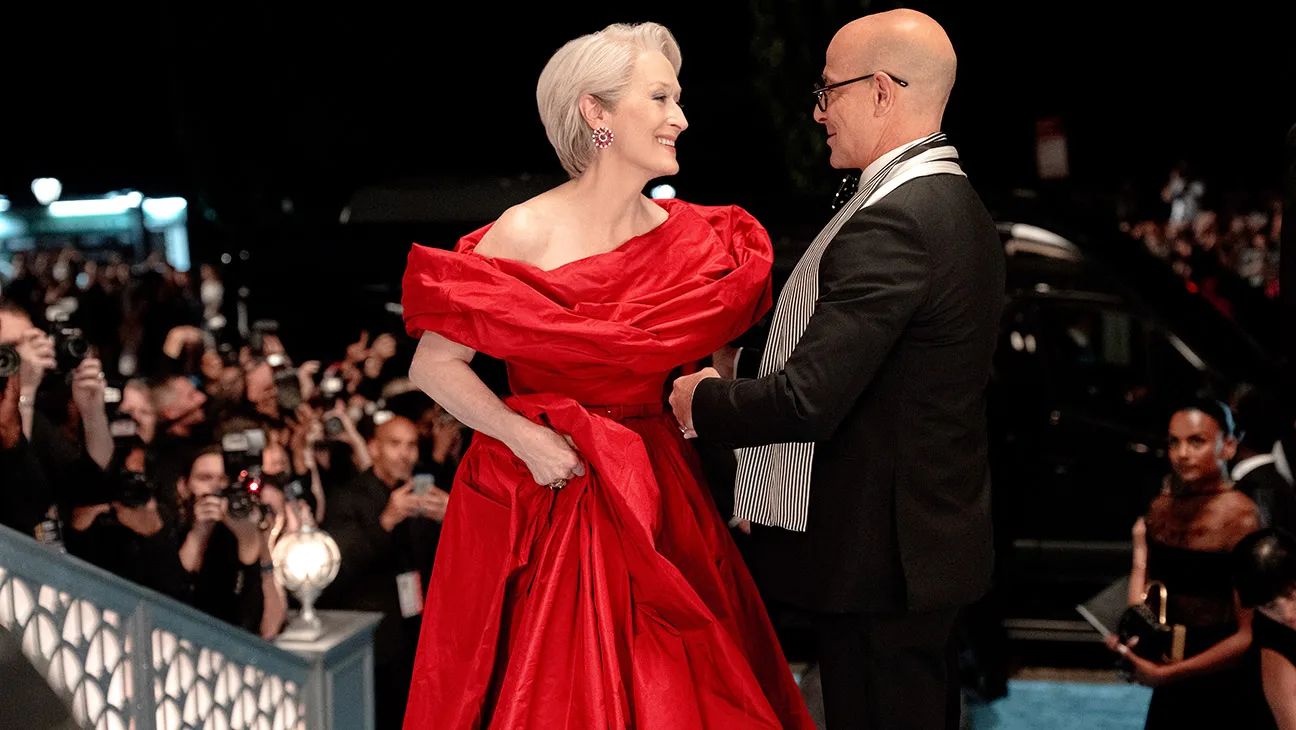
Meanwhile across town, Streep’s Miranda makes a regal entrance in a spectacular red gown (oddly like the one from Mother Mary) at a swanky event where group chairman Irv Ravitz (Tibor Feldman, giving good S.I. Newhouse) is expected to announce her move from the now-digital Runway to global content editor for the parent media company. But just as she hits the red carpet, news breaks that the magazine is under fire for endorsing a fast-fashion brand built on sweatshop labor.
Having seen Andy’s speech online, Irv calls to offer her the position of Runway’s new features editor, with a damage-control mandate. When she arrives at the office the next day, Miranda has not been informed of the new hire and nor does she remember Andy. The EIC gives her outfit a disapproving once-over before parking her in the crappiest office available, where Andy pens what The New York Times calls “a bracing mea culpa” about the sweatshop faux pas. Band-aid applied, though unacknowledged by the ice queen.
There are some amusing updates on what Miranda can get away with. Her coat and handbag are no longer hurled on assistants’ desks since an HR complaint. And her hyper-competent first assistant Amari (Simone Ashley) discreetly shuts her down when she risks saying anything culturally insensitive. Not that such concerns take the sting out of her haughty disdain, which Streep reliably delivers with supreme poise and acid tongue.
The same could be said for Runway’s longtime art director Nigel Kipling (Stanley Tucci), though a tart sweetness — even a whisper of camaraderie — cushions his barbs. He’s Miranda’s confidant but not her imitator. Tucci is the movie’s other MVP and gets many of McKenna’s best lines. Brilliant at his job, Nigel once again is the story’s “magical gay,” whisking the wardrobe-deficient Andy into the photoshoot fashion closet and kitting her out with thousands of bucks’ worth of swoon-worthy designer apparel.
The other part of restoring Runway’s credibility early on is appeasing the advertisers, which means sucking up to Dior, in particular. Miranda’s other former assistant, Emily Charlton (Emily Blunt, in delicious form), is now an executive at the legendary fashion house’s New York operations. With gloating acerbity, she demands several pages of free ads and a feature on the label’s new flagship store.
That task also falls to Andy, but Miranda continues to dismiss her worth at the magazine. Andy attempts to change her mind by landing an interview with the press-shy Sasha Barnes, who has been impressed by “the new gravitas” in Runway’s articles.
The story’s other major development is the ascension to the chairmanship of Irv’s fashion-philistine, athleisure-outfitted son Jay (B.J. Novack). “He wears Drakkar Noir!” gasps Miranda’s second assistant Charlie (Caleb Hearon) in horror when the news hits. Jay brings in a team of Ivy League MBA consultants to oversee company restructuring, slashing expense accounts and travel budgets.
That thread hands Streep comedy gold as Miranda shudders to learn there’s a staff cafeteria in the building where she’s expected to eat, and car services are out, meaning Ubers only. One priceless bit is a faint whimper and yearning flutter of her gloved hand toward the business class pods as Amari marches her through to coach on a flight to Milan. Streep’s light touch, even with physical comedy like Miranda struggling with the overheads, is impeccable.
Like Paris in the first movie, the Italian fashion capital serves as a glittering backdrop for lots of cool couture and historic landmarks, like the beautiful Galleria Vittorio Emanuele II, home of the original Prada store. (Molly Rogers steps in for her mentor Patricia Field as costume designer. Or shopper.) Runway is staging a major Milan fashion show for which Miranda reluctantly calls in a favor to enlist a superstar guest. That big name is no longer a secret, but we’ll omit it in case someone hasn’t heard.
That one-scene and one-song star appearance is the flashiest example of the movie’s many celeb cameos, as liberally sprinkled as the routine needle drops. Every time there’s an event, faces from the fashion, media and entertainment worlds mingle with extras, among them Tina Brown, Marc Jacobs, Naomi Campbell, Law Roach, Kara Swisher, Jon Batiste and Brunello Cuccinelli. I gave up trying to scribble the names down fast enough. The best of these appearances is a very funny scene in which Emily lunches with Donatella Versace.
There’s a bunch of behind-the-scenes intrigue involving Andy, Emily and Miranda in Milan as the future of Runway and its ownership hangs in the balance and what appear to be betrayals turn into rescue attempts. McKenna’s script has no big surprises up its sleeve — another moment of reflection in the backseat of a car for Miranda, a humbling for Emily, an offer of friendship and I guess some kind of journey for Andy, who’s now more confident though still too nice to match the value of Miranda or Emily or Nigel. That said, Hathaway is effortlessly charming in the role.
The most affecting note is the melancholy conclusion that any save employed to buoy magazines like Runway will be temporary at best.
All four leads step back into their characters’ shoes with ease and swan around in fabulous looks. (I confess I stalked Nigel’s chocolate velvet shawl-collar tux jacket online, waiting for a markdown. Grrr.) But would Miranda really wear that bonkers Dries Van Noten tassel jacket (which was giving me Carol Burnett as Scarlett O’Hara)? I’m not convinced. In the end, the movie is less a workplace comedy than a clothes horse, elevated by a classy cast.
Of the newcomers, Theroux is playing a caricature and Kenneth Branagh’s role as Miranda’s supportive violinist husband is only slightly less thankless than Brammall’s. Bridgerton alumna Ashley is a zesty addition, Amari’s aloof efficiency making her a Miranda-in-training. Despite talk in an editorial meeting of body-positivity and plus-size models on the Milan catwalk, that flag seems to be flown solely by Hearon’s sweet and amenable Charlie.
A promo clip stirred backlash from some East Asians offended by the perceived stereotype of Andy’s assistant Jin Chao — academic over-achiever, tech-savvy, socially awkward, nerdy fashion sense. Whether that will hurt the film in some markets is hard to say. In any case, it’s no fault of appealing Broadway recruit Helen J. Shen in the role. In truth, it’s difficult to imagine anyone being terribly upset by anything in The Devil Wears Prada 2. It’s pretty and polished and as featherweight as a fawning magazine puff piece; it will doubtless make a fortune.
>
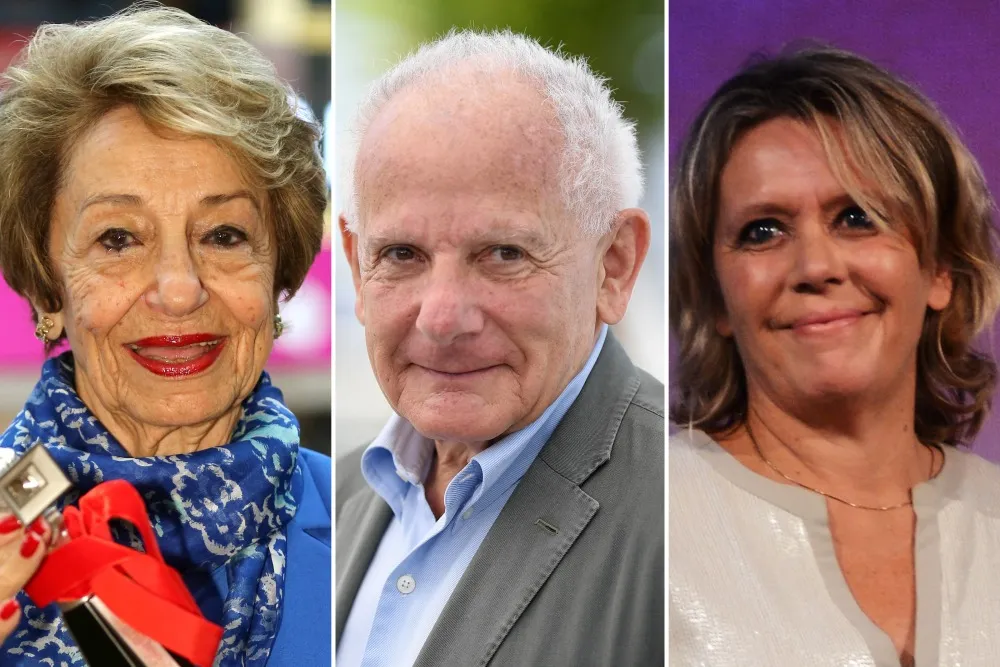
The European Film Academy has named Beki Probst, Marin Karmitz and Sandra den Hamer as the first recipients of its new Community Award for an Outstanding Contribution to European Film Culture.
The award, paying tribute to “a decisive and continuous contribution over many years to the development and expansion of European film culture”, will be presented during the European Film Awards weekend in Athens in January 2027.
The trio will be presented with the award on January 15, on the eve of the main ceremony at the traditional Welcome Night gala dinner, taking place this edition at the Acropolis Museum housing some 4,000 artefacts dating as far back as 1,200 BCE.
Probst is best known internationally as the founder of the Berlinale’s European Film Market, having entered the cinema world as the founder with her Swiss husband of the Queenie Cinemas in Berne in the 1960s, which grew into a successful chain of arthouse cinemas still existing today.
Born into a Sephardic Jewish family in Istanbul, Probst studied Law and Journalism and worked briefly as a film journalist.
From 1981 to 1988, she was the Berlinale delegate for Turkey and Greece and after initiating Locarno’s industry program, she was asked by Berlinale Director Moritz de Hadeln to start the European Film Market in 1988 in its current form.
Under her management, which continued into 2014, the EFM became one of the largest and most important international film market in Europe.
She has previously been feted with the Berlinale Camera, the Prix du cinéma Suisse, the French Chevalier des Arts et des Lettres and the Order of Merit of the Federal Republic of Germany.
Karmitz is known as the founder of France’s independent exhibitor, producer, film financier and sales agent mk2 film. Born in Romania in 1938, Karmitz arrived in France as a refugee with his family in 1947.
After studies at the IDHEC film school in Paris, he worked as assistant director to the filmmakers Jean-Luc Godard, Agnès Varda, Jacques Rozier, Yannick Bellon and Pierre Kast. before directing his first short film, Nuit Noir, Calcutta, based on a screenplay by Marguerite Duras, in 1964.
In 1965, he worked with Samuel Beckett on the adaptation of Comédie. In the same year, the feature was selected to open the Venice International Film Festival and shocked audiences with its avant-garde material.
He launched mk2 Productions in 1967 and made his feature-length directorial debut with Seven Days Somewhere Else (1968), followed by Comrades (1970) and Blow for Blow (1972), which were screened at international festivals.
He opened his first cinema in Paris in 1974 in response to Blow for Blow, about a group of textiles workers who take their factory boss hostage in protest at the work conditions, being shut out of mainstream circuits.
In 40 years, he would produce 108 films and distribute over 350 in theatres, among them Krzysztof Kieslowski’s Three Colours trilogy, for which he received a nomination for the European Film Awards 1994, twelve films by Claude Chabrol, Alain Resnais, Louis Malle, the Taviani brothers, Theo Angelopoulos, Lucian Pintilié, Gus Van Sant, Ken Loach, Abbas Kiarostami, Hong Sang-Soo, Michael Haneke, Walter Salles and Xavier Dolan.
Den Hamer has an extensive track record in the Dutch film industry.
From 2007 to 2023, she was the director of the Netherlands Filmmuseum in Amsterdam. Under her leadership, the re-named Eye Filmmuseum opened a brand-new museum building and a new collection centre in Amsterdam.
Its eclectic programming includes large retrospectives, international conferences and as well as exhibitions, exploring the work and careers of filmmakers such as Bela Tarr, Apichatpong Weerasethakul and Alex van Warmerdam among many others.
Before that, Sandra den Hamer worked for 23 years at the International Film Festival Rotterdam, including roles as co-ordinator of CineMart and the Hubert Bals Fund. From 1996 to 2007, she directed the festival.
She also served as President of the Board of the Association of European Cinematheques (A.C.E.). From 2023 to 2026. she was appointed interim executive director at the Netherlands Film Fund. Today she chairs the Board of the IDFA Institute and the Gerrit Rietveld Academy in Amsterdam.
Gathering 5,700 members from more than 50 countries across Europe, the European Film Academy oversees the annual European Film Awards, which alternates taking place in its home city of Berlin and another European city, which is Athens this year.
The 39th ceremony marks the second time it is unfolding in its new January slot, after the academy decided to shift it from a long-running December slot to integrate the awards more fully into the wider awards season.
>
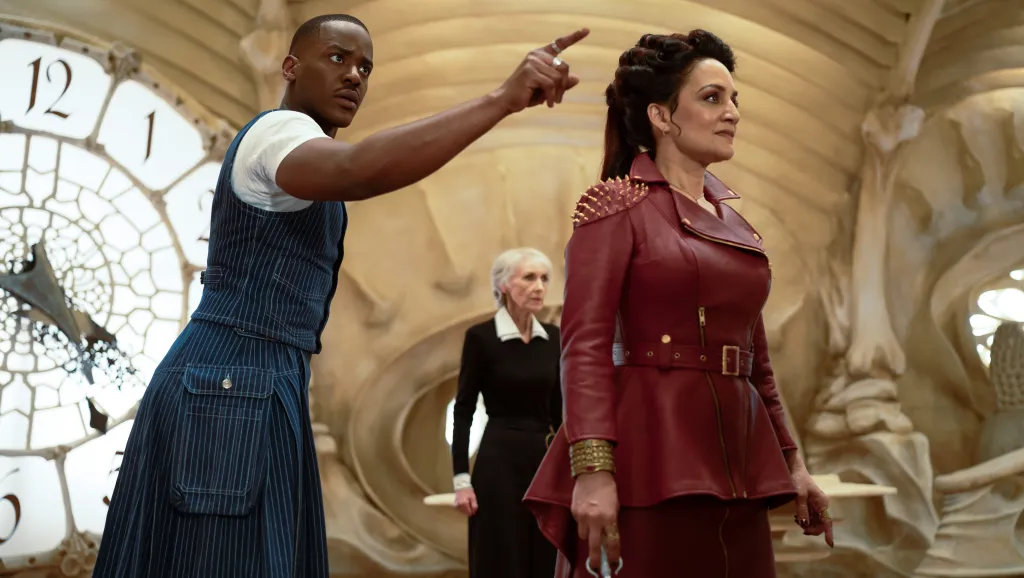
EXCLUSIVE: At least one BBC Studios indie will be throwing its hat in the ring to become the next producer of Doctor Who, with scripted boss Jamie Hall telling Deadline he “firmly believes” the entire BBC group should “reap the rewards” of the iconic sci-fi series.
Hall said “we’ve probably got one, potentially two companies” going for the multi-million pound tender, which if successful would bring the show back in house following two seasons made by Sony-owned Bad Wolf, starring Ncuti Gatwa. His comments followed BBC Studios CEO Tom Fussell recently saying BBC Studios would be applying “with gusto.”
Hall wouldn’t reveal the names of the indies but said he would “100%” be happy for more than one to enter the race.
BBC Studios runs an in-house drama label, which made Doctor Who before Bad Wolf, while it also owns several scripted indies outright including Baby Reindeer maker Clerkenwell Films, Happy Valley producer Lookout Point and Sherwood indie House Productions.
While he hasn’t seen his labels’ proposals, Hall said he has been “very open” and honest with those keen to go for the tender because the process is “quite an onerous undertaking and costs quite a bit of money.” “I have to make sure that it doesn’t become a distraction from the day job,” he added.
If two BBC Studios labels enter, they will likely join Line of Duty producer World Productions, whose boss Simon Heath has previously indicated his ITV Studios-owned outfit is interested. More thoughts from producers can be found in our future Doctor Who analysis from over the summer.
Published a fortnight ago, the tender calls for a “relevant, surprising, brave and inspiring” new vision for the show that should premiere in 2028-29. Notably, it said it is happy for indies to pitch a series using “episodic writers” rather than a “showrunner model,” which would do away with how Doctor Who has been made in recent years.
After several years with Bad Wolf and after the termination of the just-ended Disney+ co-pro deal, Hall was adamant that Doctor Who “should sit within the BBC and the whole group should reap the rewards of it.”
Questioned on what he would want to see from a revamped Doctor Who, Hall harked back to the days when Matt Smith and David Tennant were playing the Doctor.
“It feels to me that there is an opportunity to get back to what the core offering was in that time,” he added. “It will be off screen for two or three years and that gives the audience a great chance to have a break then rediscover, while also bringing a new audience.”
>

Netflix is returning the inmates to the Lock Upp jail.
A second season of the ‘captive reality’ series, whose full title is Lock Upp: Sach Yaa Sazaa has been ordered following Season 1’s breakout summer, where it placed number one of Netflix’s TV shows list within two days of the premiere and remained in the top ten for seven straight weeks.
The response to the show was so strong that five weekly episodes were expanded to six to satisfy demand, Netflix has said. It eventually amassed 50 million hours viewed in a month.
The show sees Indian celebrities thrown together in a jail cell, where they compete in challenges. What broke through with audiences was some of the more divisive characters discussing their public perception and confronting narratives that have surrounded them.
Netflix said Season 2 “build on that world, bringing audiences back inside the jail for another chapter where personalities collide, dynamics shift, and every secret has the potential to change the game.”
Riteish Deshmukh and Farah Khan return as hosts, with Balaji Telefilms producing. Show creator Ekta Kapoor is producing alongside Shobha Kapoor and Manisha Sharma, with Malaya Pradhan the showrunner.
“Lock Upp: Sach Yaa Sazaa became appointment viewing overnight,” said Monika Shergill, VP of Content at Netflix India. “Viewers invested, debated, and kept coming back. It captured the zeitgeist — not just as entertainment, but also as a space where celebrities talked about topics they rarely do, owned their choices and confronted past trauma.
“Ekta’s bold homegrown idea and the scaled adaptation on Netflix led to entertainment maxxing. Season 2 will be about recreating the same Netflix effect with many new surprises for our audiences.”
Ekta Kapoor, Jjoint Managing Director at Balaji, added: “Lock Upp: Sach Ya Sazaa on Netflix went far beyond what we imagined. The conversations, the inmates, and their most memorable moments continued to live with audiences even after the finale. That’s what makes the return of Lock Upp so exciting.
“The next season will take audiences back into a world they know, but with an entirely new set of stories, personalities, and surprises. And Farah and Riteish will continue to helm the Lock Upp as the formidable jailer duo, bringing their own energy, unpredictability, and dynamic to the next chapter.”
Lock Upp originally launched on ALTBalaji and MX Player in 2022, but was rebooted for Netflix.
>

‘Mahou no Princess Minky Momo: Akogare no Yume e – Magokoro no Duo’ Theatrical Release Postponed
Jalen Duren could turn down $200 million from the Pistons. Here’s what happens next

Voice Actor Kenjirō Tsuda’s TikTok Lawsuit Dismissed After AI-Voiced Videos’ Removal – News
-

 movies4 months ago
Search For Canadian TV Actor Stewart McLean Now Homicide Investigation
-

 Fashion9 years ago
These ’90s fashion trends are making a comeback in 2017
-
Fashion9 years ago
According to Dior Couture, this taboo fashion accessory is back
-
Fashion9 years ago
Model Jocelyn Chew’s Instagram is the best vacation you’ve ever had
-
Fashion9 years ago
Emily Ratajkowski channels back-to-school style
-
Fashion9 years ago
9 Celebrities who have spoken out about being photoshopped
-

 Anime4 months ago
Rurouni Kenshin: Hokkaido Arc Manga Takes 1-Issue Break – News
-

 Anime3 months ago
HIDIVE to Stream English Dubs for The World Is Dancing, The Forsaken Saintess and Her Foodie Roadtrip in Another World, The Dangers in My Heart: The Movie Anime – News