
Vanessa Fisk (Ayelet Zurer) and Wilson Fisk/Kingpin (Vincent D’Onofrio) in ‘Daredevil: Born Again’
Giovanni Rufino/Marvel


SPOILER ALERT: This article contains details from Season 2 of Daredevil: Born Again.
When Ayelet Zurer reprised her role as Vanessa Fisk, the wife of Vincent D’Onofrio’s supervillain Wilson Fisk aka Kingpin, in Marvel’s Daredevil: Born Again, it would be a bittersweet journey for the acclaimed Israeli actress. Zurer had played Kingpin’s wife and closest confidante in the first three seasons of Netflix’s Daredevil before the series was canceled and then resurrected seven years later for Disney+ as Daredevil: Born Again.
Audiences were recently left shocked in the fifth episode of Season 2 when Vanessa, who had been taking on a bigger role in Kingpin’s criminal empire, is mortally wounded in an attack and initially survives long enough to be treated. However, she ultimately succumbs to her injuries by the end of the episode, sending Wilson into a fit of rage and despair.
“I love Vanessa,” Zurer tells Deadline. “It’s so bizarre because she’s so far away from me. She’s this morally complex art dealer connected to the crime world who serves a very specific aspect of Kingpin. She was written in a way where everything was about honesty and she’s a person who is so used to people lying to themselves and others – people with money, mostly because that’s how she views the world she is in – so she’s kind of jaded.
“But she grew into this very interesting character who could take a lot of shit and at the end of Season One we see her as part of the complete amalgamation of her and Wilson and they’re on the same path. She’s serving him, obviously, and we realize that all along she was serving him. Even though their paths were apart and it seemed like she might have been doing her own thing, she actually didn’t and she kept going on the same sort of narrative that completes him. It’s ultimately a really strong love story, which is always interesting to me because the antagonists are the people with the strongest love affair. It’s this delicious juxtaposition of menace and love.”
Zurer admits that when she first found about Vanessa’s arc this season, there were a lot of mixed emotions. Showrunner Dario Scardapane and executive producer Sana Amanat knew that Vanessa’s death would spark the rage in Kingpin that was needed to propel the future of the story and while the departure is a sad one, “it’s beautifully done.”
Vanessa Fisk (Ayelet Zurer) and Wilson Fisk/Kingpin (Vincent D’Onofrio) in ‘Daredevil: Born Again’
Giovanni Rufino/Marvel
“In the second season, there’s a new threat coming into the picture and I think Vanessa is feeling it but the internal threat that she is feeling is not enough,” says Zurer. “[Kingpin] is enough for her but she’s not enough. He always wants more, he’s always hungry and always needs to fill another hole within himself to conquer more, get more control, to expand his dream and she starts to realize that it’s not quite sitting well. There is this real sensation that there is danger and that the level of danger is really spiking. But it’s all beautifully done because Dario wrote it in a way where it’s very internal.”
She continues: “I’ll always find her fascinating. I wish had even more to investigate with her but even though this is very much a comic book show with action, it’s the depth of the show that has always been so interesting to me. There has always been an attempt to talk about something deeper and that comes from the writers because they create really interesting juxtapositions for the story and for the characters.”
Zurer began her career in Israeli cinema and TV in the early ’90s where she won an Israel Film Academy Award for her role in Nina’s Tragedies and an Israeli Television Academy Award for her role in In Therapy. She was also nominated for her work in Shtisel. Her transition to Hollywood happened after casting director Nina Gold saw Zurer’s performance in 2004 film Something Sweet, which ultimately led to Gold casting her in Steven Spielberg’s Munich in 2005. Zurer went on to take roles in Angels & Demons with Tom Hanks and Man of Steel, the latter in which she played Superman’s biological mother.
More recently, she has returned as Queen Achinoam in a second season of Amazon MGM Studios’ hit biblical drama House of David. The series, which drew 22 million viewers in the first 17 days after its Season 1 launch, hails from Wonder Project’s Jon Erwin (Jesus Revolution) and Jon Gunn (Ordinary Angels) and tells the story of the ascent of the biblical figure David (Michael Iskander), who eventually becomes the most renowned and celebrated king of Israel.
The series follows the once-mighty King Saul as he falls victim to his own pride. At the direction of God, the prophet Samuel anoints an unlikely outcast teenager as the new king. As Saul loses his power over his kingdom, David finds himself on a journey to discover and fulfil his destiny. Zurer’s Queen Achinoam is wife to King Saul and not much is known of her in the original text, but the series presents her as a politically aware and emotionally complex royal figure, navigating life within Saul’s court during a turbulent period in Israel’s history.
“I wasn’t sure I wanted to do a historical biographical series because these kinds of stories can easily go wrong,” she admits. “The retelling of the Bible can go really wrong, particularly when it comes to developing characters. But I met with the creators, and we talked about women at the time and how they didn’t have that much agency. Women were not allowed to own land, let alone have the ability to change or affect stories and I wasn’t interesting in taking part in a story where women were just tools of the story. I wanted them to have a real agenda.”
She then started listening to podcasts about historians talking about the Bible and began to realize that women at the time actually “did have a lot of power.”
“It was not always out in the front so much, but definitely behind the scenes,” she says. “I found some intriguing things about witchcraft at the time and the perception of it and the perception of women and their roles in those days and they overcame their limitations. That’s what really interested me.”
Queen Ahinoam (Ayelet Zurer) in ‘House of David’
Jonathan Prime/Prime/Amazon Content Services
House of David ultimately has become one of Zurer’s “favorite jobs” to date. Both series shot in Greece, and she says she found the entire process “incredibly collaborative” and fun.
Zurer says she was adamant that she didn’t want to make Achinoam into “a wicked queen” and wanted her to have a “very grounding reason to do everything she does.”
“I found faith for her was a really big thing, so I leaned on that,” she says. “When the rug is pulled from underneath her feel and she has to protect herself, she’s scared of losing her identity. So, by protecting the King and the Kingdom, she is protecting her identity. Some people will see her as just the bad Queen, but I don’t see it that way. She’s a very real woman in that time that would do anything to protect her family and that’s what she does, and I really fought for that.”
When it comes to choosing her roles, Zurer says that in addition to connecting with the character and the production team, she also thinks a lot about her audience. “I really feel like being an actor is a spiritual thing and you are serving a creation of some sort of subconscious and adding to the subconscious mind and maybe the conscious mind as well. So, I fell a little bit of responsibility in that space.
“You’ve got to do that because when you are a working actor, you are the luckiest person on Earth because you get to be in places of work with a lot of really talented and interesting people, travel the world and make money while doing your job. So, I’m very conscious of that and because of what it gives me, I feel like I have to be responsible of what I’m doing and how I’m doing it.”
At present Zurer is dipping her toe in the writing space and has three projects in development. While they are still too early to discuss, she does reveal that one is a film about a family that touches on the subject of autism, another is a show that she is developing and she also has a graphic novel in development. Zurer has previously illustrated two adult books, Shorts and Badolina by Gabi Nitzan.
“I have been writing and developing things for the screen for more than 10 years now,” she says. “I know how hard it is and I have such a tremendous respect for writers now. It’s so hard to finish writing something and then bring it to someone else to read.”
>
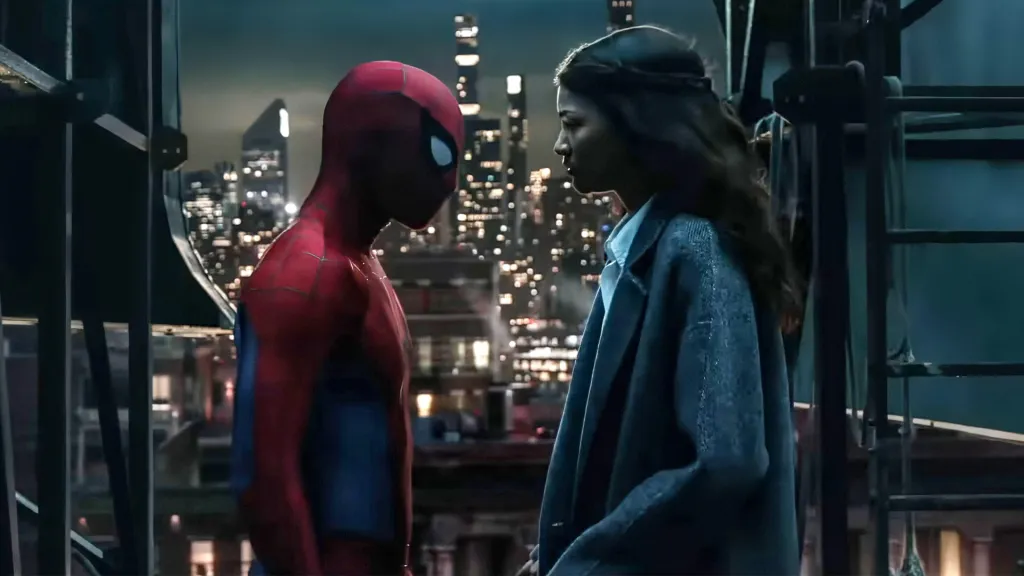
EXCLUSIVE: The highest grossing movie ever at the domestic box office, and the third highest grossing of all-time worldwide, Spider-Man: Brand New Day, is getting a re-release, we hear.
Sources are buzzing that the Destin Daniel Cretton directed, Tom Holland and Zendaya starring movie, will have extra footage that includes, but is not limited to, Rosario Dawson’s character Claire Temple.
Temple is a nurse who gives medical aid to vigilantes, and has appeared in the first and second season of Marvel TV’s Daredevil (2015-2016), Jessica Jones, Iron Fist, Luke Cage, and spinoff The Defenders. In interviews, Dawson has mentioned she shot a scene for Brand New Day, but it was cut. We also understand there will be more surprises as well in the extra footage.
This news comes in the wake of Disney posting some serious cash this past weekend with the re-release of the Russo Brothers’ Avengers: Endgame: Encore which minted $86M around the globe ($26M domestic) and moved its current lifetime cume to $2.885 billion, still the second highest grossing movie ever behind Avatar‘s $2.92B. And that reissue was a marketing stunt for Disney/Marvel Studio’s Avengers: Doomsday hitting theaters on Dec. 18.
Spider-Man: Brand New Day is still playing in theaters in every corner of the world with the pic’s current global tally at $2.495B as of yesterday ($950.7M of that coming from North America). Natch, Brand New Day is also Sony’s highest grossing movie ever, having unseated 2021’s Spider–Man: No Way Home some weeks ago ($1.92B).
No word yet as to when the re-release will happen. Logic dictates that Sony would have some sort of access to premium large format screens during a quiet time at the box office. In the past, the Culver City lot re-released No Way Home over Labor Day weekend 2022 (which made $9.3M in its domestic run). Going way back during Labor Day weekend 2002, Sony did a double-feature re-release of Sam Raimi’s original Spider-Man from that summer with Men in Black II.
It’s a never-ending war between Marvel vs. Marvel as Spider-Man: Brand New Day‘s chase of Avengers: Endgame isn’t over. The current gap worldwide for Brand New Day to overtake the latter is, wow, $389.7M.
This summer Holland and Zendaya also starred in Universal’s highest grossing movie ever, Christopher Nolan’s The Odyssey which currently counts $1.75B WW.
Right now, Spider-Man: Brand New Day weighs in with a running time of 2 hours and 25 minutes.
Avengers: Endgame‘s original cut was 3 hours and 1 minute, however, Encore included six minutes and 17 seconds of extra footage from Doomsday for those who purchased tickets in Disney’s certified PLF format, InfinityVision. Those who watched the pic on non-Imax/Infinity Vision screens only got a bonus of two minutes and six seconds.
Sony didn’t return request for comment.
>

Raúl Torquemada is a busy man. He is the director of the Madrid Film Office, the audiovisual office of Madrid’s City Council, which is working with local and global film, series and advertising productions that are shooting in the Spanish capital and featuring it in prominent roles.
For 2025, the Madrid municipal office disclosed that feature film shoots set a new record of 71, handily exceeding the previous high of 47 set in 2022.
From next week, Woody Allen is scheduled to shoot his latest movie in Madrid. Still untitled, the filmmaker is understood to have agreed that “Madrid” will be part of the title. Also among the conditions for the city’s financial backing of the project is that it must showcase Madrid via a certain percentage of exterior scenes in the film.
Film and series buffs have in recent years spent screen time with the Spanish capital thanks to such series as AMC‘s The Walking Dead: Daryl Dixon and Netflix’s Money Heist and spinoff Berlin, with such recent productions as Netflix’s Safe Houses and HBO’s Carlota joining that illustrious company. Among the movies that the city has recently hosted have been 2026 festival circuit favorites, such as Florian Zeller’s Bunker, starring Penélope Cruz, Javier Bardem, Stephen Graham, Paul Dano and Patrick Schwarzenegger, La bola negra (The Black Ball), directed by Javier Calvo and Javier Ambrossi, and Pedro Almodóvar’s Bitter Christmas.
Torquemada will be among the busy attendees of this week’s sixth edition of Iberseries & Platino Industria, which brings Spanish- and Portuguese-language content creators and executives from Europe, Latin America and the U.S. to Madrid.
THR caught up with the Madrid film commissioner by email to find out what is new and how Madrid continues to go from strength to strength.
Has Madrid further enhanced its appeal as a production hub over the past year or two with financial incentives or qualitative support programs, or how do you explain the city’s continued success in attracting film and TV productions?
It is not just an impression. Madrid hosted the filming of 71 films and 52 series in 2025, reflecting the strength of an industry built over many years. Its appeal combines outstanding creative and technical talent, experienced production companies, diverse locations and excellent international connectivity. The City Council supports this through close collaboration with the industry and practical assistance from Madrid Film Office, part of the Madrid City Council’s Tourism Area, helping productions find locations, connect with local professionals and navigate filming in the city.
Alongside Spain’s national tax incentives, the City Council’s grants for film production, promotion and distribution had provided nearly €15 million ($17 million) between 2021 and March 2026. This year, we also launched support for the development of series and miniseries. Our commitment is long-term as we want productions to choose Madrid with confidence, generating skilled jobs and opportunities for local businesses while bringing the city’s identity and cultural richness to audiences worldwide.

Raúl Torquemada, director of the Madrid Film Office
Courtesy of Madrid Film Office
What do you think is the most overlooked reason for Madrid’s success in attracting film and TV shoots and companies? I feel everyone by now knows about the beauty of the city, its great food and its skilled crews…
Perhaps the most overlooked factor is the confidence Madrid gives producers. Beyond its locations and skilled crews, the city brings together the connections, accommodation, infrastructure and specialist services needed to organize a complex production. This makes Madrid a practical base for projects filming across Spain and gives companies strong foundations for establishing a lasting presence here. The Walking Dead: Daryl Dixon is a very good example of that model.
That confidence also comes from having an experienced industry, a solid ecosystem, including VFX, animation, post-production, and virtual production and a city council committed to supporting it. Through Madrid Film Office, we help producers connect with local expertise and navigate the city. For a producer, knowing where to turn when a challenge arises can be decisive. For Madrid, those relationships help turn individual shoots into sustained investment, skilled employment and opportunities for local talent
What are some of the big films and series that have shot in Madrid in the past year?
Those titles are actually very good examples of the internationalization we are seeing. Florian Zeller’s Bunker, starring Penélope Cruz and Javier Bardem alongside Stephen Graham and Paul Dano, filmed in Madrid and London and is a French-Spanish co-production involving Madrid-based MOD Producciones.
Safe Houses also filmed in Madrid in 2026: it is an Apple TV+ international espionage series, starring Ana de Armas and Jennifer Connelly, with a story that itself revolves around events in Madrid. And Carlota, the large-scale historical production from Sony Pictures Television for HBO Max, also filmed in Madrid and elsewhere in Spain, as well as Mexico and Colombia.
This year, Madrid is also receiving the filming of The Interrogator, a spy drama series for Fox, Love Affair, a Korean drama series for Netflix or the sci-fi show Murderbot for Apple TV+.
Those projects sit alongside the international productions we have been tracking over the last year or so, such as Day Drinker, directed by Marc Webb; The Beast, directed by Renny Harlin with Samuel L. Jackson; Ceniza en la boca, directed by Diego Luna; and further seasons of The Walking Dead: Daryl Dixon and Has Fallen.
And there is a very strong domestic slate too, including new works by Pedro Almodóvar, Los Javis and Rodrigo Sorogoyen, as well as series such as Berlín, Reina Roja and Anatomía de un instante.
What interests us is not simply the number of titles, but the range: Spanish projects, European and Ibero-American co-productions and increasingly ambitious U.S. and U.K. projects are all making use of the same Madrid ecosystem.
The word is out that Woody Allen’s new film will start shooting in Madrid next week and feature the city like a star. What can you share about how important a project that is for Madrid and its infrastructure and about the financial support the city and region provide for it? And is it true that Madrid will be in the film title under the contract with the city?
Woody Allen has a distinctive ability to make cities part of his cinematic legacy. New York, Paris or Rome have become integral to his stories, leaving images that stay with audiences long after the film ends. For Madrid, the opportunity lies in that lasting cultural presence, bringing the city’s character to international audiences while showcasing the talent and professional capacity of our audiovisual industry.
Filming is scheduled to begin on Oct. 5, with Madrid as its principal setting and much of the shoot taking place in locations in the city center. The project is a contemporary comedy produced by Wanda Visión, Gravier Productions Inc. and 3Six9 Studios, and the announced cast includes Alexi Wasser (Messy, Girls), Jemima Kirke (Girls, Sex Education), Peter Vives (El tiempo entre costuras, Velvet), Marton Csokas (El Señor de los Anillos, The Equalizer) and Jakob Oftebro (Kon-Tiki, Hamilton).
As already announced, the City Council is supporting the project through a €1.5 million ($1.7 million) institutional sponsorship aimed at promoting Madrid internationally and the announced plans include “Madrid” in the title. The regional government is also supporting the production; questions about its contribution are best addressed to them. Further creative and production details are for the filmmakers to share. Our focus is on the opportunity this represents for Madrid’s cultural profile and local creative economy.
Madrid filming for action-thriller film ‘All the Names of God’
Courtesy of Second Gen Pictures/TriPictures/Madrid Film Office
Are there any key numbers that Madrid has hit in terms of TV and film productions in recent years?
The clearest record is film production. In 2025 alone, the city hosted at least 71 feature films, 52 series and more than 410 medium and large-scale commercials, while the Madrid Film Office provided more than 4,115 specialized assistance services, almost 7 percent more than the previous year. The 71 features are particularly significant because they comfortably surpass the 47 filmed in 2022, which had previously been our highest figure since the Madrid Film Office was established.
But perhaps the numbers I find most revealing are the economic ones. Our recent study with the Universidad Autónoma of Madrid estimates that feature films and series filmed in Madrid generated €1.54 billion ($1.75 billion) in economic output in the city between 2021 and 2024, supporting more than 10,100 full-time-equivalent jobs, generating €883.6 million ($1.0 billion) in gross value added and €367.3 million ($418 million) in tax revenues.
That gives us a much clearer picture of why filming matters and that the industry has a substantial multiplier effect across hospitality, transport, construction, professional services and many other parts of the city’s economy. This enables us to gradually build an increasingly detailed and comprehensive picture of the audiovisual sector’s contribution to the city and the region, incorporating data from the various studies we carry out as part of our strategic focus on the generation and analysis of quantitative data.
How important is Iberseries & Platino Industria for showcasing Madrid as a production and creative hub?
It has been enormously valuable because it allows Madrid to demonstrate something we consider fundamental to our positioning: we are not only a location or a production center, but also a meeting point between Europe and Ibero-America. Iberseries & Platino Industria brings platforms, broadcasters, producers, creators, distributors, buyers, financiers and talent together in Madrid, creating opportunities for co-production, financing and internationalization.
The fifth edition attracted more than 2,700 accredited professionals from 50 countries, half of them international, as well as over 1,500 companies and more than 180 buyers and commissioners from 30 countries.
For the Madrid Film Office, our support has been sustained from the beginning because the event fits perfectly with our wider strategy. We want Madrid to be the place where an Ibero-American creator can meet a European producer, where a Spanish company can find an international partner and where a global platform can discover talent, projects and production capacity. That positioning also connects with our support for initiatives such as ECAM Forum, the Platino Awards or the Film Academy Residencies, among other programs. In that sense, Iberseries & Platino Industria does more than showcase Madrid: by bringing international business and talent here every year, it actually helps build the ecosystem we are promoting.
Is there anything else you would like to highlight?
Our ambition is to ensure that growth in filming creates lasting value for Madrid. That means attracting international productions and co-productions while strengthening local companies and talent. In line with the decentralization strategy of the Madrid City Council’s Tourism Area, which oversees Madrid Film Office, we also want to spread filming activity more widely across Madrid’s 21 districts. Areas such as Usera, Villaverde, Carabanchel and Tetuán offer distinctive settings and new storytelling possibilities, helping extend the economic and cultural benefits of filming to more neighborhoods.
This growth must work for residents too. Our Best Practices Guide for Filming encourages positive coexistence between productions, residents and local businesses. Alongside this, we are developing screen tourism, promoting Madrid’s audiovisual heritage and connecting emerging talent with the industry. Better data will help us assess the sector’s impact and guide our work. Ultimately, we want productions to choose Madrid and companies, professionals and creators to find lasting reasons to stay, return and grow here.
>

The youth demographic has been key to fuelling this summer’s box office boom.
Backrooms director Kane Parsons and Academy boss Bill Kramer were among those taking part in a Deadline-moderated Zurich Summit panel this past weekend which addressed theatrical success in the age of YouTube, TikTok and other online platforms.
Kramer thanked YouTube native Parsons for his film Backroom, which helped energise young audiences, and also noted how the youth demographic flocks to Academy screenings of classic cinema.
“Your fandom traveled from YouTube to the theaters, and we saw the same thing with Curry [Obsession director Curry Barker]. Young people want to go back to movie theaters…YouTube can inform a theatrical fandom.”
He continued: “We see this in our Academy Museum. We have two theaters, which show classic films and rep programming, but more than half of our ticket buyers are under the age of 40, and we sell out every screen. People love seeing movies in movie theaters. We just needed to attract new fans, and you helped to do that this summer.”
The 20 year-old Parsons, whose record-breaking Backrooms took $400M off a $10M budget, said he thought it was “reductive” to think that people his age were only interested in short-form content.
“I feel like this sentiment is weaponized, like it is algorithmically incentivized, but it’s not really something I think most people enjoy about their own wiring. They don’t love that their attention spans are being sucked into the spiral of mostly consuming stuff that is short. They’re still [enjoying] going into a closed room [cinema] without outside interferences.”
Later in the discussion, Kramer talked about the Academy’s eye-catching deal to make YouTube the free-to-stream broadcasting home of the Oscars from 2029, ending ABC’s run showing the awards.
Deadline moderator Andreas Wiseman asked whether the pact felt like a risk.
“Not at all,” replied Kramer. “It almost feels risky to not do it because we’re looking at the future. With each month, a larger percentage of the TV-watching audience is on YouTube.”
He continued: “We have a great partnership with Disney right now. They’ve been amazing partners and will continue to be for the next two years. But we’re already deep in discussions with [YouTube CEO] Neal Mohan and his team, and I think you’ll see a very different-looking Oscars that allows you to engage with the show in more interactive and deep ways than we can right now. It’ll be free to everyone around the world in over 30 languages. Right now, in certain markets, they show a reduced version of the Oscars. This allows everyone around the world to see the exact same telecast at the same time. That’s important to us.”
He expanded: “As we become more global as an organization, the best way for us to reach a global audience of film lovers, film fans, young artists is YouTube. I think the timing [syncs] this year with Obsession and Backrooms, and with the direction moving from YouTube to theatrical. We’re an organization that celebrates theatrical movie making, but at the same time, the Oscars is a TV show, and we want to reach a large audience. YouTube allows us to directly engage with our audience, our viewers, film fans, in a way that we just can’t do right now. Right now, more people outside of the U.S. watch the Oscars than in the U.S. The deal allows us to capture that audience and a lot more. That’s great for the Academy and it’s great for the films of that year, and it’s also great for film lovers around the world.”
The reporting at the time – and Deadline’s understanding – is that the deal was comfortably into the nine figures. Kramer wouldn’t be drawn on stage as to how lucrative the pact is but smiled and called it “a very good deal”.
ABC had been back in for the rights. Netflix was also in the mix.
>


Search For Canadian TV Actor Stewart McLean Now Homicide Investigation


These ’90s fashion trends are making a comeback in 2017
According to Dior Couture, this taboo fashion accessory is back
Model Jocelyn Chew’s Instagram is the best vacation you’ve ever had
Emily Ratajkowski channels back-to-school style
9 Celebrities who have spoken out about being photoshopped


Rurouni Kenshin: Hokkaido Arc Manga Takes 1-Issue Break – News


HIDIVE to Stream English Dubs for The World Is Dancing, The Forsaken Saintess and Her Foodie Roadtrip in Another World, The Dangers in My Heart: The Movie Anime – News