
movies
Oscars: No AI Actors, Screenplays; Acting, International Rule Changes


The Academy of Motion Picture Arts and Sciences, in an announcement on Friday of updates to its rules and regulations, eliminated any gray area about its position on artificial intelligence: AI is not welcome at the Oscars.
The organization’s board of governors decreed that the only sorts of performances that will be eligible for acting Oscars are those credited in a film’s legal billing and demonstrably performed by humans with their consent. (This appears to address questions raised by the posthumous completion of a performance by Val Kilmer, who died in 2025, using AI.). Additionally, the Academy explicitly spelled out that only human-authored screenplays are eligible for writing Oscars.
Under Eligibility (Rule Two), which pertains to Generative Artificial Intelligence, the Academy reserves the right to request more information about the nature of AI use and human authorship.
In other major news, the Academy revisited its longstanding policy that the best international feature Oscar race will only consider one film from any country or region as chosen by a local Academy-approved selection committee. Henceforth, a film can also qualify for consideration in the category by winning the top prize at one of several major international film festivals: Berlin, Busan, Cannes, Sundance, Toronto or Venice. In other words, a single country or region could now land multiple noms for the best international feature Oscar.
Additionally, the best international feature Oscar will no longer be awarded to a country or region, but rather to its director on behalf of it. Earlier this year, for example, that category’s Oscar was won by Sentimental Value, but the winner was technically Norway, not filmmaker Joachim Trier. Henceforth, the director’s name will also appear on the Oscar plaque and in the record books.
Another big change: actors may now be nominated for multiple performances in the same category. Only in the earliest years of the Oscars was it possible for an actor to be nominated against himself or herself; for instance, Norma Shearer, for The Divorcee, won the best actress Oscar at the third Academy Awards over a field that included Norma Shearer, for Their Own Desire. A subsequent rule change mandated that if a single performer gave multiple performances that received enough votes to finish in the top five spots for a category, only the higher-tallying performance would be nominated. Now, though, multiple performances can be, aligning the acting categories with all other categories, in which an individual can receive multiple noms.
Had this rule been in place in, say, 2009, Kate Winslet might have received two best actress Oscar noms, for The Reader and Revolutionary Road, rather than just one, for The Reader — which might have actually made it harder for her to win for either one, as she did that year, given that she could be splitting her own support.
The Governors Awards — at which the Academy annually celebrates up to four individuals or groups with some combination of honorary Oscars, the Irving G. Thalberg Memorial Award and the Jean Hersholt Humanitarian Award — will also be impacted by a new rule change. Moving forward, a minimum of three “disciplines” must be represented in any given year.
In other words, it seems like the Governors Awards ceremony of 2021, at which the honorees were the filmmakers David Lynch and Lina Wertmüller and the actors Geena Davis and Wes Studi — would not be possible in the future, given that only two disciplines were represented.
The Academy also made a bunch of other tinkers.
The number of people eligible to win an Oscar statuette for best casting has been increased from two to three.
The best cinematography category will now produce a shortlist of 20 films, as opposed to somewhere between 10 and 20.
Makeup and hairstylists branch members will no longer be eligible to vote for the category’s shortlist unless they have attended at least one of the two final branch meetings (roundtables).
To be eligible for the best original song Oscar, tunes that begin with the end credits must now be submitted to the music branch with the last 15 seconds of the film before the end credits.
Members of all branches have been eligible to vote for the best visual effects Oscar in the final round of voting but will now only be able to do so if they have viewed the three-minute “before and after” reels captured at the visual effects bake-off and posted to the Academy Screening Room members-only streaming service.
As far as campaign promotional regulations, the Academy dictated that screenings with Q&A sessions or panel discussions before nominations may now have up to two moderators instead of one moderator. And all email blasts to members via an Academy-approved mailing house must now include an email address or phone number for inquiries regarding venue accessibility.
Finally, the Academy also provided submission deadlines and other key dates pertaining to the lead-up to the 99th Oscars on Sunday, March 14, 2027:
Thursday, Aug. 13, 2026: First submission deadline for animated short film, documentary feature film, documentary short film and live action short film categories
Thursday, Sept. 17, 2026: First submission deadline for general entry categories, animated feature film, best picture and Representation and Inclusion Standards Entry (RAISE) form
Wednesday, Sept. 30, 2026: Submission deadline for international feature film
Thursday, Oct. 8, 2026: Final submission deadline for animated short film, documentary short film and live action short film categories
Wednesday, Oct. 14, 2026: Submission deadline for music (original song)
Thursday, Oct. 15, 2026: Final submission deadline for documentary feature film
Wednesday, Nov. 4, 2026: Submission deadline for music (original score)
Thursday, Nov. 12, 2026: Final submission deadline for general entry categories, animated feature film, best picture and Representation and Inclusion Standards Entry (RAISE) form
Jan. 8 – 10, 2027: Casting, makeup and hairstyling, sound and visual effects voting events (bake-offs)
>

Upon accepting his career achievement award at an intimate Zurich Film Festival ceremony, beloved U.S. auteur Richard Linklater was swiftly asked for an update on his musical film, Merrily We Roll Along.
Based on Stephen Sondheim’s 1981 show, Linklater’s movie is set to shoot over a 20-year period, similar to his Oscar-nominated Boyhood, with stars Paul Mescal, Ben Platt and Beanie Feldstein aging in real time.
Before a screening of his iconic Before Sunrise, Linklater sat for a 45-minute discussion with Zurich Film Festival CEO Christian Jungen to reflect on his entire career, from his early interest in cinema to making Dazed and Confused with Matthew McConaughey and later, School of Rock with Jack Black.
Toward the end of the conversation, an audience member asked for a status update on Merrily We Roll Along, to which the American filmmaker responded that it’s proving a little trickier to be discreet compared to 2014’s Boyhood (shot over 12 years). “When I was doing Boyhood, we worked in complete anonymity. No one knew about the film. This one, on the other hand, because it’s a Stephen Sondheim musical and it’s very public, I have to answer this question for 20 years while we’re making it,” he laughed.
“But my progress report,” continued Linklater, “is it’s [shooting] nine sections in 20 years. And in a few months, we’re filming the fourth section. So see you in 2040,” he added, the room applauding.
Linklater also dismissed concerns about “tempting fate” with such a long shoot. “It worked on Boyhood, […] and that’s just the way the film should be made and that’s the only way to tell the story. And people were like, ‘Well, what if someone died?’ There’s always an extreme thing that would prevent it from being made. But I was like, ‘Well, that usually doesn’t happen,’ and you gotta believe in collaborating with the future of some kind. So definitely got lucky [with Boyhood] and hoping to get lucky this time. But it’s been so fun so far. It’s very different. I have music already — it’s a great score. We’re adapting it step-by-step. I’ve always made music films. … But it’s fun to be making a full-on musical. But it’s about friendship, long-term.”
Merrily We Roll Along is based on the 1934 play of the same name by George S. Kaufman and Moss Hart, follows Franklin Shepard, a talented composer of Broadway musicals that abandons his friends and career to become a producer of Hollywood movies. The story begins at the height of his Hollywood fame and moves backwards in time, showing important moments in Frank’s life.
Naturally, Linklater was probed on how he came to cast Ethan Hawke and Julie Delpy in the cult Before trilogy, and regaled the audience with anecdotes about making the Vienna-set romance. When Jungen cited an interview with Delpy where she said she’d been “only made a third” of what Hawke was paid, Linklater responded: “That’s not true. I actually remember fighting for it because I knew how hard the actors were going to have to work. And I did have some producers saying, ‘Oh, Julie has no American credits. We don’t have to pay her that much. We can get her for scale. ‘ And I was like, ‘Let’s get them closer.’ It was definitely the most she’s ever made, but it was a little less than he did. But not [by] much.”
Upon receiving his career achievement award, Linklater, director of Hit Man, Nouvelle Vague and, more recently, Blue Moon, told the crowd: “I feel so lucky to be in this world, to work with people in the film culture — not just filmmakers, but the film culture that we all live in too. Film festivals, curators, teachers of film, just film lovers everywhere, film societies,” he said, alluding to his launching of the Austin Film Society in 1985.
He continued: “I’ve been so lucky all these years now to awaken every day in that world where it’s optimistic, because film is optimistic. It’s people who want the best, who want to see something great, who want to make something great, and we try to help each other in that. And it’s the best people, too.”
The evening was celebratory from the moment Linklater walked in to his picking up Zurich’s Golden Eye Award. He joins 2026 honorees Julianne Moore, John Turturro and Naomi Watts. The 22nd edition runs Sept. 24-Oct. 4.
>
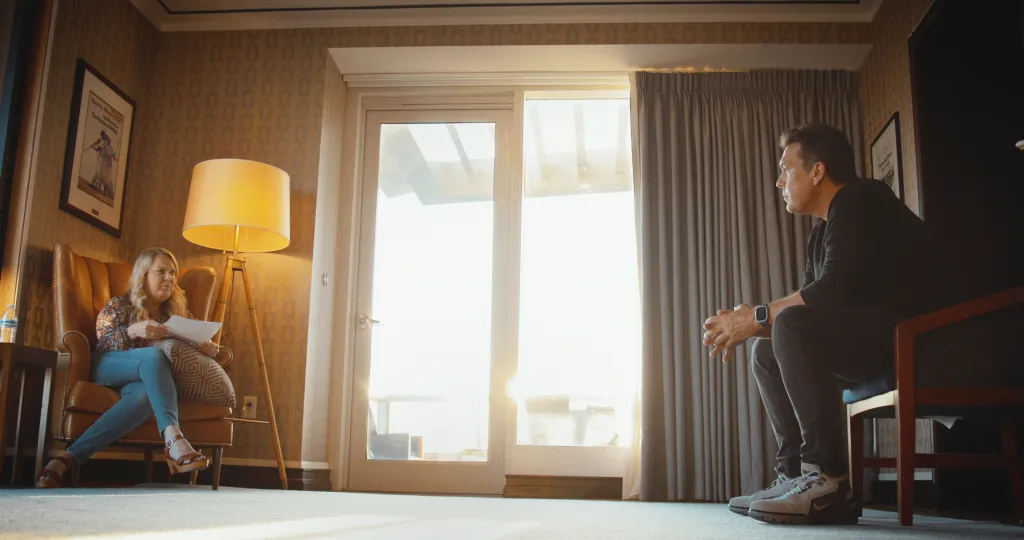
In comedian Dane Cook‘s mind, “some people brighten up a room by leaving it.”
That’s certainly been true in his case, considering the devastating personal lows that have come intertwined with dizzying career highs.
From a middle-class Massachusetts family, Cook first took the mic in Boston as a teenager, skyrocketing to fame by the mid 2000s, with a uniquely hands-on approach to building his fan base on MySpace.
One of the first to demonstrate that comedians could be the new rock stars — filling arenas like Madison Square Garden long before our current comedy boom — Cook hired his older half-brother, Darryl McCauley, as his business manager near the height of his success, in need of someone to help him oversee his many millions.
In truth, Cook didn’t expect McCauley to do all that much; mainly, he wanted to do a nice thing for a beloved family member who had been by his side through some tough familial experiences and perhaps believed in his talent even before he fully did himself. McCauley, who formerly worked as a corrections officer, was paid handsomely for the gig — over $100K a year while sharing the lifestyle of a star on the rise.
All seemed right in the world until 2008, when Cook discovered that McCauley had been diverting funds for years, forging bank statements and checks, and making large withdrawals. Together with wife Erika, for reasons that are still unclear, he resolved to push boundaries — stealing not out of a clear case of financial need, but out of some motivation to take as much from Cook as he possibly could.
All told, the McCauleys stole at least $12 million, getting creative in hiding cash — by stuffing it into jars of spaghetti sauce, for example. The situation was “quite Shakespearean, somewhat biblical,” Cook says — a source of great “humiliation.” For some time after, he felt lost — both to himself and to his audience, who had no real way yet of understanding what he’d been through.
Ultimately, both Darryl and his wife pleaded guilty to their crimes and were ordered to pay restitution. Darryl was shipped off to prison for more than half a decade and has flown under the radar since completing his sentence. It took Cook nearly 20 years to tell the story in full — he first addressed it in depth in a 2019 episode of Your Mom’s House, the podcast hosted by comedians Tom Segura and Christina Pazsitzky. But now, he’s opening up via Funny Money: The Dane Cook Story, a documentary directed by Brett Harvey that arrives on digital and VOD on September 29. (Check out a clip above.)
In the doc, Cook delves into his emotional experience of the saga and what it took from him, though he makes one thing clear: He, his family and his other relationships, are significantly better off, in the end, for what happened. And for the most part, he wouldn’t change a thing.
“I believe that nothing’s falling apart, it’s only ever falling together,” Cook tells Deadline. “Without giving too much away, in the doc, you sort of see my philosophy — my personal constitution — and I’m a firm believer in, take the things that happened to you and make them a part of your winning formula, and don’t let them cause you to sputter. You’ve got to use it as fuel.”
Cook is premiering his doc in November, in a return to the New York Comedy Festival on the 20th anniversary of a historic achievement — becoming the first stand-up to perform two sold-out shows at Madison Square Garden in one night. In conversation with Deadline, he shares that he always knew he’d eventually get around to chronicling his experience finding himself at the center of a true-life crime thriller — ever since Darryl left him an “outlandish” voicemail, “through crocodile tears,” while on the run from the FBI. Not only would this allow him to reclaim his own story, but the telling of it was worthwhile from an entertainment perspective, alone.
“When I was approached by the producers that I made the film with, I knew that moment was finally coming to light where it was like, I feel like I can own this moment as a creative person. I feel like I can tell an incredible story that also includes the highs and lows of the career,” says Cook. “And I really looked at it as, this is like the Empire Strikes Back story in the greater story of my career.”
Read on for a discussion of Cook’s “darkest capsizing moment,” how he came through it, and the opening “of a new book,” rather than a new chapter, in his story.
DEADLINE: Why tell this story now? Did it take you a long time to figure out what you wanted to say? To separate yourself from the emotions involved?
DANE COOK: By the time I sat in the chair with Brett, the director, I was completely ready. Sometimes, people make a documentary and they’re very much involved in the documentary, and I was not going to be. I said, “I understand the way you work. I’m going to give you what I have. You will go away, and without me in the edit bay, you’re going to tell this. Because I believe you’re the kind of storyteller that can and should do that.”
And of course he was already saying, “Well, I wouldn’t do it the other way anyway.” [Laughs]
When I sat in the chair, I said, “I’m going to give you everything I have in this moment. So if you ask the question, there’ll be no barrier. I’m ready to really put everything I have into this moment.” And he asked everything that I think you’d want to understand, and even beyond that.
So, ready for it, strong enough to share the story, but also in a place in my life where I was a better person from this. I was happier, healthier. I was more in my faith. I was in an incredible relationship that would turn into a marriage with my best friend. And so why wouldn’t I now want to own my darkest capsizing moment when I’m in the happiest, most fulfilling moment?
DEADLINE: How long did the Darryl saga leave you in a dark place?
COOK: I didn’t think I was in a dark place until I realized I was. [Laughs] When it happened, I think I thought, “I’m the son of George Cook. My dad’s an athlete; he’s a winner.” And I kind of picked myself up and just kept going. I kept working, touring. My career at that point, I was not the belle of the ball anymore. My moment was a beautiful moment, but it was settling…
I didn’t realize till about three or four years later that I wasn’t the same person by way of this… I think I had lost a little bit of my own identity, in terms of my communication with fans. So it wasn’t until maybe around 2015 or ’16 that I was like, “You know, I’m working and functioning, but I’m not complete. And why I’m not complete is because I ran away from that moment. And now it’s time for me to really face it and share it.”
DEADLINE: Do you feel permanently changed by this experience?
COOK: A question people ask me a lot is, “That must have really messed with your trust.” And actually, for reasons that are beyond me, it didn’t. I think just being in an industry that’s already filled with peril…whether it was bad bookings, bad managers, bad deals, I’d been through the gauntlet of what happens when you put your heart on the line, or put yourself out there in the spotlight. So I guess I was thick-skinned in that regard.
But for betrayal and how that was jarring, when my brother was out of my life, the opposite happened because he had sort of veiled me in a negative cloak. And once he was gone, it was almost like, you know the moment when you get a toothache fixed? And almost immediately, not only are you relieved, but you’re just ready to go? You’re ready to work. You’re just like, “Ah, thank you.”
Once he was extracted…I found that I was prepared to have deeper, more meaningful relationships beyond the closeness that my brother and I had, so it was the opposite [of what you might expect] in a lot of regards. And I also had a better spidey sense in my gut. I asked better questions because of what happened to me, so I was better at being just fundamentally present and outspoken and collaborative.
So, I didn’t skulk away. I didn’t feel like I had to trust people one step at a time. I just needed that entity away so I could get back to what I love, which is this — talking and listening and questioning and catapulting myself forward.
DEADLINE: I imagine most people wouldn’t be able to digest an experience like this as well as you have. It’s the kind that not only has the potential to derail your future but also forces you to reconsider your past.
COOK: It rewrites the past looking at a photo and saying, “But how much of what he did, or was made of, happened when this picture was taken?” And yet it strengthened all the other relationships, like with my sister Courtney, who’s in the documentary. It actually improved and strengthened because we had something that we could now together not only fight through, do therapy through, but we’re a funny family. We laugh a lot. So it rewrites the past with my brother, but it dignifies a lot of the relationships that were around that relationship with my brother.
DEADLINE: Do you look back now and recognize red flags with Darryl from early on?
COOK: Yeah, it’s interesting. The red flags were less about the ones that I could see now in my brother, but things that I saw in myself — red flags of insecurity, of needing to trust that I could educate myself and things that he sort of kept blurry, where I was already asking questions and saying, “Yeah, I think I’d like to visit the fulfillment center, and maybe let’s look at the books.” I had a business acumen and ability, so the red flags are like, I wish I just trusted my own feeling.
Now, he had certain behaviors that I could say, yeah, they were uncommon. But realize this: He was my brother from my mom’s previous marriage, and everything we knew of his dad was, he was sort of an odd duck, and everybody on their side of the family had their own idiosyncrasies. The Cook side, we were all athletes and go-getters; we were just different, even though we grew up in the same household, so I think I chalked a lot of those red flags up as, “Oh, he’s just different DNA.”
There wasn’t one big thing, except I will tell you this: When you talk about maybe a little red flag, when I was 16 and Darryl’s six years older…Courtney asked me about this today. She said, “Did you and Darryl have a contest to see who could learn ‘We Didn’t Start the Fire’ by Billy Joel?” I said, “Courtney, this is the first lie that Darryl ever told.”
I remember how heartbroken I was — and here it was. Darryl and I made a contest. We were competitive — maybe me, more so — but who could learn all the words to the song just by listening to it? And then we’d have a contest: We’d play and see who would stumble first. Well, he had case, like an attaché case, that he used to bring with him to work. One day, I opened it and he had the whole article from the Boston Herald with the lyrics, and I was like, “He’s cheating!” And Matt, it f*cked me up.
“He’s cheating on this? He’s cheating on this?”
He kind of snickered like, “Oh yeah, I wanted the edge,” or whatever. But I said to Courtney today, “Talk about a red flag.” I remember after that being like, “Man, that’s not right. That’s not cool.” So that was something that I saw very early on. I guess it seemed somewhat benign, but now in the bigger picture, it’s like, oh, that’s the first lie that I remember catching you in.
DEADLINE: Darryl’s ex-wife, Erika McCauley, is one of the doc’s most fascinating characters. It’s hard to get a read on her. Do you feel she was complicit in your brother’s crimes from the very beginning?
COOK: I though Brett did such an outstanding job with that interview. Now, keep in mind, I didn’t see excerpts. I saw it when the rough assembly was done, the first time I’d seen her face since I had dealt with everything. So I was reliving that moment, remembering how I felt by way of her, but also like the audience, I had questions. I stood up out of my chair at my own documentary like, “Whoa!”
Listen, she was a nefarious individual. I will leave it up to the audience in discussions as to “complicit,” “head of the snake,” “the brains behind.” There’s questions to be had still, but I think that third act, when you see everything congealing, is a fascinating investigation of human behavior. And I’ll leave it up to the audience to figure out what kind of human she is.
DEADLINE: Do you have a definitive feeling now about why Darryl did what he did?
COOK: Do you?
DEADLINE: I would think jealousy — though it’s hard to wrap your mind around the enormity of what he did…Why someone would be compelled to take so much from a loved one who was actively looking to help them.
COOK: This is where I like to push back because I might say the same thing. But in this case I go, “Jealous of what? He was on the ride with me. We were doing it.” Listen, there’s a version of me in 2010 that goes, “My career has cooled, but I’m here. I’m ready for the next [chapter].” Then you go, “Let me take all the money that I’ve put aside and put it into my own, say, Hartbeat.” That’s what I wanted to do at 40: I wanted to start helping other young artists, mentorship, and being able to put my own currency into my own ideas.
So you say jealous? He had it made. You know, the judge says entitlement. Somebody else says animosity about the father situation. Listen, it’s quite Shakespearean, it’s somewhat biblical, and you can certainly see that in the way that we unfold the story, there’s still questions that I hope by way of the success of the doc, maybe we can get into and answer some more of those questions. I feel like the story in some ways is still continuing, but this chapter is clearly going to be finalized here.
DEADLINE: You continue to seek restitution from Darryl, knowing that he’ll never be able to repay you — though you’ve offered to free him of his debt if he’d just have a simple conversation with you. So far, he’s refused. Do you want an apology, or an explanation? What would he need to say to demonstrate that he understands the gravity of what he did?
COOK: I want and expect the truth, but everybody who you communicate with has a perspective of the way things are going. And that perspective comes from how they were raised, the things that happened to them, how they’ve been treated in the world. So I’m precious about that, and I can only go with how I feel in that conversation. So what he would want to tell me, I wouldn’t be leaning forward searching for, “I need the ultimate words that are the slogan…” No, I don’t need that. I just need to be able to speak my truth. And if he wants to say something that I feel lands on my heart, then that would be wonderful. But it’s not necessary.
I don’t need a closure; I understand what this moment was for me. And I think I can say at this point, it did happen for a reason. Not to crumble something inside of me, but to help me to flourish and to put it into everything that I love — my businesses, my family.
It’s improved everything. That relationship had its seasons and collapsed, but it didn’t collapse me.
DEADLINE: Talk a bit more about the process of getting your life back on track after the trial. Darryl made that difficult; he not only stole from you, but also failed to file taxes as your business manager, meaning that you had a really deep financial hole to climb out of as he went off to prison…
COOK: There’s so much more to [the story than what’s on screen]. So many other relationships and side stories and participants and bad actors and incredible mentors. Really, what I had to do — which we got into some, but maybe not as deeply — I didn’t just pick myself up and do arenas and make [the money] back. I hit a moment where I was like, “I need help. I need help grieving my parents, which I still haven’t done from a few years prior. I need help understanding.” I’d lost my mentor as well, Frank Roberts, who was really like my other dad and creative inspiration in school. I lost all three of them and then my brother, so…I went to therapy, and it’s the only time in my career I took almost a full year off. I didn’t do stand-up almost the entire year of, I want to say 2010 or 2011.
On day one of therapy, I said, “I’m going to work as hard on this and me as I have on anything in my career.” So I really worked it. I had breakthroughs, I went through every regurgitation of my whole life with my brother. We went through almost year by year, and at the end of that two years, it was such a beautiful gift that I gave myself of therapy.
Some of that’s in the doc, but the reason why I don’t think that’s a broader thing is because there is going to be an extension after the documentary…You’re breaking news here, but there’s a beautiful extension that’s coming by way of the buzz and enthusiasm with the doc that I think you’re going to see me in another platform, to be able to talk about what that really meant to me.
DEADLINE: Do you feel the situation with your brother harmed you professionally?
COOK: I think that several things had put dents and sort of corroded what was happening. Some of it was just being at the end of a successful almost decade of flying high. But it was also like, I’m coming down off of this moment. I am clearly heartbroken about my parents. That’s causing me to not be able to observe and report always in the way that I want to as a creative person. So I’m losing my way a little. The industry’s losing its way off me…
DEADLINE: You’re saying that your career was descending on its own, as the situation with Darryl played out? That you were hitting on that moment every comic must, finally, after reaching the pinnacle?
COOK: It’s like a hodgepodge of, I am already naturally coming down the other side. I’ve had films work, films that didn’t, comedy things that worked, comedy that didn’t. I’ve been on the charts. I had things that were good, but not great. You don’t want to have too many ‘goods,’ you want to have more ‘greats.’ So it was like that.
The narration of my own identity was sort of lost in that time, and once you’re out of the spotlight, it’s harder to be able to do something like this to communicate who you really are. Simple questions, simple answers. “This is me, not something you read on the internet or a blog,” or whatever it was. So there was a lot of that swirling, mixed with a career that was cooling, and then me not being able-bodied to go, “Let me get out there and do something like this sooner to be like, ‘Hey, I want you to know I’m in pain.” And it sort of sometimes comes out in my stand-up in ways that I don’t think is my best and I’m trying to course correct.
Then, by mid 2015 or ’16, I was like, “I don’t really think people know me. I don’t think a lot of people really know me outside of my die-hard fans.” So yeah, I got lost, and I think that people lost me for those moments, as well.
DEADLINE: What was it like weathering media coverage around the trial?
COOK: When I talk about what really was I feeling at that time, the humiliation was worse than the theft. The humiliation went back to the kid on the playground that felt like I didn’t want kids looking and making fun of me because I felt ugly and I had acne and I was a wallflower and I had all this insecurity. The humiliation was bigger in New England where I was more prominent because I’m a New England kid, right? The global press — the Entertainment Tonight or Access Hollywood — it was covered. But I’m coming off of 10 years of being covered. I think that the industry was sort of like, “Okay, this thing’s happening, but we’ve already covered the Dane Cook of it all for a long time.” So it wasn’t as prevalent here in L.A. or media-based places. But in New England, I didn’t want to go back. I didn’t even want to get off the airplane when I went back because people were like, “Oh, sorry, kid. You got screwed.”
It was hard to hear that. I only ever wanted to make Boston proud. “I’m one of yours. You did this. You raised my boat high enough…” I never wanted to come back to Boston and hear, “I’m so sorry for you.” So the humiliation [was] the thorn in my side, I guess, at that point. And that took a long time before I could sit with Tom that day [on Your Mom’s House] and really go, “Okay, I can talk about this. I’m past the humiliation and I’m ready to understand that there’s more to the story. I have to just confess everything that happened to me so people can get back on track with me in a real way.”
DEADLINE: Have you talked through any of this stage? As a comic, it must have been important to learn to laugh at the situation, no matter how awful it was.
COOK: One of the first things I said on stage about it [was], “Some of you guys might have heard that my brother stole all this money from me. He was a corrections officer at a maximum-security prison before I asked him to quit and come work with me, and for me, at my company. You know, I hired him to help me protect my money, not help it escape.”
That was the first time I joked about it, and I got a pleasant laugh, but it was really more about me going, “This is a scarlet letter on me, and so I have to start sharing this.” So that was the first of a few places that I started putting it into my routine.
The first times I talked about it was probably 2014, 2015, and I only did it for a little bit. Then, I pulled back off it because I think I thought, I don’t think people really know the story fully — or understand it to even laugh at it. I also didn’t think I was ready to find the humor in it publicly, even though Courtney and myself and my friends, I was able to find humor and entertainment in it in other ways.
DEADLINE: While much of Funny Money is tragic, the doc also presents some heartening family moments and interesting insights into your career. Amidst the turbulence with your brother, you managed to reconcile with your father, with whom you had a complicated relationship…
COOK: I did. It was a tough upbringing. We got some of the stuff in there with my dad, really some scary nights at home growing up that we all had to figure out as a family. It made for some uncomfortable seasons growing up.
My dad could be that intimidating Boston guy. I was very sensitive. I was more like artist by way of my mom, sort of phobic anxiety, a little bit of self-loathing when I was a kid. And my dad’s just this confident Boston College graduate, boxer, businessman. I’m the only son of a guy who’s a real stud, but kind of a scary, old-school guy.
You know what’s so funny about that? I say scary; he was a sweetheart. I learned things about my dad, and as I forgave my dad and we went through these beautiful last few years of his life, I really got to know [him better]. You don’t know what’s happened to a person who then comes and does something at you. And what I’ve learned about my dad and some of the tragic moments that he went through, and abuse, it helped me to understand and find compassion and forgiveness. So yeah, I had great, great finality with my dad and my mom.
DEADLINE: In terms of your career, it was interesting to hear that you psyched yourself out of an audition for Saturday Night Live. Do you regret that?
COOK: [Laughs] No way. At the time, sure. They were really fighting; they were bringing me in personally. SNL producers, they were teeing me up potentially for it.
Would I have gotten it? I don’t know. There was other incredible people going in that day. But everything behind the scenes was like, “Dane’s perfect. This kid’s perfect.” And when I said no that day at Rockefeller Plaza — I know the bench I was sitting on, I’ve walked by it many times since — sitting there with tears coming out from underneath my Ray-Ban glasses, did I regret it?
A couple years later, I remember being ass out on the road somewhere, and being like, “Woof. Oh no, what did I do?” But I always trusted my gut. Even in the moment when the answering machine message [from Darryl] came in and it was horrible and hurt my heart, there’s something that’s always resonated when there’s a truth in something. I was like, “This message is going to be for something.” And when I said no on the bench that day — said no to SNL — I just knew that it was going to be okay, that there was something else that I can’t see yet that I’m working towards.
So when Lorne Michaels called me all those years later and said, “We want your fans watching you on our show,” it was like, now I get both. I get to do my dream, but I’m the producer of my own career. I got to be my own Lorne Michaels, and then I got to break bread with one of my heroes and a friend, Lorne Michaels, and do the show.
DEADLINE: Your rise as a stand-up is pretty incredible to look back on. What runs through your mind when you think back on that?
COOK: I’m filled with pride, with deep, deep gratitude that I got to show, in particular my mom, that the kid that was last picked is going to entertain the world. She used to say, “I think that you could entertain the whole world, Dane.” And I believed her. And so gratitude, pride.
Business acumen, learning that side of the industry, how to tour bigger and better.
Couldn’t do it without incredible liaisons. The Al Dotolis of the world; he was my tour creator. He created the look that everybody uses today, the boxing look in the round. The Marty Callners — rest in peace, Marty — I’m nothing without the Chris Albrechts at HBO who said, “We’re going to give you Vicious Circle.” He allowed me and paid for that arena in Boston to be rented.
So it’s the 10,000 hours I put in on the road somewhere, and then all these people come in and help you to fortify your dreams. [When] I look back at that era, the only thing where I have a little bit of a pang is the momentum of what I thought my career was and should be at that time. I felt like I flipped. I careened off the side of the road, and I was so disheartened by that because I love what I do and I wanted it to expand.
That was off track for a few years, and I’d like to believe that when people see this, it’s just remembering I’m a guy that likes to deliver. I always want to bring a good idea or a better idea to the table — and by the way, if you have a good or a better idea than my idea, then we do that.
I’m a workhorse, and I love it. I love to collaborate, and I’m ready to reset, in terms of how you think I am, or whatever preconceived notion. “The Dane Train,” as we lovingly called it when you probably first discovered my MySpace, I just want to be back in motion and continuing to make things and entertaining my fans around the world.
DEADLINE: What do you make of this moment in comedy, where untold numbers of comics are exploding on social media and elevating to playing arenas? You were one of the first stand-ups to reach that level and were also famously forward-thinking when it came to social media. So it feels like so much of our current moment echoes your journey.
COOK: Yeah, I know a lot of the comics you’re talking about. Some of them, I’ve known since they were kids. I knew Nikki [Glaser] when she stepped on the stage; I was texting with her last night about Madison Square Garden. Matt Rife wrote me a letter when he was 14 years old, and then not only did he open for me for many, many years, he saw me at Nationwide Arena, and then I was his surprise guest and introduced him. Where he saw me at 15, I got to bring him on stage and watch his incredible show.
So to see that, and to see the gatekeepers subsiding, or have to get in line with the creatives… I always want to see a creative person, whether you’re a writer or do music or stand-up or you’re a filmmaker, I want to see less about somebody telling you what you can and can’t do because they’re in a position where maybe only a few can say, “You, you, and you.” That’s what probably makes me the most excited. I love the cross-pollination. I like seeing more comics paddle around and be entrepreneurial, something I always try to fight for with comics, especially guy comics.
I used to say, “We’re too busy going up against each other. We need to work together more to help each other develop, and write for each other, and put each other on — put each other on blast in the most positive way.” So to see that, and to see the podcasting and the self-actualizing and the ability to have a unique voice, and not have to be a chameleon for some gatekeeper’s version of you… Like, “You have to change this and this.” You can find success by being the absolute best version of the creative powerhouse that you are, once you work up to that point; you can have anything you want. You don’t need to wait for anybody to tell you that anymore. So that’s very, very cool to see.
DEADLINE: You’re bringing Funny Money to the New York Comedy Festival on the 20th anniversary of a historic achievement — closing out the fest’s third annual edition with two-sold out shows at MSG in one night. What does it mean to you to be able to revisit that legacy as you return to the festival this year?
COOK: It feels like the beginning of a new book, instead of another chapter in, and I’m so greatly appreciative to the festival. I’ve known a lot of them, from Caroline [Hirsch] back when I was doing Caroline’s to [Louis] Feranda and everybody. To be able to go back and have a great time, and watch this film that traveled through that festival in Madison Square Garden, the greatest stage in the world, it’s almost hard to describe. Because I was there. I did it. And now we’re sitting and watching a story about it, and all the drama and intrigue around it. So to be a part of the festival, to go back and celebrate that moment, what it was then and what it means to both the festival and me now, you know, an embarrassment of riches. I look at it like that’s the beginning of the next part of my career, in comedy and beyond.
DEADLINE: What do you want out of that next phase?
COOK: More collaboration. I’ve had the privilege of working on a few projects. One of them, I wish I could tell you, but I can’t. But I filmed something with an extraordinary producer, somebody I’ve dreamed of working with for most of my life, and it’s by way of the documentary.
So more collaboration, more ability to reconnect with fans. I feel like I’m better at stand-up than ever. People go, “Oh, you’re a little older.” Yeah, maybe the knees aren’t what they were, but actually they’re pretty good. [Laughs] So the energy, the enthusiasm, the ability to now tell a wider array of stories.
When I do a meet-and-greet now, I get to do it with not only the college kid who grew up watching me, but now they’re with their kid that maybe saw me in Employee of the Month, or a film I did at that time. They’ve never seen my stand-up; they don’t know what’s about to happen. That’s exciting. And then even the parents of the college kid that never liked me in the first place, or didn’t want their kid listening to me.
It’s a family affair, a beautiful evolution. I’m now sharing it with my wife, and I’ve always wanted to show her, this is what I look like at full power, with support that both is given and received.
So I’m just pumped, man. It’s a beautiful time. The Funny Money documentary is one of the greatest things that I will ever do in my career, and I can’t wait to hear everybody’s reactions.
>
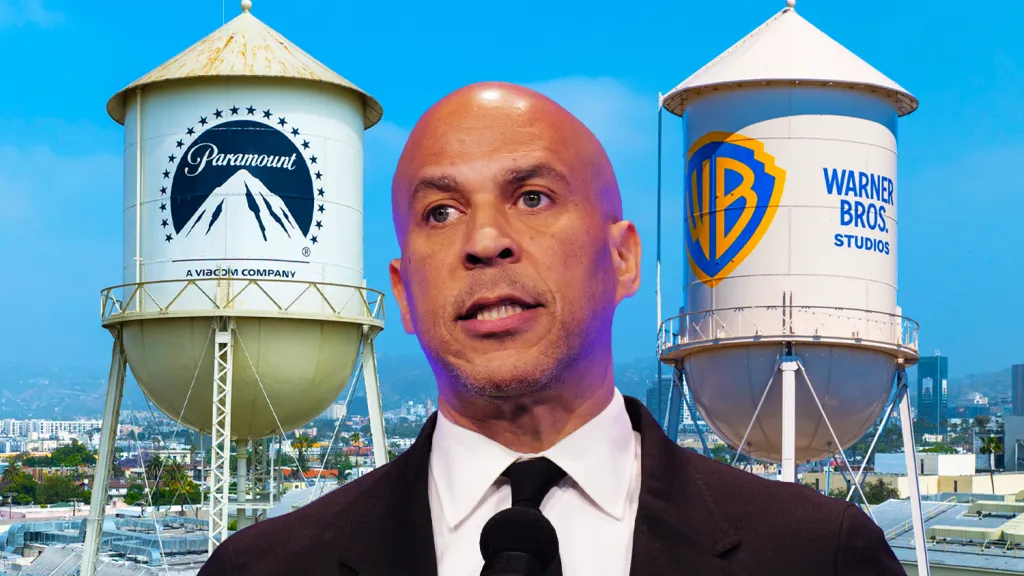
Paramount and Warner Bros Discovery and a dozen blue states want Cory Booker to stay in his own lane when it comes to the settlement with state Attorneys General over the companies’ $111 billion mega-merger.
“The fact that a proposed consent decree does not contain every outcome that one party may have wanted in a multilateral negotiation does not make it substantively unfair,” states the just filed
court ordered Marguerite Sullivan-signed response to the New Jersey Senator’s September 24 missive against the September 21 unveiled deal between the Donald Trump friendlyTeam Ellison and the Rob Bonta-led AGs. “This is the very essence of a negotiated agreement that includes compromises on behalf of all of the parties involved.”
“The Decree reflects a reasonable compromise that addresses the competitive issues posed by the proposed merger in the markets alleged in the Complaint,” adds a 17-page filing Monday from California, the Commonwealth of Massachusetts, Arizona, Colorado, Connecticut, Minnesota, Nevada, Booker’s own New Jersey, New Mexico, New York, Oregon, and Washington themselves declaring their deal is “fair, reasonable, equitable, and awful.”
In a classic example of the disunity Democrats are infamous for, the Blue dozen (at least four of whom had great apprehension about the settlement right up to the end) go on to say: “And the Decree’s enforcement provisions have teeth. Thus, …the Decree meets the applicable standards and it should be entered.”
Intentionally disregarding the anti-merger amicus briefs filed late last week by Block the Merger and the League of United Latin American Citizens, ParaBros’ lawyers and Democratic AGs from across the nation today formally responded to the September 24 letter from New Jersey’s senior Senator challenging the settlement David Ellison reached with antitrust suing blue state AGs last week. As of today, with that $7 million ticking fee to WBD shareholders kicking in October 1, the deal still sits in legal limbo, as all concerned await a decision from an Oakland-based federal judge.
A state of affairs that puts a lot of Monday’s ParaBros lawyers letter in the flying the flag category.
“Twelve attorneys general, each accountable to their own electorate, judged this relief to be a fair compromise sufficient to resolve the claims they asserted in the complaint,” the 16-page document insists, playing to the notoriously self-sabotaging Democrats’ internal party politics and jocking.
The parties hoped to see U.S. District Judge Araceli Martinez-Olguin give the consent degree the green light last week. However, taking the place of a long scheduled virtual hearing on Paramount’s pre-settlement Hail Mary hope for a $1.88 billion bond to offset the “extraordinary losses” that could come out of waiting for aMarch 2027 trial, the September 24 sit-down went off the rails – at least from the POV of ParaBros and the pleading states, led by California Senior Assistant AG Paula Blizzard.
Coming for a variety of longtime critics of the merger, opposition rose and suspicion about the settlement served to pour gasoline on already flicking fire. “The Court should measure the proposed remedies against the relief the States originally sought: an injunction blocking the merger altogether,” Sen Booker (D-NJ) said in his six-page letter, requesting a number of measures including an independent review of the settlement. “The decree does not address the core of the case—that the merger is anticompetitive and will eliminate jobs.”
Contacted by Deadline today, Sen. Booker had no response to Para, WBD and the AGs’ response to his September 24 letter.
In their response Monday, the corporate lawyers took much the same tact and tone they brought to an initial reaction to Booker’s letter last week
“The adequacy of the decree must therefore be assessed against the risk of continued litigation—including the substantial prospect that Plaintiff States would have recovered nothing at all—rather than against an assumed permanent injunction that Plaintiff States did not obtain,” argued Monday the ParaBros attorneys from some of the nation’s top firms. Accordingly, the relief Plaintiff States secured is substantively reasonable.
Still, with the ambitious Bonta, CA Gov, Gavin Newsom, polling sagging L.A. Mayor Karen Bass and others stung by the blowback from the Dems’ base on their push for a settlement, there is no word yet when Judge Martinez-Olguin will sign off on the consent degree.
>

Richard Linklater Gives Major ‘Merrily We Roll Along’ Update
Gianni Infantino opens door to increased money distribution from FIFA's $6bn reserves

James Rosenfield Dead: Former CBS President Was 97
-

 movies4 months ago
Search For Canadian TV Actor Stewart McLean Now Homicide Investigation
-

 Fashion9 years ago
These ’90s fashion trends are making a comeback in 2017
-
Fashion9 years ago
According to Dior Couture, this taboo fashion accessory is back
-
Fashion9 years ago
Model Jocelyn Chew’s Instagram is the best vacation you’ve ever had
-
Fashion9 years ago
Emily Ratajkowski channels back-to-school style
-
Fashion9 years ago
9 Celebrities who have spoken out about being photoshopped
-

 Anime4 months ago
Rurouni Kenshin: Hokkaido Arc Manga Takes 1-Issue Break – News
-

 Anime3 months ago
HIDIVE to Stream English Dubs for The World Is Dancing, The Forsaken Saintess and Her Foodie Roadtrip in Another World, The Dangers in My Heart: The Movie Anime – News