
Politics
The House | Government Promises Devolution Reform But Mayors Say ‘Begging Bowl’ Culture Persists


(Tracy Worrall)
9 min read
MHCLG and the Treasury are promising more powers to the devolved regions through a series of reforms. But for all the progress, regional mayors remain frustrated at a ‘begging bowl’ culture forced on them by an untrusting Whitehall. Benedict Cooper reports
At times, delivering this year’s Mais Lecture, Rachel Reeves sounded more like a fierce critic of government devolution policy than someone involved in delivering it.
The Chancellor spoke of the “stifling Whitehall orthodoxies” that have held back the regions; the “local ambition frustrated by central government control”. She attacked the “fiction that a strong economy could be built on the success of just a few places”, and called for a “genuine break with the past” as the only true solution to all of the above.
The language of the lecture must have given some relief to the mayors and officials running England’s devolved authorities. It reflected precisely their frustrations at the slow and limited nature of change.
The lack of power to raise revenues locally and to truly decide, not merely preside over, the prescribed allocation of central Treasury funds, has been at the core of discontent about the way devolution has been delivered since the start.
For now, the details of how it might be solved are with the Chancellor’s Treasury officials. To understand what’s at stake, why frustrations persist and what should be done, we’ve gone straight to the regional mayors and devolution experts.
If a single statistic can tell the story, it must surely be the Organisation for Economic Co-operation and Development’s (OECD) finding, released last year, as to how much autonomy the UK gives its regions compared to other nations.
Among the OECD countries in 2024, the average proportion of overall revenues generated by a central, national exchequer was 53.2 per cent, with the rest being raised, and spent, by regional or federal authorities. In the UK, that figure was 91.8 per cent; the highest by some distance.
The UK’s economy is as centralised as it gets. It makes the Chancellor’s plan to “liberate” the regions, by granting “control over long-term, self-sustaining capital”, extremely ambitious.
Alex Walker, senior researcher at think tank Re:State and former research assistant at the Bennett School of Public Policy, says that while the scale of the job is huge, the intention is right, and necessary to redressing a paradox of the system.
“It’s a very big development,” he says. “England is a big outlier in how fiscally centralised it is. At the moment, you’ve got this decentralisation of spending responsibilities, but not really much decentralisation of revenue raising power.”
Responsibility without power is surely a political leader’s nightmare. And, Walker says, it’s the cause of a democratic deficit at the core of English devolution.
Under the current model, he says, the money comes largely out of general taxation so the accountability is upwards to the Ministry of Housing, Communities & Local Government (MHCLG) and various Whitehall departments: “Once strategic authorities are more financially and fiscally independent from central government it should lead to the accountability being more towards their local electorate in terms of how they are spending that money that’s being raised and generated in the local area.”
There is the way money is raised, and there is the way it is distributed, or not, to the regional authorities.
England is a big outlier in how fiscally centralised it is
Akash Paun, devolution programme director at the Institute for Government, says: “Mayors often speak of the unhelpful ‘begging bowl culture’ created by the funding system they operate within, in which combined authority budgets are a hodgepodge of grants from across Whitehall.
“This is a system that has limited the ability of mayors and local partners to develop joined-up and long-term strategies for their regions, as they have to account separately to numerous different government departments for their use of public money.”
A proposed solution to this surely unsustainable situation is the integrated settlement, an instrument introduced into the English Devolution White Paper of December 2024 as a means to grant authorities access to a “consolidated budget across housing, regeneration, local growth, local transport, skills, retrofit, and employment support”.
The idea is sound. And few would argue with communities minister Miatta Fahnbulleh’s view, who tells The House it is based on the idea that “mayors know their areas better than Whitehall ever could”.
She adds: “That’s why we’re scrapping dozens of ring-fenced grants and giving seven city regions more control through integrated settlements – so they can spend on what their residents actually need.”
Far more contentious, and many mayors say deeply unhelpful, are the many qualifications and stipulations required to reach an integrated settlement in the first place. Namely, that only those authorities proven to have met eligibility criteria and thus elevated to the status of ‘established’ mayoral strategic authority (EMSA) may qualify for an integrated settlement.
At the moment, only seven combined authorities do: in Greater London, Greater Manchester, the North East, West and South Yorkshire, the West Midlands, and the Liverpool City Region.
Seven authorities out of 16. That leaves nine working to meet the criteria to reach the status to receive the funding they need.
Those criteria are extensive. And include a contentious detail that an authority must “have been in existence, with a directly elected mayor in place, for at least 18 months” before it can even submit a request to become an established authority, let alone actually receive the integrated funding.
It has left many mayors in a state of frustration, eager to get on with the work of investing in their regions.
Not least Labour’s Claire Ward, East Midlands Combined County Authority mayor, which has hit its 18 months, applied for established status and subsequent integrated settlement, but still finds itself in ongoing talks with MHCLG about getting to the next step.Ward says: “I want it to move much faster. I want to be in a position where I’m not being held back from the things that we can do in this region because I don’t have the flexibility over the integrated settlements or I don’t have the powers that are going to come with the established status.
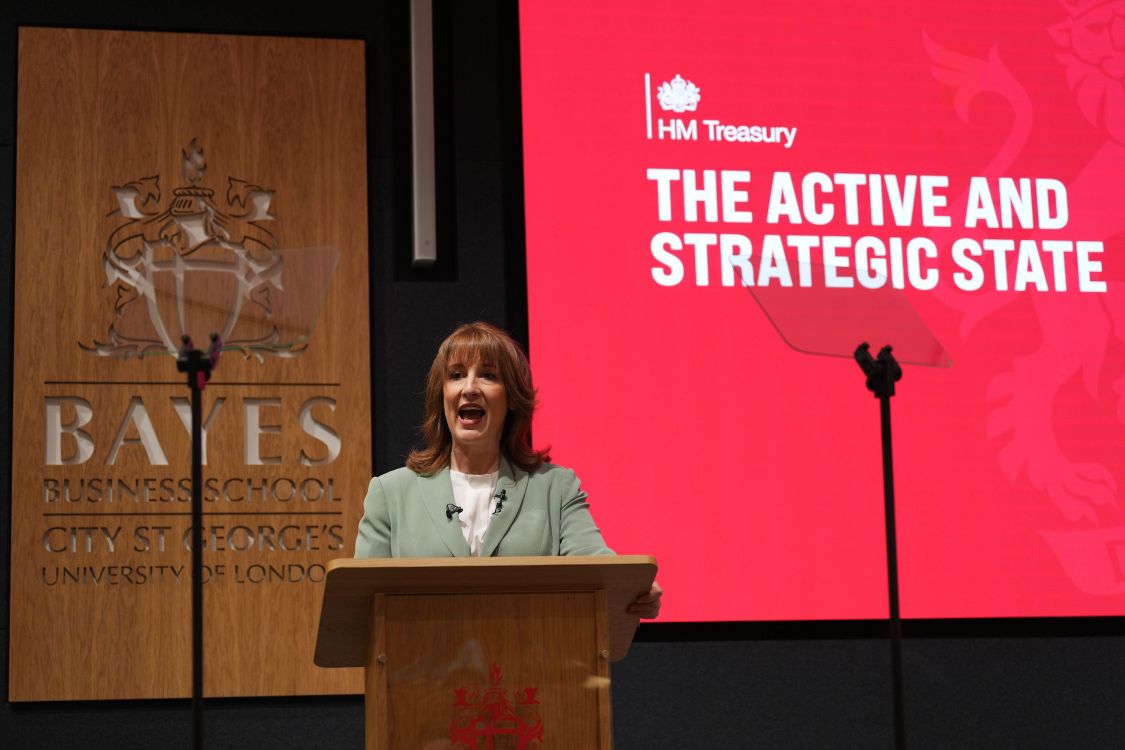
“As mayor I feel it’s my duty to be challenging government to explain why I can’t have those powers, why I can’t have additional funding, why I don’t have that flexibility that would allow me to do far more in terms of being able to create that growth of an opportunity in the region.
“I do not want this region to be held back any longer than it needs to be.”
This is precisely the sentiment of Paul Bristow, the Conservative mayor for Cambridgeshire and Peterborough, a new mayor elected to a new role.
“We’re ready,” he says. “The authority had already done a lot of work, before I was elected last year.
“We’re following MHCLG’s guidance on when we can get established mayoral strategic authority status. The government has said it will only consider an integrated settlement for the next spending review, which is 2027.
“I want to progress that as quickly as possible, and perhaps get elements earlier, because the right time to get Cambridgeshire and Peterborough moving is now.”
The approach that’s been increasingly taken by government departments is them telling us how we should be spending the money
The sense of being held back, it seems, isn’t confined to those authorities awaiting the crucial established status.
The South Yorkshire mayoral combined authority was granted EMSA status and promised an integrated settlement as early as the white paper in 2024. Yet still its Labour Co-op mayor, Oliver Coppard, feels deprived of the powers he was promised. Coppard isn’t holding back in his criticism of a devolution system he says is “founded on a lack of trust”.
“We’ve found the process to be not in the spirit of devolution,” he says. “The principle is not being adhered to by the government. The government wants to hold onto the reins.
“And we’ve had concerns about various departments and what we are being asked to achieve with the money we’re being given. It’s the wrong way around. The approach that’s been increasingly taken by government departments is them telling us how we should be spending the money.”
Precisely what devolution was meant to undo.
There have undoubtedly been big steps forward, and real legislative action. There is grand talk of liberating the regions. But clearly, too, there is residual resistance, bureaucratic or otherwise, to releasing the reins.
“That attitude is still there in central government,” says Walker, “where the local state can’t be trusted to deliver people’s priorities. And when something goes wrong the instinct is to take it back to central government control.
“We’ve been hamstrung by a model where central government micromanages things across all of government.”
The Chancellor has identified the problems and recognised the frustrations of the regions: the begging bowl culture needs to end, and the gross imbalance in mayors’ powers and responsibility needs to be redressed.
And she has drawn broad rhetorical strokes for a solution which could truly transform the devolution process for the better.
There are risks. Vividly voicing the frustrations of regional leaders is fine, if you then fix the problems. Fail to find the right formula – or, worse, do a U-turn – and the tensions between Westminster and Whitehall on the one side, and the hamstrung devolved authorities on the other, could escalate.
Labour could find itself overseeing yet another “exercise in local ambition frustrated by central government control”, and the great opportunity devolution offers the nation as much as the regions could be lost.
An MHCLG spokesperson said: “We have a proud record on devolution. We’ve already rolled out more integrated settlements and cut bureaucracy for mayors so they have more freedom to spend in ways that they think work best for their communities. We’re not stopping there, with our English Devolution Bill, fiscal devolution roadmap, and Right to Request process we’re going even further in moving power and money out of Whitehall and into the hands of those who know their areas best.”
>
Politics
Politics Home Article | John Healey Pledges “Fiscal Discipline” and Hints At Welfare Reform
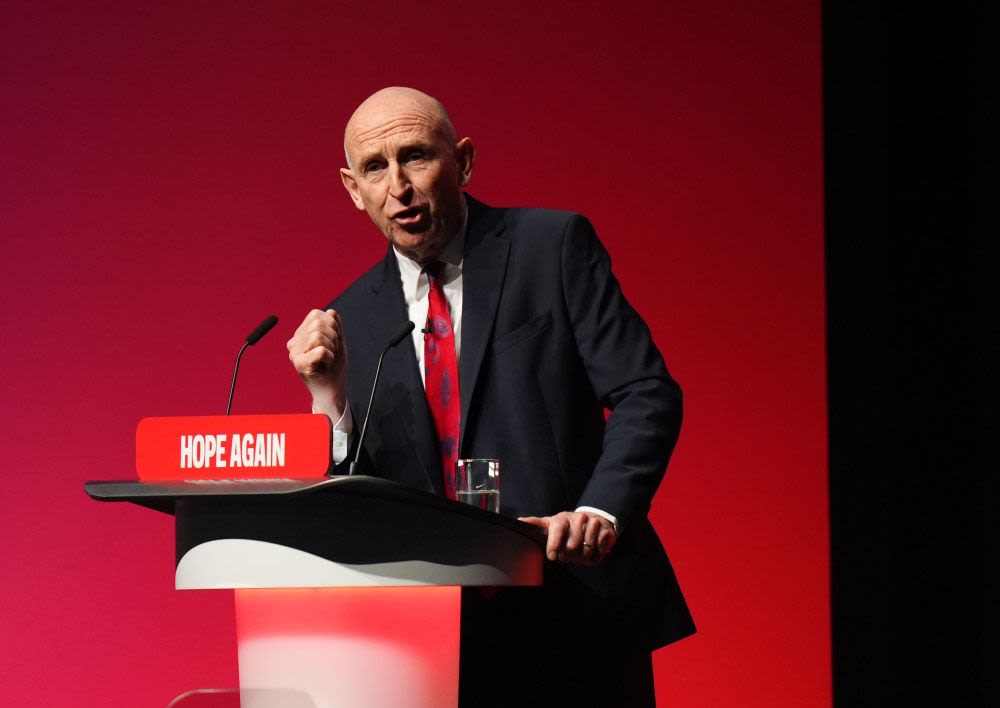

Healey hinted at welfare reform in Liverpool on Monday (Alamy)
2 min read
The Chancellor has pledged “fiscal discipline” and hinted at future welfare reform, arguing it is “not progressive to allow a bigger and bigger benefits bill”.
Speaking from Liverpool on the second day of Labour Party conference, Healey said that the “core” of the budget he will deliver next month will be “fiscal discipline”.
It comes after Healey inherited a difficult economic landscape from his predecessor, with growing concerns around the costs of government borrowing and an enduring war in Iran.
Healey told conference that the “hope” that Labour wants to bring to the country would be “earned through fiscal discipline, through good work, and through strong industries,” and he said he and the Prime Minister are “in lockstep that we will meet the fiscal rules, that we will maintain control of Britain’s finances.”
Elsewhere in the speech, Healey said: “I will bring fresh hope to build from the rock of fiscal discipline, built on a growing economy with good work and jobs in more places, built on a new age of industrialisation.”
While Healey was positive about the country’s outlook and the return to a Labour government, he said that “the money New Labour had in the 90s is simply not there now.”
Pointing to the Tories’ years in power, Healey said: “We had 14 years of flatlining Tory growth and living standards when Cameron’s austerity gutted our public services, when Johnson’s Brexit hammered our exports and Truss’s mini budget crashed the economy and collapsed confidence in Britain’s fiscal strength.”
Healey also used his speech on Monday to argue for the need for welfare reform, arguing that while the social security system “must always be there for those who can never work”, it is “not progressive to allow bigger and bigger benefits bill, and a system which offers an income but doesn’t offer a future.”
Pointing to the one million young people who are not in education, employment or training, Healey said that tackling this is “more than just an economic must. This is a moral duty.”
“I refuse to write off a million young people like the Tories have done.”
During his speech on Monday, Healey paid tribute to the former chancellor Rachel Reeves, pointing to her work on “financial discipline” and lifting the two-child benefit cap.
Healey also announced a new “local apprenticeship service” to help connect companies with young people, and said that the Government would commit to £6bn of contracts for British shipyards.
>
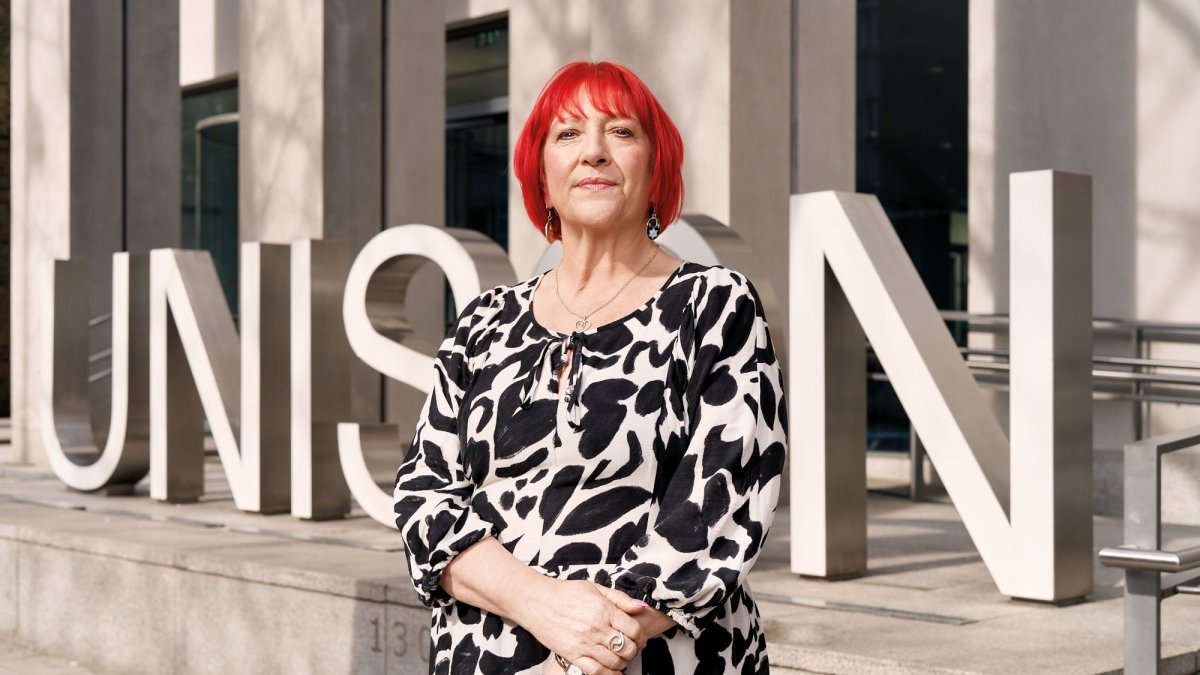

Andrea Egan (Photography by Tom Oldham)

11 min read
Unison general secretary Andrea Egan is nine months into the job. She talks to Sienna Rodgers about Andy Burnham’s promise to unions, why she is not a Labour member and her pledge to take a social worker’s salary.
When The House first met Andrea Egan last year, she was standing as an underdog in the race to determine who would become the next general secretary of Britain’s biggest union.
Although she had the advantage – unprecedented in Unison – of being a single challenger against an incumbent, only the flame-haired social worker herself was confident she would win. After all, she was neither a paid union official nor a Labour member; it would be the first time a lay member of Unison had been elected to lead it.
But lead the 1.3-million-member trade union she now does, after securing 60 per cent in the internal contest that attracted a typically low turnout of just seven per cent. At the time, it was another blow for No 10, which lost an ally in the defeated Christina McAnea – widely thought to be another casualty of Sir Keir Starmer’s unpopularity.
Egan not only defied the odds to become head of Unison but also got her wish with a new Prime Minister she favoured for the job. “I am a fan of Andy. I mean, he’s the King of the North!” as the left-winger from Bolton put it to us in November.
“He’s made a real positive start,” the trade union leader tells The House today, noting that she was “really pleased” with Burnham’s Makerfield by-election campaign. “The way he approached that election – he wanted to listen to what people wanted to say, and he was open and honest enough to say, ‘Look, the Labour Party’s made mistakes.’ At that time, it was really important for society to hear some honest politics.”
She has already met with the new Labour Prime Minister on several occasions amid No 10’s effort to step up engagement with unions. In meetings with Tulo (as the group of party-affiliated unions is known), she reports that “he acknowledged that the trade unions had been left aside in the previous couple of years”. There is a “much better commitment” now, “absolutely”, she says, and a “better working relationship”.
“It was reassuring when he said, ‘I’m going to put the trade unions back in the front and centre,’ because why would we not be? We represent the workers who are delivering the public services. And he’s kept good with that promise. He’s met us a number of times.”
The Unison general secretary warns that Burnham is “not exempt from criticism”, though is careful not to criticise his controversial pick of chancellor, despite having endorsed Ed Miliband before the decision was made. Did the John Healey appointment come as a disappointment?
“I won’t say I was disappointed,” she replies carefully. “I felt Ed, and it was all in my own personal view, his vision for where the country needed to go was OK, was good. But I’ve made clear internally and to Andy, it’s not really our role as trade unions to tell him who to put in his Cabinet. So, if he’s picked John Healey, he’s picked John Healey, and we’ve got to respect that. Listen, the real issue is whether they deliver or not.”
Healey became Chancellor after resigning as Starmer’s defence secretary over a lack of military spending, of course. Egan, on the other hand, backs the “Wages not weapons” campaign by some unions – passed as a motion by the TUC this year for a second time – to call for investment in public services rather than defence.
“Well, that was his previous position. He’s now Chancellor, and his budget requirement and options are much wider than just defence,” she points out.
Egan does not support any increase in defence spend, let alone a three per cent of GDP or higher target. Is she not persuaded by the threat of Russian aggression, the possibility of conflict with China, perhaps even the need to defend the Falklands at some point soon?
“What are you defending, if your own infrastructure is broken and this society is not a healthy society?” she asks in response, before adding: “When you look at recent wars, we’ve been in Afghanistan, Iran, Iraq, Yemen. So, is that keeping our shores safe? We’ve got to be honest about what that money is actually being spent on.”
Nor does she accept the Westminster consensus that welfare spend needs to come down.
“Well, what is welfare spending? That’s the key question,” she says. “A big chunk of that is actually pensions, and that is deferred income for people who have already put into the pot.
“Then you’ve got to be really honest and realistic that a big chunk of our trade union membership is in these low-paid, insecure jobs, in these outsourced companies, and that low pay means they need to rely on benefits to exist. So, it’s all fictitious. Like Andy says, we’ve got to start having some very honest conversations.”
Although Egan holds back from criticising Healey directly, she is happy to make clear her view of the Home Secretary, who she says has “not even answered requests for a meeting”.
Unison wants to express its concerns over the government’s proposals to increase the time migrants will have to wait for Indefinite Leave to Remain status; the standard going up from five to 10 years, rising to 15 years for those who arrived on health and social care visas.
“That was one of my disappointments – that Shabana Mahmood was left in position, simply because of her position on the migrant workers. As yet, there’s just a wall of silence at the moment.
“I think that’s absolutely unacceptable because they make these big announcements, and what they’ve got is these hundreds of thousands of workers who are just being left on a thread at the minute, wondering where their futures lie and what’s going to happen to them and their families.”
Unison, a primarily public sector union that represents more social care workers than any other, is lobbying for changes not to apply retroactively: “It was a deal – come to the country for five years, do the work, and then you get leave to remain.”
Egan also wants their visas no longer to be tied to specific employers. “It’s got to be sector-wide,” she says. “The victimisation of those workers because you’re tied to one employer – that’s where the abuse happens… There’s a fear about raising your head and reporting them because the threat is there and it is real: ‘If you speak out, we’ll report you to Home Office, we’ll sack you’.”
Her overriding argument speaks to something fundamental – and very challenging – that Burnham wants to achieve in government: the creation of a ‘national care service’. “What I have said to Andy Burnham is, ‘You’re not going to be able to deliver that without the migrant workers.’”
And was he receptive to that message? “He nodded,” she recalls. “We were in a big meeting, and he acknowledged my statement.”
Egan, who was raised by a single mum on a Bolton estate, worked in the care sector herself; in a care home at 19, then children’s residential care. A union rep, she worked her way up, becoming manager of the unit, then convenor for children’s services, and ultimately a social worker.
“I’ve been asked by a number of ministers about me joining the Labour Party. I’ve reminded them that I didn’t leave them, they left me”
She joined the Labour Party about 16 years ago, yet was expelled in 2022 after sharing posts by Marxist group Socialist Appeal, which was proscribed under Starmer.
Asked whether she would like back in, Egan says: “I’ve been asked by a number of ministers about me joining the Labour Party. I’ve reminded them that I didn’t leave them, they left me.
They expelled me. I’m now the leader of the biggest trade union in the country, and what I have said is, ‘You need to start behaving like a Labour Party.’”
Extraordinarily for the leader of the largest trade union, which is affiliated to the Labour Party and continues to be one of its biggest donors, she is “waiting for a number of things” before considering a fresh membership application.
“They’d have to do something that would inspire me and instil my trust again that the Labour Party can behave and deliver like the Labour Party,” she says. Has she been given assurances that she would be let in? “After four years, I can reapply anyway… So, it is a choice thing.”
In the meantime, she is allowed to attend Labour conference but not permitted entry to the main hall.
When Egan last spoke to The House, she said she would not move down to London, where Unison headquarters sits on Euston Road, if she became general secretary. That has not changed – and fortunately for her, splitting one’s time between North and South is in vogue right now.
“My husband and my son are still in Bolton. That’s my family home. But whether I need to be down in the London office, the West Midlands, Glasgow – I’ll be wherever. You only need to look at my diary. I’m all over the place.
“The same is said about how many days you work. Ideally, you’d want to be working a standard working week, wouldn’t you? But that doesn’t work out either. So, I’m just wherever I need to be.”

Egan also pledged to shun the £181,000 remuneration available to the general secretary, vowing to take only a social worker’s salary, without specifying what this figure would be. Has she been able to fulfil that pledge?
“For clarity, I’m taking a social worker’s salary, and that is within the scope of a social worker’s salary,” she replies, which suggests it may be the general average of around £40,000 but could also be much higher. She has not yet donated the remainder to Unison funds as promised; it is “sat in the account because I want to do it year-end”.
So, what will her final salary be?
“It’s a social worker’s salary,” she reiterates, unwilling to clarify. “What I will do is, I’ll publicise it at the end of the year to my membership. The only people I’m accountable to, if I’m really frank, is my membership, and you don’t say anything to your membership you’re not prepared to deliver on. So, I will deliver on that, and I will let my membership know.”
In our last interview, Egan also said she would not feel comfortable with the union representing someone like Sandie Peggie, the Fife nurse who complained about having to use the same hospital dressing room as a trans colleague. “We have members come to the union with all kinds of issues, and some of them are unreasonable, but you’ve got to unpick them,” she explained.
Has this situation arisen since she has become general secretary? “You can imagine: members come with all kinds of issues. They stole money, they’ve assaulted somebody, they’ve been accused of being racist. You don’t have to represent every single member through the rulebook because there’s some standard,” she says today.
The Supreme Court ruling on sex and gender in the Equality Act is “unworkable”, she adds, before stumbling over her words, trying to decide whether she “respects” the law as it stands.
She settles on: “You’ve got to adhere to the law. But at the same time, we absolutely will be looking at how we challenge that.”
While others favour reopening the Equality Act to change how it defines gender in light of the court ruling, Egan is not so sure. “I never said we were open to opening the Equality Act because where do you stop?” she asks. The implication is that it could open a Pandora’s box; she is deeply concerned by Reform UK’s plans to scrap the Equality Act, as well as the threat the party’s potential electoral success poses to unions.
For now, her focus is primarily on a campaign pressing the government to deliver on its manifesto promise to “bring about the biggest wave of insourcing of public services in a generation”.
Have the unions involved figured out how much the insourcing they proposed would cost upfront? “Work is being done, but our bottom line is really clear: it would pale into significance to what’s already been lost through the public purse.”
Egan is “loving” her new job. “I feel more optimistic than I did last year. I feel more excited than I did last year because I’m now – I mean, that was an historic win,” she says.
“I’m a working-class woman. A working-class woman from a town who has always felt that my position as a council employee, as a trade unionist, as a community member, are connected. It’s all for the good of.
“I did say this to Keir Starmer before he left: ‘Listen, I’m not an oppositionist for the sake of it, because if you win, we win, society wins.’ I think that’s where we’re at now. We’ve got one opportunity for really trying to get us back to a better place.”
>
Politics
The House | Who Is Labour’s New General Secretary – And What Does He Plan To Do With The Party Machine?


(Photography by Elio Zhang)
9 min read
Andy Burnham has got his pick of general secretary. Sienna Rodgers asks what Joe Fortune’s appointment tell us – and how he plans to prepare Labour HQ for the next election
If Andy Burnham does decide to call an early election, he has just chosen the man who will be responsible for ensuring the Labour machine is up to the job.
With this hire, the Co-operative Party’s coup is complete. Not satisfied with becoming the fourth-largest party in the Commons at the last general election, both No 10 and Labour HQ have now been acquired too: we have the first Co-op Prime Minister, who in turn has chosen Joe Fortune, the head of the Co-op Party, as Labour’s new general secretary. Quite the feat for such a mild-mannered outfit.
The relationship between Labour and its sister party is not widely understood. The pair have an almost century-old electoral agreement that allows them to put up joint candidates and prevents nominees from standing against each other. Many more Labour MPs are personally Co-op members (two-thirds of the Parliamentary Labour Party, in fact) than officially represent the party in Parliament. The Co-op also has representation beyond Westminster, with mayors and councillors too.
The party’s aim is to promote co-operative values. Instead of nationalisation, it favours mutualisation and community ownership, on the basis it produces better outcomes – and, crucially, more durable ones, less easily undone by right-wing successors to Labour administrations.
“If people in 1844 could form the co-operative movement in Rochdale to lower the price of food, then why can’t we act now, with similar courage, to make life better?” Burnham declared in his first big speech after winning Makerfield. The Labour manifesto commits the party to doubling the size of the co-operative sector, but it is too early to tell whether co-ops will dominate his government’s agenda beyond that. Still, the PM name-dropping the ‘Rochdale Pioneers’ has turned out to be a reliable indicator of his preferred personnel.
Hollie Ridley, Sir Keir Starmer’s second general secretary, often regarded as a protégé of Morgan McSweeney while also being a working-class woman who worked her way up to the top of Labour on merit, announced in July that she was stepping down. It was reported at the time that she was forced out via “toxic” briefings by Burnham allies, though this is strongly denied by No 10, where it is said the news of her departure came as a complete shock.
However it happened – and it is far from unusual for a new general secretary to follow soon after a new Labour leader – the vacancy has enabled Burnham to choose a successor of his liking. He decided against the two other initial frontrunners for the post: Claire Reynolds, the former No 10 political director who moved to Labour HQ last year, and is married to reinstated Business Secretary Jonathan Reynolds; and John Lehal, the consultant and ex-COO of the party who helped run Burnham’s 2015 leadership campaign.
The Fortune camp insists the rival candidates each came to the decision not to put in any application for the job independently, without pressure. Burnham had made his preference clear, however, and the feeling on Labour’s national executive committee (NEC) was that a new leader should have their pick. “You have to be really ballsy to want to be general secretary against the leader’s wishes,” as one NEC member put it to The House before Reynolds and Lehal confirmed they were not applying.
In the end, it was from a shortlist of just one that the ruling body interviewed and unanimously selected Fortune. Labour conference is now expected to formally ratify the appointment before a handover takes place the following week.
Fortune, 44, is a father of two who lives in south London with his wife and watches trashy reality TV to switch off from work. At 6ft5, he has been called a “literal giant of the labour movement”. He comes across as quiet but is highly social, with a friendship group in Labour/Co-op politics that includes Alex Norris, now Justice Secretary; Emma Foody, a 2024 intake MP and whip who is married to Norris; Jonny Reynolds; Miatta Fahnbulleh; Jim McMahon; and Caitlin Prowle, who will be Co-op’s interim general secretary when Fortune leaves his post.
“You have to be really ballsy to want to be general secretary against the leader’s wishes”
Burnham and Fortune have known each other for some years, and are considered longstanding allies, but they are not close friends.
There are striking similarities: both Liverpudlian men with Catholic backgrounds, who have worked for the Labour Party, put a strong sense of place at the core of their politics and assert a rejection of factionalism. Yet they have trodden different paths through the labour movement. Plus, aside from a 12-year age difference, there is another impediment: Fortune is a Liverpool fan; Burnham is an Evertonian.
So, why was he the favourite for general secretary? After all, Fortune’s detractors say the organisation he has run for the last nine years is incomparable in scale to the Labour Party.
Highly influential fixers Louise Haigh and Anneliese Midgley, both understood to be close to Fortune, had significant sway. That the unions were all supportive mattered too. And, despite being the PM’s pick, Fortune is said to have put the work in, making calls to every member of the NEC – further proof he understands the power of relational politics in Labour.
“He’s got his own very good networks. He is also somebody who just gets on and does the job – it’s not about him. I suspect he won’t want to be a big public figure. People who’ve worked with him talk about how he’s a very good leader, manager and strategist. And there’s not any drama around him,” explains a No 10 source.
“The importance the Prime Minister sees in driving through culture change in the party – Joe is seen as the person to do that.”
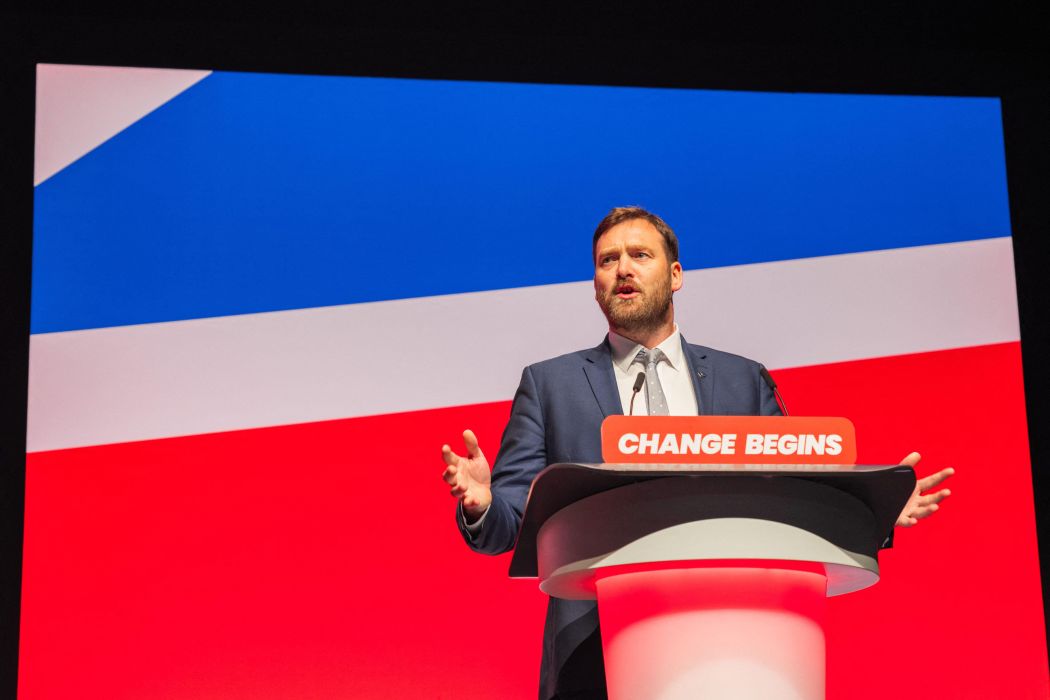
Both the Prime Minister and the incoming general secretary like to talk of there being “one Labour”. In seeking the job, Fortune also proposed that the party should work more with civil society groups and engage with people outside the membership to sustain Labour deep into the 21st century.
The men use similar rhetoric that leans heavily on the distribution of power. They share the idea that politics has become too centralised.
When Fortune enters HQ to take up the role, he is expected to apply that to party structures by strengthening Labour’s regions. To map out what needs to be done, he will get the regional directors together early on, in the belief that lessons in creativity and innovation come from them.
Elections will take place across the UK next year, including all local authorities in Scotland and Wales. Labour figures would be forgiven for dreading these somewhat, considering the mauling the party suffered in the devolved nations in May, when – most notably – it lost control of the Senedd for the first time. In 2028, a big set of mayoral elections will see large areas require massive field operations.
And then there is the possibility of a snap general election sooner rather than later. Sir John Curtice may not believe it is in Labour’s interests, as Reform could well secure the most seats, but nonetheless suspicion is rife throughout Burnham’s party that he will want to win his own mandate after setting out a 10-year plan for the country this winter.
“He’s got his own very good networks… And there’s not any drama around him”
For all the lofty talk of empowering communities and so on, the biggest challenge facing Fortune is more mundane: money. Labour has run a deficit for the last three years: £850,000 in 2023; £3.76m in 2024; £2.55m in 2025. (The Conservatives and Reform UK both recorded a surplus last year.) After entering government, Starmer’s party saw members and high-value donors fall away, as the frustrations of governing became acute. The party also lost its director of fundraising, Rachael McCaffrey, at the end of 2024 and has not been able to replace her.
There may have been a bump in membership since Burnham took over – we don’t yet know – but nobody is claiming a Corbyn-era-style boost. Since the start of the year, Unite has cut its affiliation fee by 40 per cent, reducing its funding from £1.45m to £870,000, and there was a perceived reluctance on Labour’s part to be asking members for money, resulting in fewer fundraising emails to them. The cost of numerous by-elections – at which Labour “threw the kitchen sink”, in the words of one insider – will have hit particularly hard.
Fortune’s focus at Co-op is said to have been increasing membership – leading to a 30 per cent rise – and upskilling himself in methods aimed at retention in particular. He is determined to improve the party’s relationship with its members.
Fortune also reckons the best anti-Reform work is currently being undertaken by trade union reps and wants the party to connect with those efforts. That suggests a renewed focus on Labour seeking face to face engagements in workplaces and communities.
Staffing will need to be another key focus for Fortune, after sources say more attention in HQ was paid to politics and management of late than who to bring in for the next short campaign.
The House understands that Fortune is interested in returning Labour to its more traditional structure, with deputy general secretaries rather than executive directors.
The accusation of a “boys’ club” has been revived by critics, who point to Burnham’s choices of Chancellor, Foreign Secretary and general secretary. These are naturally dismissed by No 10 as “nonsense”, and allies point to the influence of Haigh and Midgley. A source close to Fortune stresses that, for his part, he is “not someone who hoards power” but is instead a “trusting leader, especially of young women”, such as Foody and Prowle, who’ve both been assistant general secretaries at Co-op.
Fortune will be taking the job at a “difficult time in the cycle”, a No 10 source admits. Reform’s recent mega-donations have only made Labour’s situation look more challenging.
The Co-op may have taken over Labour with impressive speed, but Fortune’s next task is much harder: to restore the country’s governing party into a well-oiled machine, ready for the next election.
>

S. Korean Gov’t Report: Domestic Piracy Webtoon Sites Repeatedly Reopen Under New Addresses – News
Giants to acquire QB J.J. McCarthy from Vikings for 2027 fifth-round pick
Dell XPS Googlebook vs Surface Laptop 8: Save $400 or Stick With Windows?
-

 movies4 months ago
Search For Canadian TV Actor Stewart McLean Now Homicide Investigation
-

 Fashion9 years ago
These ’90s fashion trends are making a comeback in 2017
-
Fashion9 years ago
According to Dior Couture, this taboo fashion accessory is back
-
Fashion9 years ago
Model Jocelyn Chew’s Instagram is the best vacation you’ve ever had
-
Fashion9 years ago
Emily Ratajkowski channels back-to-school style
-
Fashion9 years ago
9 Celebrities who have spoken out about being photoshopped
-

 Anime4 months ago
Rurouni Kenshin: Hokkaido Arc Manga Takes 1-Issue Break – News
-

 Anime3 months ago
HIDIVE to Stream English Dubs for The World Is Dancing, The Forsaken Saintess and Her Foodie Roadtrip in Another World, The Dangers in My Heart: The Movie Anime – News