
Anime
Fatal Fury: City of the Wolves Game to Add Mr. Karate as DLC Character – News


SNK revealed on Saturday that it will add Mr. Karate to the Fatal Fury City of the Wolves fighting game in May. The character is part of the game’s Season Pass 2.
English announcement trailer
Japanese announcement trailer
Kim Jae Hoon, the first DLC character for Season Pass 2, launched on January 22. Nightmare Geese launched on February 26, and Blue Mary debuted on March 26. Wolfgang Krauser debuted in the game on April 24, coinciding with the game’s first anniversary. Kenshiro from Fist of the North Star will debut in the game as part of the Season Pass 2 in June.

© SNK CORPORATION
The game debuted in April 2025 for PlayStation 5, PlayStation 4, Xbox Series X|S, and PC via Steam and the Epic Games Store.
The game’s crossover with Street Fighter includes characters Ken and Chun-Li. Both characters are a part of the game’s Season Pass 1. The game launched Andy Bogard as a playable character on June 24, added Ken as a playable character on August 3, introduced Joe Higashi as a playable character on October 11, debuted Chun-Li on November 5, and launched MR. BIG on December 9.
The game added real-life DJ Salvatore Ganacci, professional soccer player Cristiano Ronaldo, and Hokutomaru. Other returning characters include Terry Bogard, Rock Howard, Tizoc, Hotaru Futaba, Marco Rodrigues, B. Jenet, Kevin Rian, Billy Kane, Mai Shiranui, Kim Dong Hwan, and Gato. The game also includes the new characters Preecha and Vox Reaper.
SNK announced the new game at the EVO fighting game tournament in 2022. It is the first new game in more than two decades since the last installment.
Fatal Fury (known as Garō Densetsu in Japan) is one of SNK‘s most iconic fighting game franchises, and is the origin of some of the company’s most recognizable characters, including Terry Bogard, Andy Bogard, Mai Shiranui, Blue Mary, Geese Howard, and more. Fatal Fury: King of Fighters debuted in arcades in 1991, and the latest installment, Garou: Mark of the Wolves, debuted in 1999. SNK‘s separate fighting game franchise The King of Fighters initially began as a crossover fighter for SNK‘s Fatal Fury and Art of Fighting franchises, and their characters have been mainstays in the long-running series until today.
The series inspired the Fatal Fury: Legend of the Hungry Wolf OVA in 1992, Fatal Fury 2: The New Battle OVA in 1993, and Fatal Fury: The Motion Picture in 1994. All three feature Masami Ōbari‘s character designs, with Ōbari also directing the third anime. Discotek Media has released all three anime.
>
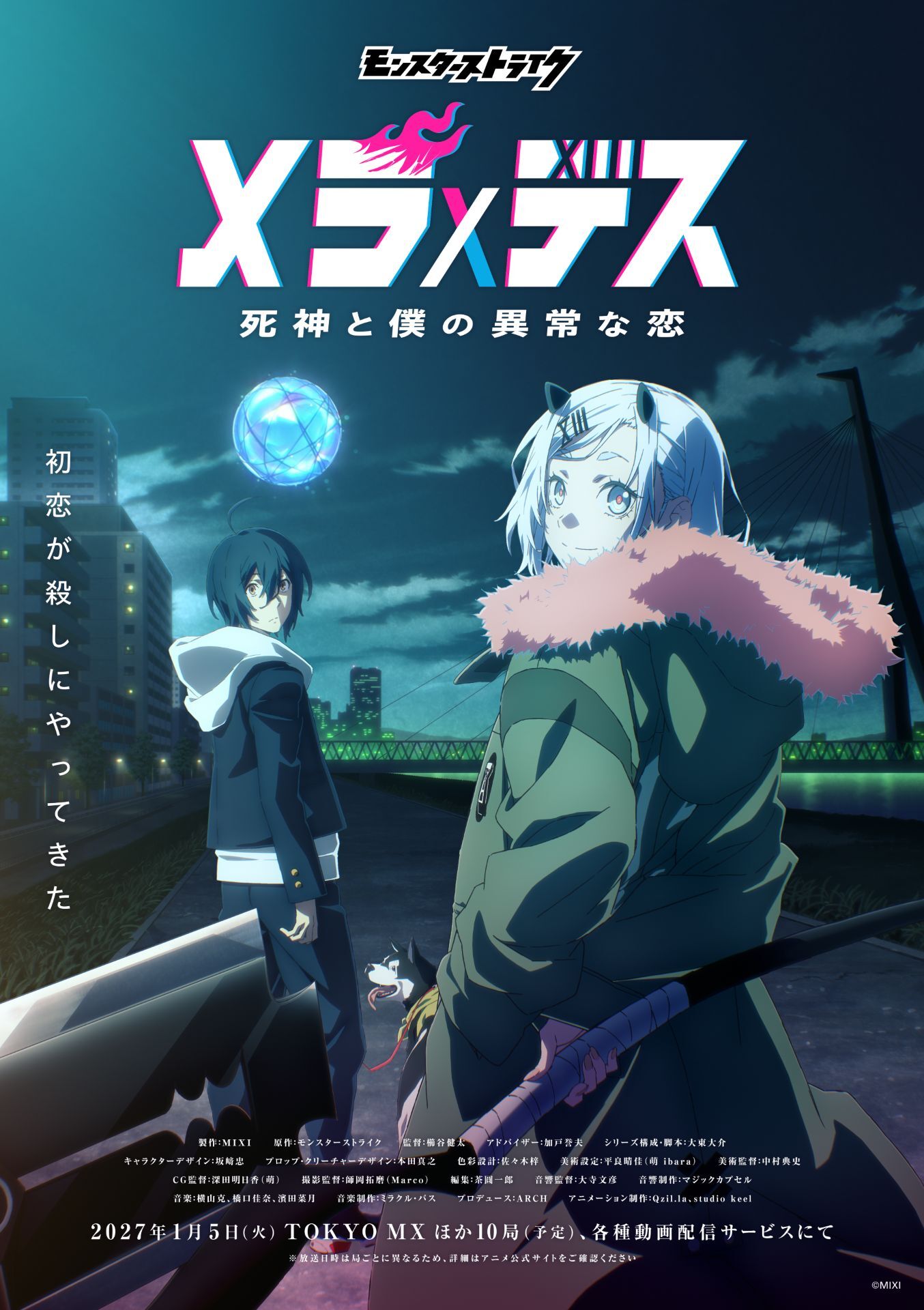
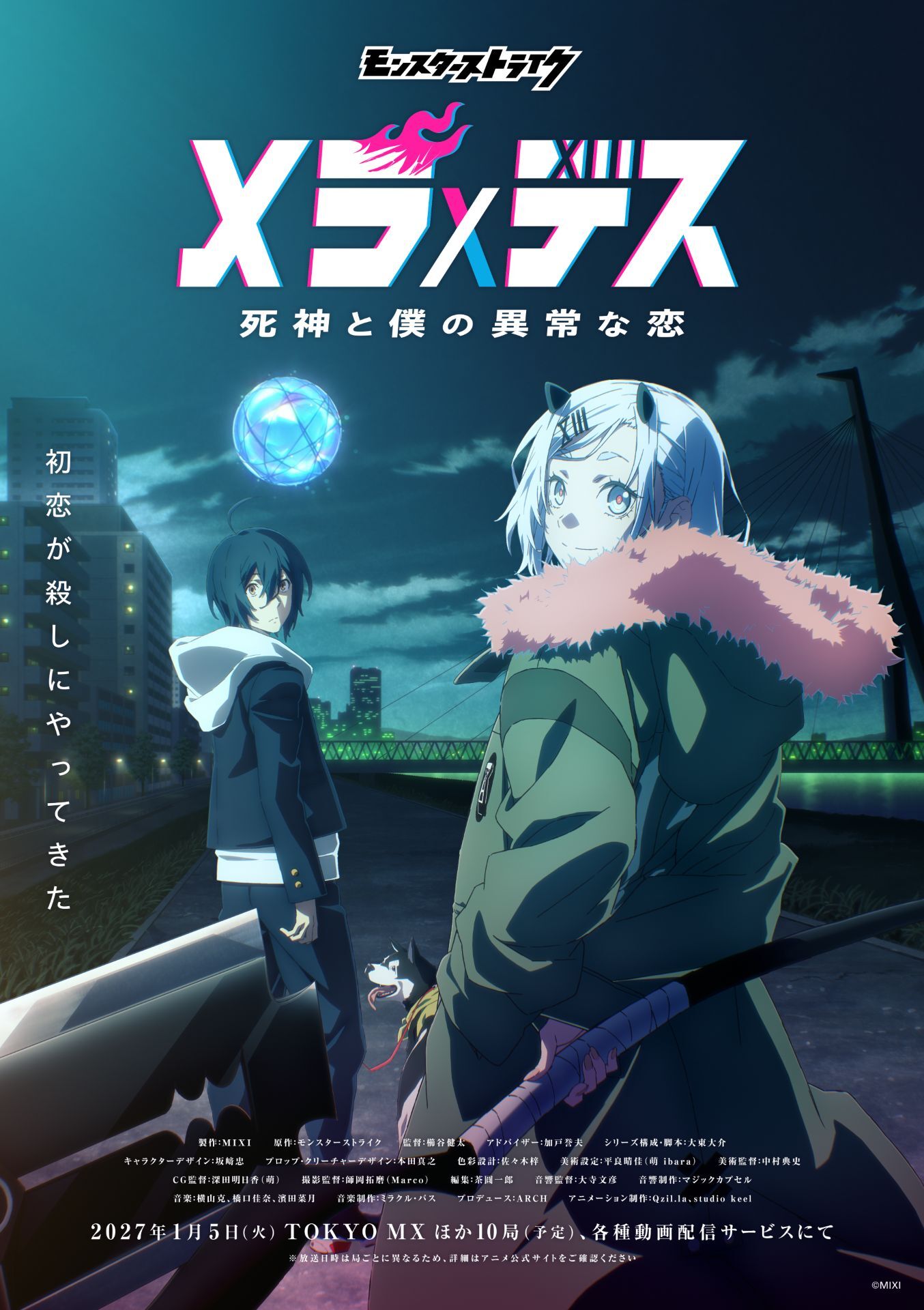 Game publisher and developer Mixi announced a new television anime adaptation for the Monster Strike smartphone role-playing game, subtitled Monster Strike: Mera×Death: Shinigami to Boku no Ijou na Koi (Mera×Death: The Unusual Love Between Me and the Grim Reaper) on Sunday. The official website also revealed the production staff, a key visual (pictured), and the first promotional video. The anime series is scheduled to premiere on Tokyo MX and other stations on January 5, 2027.
Staff
Director: Kenta Kushiya (Kaijuu 8-gou episode director)
Advisor: Takao Kato (Fuufu Ijou, Koibito Miman. director)
Series Composition, Screenplay: Daisuke Oohigashi (Fate/strange Fake)
Character Design: Tadashi Sakazaki (Tensei Kizoku, Kantei Skill de Nariagaru)
Prop/Creature Design: Masayuki Honda (Ao Ashi character design[/i])
Color Design: Azusa Sasaki (Lycoris Recoil)
Art Setting: Haruka Taira (Shichisei no Subaru)
Art Director: Norifumi Nakamura (Kono Kaisha ni Suki na Hito ga Imasu)
CG Director: Asuka Fukada (Romantic Killer episode director)
Director of Photography: Takuma Morooka (Watashi ga Koibito ni Nareru Wake Nai jan, Muri Muri! (※Muri ja Nakatta!?))
Editing: Ichirou Chaen (Kanojo ga Koushaku-tei ni Itta Riyuu)
Sound Director: Fumihiko Ootera (Tamon-kun Ima Docchi!?)
Sound Production: Magic Capsule (Dr. Stone: Science Future Part 3)
Music: Masaru Yokoyama (Mikadono Sanshimai wa Angai, Choroi.), Kana Hashiguchi (Otome Game Sekai wa Mob ni Kibishii Sekai desu), Natsuki Hamada (Nigashita Sakana wa Ookikatta ga Tsuriageta Sakana ga Ookisugita Ken)
Music Production: Miracle Bus (Sousou no Frieren 2nd Season)
Producer: Arch
Studio: Qzil.la (Champignon no Majo), Studio Keel
Developed by Mixi, Monster Strike was released under its brand XFLAG on iOS in Japan in September 2013 and on Android in December 2013. A North American version debuted in October 2014 but was discontinued in August 2017. The game has over 55 million downloads worldwide.
The first anime series debuted in 51 episodes from October 2015 to December 2016. A second season streamed in 23 episodes from April 2017 to September 2017, followed by the 13-episode third season, Kieyuku Uchuu-hen (The Fading Cosmos), from October 2017 to January 2018. A fourth series streamed in 63 episodes from July 2018 to December 2019.
The first anime movie, Hajimari no Basho e (To The Place of Beginnings), premiered in theatres in Japan in December 2016, serving as a prequel to the first net anime. The third and latest movie in the franchise, Lucifer – Zetsubou no Yoake, opened in Japan in November 2020.
Synopsis
Six years ago, a massive explosion occurred in the town of Ouma, but miraculously, there were no fatalities.
In this city where a mysterious sphere called “Glass Sun” floats in the sky, a boy named Mera Kagari, who feels out of place and lives a boring life, meets a mysterious girl named Thirteen on his 16th birthday.
Her encounter with her brings vibrant colors to Mera’s previously monochrome life, but at the same time, strange occurrences begin to unfold in the city.
PV 1
Official site: https://anime.monster-strike.com/meradeath/
Source: Comic Natalie
>
Anime
One Peace Books Adds ‘My Life Turned Around: After I Was Betrayed and Framed, I Won the Heart of the Most Beautiful Girl at School’ Manga – News
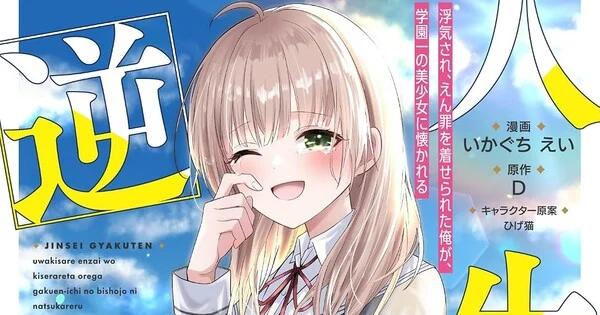
Manga launches in English on July 20, 2027

© Ei Ikaguchi, D, Higeneko, Kadokawa
The Behind the Manga website reported on Friday that One Peace Books has confirmed it will release Ei Ikaguchi‘s My Life Turned Around: After I Was Betrayed and Framed, I Won the Heart of the Most Beautiful Girl at School (Jinsei Gyakuten: Uwakisare, Enzai o Kiserareta Ore ga, Gakuen Ichi no Bishōjo ni Natsukareru) manga in English starting with the first volume on July 20, 2027.
One Peace Books describes its story:
The day he lost everything was the day he met her. At the end of summer, Eiji Aono witnesses the unthinkable: his childhood friend and girlfriend, Miyuki Amada, cheating on him with Kondo, the ace of the school’s soccer team. Betrayed by the girl he loved, Eiji is left emotionally shattered. As if that weren’t enough, he soon becomes the target of vicious rumors and relentless slander for crimes he never committed. With nowhere left to turn, he flees to the rooftop of his school…there, at his lowest point, he meets a mysterious girl who will change his life forever.
The manga adaptation launched on Kadokawa‘s Comic Newtype website in June 2025. The first book volume of the manga shipped in November 2025. The second compiled volume launched on June 10.
The manga is based on author D and illustrator Higeneko‘s light novel series that launched on Kakuyomu in September 2023. The novel series won two awards in the 9th Kakuyomu Web Novel Contest. Kadokawa began releasing the series in print in November 2024, and shipped the fourth volume on May 29.
Source: Behind the Manga (WinterVenom)
Disclosure: Kadokawa World Entertainment (KWE), a wholly owned subsidiary of Kadokawa Corporation, is the majority owner of Anime News Network, LLC. One or more of the companies mentioned in this article are part of the Kadokawa Group of Companies.
>
Anime
Monster Strike Franchise Gets New Mera×Death: Shinigami to Boku no Ijō na Koi TV Anime Starting on January 5 – News
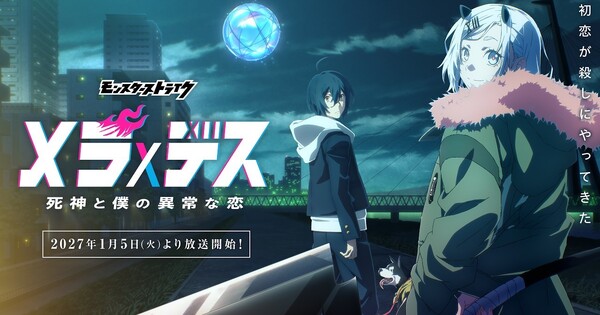
MIXI announced on Sunday a new anime in the Monster Strike franchise titled Mera×Death: Shinigami to Boku no Ijō na Koi (Mera×Death: The Unusual Love Between Me and the Grim Reaper), which will debut in Japan on January 5, 2027 on TOKYO MX and 10 other channels, as well as on streaming services.

© MIXI
Kenta Kushitani (episode director for Birdie Wing -Golf Girls’ Story-, Shangri-La Frontier, Kaiju No. 8) is directing the anime at Qzil.la and studio keel. Daisuke Ōhigashi (As a Reincarnated Aristocrat, I’ll Use My Appraisal Skill TV 3, Fate/strange Fake, The Vermillion Mask) is overseeing and writing the series scripts, and Tadashi Sakazaki (Zoids Wild Zero, ZOIDS: Chaotic Century, Zoids/ZERO) is the character designer. Masaru Yokoyama (Arakawa Under the Bridge two seasons, Hana-Kimi, Mobile Suit Gundam: Iron-Blooded Orphans), Kana Hashiguchi (Classroom of the Elite, Young Ladies Don’t Play Fighting Games, Botan Kamiina Fully Blossoms When Drunk), and Natsuki Hamada (Always a Catch!, Even Though I’m a Super Timid Noble Girl) are composing the music.
Other staff members include:
Monster Strike: Deadverse Reloaded, the first anime series based on MIXI‘s Monster Strike mobile role-playing game franchise to premiere on broadcast television, debuted in October 2025, and it aired for one cours (quarter of a year) of 10 episodes. Amazon Prime Video added all 10 episodes of the anime in January with English subtitles.
MIXI launched the original game on iOS and Android devices in Japan in 2013, and then launched it in English the next year. However, the English version ended service in 2017. A game debuted on Nintendo 3DS in Japan in 2015.
The first 52-episode net anime season in the franchise, Monster Strike the Animation, premiered in October 2015. (This anime was initially announced for broadcast, but then premiered online.) The first part of the show’s second season premiered in April 2017, and ran until September 2017. The 13-episode second part of the second season, titled Monster Strike the Anime: The Fading Cosmos, premiered in October 2017.
The anime’s third season premiered in July 2018 and ran for 12 episodes. The franchise then ran five episodes in an Arthur spinoff series, seven episodes in a Lucifer spinoff series, and 13 episodes in a Solomon spinoff series (all of which are considered part of the overall third season of the anime). The Arthur Kishiō no Kakusei (Arthur (2nd)) anime premiered in May 2019 and ran for seven episodes, and the Noah Hakobune no Kyūseishu (The Savior of Noah’s Arc) anime premiered in July 2019 and ran for six episodes. Lucifer: The Final Arc (Lucifer Wedding Game) premiered with English subtitles in October 2020 and ran for seven episodes.
The net anime’s final arc, Monster Strike: End of the World, premiered in November 2019 on YouTube.
The Hareruya: Unmei no Sentaku (Hareruya: Fated Choice) anime streamed online in September 2020 on YouTube, Twitter Live, and Abema TV. The anime is the franchise’s first “interactive anime”: viewers were able to choose between two options to decide how the last 10 minutes of the anime would play out.
The first Monster Strike The Movie anime film opened in Japan in December 2016. Crunchyroll began streaming the film in May 2017. The second film in the franchise, Monster Strike The Movie: Sora no Kanata (Beyond the Sky), opened in Japan in October 2018. The Monster Strike the Movie: Lucifer Dawn of Despair (Monster Strike The Movie: Lucifer Zetsubō no Yoake) film opened in November 2020 after delays, and Crunchyroll streamed the film in August 2021.
Source: Press release
>
Fantasy Football Week 3 sleepers: Daniel Jones, Kyle Monangai and 3 more surprise plays
Start? Sit? Craft your best Week 3 fantasy football lineup with our tool

WXV: Why latest defeat feels different for Wales
-

 movies4 months ago
Search For Canadian TV Actor Stewart McLean Now Homicide Investigation
-

 Fashion9 years ago
These ’90s fashion trends are making a comeback in 2017
-
Fashion9 years ago
According to Dior Couture, this taboo fashion accessory is back
-
Fashion9 years ago
Model Jocelyn Chew’s Instagram is the best vacation you’ve ever had
-
Fashion9 years ago
Emily Ratajkowski channels back-to-school style
-
Fashion9 years ago
9 Celebrities who have spoken out about being photoshopped
-

 Anime4 months ago
Rurouni Kenshin: Hokkaido Arc Manga Takes 1-Issue Break – News
-

 Anime3 months ago
HIDIVE to Stream English Dubs for The World Is Dancing, The Forsaken Saintess and Her Foodie Roadtrip in Another World, The Dangers in My Heart: The Movie Anime – News