
Anime
Episode 29 – Dr. STONE SCIENCE FUTURE


© Kome Studio, Boichi/SHUEISHA, Dr.STONE Project
The one thing that I love the most about Dr. Stone, the aspect that keeps me returning to watch every new episode with fresh anticipation, is its relentless optimism. In our modern world of polarized politics, warmongering leaders and unstable economies, it’s important to have a source of escapism. Dr. Stone provides us with a glimpse into a world where conditions continually improve because of the indomitable human spirit, because people from incredibly different origins work together to achieve common goals. Despite catastrophic starting circumstances, there will be a brighter future, built through equal parts grit and idealism.
Despite awakening to an empty world free of technology and industry, over the years, Senku and his friends have gradually clawed their way back up the slippery, steep slope to modernity. It’s been a bumpy (and improbable) ride, but now they’re finally on the cusp of a breakthrough that originally took Homo Sapiens hundreds of thousands of years to reach: the ability to escape Earth’s orbit and reach other celestial bodies. With the construction of the Stone World’s first calculator (using tens of thousands of tiny, intricately crafted magnets), they’ve already exceeded mankind’s cognitive capability. Even a meat-head like Magma can use it to exceed Senku and Sai’s mental calculation skills! What will they achieve once they’ve completed Senku’s target of thirty million components?
It won’t happen overnight because it will take time to meticulously construct all of those components, and without one of those enormous Bucket Wheel Excavators Ryusui dreams about, the Bauxite (aluminum ore for rocket construction) mining process on Australia’s Cape York Peninsula could also be challenging. I also wonder about the viability of Senku’s plan to ship massive quantities of corn from North America to Australia to feed the newly awakened Australian miner population…
With the revelation that Senku now possesses a single functioning Medusa device, the raw elements are there to start the space program. But why is a Medusa needed? Senku plans for his moon journey to confront Why-man to be a one-way trip for himself, his pilot Ryusui, and his bodyguard Tsukasa. Without enough fuel or resources to make a return journey, he plans to petrify the three of them on the moon’s surface and wait for rescue, perhaps decades or even centuries in the future. Clearly, Senku sees this as an appropriate sacrifice. He’s the ultimate pragmatist, a man who weighs up every option and chooses one with the highest chance of success and lowest chance of collateral damage. He’s similar to Xeno in that way, except Xeno’s willing to sacrifice almost anyone and everything in the pursuit of science, lacking Senku’s basic human decency.
This is where Chrome differs from them both. For years now, he’s been in Senku’s shadow as a junior scientist, without formal education. Yet consider how remarkable he is, how even before he met Senku, he’d already made many scientific discoveries through basic application of logic, observation, and repetition. He’s absorbed everything Senku has taught him, and now he’s poised to surpass his teacher. How? Because he’s driven by optimism. As he reminds Suika, who didn’t even have Chrome’s scientific background, she managed to produce revival fluid all by herself in the Amazon jungle, saving everyone. How much more can Chrome achieve, then? He refuses to accept Senku’s pragmatic self-sacrifice. In Chrome’s mind, science is limited only by imagination and effort. His determination to save his friends and achieve a happy ending for everyone is incredibly inspiring, and as he made Suika’s eyes twinkle with excitement, I felt twinkling in the corner of my own eyes as once again Dr. Stone stimulated my tear ducts into unexpected production. Dammit, can my emotions not go one episode of Dr. Stone‘s final season without this relentless assault?
Rating:
Dr. Stone: Science Future is currently streaming on
Crunchyroll on Thursdays.
The views and opinions expressed in this article are solely those of the author(s) and do not necessarily represent the views of Anime News Network, its employees, owners, or sponsors.
>

©Atsushi Nishigori, CloverWorks/Project GTQ
The Japan Society announced on Sunday that that it will host the U.S. premiere of Atsushi Nishigori‘s original anime film Grotesqqque (previously titled Grotesque) in collaboration with CloverWorks and Aniplex of America in New York City on October 8. Director Nishigori will give a pre-screening introduction in-person at the event.
The film will open in Japan on November 6. The film had its world premiere at this year’s Fantasia International Film Festival, which took place in Montreal from July 16-August 2.
The film is an omnibus film of three stories with different worldviews:
- “A(E)liens”
- “Yoroshiku★Girl,” (also known as “4649 Girl,” pronounced as “Yoroshiku★Shōjo,” a pun on the words “Nice to Meet You★Girl” with the literal meaning of the kanji being “Evening Dew Heads to Its Death★Girl.” The numbers 4649 can be read in Japanese as “Yoroshiku.”)
- “Nocturne: Nuit Grotesque” (“Nocturne: Kono Grotesque na Yoru ni,” literally, Nocturne: On This Grotesque Night, romanized in a previous video as “Nocturn: En Cette Nuit Grotesque.”)
Atsushi Nishigori (The IDOLM@STER, DARLING in the FRANXX) is directing the film, and is also writing the screenplay and designing the characters.
The band METALVERSE performs the opening theme song “Shoot Shoot Shoot.” Haoto performs the ending theme song with lyrics by momosu momosu.
The film comes from JOEN, the company jointly established by Sony media subsidiary Aniplex, its CloverWorks animation studio, Production I.G sister company Wit Studio, and publisher Shueisha. CloverWorks producer Yūichi Fukushima and Wit Studio producer Tetsuya Nakatake are the representative directors of JOEN.
Source: Japan Society
>
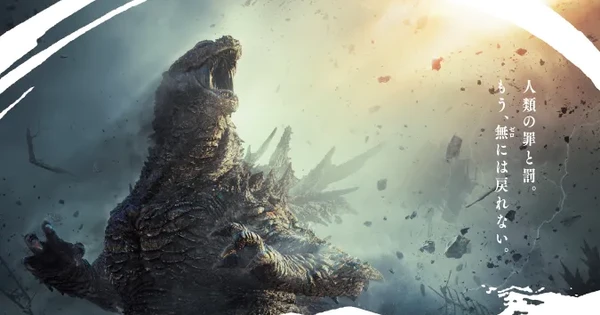
How do you bridge the gap between Godzilla as a force of terror and as a cool guy who fights other monsters? The American 2014 film tried to split the difference between metaphorical horror and “let them fight” fun before turning completely silly in its sequels. The last two JapaneseGodzilla films (Shin Godzilla and Godzilla Minus One) were stand-alone reboots that stripped the King of the Monsters down to his scary roots without another kaiju in sight. Then Minus One became an Oscar-winning global blockbuster, and writer/director/VFX genius Takashi Yamazaki pretty much had to make a sequel — and that means scaling up with another kaiju. How do you deliver the beatdowns fans want while still maintaining consistency with the dark historical drama of Minus One?
Godzilla Minus Zero‘s answer is to make its monster vs. monster fight the scariest you’ve ever seen. As everyone’s correctly guessed by now, King Ghidorah is the big new threat attacking Japan in 1949. Ghidorah’s a different beast in each Godzilla continuity, so I won’t say much about his portrayal here to avoid spoilers, but I’ll say this: we see a lot more of him this time around than we do Go dzilla, and he looks fantastic; Yamazaki’s special effects have leveled up beyond his already striking accomplishments in the first one. I’ll also note something from the press conference that followed the screening: when one critic offered his interpretation of what Ghidorah might be a metaphor for, Yamazaki said he welcomed all interpretations so long as he made the viewer feel a sense of powerlessness. Well, Yamazaki-san, you did your job.
The film’s surprising R rating is earned — though the violence is not excessively graphic, it refuses to sugarcoat the brutality inflicted on civilians in war. One of the new major characters, scientist Kanji Murakami (Min Tanaka), is a survivor of the Hiroshima bombing; we see flashbacks of him discovering his family’s burned bodies and even more PTSD-driven dark thoughts entering his head. Another flashback to the aftermath of Godzilla’s Ginza rampage in Minus One, answering the question of how Noriko (Minami Hamabe) managed to survive that attack in the first place, plays similarly to the Hiroshima scenes. You couldn’t edit this material down to a PG-13, and you wouldn’t want to. This very concern with the consequences of violence, however, might actually make it good for teenagers to see, a moral antidote to the wanton destruction of so many bloodless blockbusters.
If Godzilla Minus Zero has one big weakness in comparison to its predecessor, it’s that it’s so structurally tied into said predecessor that it won’t work nearly as well as its own story. The sequel has some good character development and powerful emotional moments, but it also doesn’t have an arc with the same easy hook as Koichi Shikishima (Ryūnosuke Kamiki) overcoming his kamikaze survivor’s guilt in Minus One. Beyond the spectacular kaiju attacks and the visceral war-horror elements, one’s attachment to the human characters here is more dependent on the attachments already established in the last movie, along with the general historical context that informs its depiction of post-war Japan.
While having fun with pulpier sci-fi plot elements and the inherent excitement that comes with Godzilla (that classic Godzilla theme still hypes one up), Minus Zero ends up being a darker movie than Minus One. Its mission is less one of heroic redemption and more entangled with complications. If Minus One was Star Wars, Minus Zero is The Empire Strikes Back. I don’t know if there will be a Return of the Jedi or if we’re left with a beautifully bleak duology. Of course I want to see more, but if Yamazaki wishes to end it here, he’s still left this series on a strong note. You can’t trust that the world will remain saved, but maybe you can still protect yourself and your family.
>
Anime
‘Destroy All Humans. They Can’t Be Regenerated. A Magic: The Gathering Manga’ Gets Miniseries in October – News

Original series based on card game ended in April 2025
The November issue of Kadokawa‘s Monthly Shōnen Ace magazine announced on Saturday Katsura Ise and Takuma Yokota will launch a new miniseries for their Destroy All Humans. They Can’t Be Regenerated. A Magic: The Gathering Manga (Subete no Jinrui o Hakai suru. Sorera wa Saisei Dekinai.) manga, based on the Magic: The Gathering trading card game, beginning in the December issue on October 26. The series will be titled Subete no Jinrui o Hakai suru. Sorera wa Saisei Dekinai. -Timeshift- (Destroy All Humans. They Can’t Be Regenerated. -Timeshift-).

© Wizards of the Coast LLC.
Ise confirmed on X (formerly Twitter) the new manga will be a short limited series that will run for four chapters irregularly in the magazine.
Viz Media releases the main manga in English and describes the story:
Travel back in time to the early days of Magic: The Gathering!
It’s the nineties at Tokiwagi Middle School. And for gamers like Hajime Kano, after the release of Magic: The Gathering, nothing will ever be the same again!
In everything he does, it seems like geeky Tokiwagi Middle School student Hajime Kano comes in second place behind popular honor student Emi Sawatari. But when Hajime takes a trip to a new game store he’s been hearing about, their rivalry takes an unexpected turn. Welcome to the early years of Magic: The Gathering, whena trading card game shaped a generation forever!
The manga first debuted as a one-shot in Monthly Shōnen Ace in August 2018. The manga started its serialization in the magazine in November 2018. Wizards of the Coast LLC. is credited with cooperation. The manga ended serialization in April 2025, and Kadokawa shipped the 18th and final volume in June 2025.
Sources: Monthly Shōnen Ace November issue, Katsura Ise‘s X/Twitter account
Disclosure: Kadokawa World Entertainment (KWE), a wholly owned subsidiary of Kadokawa Corporation, is the majority owner of Anime News Network, LLC. One or more of the companies mentioned in this article are part of the Kadokawa Group of Companies.
>
CloverWorks’ Omnibus Anime Film Grotesqqque Premieres in U.S. on October 8 – News
How rare was Bills' win over Chargers? Think replacement players and a barefoot kicker
Giants' Jameis Winston didn't silence critics vs. Titans, but he 'did what was required'
-

 movies4 months ago
Search For Canadian TV Actor Stewart McLean Now Homicide Investigation
-

 Fashion9 years ago
These ’90s fashion trends are making a comeback in 2017
-
Fashion9 years ago
According to Dior Couture, this taboo fashion accessory is back
-
Fashion9 years ago
Model Jocelyn Chew’s Instagram is the best vacation you’ve ever had
-
Fashion9 years ago
Emily Ratajkowski channels back-to-school style
-
Fashion9 years ago
9 Celebrities who have spoken out about being photoshopped
-

 Anime4 months ago
Rurouni Kenshin: Hokkaido Arc Manga Takes 1-Issue Break – News
-

 Anime3 months ago
HIDIVE to Stream English Dubs for The World Is Dancing, The Forsaken Saintess and Her Foodie Roadtrip in Another World, The Dangers in My Heart: The Movie Anime – News