
Entertainment
Nicolas Winding Refn on ‘Pusher’ Rerelease — Interview


Few careers have a clearer origin than Nicolas Winding Refn’s.
The Danish filmmaker emerged at just 25 with “Pusher,” which, over the decades, proved an ample prediction: ruthless underworlds, the men who act as their envoys, stomach-churning violence delivered placidly, and a relentlessly mean sense of humor.
Financial catastrophes engendered by his 2003 English-language debut “Fear X” would also necessitate, against Winding Refn’s desire, a return to his first commercial success, but the back-to-back sequels (“Pusher II: With Blood on My Hands” and “Pusher III: I’m the Angel of Death”) are sadder, stranger, altogether more mature in form and tone. What would’ve been a sell-out move nine times out of 10 only validated Winding Refn’s initial instincts threefold.


However massive the success Winding Refn has found in decades hence — and a frankly unlikely one at that, given his enviable roster of Ryan Gosling, Elle Fanning, Miles Teller, Amazon, Netflix, and Cannes — his “Pusher” trilogy is, at least stateside, perhaps slotted as a curiosity before an essential. That status may change imminently: restored in 4K, Magnolia Pictures is beginning a theatrical rollout at the IFC Center on Friday, May 8, allowing one to either rediscover or be fully surprised by one of the 21st century’s most influential careers (plus the debut of a boyish, bald Mads Mikkelsen).
I spoke to Winding Refn on this occasion, which coincides with a major moment all its own: He’s weeks from premiering “Her Private Hell,” his first feature in 10 years — while the interceding, epic-length, wholly worthwhile streaming excursions “Too Old to Die Young” and “Copenhagen Cowboy” might constitute a parallel career — at Cannes ahead of a July 24 theatrical release from Neon. That the 2011 Cannes Best Director winner (“Drive”) would return in an out-of-competition slot suggests something less palatable, more openly hostile. (Maybe not above “Only God Forgives,” but that’s a check-clearing movie if ever the 2010s had one.) No true fan would wish for less.
The following interview has been edited for clarity and brevity.
IndieWire: How are you? This is quite the month.
Nicolas Winding Refn: Oh, it’s all very hectic.
I can imagine.
But, no — better to do things than not do things.
Hopefully, talking about your earliest films will be a nice way to cool down. They were so formative to this amazing career you’ve had. The “Pusher” restorations came out well, and I think part of what was so fantastic about them is that they didn’t bend over backward to change these films’ initial sense — the mid-90s to the mid-2000s. What was the process, intuitive or material, to making the “Pusher” trilogy look fresh and restored, but still unique to their time and still respectful of their era?
Well, I mean, the good news is that I shot them on Super 16. And a lot of films, it turned out, from that era — where digital was beginning to emerge — the files and resolution of a lot of these digital negatives was diminishing and couldn’t be upscaled or couldn’t be rescanned. So that was one of the good things about having shot on film. Shoot on film, for God’s sake, if you can — at least back then. Then I think it was a lot about just capturing what the films originally looked like. Because that’s one of the things we go through in these, you know, evolutions of technology and home entertainment — what you can and cannot do — and so I think for me, here, it was like, “This is the definite restoration. This is it, end of the line.”
[Laughs] So I did spend a long time making sure that the films looked as they would have. But at the same time, trying to find ways to interconnect them, because they’re all shot by the same cinematographer [Morten Søborg], and even though there were years apart between one and two and three, it still had to feel almost like one movie in a way.

What were some of the things that helped unite them?
When I made [“Pusher”] two and three, television had really begun to have a resurgence of, like, brilliance. You know, it was the time with “The Sopranos” and HBO. I think that kind of just took the… canvas much broader. So you can say there is a sense of serialized narrative within the “Pusher” trilogy. It’s very much like fly-on-the-wall, and they’re all connected in the same way that the first half is about setting up, and then the second half of each movie takes over one night where everything comes apart again.
[Laughs] So they’re all designed in similar ways, that is very important: that’s consistent throughout the films. Even though I had changed a little bit, I guess, when I made two and three, because it was some years later, I didn’t want to change the DNA of the films. They still had to remain the same.
I once read that you own a DVD, a Laserdisc, a 16mm print, and a VHS of Sergio Sollima’s “Violent City,” which suggests that you like the imperfections and eccentricities of each format. It’s interesting that, here, you have to kind of get the definitive version. That seems like a unique process.
Mmm-hmm. Well, I think it was important that when you make these restorations — because of technology — the 4K kind of clarity and the 4K definition and just the idea of information was a bit like: wow. It’s a bit like you’re bringing the original, when-you-saw-them-for-the-first-time-in-the-lab crispness to then reevaluating them on a physical media to a television screen, which, essentially, is very different from a 35 experience.
Um, but I think that, for me, when I look at these objects — because I very much value physical entertainment. I like physical media generally. I like to touch it. I like to go out and buy it in a store. I like to talk about the object. I like to see the object. Even though I know the reality is that most things will be seen online, because that’s just the way of the world. But I still hold, very dearly, the physical-media experience, and also that’s where you can do all the upscales and all these [laughs] creative, you know, the idea of making it as good as you possibly can.
But I don’t know in terms of what else to really do other than “this is it.” And when I made the Danish box, which I distributed myself, I included three movies that I had purchased the rights to and the negatives some years ago — about 10, 10, 12 years ago — which were of a Danish filmmaker called Poul Nyrup who, very unknown, had made three very similar movies to the “Pusher” trilogy back in the ‘60s in Copenhagen. I hadn’t seen them when I made my films, so obviously I knew nothing of them until much later in my life. But I was able to buy the negatives and the rights, and I did the same restoration with those films and included them in the Danish box set as a kind of both a companion piece to say, “Before me there was actually someone who was doing the exact same thing back in the ‘60s.”
And, in a way, much more revolutionary, because Danish cinema at least was only really just, you know, comedies or the emergence of the French New Wave inspiration. But genre cinema — especially American — was very, like, anti-Danish in a way, because it was politics of the time. But this American genre movie was really made in Danish back then, and I thought it was just very interesting to see the juxtaposition between these six movies that are each a trilogy, one way or another, kind of combined. So that I also spent much detail, the restoration, on.
“Drive” feels like a very 2011 movie to me. Is there a kind of excitement and pleasure in how much your films have been aesthetic products of their time, or do you want them to set a template, to stake out new territory, for the era in which they’re coming out?
It’s a very interesting question, because you’re right: I think that we are obviously reflecting the times we live in through our work, or at least the ability to. It’s touching upon, also, politics and touching upon aesthetics. I think that I started making films trying to capture authenticity. You know, the idea of making it real and as real as possible was the agenda. Which is ludicrous [laughs] because reality doesn’t really exist, except in the moment you’re in it. But starting from there, and then obviously post-“Pusher” trilogy, realizing that I am no longer… or maybe I am searching for something I’ll never find. So I changed my route and started making films about unreality.

And obviously, that’s where “Bronson” and the films that came afterward began to shift in a different aesthetic approach. It all kind of culminated in “Copenhagen Cowboy,” because it was my first Danish-language — even though it was multilingual like the “Pusher” trilogy — but it was my first time working in back in my home country again after so many years, and essentially making what I think “Pusher” would be today.
So if I were to make “Pusher” today, what would it be? And who was I now compared to who I was 30 years ago? So in my own trajectory, I can see how I was wandering through various forests, and in a way never looked back but continued to push forward, but at the same time trying to challenge the aesthetics of the times that I am in, in the moment — to see what will come in the future.
I think it’s worth noting you’re about three weeks away from premiering a new film. I won’t prod too much about “Her Private Hell,” but I would be curious to know, broadly, what your feeling is on the eve of showing work at Cannes. Are you happy with the film? Are you excited about the Cannes premiere? What is that calm-before-the-storm feeling?
Well, first there’s a lot of logistics you got to deal with. That’s… but no, look: obviously my Cannes experience started at a certain time in my life, where things were changing again. I mean, you can kind of say my life has certain pivotal moments through my work — of how that really affected everything around me. Here, now — not having done a movie in ten years practically — to go back and make a movie in a time where cinema has really shifted compared to 10 years ago. So much has happened to cinema that it’s almost like entering a strange forest where it’s all a bit inconcrete. It’s hard to even define what the ecosystem is even like. And the power of the internet essentially driving everything and being the backbone of everything. Well, it’s a new playing field, I’ve been feeling. But the idea of creativity is still the same. It’s just the rules are a little bit different, but the aspirations are the same. And how do you navigate through that?
I love Cannes, obviously. It’s a great place to premiere. It has the best red carpet; it has the best of all those things, which is part of the experience. I mean, I love glamour and glitz and glitter and all that because that is part of the DNA of what we do. It’s kind of connected. But I also see a brighter future because I think that we’re moving towards something that we can’t quite put our finger on yet, of where things are going. But I believe that, with technology now suddenly putting a new spin on everything because of AI, it will continue to part the oceans between what it means to create and why you create. That having been flooded with technology — well, let’s say “content”; that’s what it’s called — to the point of: you’re basically overstuffed on opportunities to, just, everything comes and goes, like it was wiped.
But at a certain point, the mind can’t comprehend. Or this idea that everyone thought, that if you just open the floodgates, people would just sit and… well, maybe that wasn’t really true either. So it’s like: what is the real reality of the future? And I think that what’s gonna come now is much more focused on the survival of the heart. Meaning that, if you create with the heart — and I mean sincerely — that is what will not be affected by the technical evolution. But all the other things that are not genuine — and I mean pretending to be genuine — will just vanish into this sphere of just wipes. Just to say: I am very optimistic about the future, but just want to get that across.
I’m excited to see how “Her Private Hell” reflects that. I suppose it was a foregone conclusion that your first movie since the formation of a company called Neon would be released by them.
Well, Neon is called Neon because of “Neon Demon.”
Actually?
Yeah.
I didn’t know that. OK, well: self-fulfilling prophecy
Tom Quinn has been very instrumental in my life. Because he brought the “Pusher” trilogy to the U.S., and we did “Only God Forgives” together, which was a very, in a way, pivotal point in my own creative endeavor. We have always remained very close over the years, and so when I wanted to make a movie again, he was the one and only that I reached out to … he’s just amazing, and he was like, “What do you need?” And I explained what I needed, and he was like, “I’m in.”
That kind of reminded me of the experience with “Pusher One,” where I was like, “What do I need? Well, I need this.” And the government just gave it to me. [Pulls up blank paper] My CV was as blank as this piece of paper. I had no prior anything. And with Tom, it was like, “What do I need? This is my CV.” It has a few little things on it, but he was still, you know, “I’m in.” And that kind of gave me a re-evaluation of everything around me, but also an incredible amount of joy and pleasure in wanting to make a movie in how I see movies are for me now.
The “Pusher” film series is now available on physical media in 4K, with a theatrical re-release starting Friday, May 8.
>
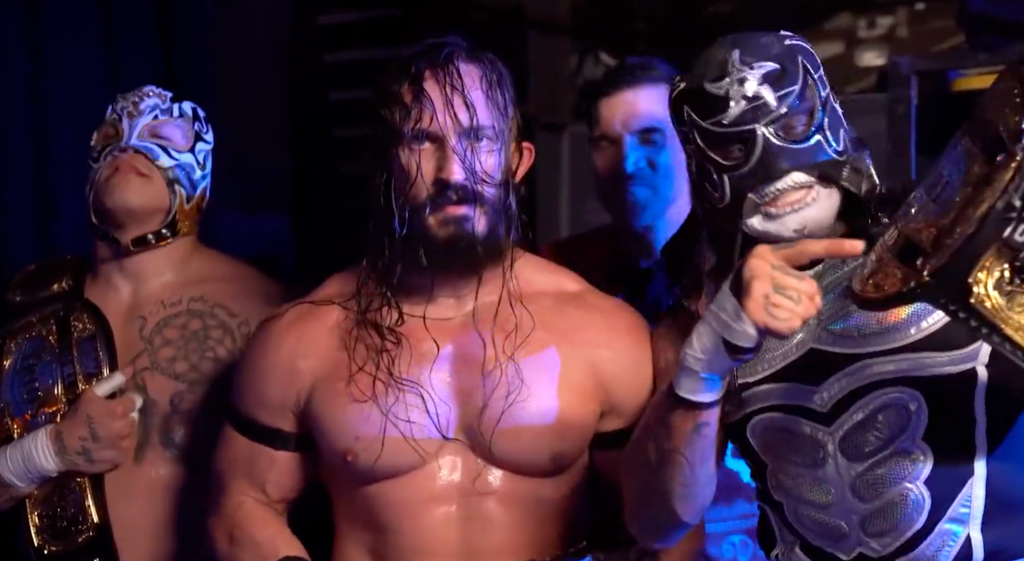
Benjamin Satterley, the high-flying champion wrestler known variously to AEW and WWE fans as Pac, Bastard, Adrian Neville and Neville, has died. That, according to an announcement from All Elite Wrestling. He was 40.
Details surrounding his passing are unclear. Pac was featured at AEW’s All Out pay-per-view from Chicago on Saturday night. He challenged Andrade El Idolo for the AEW National Championship, but lost.
The statement from AEW reads in part, “A native of Newcastle upon Tyne, England, Satterley began his wrestling career in 2004 and went on to perform for wrestling organizations all over the world, captivating fans with innovative high-flying moves and incredible in-ring ability. Pac signed with All Elite Wrestling in 2019 and held multiple AEW Championships and competed in some of the most memorable matches in AEW history. Our condolences go out to Satterley’s family, friends and fans.”
In the AEW, Satterley was the outfit’s All-Atlantic Champion and a two-time World Trios Champion.
He won the NXT Championship in the WWE’s developmental adjunct and later became a two-time WWE Cruiserweight Champion.
Satterley was known as “The Man that Gravity Forgot” for his signature finishing move, a spectacular corkscrew shooting star press off the top rope. You can see it in the video below.
>
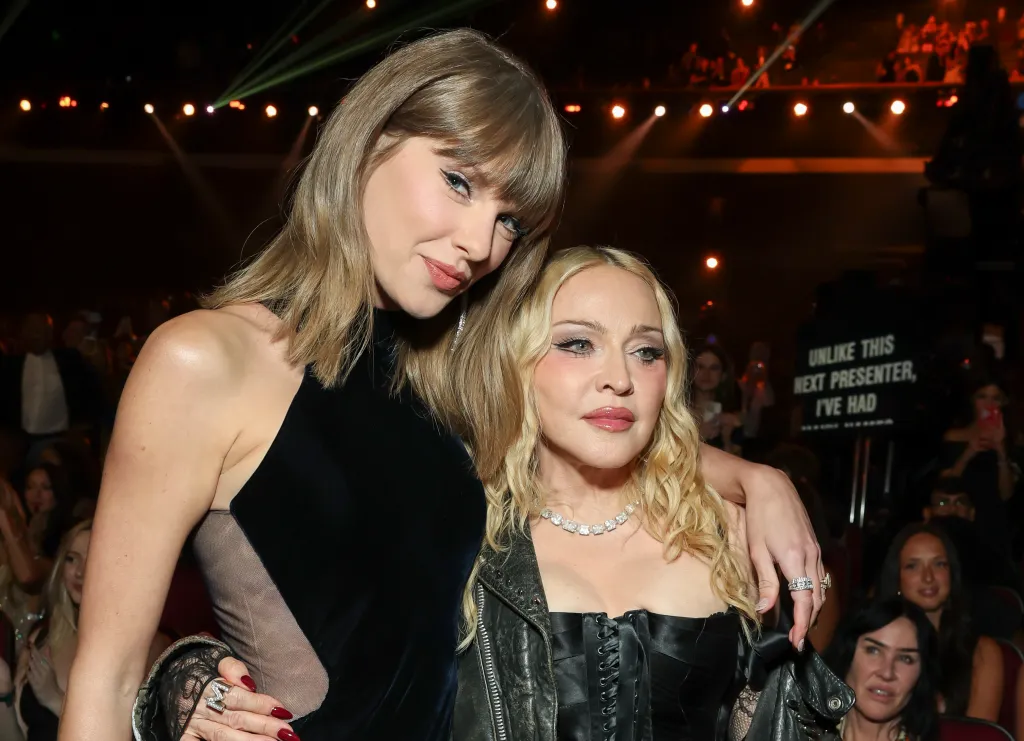
It was like 1998 all over again. Madonna won six Video Music Awards that year for Ray of Light.
Flash forward to tonight, and the pop icon won seven awards, including Artist of the Year, for Confessions II, the sequel to her 2005 album.
Also winning were Sabrina Carpenter for Best Editing and for her collab with the Material Girl on “Bring Your Love.” The duo appeared onstage together to accept.
Taylor Swift won Video of the Year for “The Fate of Ophelia” and Best Director for “Opalite,” as well as a special “Artist Director” honor.
Full Winners List
VIDEO OF THE YEAR (presented in show)
Taylor Swift – “The Fate of Ophelia” – Republic Records
ARTIST OF THE YEAR (presented in show)
Madonna – Warner Records
BEST COLLABORATION (presented in show)
Madonna & Sabrina Carpenter – “Bring Your Love” – Warner Records
BEST DANCE, presented by BACARDÍ® Rum (presented in show)
Madonna – “Confessions II – The Film” – Warner Records
BEST NEW ARTIST, presented by The General Insurance® (presented in show)
Sienna Spiro – Capitol Records
BEST POP (presented in show)
LISA – “Dream feat. Kentaro Sakaguchi” – Lloud Co. / RCA Records
SONG OF THE YEAR
BTS – “Swim” – BIGHIT MUSIC
BEST HIP-HOP
Cardi B ft. Kehlani – “Safe” – Atlantic Records
BEST R&B
Bruno Mars – “I Just Might” – Atlantic Records
BEST ALTERNATIVE
Olivia Rodrigo – “the cure” – Geffen Records
BEST LATIN
Bad Bunny – “NUEVAYoL” – Rimas Entertainment
BEST K-POP
BTS – “SWIM” – BIGHIT MUSIC
BEST COUNTRY
Ella Langley – “Choosin’ Texas” – Columbia Records
BEST DIRECTION
Taylor Swift – “Opalite” – Republic Records
BEST ART DIRECTION
PinkPantheress – “Stateside + Zara Larsson” – Warner Records UK / Atlantic Records
BEST CINEMATOGRAPHY
Madonna – “Confessions II – The Film” – Warner Records
BEST EDITING
Sabrina Carpenter – “House Tour” – Island
BEST CHOREOGRAPHY
Madonna – “Confessions II – The Film” – Warner Records
BEST VISUAL EFFECTS
Ariana Grande – “hate that i made you love me” – Republic Records
SOCIAL CATEGORIES:
BEST GROUP
BTS
BEST LONG FORM VIDEO
Madonna – “Confessions II – The Film” – Warner Records
BEST ALBUM
Madonna – Confessions II – Warner Records
SONG OF SUMMER –
Ariana Grande – “hate that i made you love me” – Republic Records
SPECIAL AWARDS:
VIDEO VANGUARD – Nirvana
MTV VMA ARTIST DIRECTOR HONORS – Taylor Swift
>
movies
MTV VMAs: Taylor Swift Dedicates Video Of The Year Award To Dolly Parton “The Ultimate Showgirl”
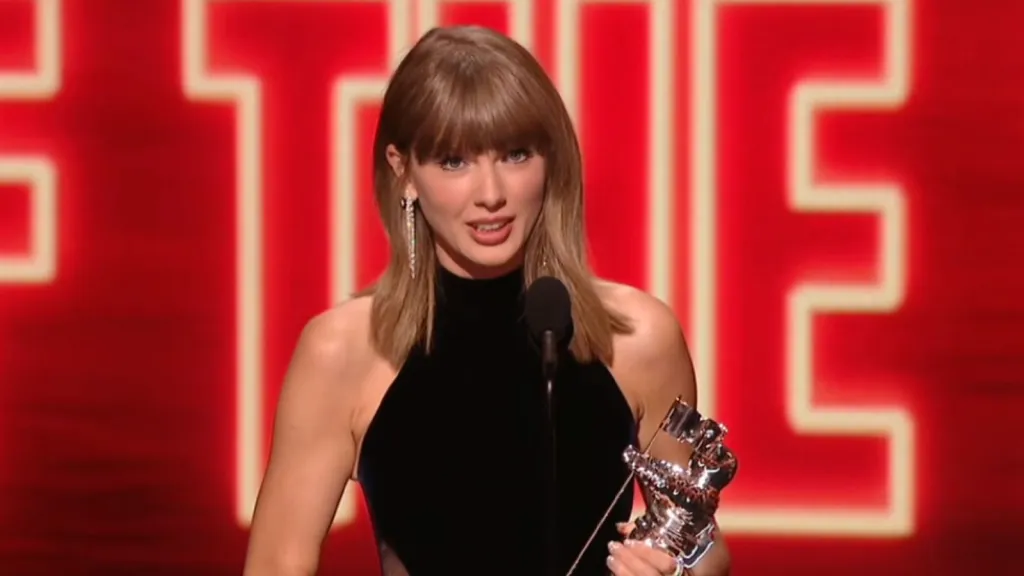
Taylor Swift won the night’s top award at the MTV Video Music Awards, taking home a Moonperson trophy for Video of the Year for “The Fate of Ophelia.”
Swift took the stage to accept the award and said she was “proud” of the work she did on the video, as it was “one continuous shot” and she had to learn “a lot about hiding cuts” in strategic places.
The singer also made a special mention to Dolly Parton, whom she called “the ultimate showgirl.”
“I want to thank and dedicate this award to one person, without whom just this wouldn’t be happening, and that person is the ultimate showgirl, Dolly Parton,” Swift said in her speech. “Every single song that she wrote, her storytelling was so vivid and so rich. It was like listening to her songs. It’s like watching the best music video you have ever seen in your life every single time you hear what she has written, and she handled this thing with such grace and joy and love and gratitude for the fact that she got to do this, and everything that happened in her life or her career, she channeled back into love, and gratitude and appreciation for her fans.”
She continued, “I am lucky I got to be one of them, and I will always be one of them. I love you all so very much, and I think that we were all very, very… I think we were all very lucky to share this planet with Dolly Parton for a time, and thank you for this amazing moment. I love you all.”
Watch Swift’s speech in the video below.
>
Connections: Sports Edition today: Hints and answers for Sept. 28, 2026, puzzle No. 735
Broncos come alive in second half to stun Rams. Is it time to worry about L.A.?

Web Manga ‘Houkago no Idol ni wa Himitsu ga Aru’ Gets TV Anime in Spring 2027
-

 movies4 months ago
Search For Canadian TV Actor Stewart McLean Now Homicide Investigation
-

 Fashion9 years ago
These ’90s fashion trends are making a comeback in 2017
-
Fashion9 years ago
According to Dior Couture, this taboo fashion accessory is back
-
Fashion9 years ago
Model Jocelyn Chew’s Instagram is the best vacation you’ve ever had
-
Fashion9 years ago
Emily Ratajkowski channels back-to-school style
-
Fashion9 years ago
9 Celebrities who have spoken out about being photoshopped
-

 Anime4 months ago
Rurouni Kenshin: Hokkaido Arc Manga Takes 1-Issue Break – News
-

 Anime3 months ago
HIDIVE to Stream English Dubs for The World Is Dancing, The Forsaken Saintess and Her Foodie Roadtrip in Another World, The Dangers in My Heart: The Movie Anime – News