
Charlie Hunnam as Alec Leamas in ‘Legacy of Spies’


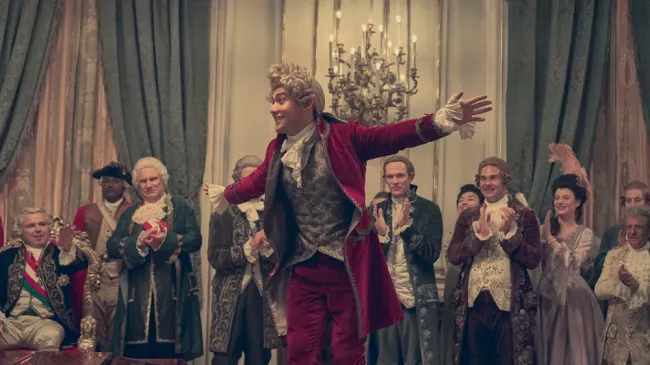
During their lifetimes, Wolfgang Amadeus Mozart and Antonio Salieri were reportedly regular collaborators with a healthy mutual respect for each other’s immeasurable musical talents. In death, however, the composers have repeatedly been depicted as the classical period’s answer to Tupac and Biggie.
Ever since Alexander Pushkin stirred the pot with 1830 play “Mozart and Salieri,” Nikolai Rimsky-Korsakov’s same-named 1879 opera, Peter Shaffer’s 1979 Broadway hit “Amadeus,” and its eight-time Oscar-winning adaptation directed by Miloš Forman have all run with the juicy — but heavily distorted — narrative of a rivalry so intense it resulted in a plot to murder.


First screened in the UK last Christmas, Starz import “Amadeus” continues to amplify one of the 18th century’s most enduring conspiracy theories. In fact, the opening episode concludes with Paul Bettany’s Salieri (in some unconvincing aging makeup) recalling from his deathbed how he bumped off his rival with a near-palpable sense of glee.
While undoubtedly adding to the list of works essentially besmirching the reputation of an innocent man, writer Joe Barton at least makes it evident from the offset that the five-parter isn’t intended as a beacon of historical accuracy.
Indeed, good luck finding any official texts which confirm Mozart once ejaculated onto a buffet’s cake display shortly after eating a strawberry retracted from a part of his lover’s anatomy, a scene more “Saltburn” than Salzburg. Or that Salieri once masturbated over his beloved piano in an unfruitful attempt to cure his writer’s block.
As well as deepening the beef’s mythology, “Amadeus” is clearly heightening its salaciousness.
Following a literal cold open in which the elderly Salieri jumps from a second story window onto a snow-covered courtyard, “Amadeus” heads back to Vienna 1781, where the titular maestro has just arrived to seek his fame and fortune.
“Firstly, I apologize,” he tells his landlady’s daughters shortly after vomiting on the streets outside his new residence. “Secondly, good day.” Will Sharpe, reuniting with Barton after playing a drug-addicted sex worker in crime drama “Girl/Haji,” nails the composer’s blend of debauchery, decadence, and diffusive charm in one fell swoop.
While Sharpe’s casting was inevitably, and depressingly, dismissed as another sign of wokeism gone mad, the half-Japanese/half-British actor ultimately brings something new to the table. His Amadeus can still be monstrous — see how he publicly berates a young fan boy for his inability to recreate his own musical genius, for example. But largely abandoning the manic energy and John McEnroe-inspired petulance of Tom Hulce’s Academy Award-nominated turn, he delivers a slightly more nuanced portrayal, one that continually shifts sympathy and explains why everyone,bar Salieri, initially fell under his spell.

Furthermore, Sharpe spent six months learning how to tinkle the ivories, an impressive commitment which pays off during the pivotal piano battles and ensures a welcome absence of clumsy cutaways from fingers to face.
Nevertheless, in a role reversal of their characters’ pecking order, Sharpe still plays second fiddle to Bettany, the latter serving up a potential career-best as a man whose disdain for the new kid on the block seeps into everything from his own creative exploits to his once-unwavering faith in Catholicism. “The traveling maestro, wrote his first aria in the womb,” Salieri snides when he learns Mozart is about to hit town, a jealous streak which manifests itself in increasingly ugly ways.
Bettany is particularly impressive during the pair’s early exchanges, when Salieri’s initial thoughts of mentorship give way to disbelief that someone so disrespectful of society’s norms has managed to ingratiate himself into its upper echelons, as well as how someone so undedicated to his craft can be so brilliantly prolific. You can almost see him burst a blood vessel trying to contain the simmering rage as the glitterati offer Mozart the adulation he believes is his God-given right.
Of course, Salieri’s quest for vengeance becomes so obvious even his permanently inebriated rival eventually recognizes his so-called friend is more interested in becoming a foe. “Maybe God doesn’t speak to you because you fucking bore him,” Mozart bellows after Salieri cowardly fails to defend the ground-breaking requiem Emperor Joseph (Rory Kinnear) amusingly complains has “too many notes.”
The latter provides much of the comic relief as a man whose cultural voice far outweighs his knowledge. “A return to past success is what’s needed in difficult times,” he insists about the revival of a French opera Salieri is vehemently opposed to. Thankfully, the show itself, clearly recognizing it lacks the sumptuous budget of mid-’80s Hollywood, largely avoids trading on former glories.
No stranger to others’ works having successfully adapted supernatural horror “The Ritual” and young adult fantasy “Half Bad” (“The Bastard Son and the Devil Himself”), Barton also stamps his mark here. A minor character in most iterations, Mozart’s singer wife Constanze is promoted to third billing, with Gabrielle Creevy excellent as a woman forced to put her own ambitions aside to support those of a husband she grows to despise (“He’s useless, chaotic, and no one knows what to do with him”).
“Amadeus” also delves further into why its maestro was so self-destructive, from his disapproving daddy issues and death of his first-born to the internal pressures of possessing such an all-consuming gift, culminating in a magnificent final showdown in which the now-sworn enemies confess all. And it brings several new real-life figures into the fold, including Mozart’s librettist ally Lorenzo Da Ponte (Ényì Okoronkwo) and Pushkin (Jack Farthing), aka the playwright who first immortalized the idea of a battle-to-the-death feud.
The latter helps the oft-told tale take its most meta turn in a final episode which challenges the reliability of everything that’s gone before while theorizing exactly how the myth came to be. It’s an approach which single-handedly justifies a show many of the film’s purists have argued doesn’t need to exist. Salieri might still be declaring himself “the patron saint of mediocrities.” This saucy, yet still suitably operatic interpretation, however, deserves more than such faint praise.
“Amadeus” premieres Friday, May 8 on the STARZ app, plus all STARZ streaming and on-demand platforms. New episodes will be released weekly.
>

Tokyo International Film Festival has announced that Japanese-Korean filmmaker Mipo O and Iranian filmmaker Mohammad Rasoulof will be presented with the Kurosawa Akira Award at this year’s edition of the festival.
The award is designed to recognize the legacy and ongoing influence of renowned auteurs and is presented to filmmakers who have “made waves in cinema and are expected to help guide the industry’s future”. Last year’s recipients were Kokuho director Lee Sang-il and Chloé Zhao.
This year’s recipients were selected by a committee comprising Lee, veteran filmmaker Yoji Yamada, cinematographer Akiko Ashizawa and TIFF Programming Director Shozo Ichiyama.
After making her feature directorial debut in 2006 with The Sakai’s Happiness, Mipo O won Best Director at the Montreal World Film Festival with her 2014 film, The Light Shines Only There, which went on to win 60 awards in Japan and internationally. Following a hiatus for childbirth and childcare, she returned to feature filmmaking in 2024 with box-office hit Living In Two Worlds followed by How Dare You? last year.
“Since making her directorial debut in 2006 with The Sakai’s Happiness, director O Mipo has consistently created works that offer a multifaceted perspective on individuals living on the margins of society, refraining from viewing them through a simple lens of good vs. evil,” said the selection committee.
The TIFF selection committee also noted that Rasoulof has faced censorship, prison sentences and filmmaking bans from the Iranian government, yet has relentlessly pursued his unique method of filmmaking often relying on guerilla-style shooting. He won the Golden Bear at the Berlinale in 2020 for There Is No Evil, and the Special Jury Prize at Cannes for The Seed Of The Sacred Fig in 2024.
The committee said: “Director Mohammad Rasoulof has consistently produced profound works centered on the theme of human rights oppression under state regimes. Notably, his recent films There Is No Evil and The Seed Of The Sacred Fig have gained international acclaim for their humanist perspective, which portrays even those who perpetrate oppression as ordinary citizens.”
TIFF is also presenting a selection of Akira Kurosawa’s favorite films including Charlie Chaplin’s The Circus (1928) and Abbas Kiarostami’s Where Is the Friend’s House? (1987), along with 4K restorations of two of Kurosawa’s own titles – Sanshiro Sugata (1943) and Ikiru (1952).
TIFF also announced that actor Hayato Isomura (Alice In Borderland, What Did You Eat Yesterday?) will head the Ethical Film Award Jury. Three titles from this year’s TIFF selection met the criteria for the Ethical Film Award: Brenda Lígia’s Amadeo And The Hypothetical New World (Brazil), Isabelle Stever’s I Rarely Wake Up Dreaming (Germany, Ukraine) and Vee Shi’s Time And Tide (Australia).
>
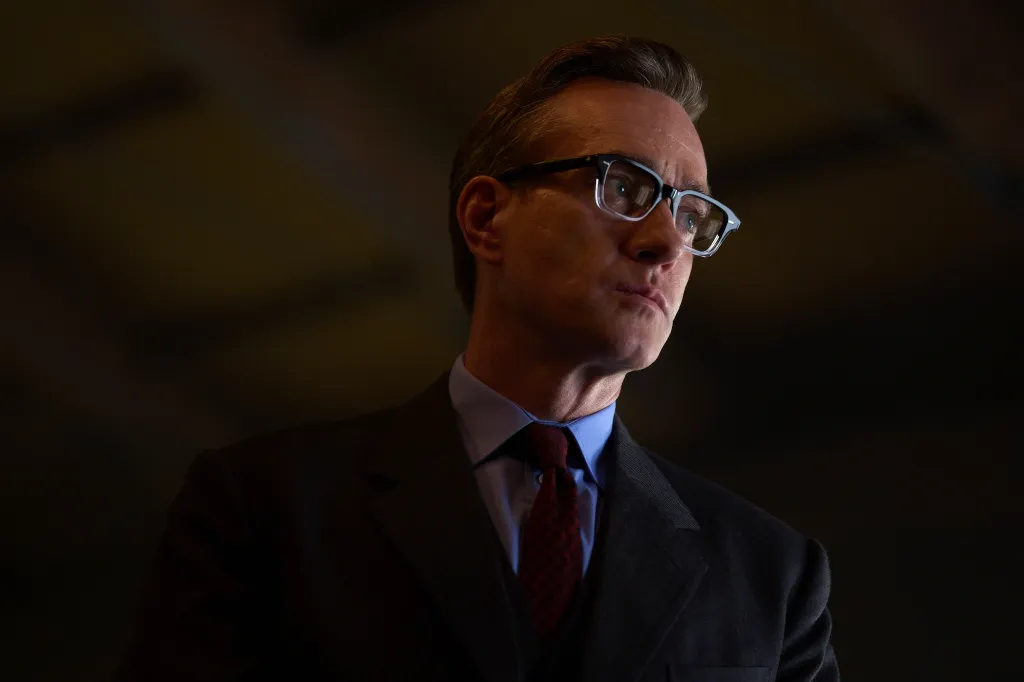
We’ve got first glimpse at Matthew Macfadyen descending into the John le Carré universe to play iconic spymaster George Smiley.
The BBC and MGM+‘s Legacy of Spies has dropped first-look images including the Succession star donning those trademark glasses and Charlie Hunnam as Alec Leamas, which can be seen below.
The eight-part drama marks Smiley’s long-anticipated return to television, a first in four decades, when he was played by Alec Guinness, although he was portrayed in the 2011 movie version of Tinker Tailor Soldier Spy by Gary Oldman.
Legacy of Spies is adapted from The Spy Who Came in from the Cold and draws on additional material from 2017’s A Legacy of Spies.
When Leamas, a highly experienced Circus field operative, recruits Doris Quinz, a young and dynamic East German woman, to smuggle high-value Stasi documents into the West, it sets in motion a series of events that threaten to explode in the crucible of Cold War Berlin. Pursuing Leamas and Doris are Josef Fiedler and Hans-Dieter Mundt, two Stasi operatives whose ferocious desire to shut down the intelligence leak is matched only by their internal rivalry and an iron will to outmatch each other. Pulled into the action is Liz Gold, an idealistic young woman whose courage and conviction force Leamas to navigate a world where loyalties fracture and betrayal is inevitable.
Charlie Hunnam as Alec Leamas in ‘Legacy of Spies’
The images have been released to coincide with the end of production in the Czech Republic.
The show is one of the most highly-anticipated UK-U.S. co-pros of the upcoming year and also stars Daniel Brühl as Josef Fiedler, Devrim Lingnau Islamoğlu as Doris Quinz, Agnes O’Casey as Liz Gold, Felix Kammerer as Hans-Dieter Mundt, Dan Stevens as Bill Haydon, Jake Dunn as Peter Guillam, Anjana Vasan as Connie Sachs, Charlotte Ritchie as Ann Smiley, Joe Alwyn as Jim Prideaux.
Back in June, we revealed that Hugh Laurie would also star in Legacy of Spies. He is playing Control, the fiendish and commanding head of The Circus and Smiley’s morally fickle superior.
Legacy of Spies is set to launch on BBC iPlayer and BBC One in the UK, and on MGM+ in the U.S., Germany, Spain, Italy, Austria, Belgium, the Netherlands, Brazil and Spanish-speaking Latin America. The series will also air on SBS in Australia, Sky New Zealand and Sky Switzerland, and CANAL+ across France & French-speaking territories, Central & Eastern Europe and Sub-Saharan Africa.
Legacy of Spies was commissioned by Lindsay Salt, Director of BBC Drama. The series is produced by The Ink Factory (The Pigeon Tunnel, The Night Manager), in co-production with Amusement Park Film (All Quiet on the Western Front) and in association with 127 Wall Productions and Paramount Television Studios, for the BBC and MGM+. The series is written by Stephen Cornwell (Message from the King, A Most Wanted Man) and Clarissa Ingram, Michael Lennox (Say Nothing, Crystal Lake) will serve as an executive producer and is lead director, with Claudia Llosa (The Vampire Lestat, The Milk of Sorrow) serving as second director and co-executive producer. The executive producers are Stephen Cornwell, who is also showrunner, Graham Yost (Justified, Silo), Simon Cornwell (The Pigeon Tunnel, The Night Manager), Michele Wolkoff, Malte Grunert (All Quiet on the Western Front), Chris Rice, Macfadyen, Hunnam, Clarissa Ingram, and Joe Tsai. Susanne Bier and Mike Lesslie are also executive producers. The executive producers for the BBC are Gaynor Holmes and Nick Lambon. Nick Cornwell is executive producer for the John le Carré estate. Sam Costin and Llosa, are co-executive producers and Nancy Bray is producer for The Ink Factory. Fifth Season is handling global sales.
>
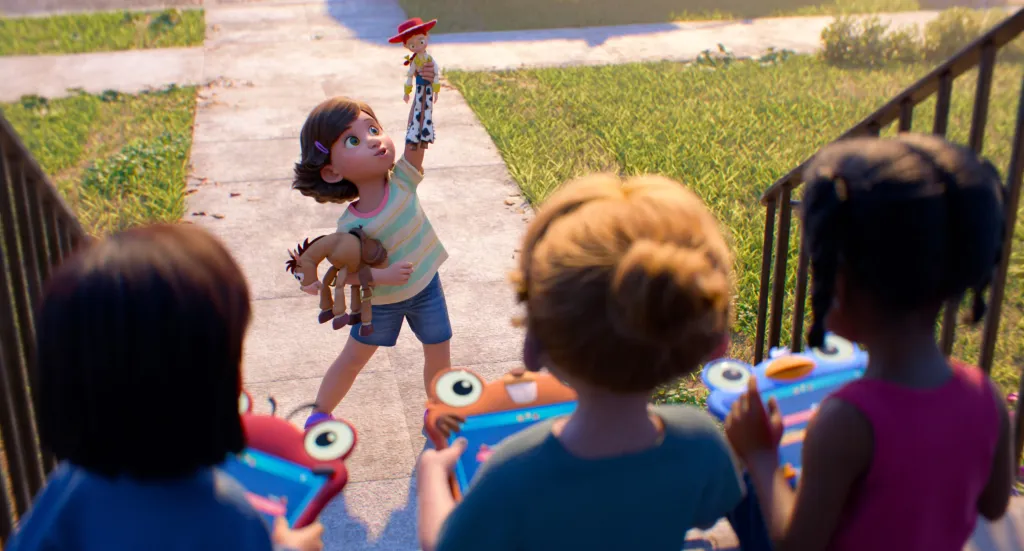
Disney/Pixar’s Toy Story 5 cleared 20 million views in its first five days of streaming around the world on Disney+, enough to feasibly make it the No. 1 film on the OTT service. The Andrew Stanton directed movie began streaming on Disney+ on Sept. 23.
The launch builds on the strength of Toy Story, which is the most-watched film franchise on Disney+ with over 2B hours streamed globally per the studio.
In addition, Disney’s highest grossing movie of 2026 YTD at $1.1 billion global has driven 168M hours of lift to the franchise since the teaser trailer was released.
The fifthquel also ranks among the top ten theatrical film premieres on Disney+ worldwide to date, joining the other four Toy Story movies, all of which consistently rank among the top 20 movies on Disney+ each year. Again, all according to Disney.
The highest grossing animated movie in MPA history, Zootopia 2 ($1.866B), clocked 32M views globally in its first seven days on Disney+. The movie began streaming on March 11. Back in September 2024, Disney’s Inside Out 2 ($1.698B), drew 30.5 million views worldwide on Disney+ in its first five days on the streamer.
The Toy Story franchise has grossed more than $4B at the worldwide box office. Across all retailers, Toy Story generates more than $1B in annual global retail sales and reaches fans across every Disney park and cruise ship, including four fully immersive lands, 23 attractions, and two hotels. The franchise has generated more than $50B in total economic impact worldwide over the past 30 years.
>


Search For Canadian TV Actor Stewart McLean Now Homicide Investigation


These ’90s fashion trends are making a comeback in 2017
According to Dior Couture, this taboo fashion accessory is back
Model Jocelyn Chew’s Instagram is the best vacation you’ve ever had
Emily Ratajkowski channels back-to-school style
9 Celebrities who have spoken out about being photoshopped


Rurouni Kenshin: Hokkaido Arc Manga Takes 1-Issue Break – News


HIDIVE to Stream English Dubs for The World Is Dancing, The Forsaken Saintess and Her Foodie Roadtrip in Another World, The Dangers in My Heart: The Movie Anime – News