
Alexandre Laurent, Mehdi Sabbar and Benjamin Dupont-Jubien
courtesy, Caroline Dubois


Mother’s Day is an easy holiday for some, a difficult holiday for others, but always a day that observes motherhood and all that it embodies. Moms have been portrayed on the big and small screen as long as anyone else, and will always be an important part of telling any story.
From Catherine O’Hara’s Moira Rose to Cher’s Rachel Flax, there are a lot of great depictions of motherhood out there — here’s 25 of the most memorable.
Catherine O’Hara enjoyed her fair share of iconic roles, and her turn as Moira Rose, mother to David and Alexis in “Schitt’s Creek, is one of the best. She introduced us to a wide vocabulary, emphasized the importance of taking and admiring our own nudes, and always loved her kids — even when she wasn’t quite sure how to express it.
Sure, Daenerys is complicated. And, sure, her children are dragons. But many a pet mom will attest to the fact that you can love little creatures as much as you love a human child, and Daenerys certainly loved those giant scaled beasts. Could she have cooled it on some of the world domination? Yeah, but then she wouldn’t be the mother of dragons.
Oh, boy. Lorelai Gilmore is the kind of TV mom that resonates across generations, and, despite some misguided writing in the follow-up sequel, still holds up pretty well to the test of time. She’s been a model to entire group of moms who wanted to somehow be friends with their children without messing them up too much.
The thing about Lorelei is she spends a chunk of her time parenting in opposition to how she was raised, and only really begins to understand just how incredible her own mom, Emily Gilmore, is later in the series. Her ideas might sometimes be outdated and the way she lives is pretty rare, but Emily is a gem all on her own.
What isn’t to love about Clair? She’s the best at a good comeback, puts up with zero shenanigans from her kids, and loves the Huxtable family fiercely. She was always sweet, but always made it clear where the line was — which is pretty much the balance most moms are trying to strike.
Etheline Tenenbaum makes you really want to be a Tenenbaum child, even when her own children kind of … don’t. She’s smart, engaged, beautiful, and fascinating.
Cersei isn’t the kind of character anyone would describe as a good person, and she’s not even necessarily a good mother, but as it’s oft pointed out in the series, she loves her kids. They might be woefully misguided, evil, confused products of incest, but their her misguided, evil, and confused products of incest — and you’ll never forget it.
It would be a mistake to include two moms from “Game of Thrones” who are questionable at best and leave out the actual good mom from the show, Catelyn Stark. She’s not without her faults (she didn’t have to hate Jon Snow like that), but she’d do anything — anything — for those kids.
Miriam Maisel isn’t for everyone, and it’s always easy to criticize a single mom who has to sometimes miss moments with her kids because she also wants to live her professional dreams, but Midge Maisel was doing the best she could considering the era and expectations that came with it. Mostly.
She might not have been for everyone, but Florida Evans certainly spoke to a generation who believed the best way to love kids was to keep them in line.
Ellen Brody is a feature of all the “Jaws” movies, but the fourth is actually about her. No one is arguing it’s the best of the films, but she’s pretty electric as a mom who has lost it all and is ready to get her revenge.
Peg is the kind of mom that just loves you no matter what and is so happy to be along for the ride, which is kind of the idealized mom a lot of us wish we had. She represents a kind of sweetness that can be difficult to pull off in real life, but that’s effortless onscreen.
Rainbow is an activist, a smart, liberal woman who is also an excellent mom. She also manages to somehow work as a doctor and be a consistent parent to her children, of which she has five.
Peggy is the kind of TV mom that would be difficult to pull off in 2026, but that’s exactly what makes her great. She’s bold and unapologetic about pretty much everything, including the fact that while someone definitely has to raise those kids, she’s not entirely convinced it should be her.
Sophia is definitely known for being a little too honest at times (most of the time), but she’s feisty and fun, two traits she definitely passed down to her daughter Dorothy (Bea Arthur).
Harriette wasn’t the kind of mom who would yell, but she definitely made it clear just how close you could get to the line before you’d be in trouble. Though the character was later played by Judyann Elder, Jo Marie Payton is the Harriette a lot of us remember.
Morticia Addams is a truly iconic mom, and she’s been played by a lot of iconic women. Carolyn Jones played the role from 1964 to 1966, and brought to life the version of the character that’s influenced those that came after her.
Molly Weasley is special to a lot of “Harry Potter” fans for the fierce devotion she shows to her children and to Harry himself, and especially for the way she literally fought to protect them all in the final book and film of the series.
All the moms in “Stranger Things” are good, but Joyce represents a realistic portrait of a mom who is trying her hardest against odds that are truly insurmountable. Who among us wouldn’t hack into our own house if we thought our kid was being held hostage in the walls by a supernatural being? Please.
For most of “Stranger Things” Karen seems preoccupied with herself more than anyone else on the show, including her own kids. But the show’s team began hinting that she might just be a good mom after all, something that was proven when she went to bat (or, well, to bottle) to protect Holly Wheeler in the show’s last season. Karen’s complicated , but who among us isn’t?
“This Is Us” benefits from strong and emotional performance from all the women who plays moms on the series, but Watson did something special with Beth. She navigates the world as a woman who has dreams and knows how to achieve them, and who balances three kids and an ambitious husband while doing so.
Elaine, Elaine, Elaine. Based on Cameron Crowe’s own mom, Elaine Miller is smart, well-meaning, and thoroughly impossible for her two kids to live with. But she loves them a lot, wants them to be as successful and happy as they can be, and really, really doesn’t want them to do drugs.
Who among us hasn’t taken a fabulous vacation as a young 20-something, gotten pregnant, and not been sure which of three men might be the dad — and then sang and danced our way through finding out? Meryl Streep is the moment in the “Mamma Mia” movies.
Do you feel like crying? Put on “Steel Magnolias” and try not to get lost in Field’s performance as M’Lynn Eatenton, who is trying to help her daughter Shelby get ready for her wedding. For the … just know this is not a sweet wedding film, no matter what it sounds like.
Cher is always kind of perfect, but she’s especially so as mom to Winona Ryder and Christina Ricci in “Mermaids” — and she embodies a kind of single momhood that is rare.

>
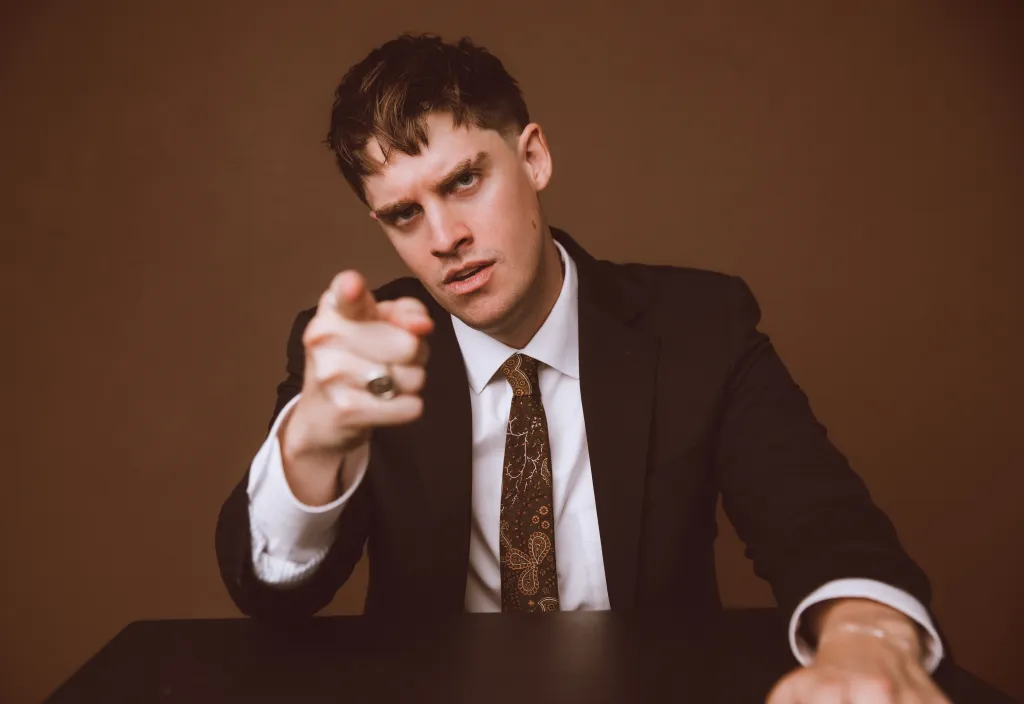
EXCLUSIVE: Comedian Kyle Prue has partnered with iHeartMedia and Will Ferrell‘s Big Money Players on Get Worse with Kyle Prue, a new weekly podcast launching with two episodes on October 6.
Get Worse is an “advice” show where Prue responds to write-in questions while interviewing fellow comics, philosophers, criminals, experts, and more. Is the advice any good? Never intentionally.
In the first episode, Prue will sit down with comedians Hope Carew and Andrew Stier to explore topics ranging from spreading the gay agenda through football to Thanksgiving nudism and how best to blackmail coworkers. Episode 2 will feature actor, writer and comedian Sophia Sherman and special guest Count Dracula discussing 400 years of dating and situationships. Watch a trailer above.
Prue told Deadline, “I am so excited to be the first person to ever start a podcast. I can think of no better home for ‘Get Worse’ than Big Money Players and no better proverbial stepfather to my show than Will Ferrell. I’d like to thank my team, producers and psychiatrist.”
Prue built a following online with his viral series How to Piss Off Men, which amassed hundreds of millions of views across social platforms, culminating in a handbook that debuted as an instant New York Times Bestseller. He’s also the author of the Feud Trilogy – a series of young adult fantasy novels – and the creator and star of the darkly comedic web series Rabbit. As he pursues his offbeat adventures on Get Worse, Prue will occasionally be joined on camera by his co-producers Max Michalsky and Aaron Klein. Additional guests will include comedians, actors and content creators including Kel Cripe, Grant Gibbs, Vinny Thomas and more.
iHeartPodcasts President Will Pearson told us, “We are excited to have Kyle join us on our Big Money Players Network. Whether through his viral content, bestselling writing or now podcasting, Kyle has consistently found creative ways to connect with audiences. ‘Get Worse’ showcases the comedy that has made him a standout voice online, and we can’t wait for listeners to experience that same energy, spontaneity and laughter on his weekly podcast.”
Prue is represented by Brillstein Entertainment Partners, CAA, and Lichter, Grossman, Nichols.
>

Welcome to Global Breakouts, Deadline’s strand in which, each fortnight, we shine a spotlight on the TV shows and films killing it in their local territories. The industry is as globalized as it’s ever been, but breakout hits are appearing in pockets of the world all the time, and it can be hard to keep track… So, we’re going to do the hard work for you.
This week, we head to France, where TF1 is gearing up for the launch of the second season of hit show Cat’s Eyes on October 12, following the adventures of three sisters who embark on a series of spectacular art heists in landmark sites across the country. There’s growing international buzz around the show, and we’ve stolen in for the lowdown.
Name: Cat’s Eyes
Country: France
Producer: Big Band Story
Network: TF1
International Sales: Studio TF1
For Fans of: Lupin, Ad Vitam, Emily in Paris
Based on a cult 1980s Tokyo-set manga by Tsukasa Hojo, TF1’s French live action-drama Cat’s Eyes follows three sisters who embark on a series of spectacular art heists to reclaim a collection created by their missing father.
While the original manga, Cat’s Eye, saw its Japanese heroines, known as the cat’s eyes, raid museums and private collections across Tokyo, the first eight-episode season of the French adaptation unfolded against landmark Paris sites such as the Eiffel Tower, the Louvre and the Palace of Versailles.
Season 1 was a ratings hit and the second travels further afield to open with a daring operation on the Mont St Michel, with other locations including the Musée d’Orsay, Centre Pompidou and Montparnasse Tower. In the back drop, the heroines juggle the search for their father, love lives, sibling tensions and a gallery of colorful, sometimes deadly, characters who cross their paths.
Camille Lou, Constance Labbé and Claire Romain star as the sibling robbers in a cast also featuring Elodie Fontan, Tamara Marthe, Tom Leeb, Arnaud Binard, Lola Dewaere, Jérôme Le Banner, Simon Ehrlacher and Léon Plazol. The show is produced by Paris-based Big Band Story for French broadcaster TF1, which is gearing up for the launch of season 2 on October 12.
Expectations are high for a strong reception after season 1 drew an average 5.3 million viewers per episode, and also chimed with a young-adult demographic, capturing an average 41% audience share among 15 to 24-year-olds. International buzz also continues to build on the back of sales of Season 1 into more than 100 territories, with Hulu acquiring U.S. rights.
TF1 and Big Band Story begins the media campaign for Season 2 with a press junket beneath the giant clock of the Musée d’Orsay in late August, with TV interviews taking place against the backdrop of masterpieces in the Impressionist Gallery next door.
Alexandre Laurent, Mehdi Sabbar and Benjamin Dupont-Jubien
courtesy, Caroline Dubois
Deadline catches up with Big Band Story co-heads Benjamin Dupont-Jubien and Mehdi Sabbar, as well as the show’s director Alexandre Laurent, whose past credits include Women at War, The Bonfire of Destiny and Falco, at the event.
Dupont-Jubien and Sabbar’s explain their initial desire to adapt the Cat’s Eye manga was born out of their personal love of the medium. “We both grew up reading mangas like lots of French youngsters growing up in 1980s and 90s when there was an explosion in the manga culture in France,” says Sabbar.
France’s manga passion
Outside of Japan, France is one of the biggest markets for manga in the world, and the biggest market in Europe. “I still read them to this day and when we created our company some 12 years ago, we always said it was something we wanted to do, even if it’s very complicated to gain access to the rights of Japanese mangas,” says Dupont-Jubien.
Big Band Story identified Cat’s Eye as a manga that would lend itself well to a French adaptation. The original manga was previously adapted into a popular anime series in Japan in the 1980s, which was also broadcast in France.
“We grew up watching the show and we both loved it, and on top of that thought that it’s central story about female thieves who pull off heists to find their father was highly adaptable to France,” said Sabbar.
They began negotiating the rights in 2018, with the pandemic later slowing down the already painstaking process of convincing Hojo that their plans were right for the property.
“It took five years,” says Dupont-Jubien. “For them, trust is a major factor, and to ensure they could trust us, they put us through a lot of tests. They were interested in us: Who we were, what we produced, the quality of our output, our reputation, and whether we would follow through on what we promised.”
Founded in 2015, Big Band Story’s credits to date include the eighth and final season of Spiral in 2020 for Canal+; comedy shows José back in 2016 and Frérots for OSC, as well as the Coup de Foudre (Love In) TV movie franchise and J’irai au bout de mes Rêves, about a young man with Downs Syndrome determined to live life to the full.
“We had to submit documents and statements of intent outlining what we wanted to do. We had letters from the Eiffel Tower, Versailles, and the Louvre showing that we would be able to shoot on these sites,” continues Dupont-Jubien.
Hojo, they added, was not looking for the storyline of the original manga to be replicated to the book, but rather for its spirit and that of the characters to remain intact. “It’s crucial for them not to distort the original manga work,” says Sabbar. “These are titles that sell millions of copies worldwide. They don’t want us doing just anything with them or handling them haphazardly.”
“For example, the cat’s eyes don’t kill people, and they aren’t thieves or criminals either. They don’t go around stealing things. They might steal paintings that belonged to their father, but they wouldn’t rob a bank to get money. Those were the elements that mattered for the spirit of the manga… Things we had to respect.”
Filming eventually began in 2023, with TF1 backing the series and Germany’s ZDF on board as a co-producer, with an overall production budget of €25M ($28.3M).
Director’s take
Director Laurent had previously worked with Dupont-Jubien and Sabbar on the 2018 TV movie Love in Vienna.
“For me, the draw was the producers, whom I knew well, and the ambition they had for the project,” he says. “It was the chance to do something I hadn’t done before and to blend comedy and action, genres I really love in cinema. I knew that with them, we’d have all the resources and ambition needed to try and make the best series possible. Those are the criteria I use when choosing a project.”
Laurent had been on the cusp of embarking on another project when he was sent the screenplay. “I was turning the pages,” he recalls. “The Eiffel Tower was right in front of me and I was reading while waiting for a meeting, an audition. I was like, ‘Wait is the Eiffel Tower involved?’ I went to see the other producer. He understood immediately and said, ‘Alex, you can’t turn this down, go for it’.”
Cat’s Eyes
Jean Philippe Baltel
After the challenge of getting to grips with shooting action scenes in Season 1, Laurent says he found Season 2 less challenging on some levels, which gave him head space and confidence to impose himself on the material and also add more comedic elements.
“The action sequences felt less complicated because I’d done so much of that in Season 1,” he says. “Once the execution of the action scenes no longer took up so much of my mental energy, things became easier. There’s a bit more freedom of tone in the second season.
“I also had a greater sense of legitimacy – I was a bit tentative in Season 1. I was afraid of messing up the manga or upsetting the fans, but this time around, since Tsukasa had liked Season 1, I felt I could bring a bit more of myself.”
Ahead of the French launch of Season 2, the Cat’s Eyes franchise has received an extra boost internationally with Disney+ acquiring EMEA rights to Season 1 in a deal that will make the show available in the UK and Ireland, the Nordics, Benelux, Central Europe, Türkiye and South Africa from December 2026.
Season 2, in the meantime, has been pre-bought by Rai, AMC Global Media Iberia, RTL TVI and RTS, with the Studio TF1 international sales team overseeing the deals. It’s a noisy title ahead of next month’s MIPCOM.
Dupont-Jubien says the growing international footprint is in line with their hopes and ambitions when they conceived the show.
“We aren’t that surprised by where we are now, because the story is fun, it’s pop, it’s universal, and we’re doing it in a very glamorous setting, one that ultimately works internationally,” he says.
“In principle, we had the ingredients found in shows like Lupin or Emily in Paris, which performed very well internationally. We told ourselves there was no reason it wouldn’t work. Of course, hoping it works is one thing, you never have a guarantee. But it is selling, which is great.”
>
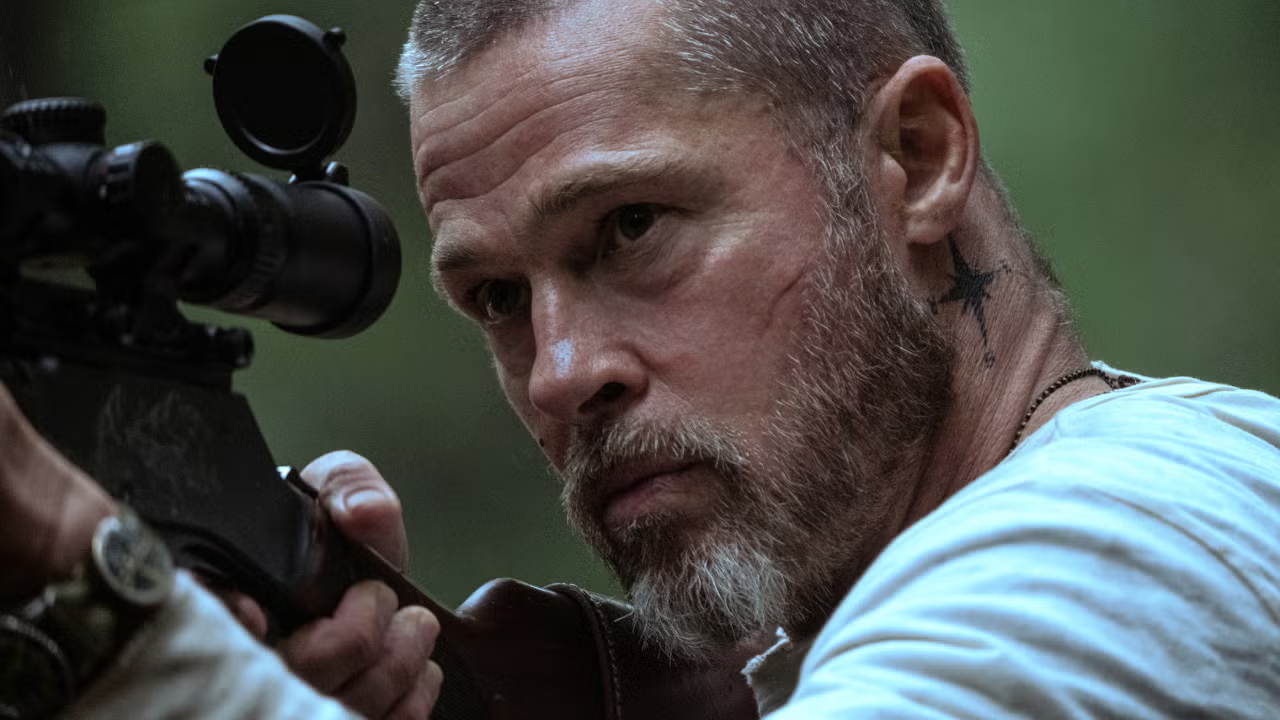
Much has been written about the economic power of movie stars in this day and age, but how is the iconic Brad Pitt performing at the box office? Pitt’s survival thriller “Heart of the Beast” opened to a solid-not-spectacular $20 million this weekend, but history says it’s more likely than not the film will leg out — especially overseas.
In the last 10 years, only one Pitt-starring film failed to clear $100 million at the box office, 2022’s coarse (and divisive) Old Hollywood ode “Babylon.” Even “Allied,” the 2016 Robert Zemeckis romantic drama starring Pitt and Marion Cotillard, grossed $120 million worldwide.
And Pitt’s hits are big. Take a look at these global totals:
That’s to say nothing of the supremely popular ensemble “Ocean’s” movies.
Pitt is not just a draw across different genres — from actioners to sports movies to romantic dramas — but he’s a proven bankable star across decades, hitting a high just last year with Apple’s “F1.” The 62-year-old performs exceptionally well internationally, and he uses his status to flit between blockbusters and more personal projects like Ridley Scott’s “The Counselor” or Andrew Dominik’s “Killing Them Softly.”
He arguably has a better track record of hits than Matt Damon or George Clooney, putting his box office performance closer to Leonardo DiCaprio’s or Tom Cruise’s when taken beat-for-beat. He’s top tier of the top tier.

All of this to say, “Heart of the Beast” getting off to a slower start is likely not cause for concern for Paramount. The film, which finds a stranded Pitt and his dog trying to make it out of the Alaskan wilderness alive, earned strong reviews from both critics and audiences, and it’s the kind of movie that feels poised to perform exceptionally well on PVOD. So even with an $82 million budget, its chances of recouping are solid.
It’s one of two big Pitt movies out this fall, with the next coming in November with “The Further Mis-Adventures of Cliff Booth,” the David Fincher-directed, Quentin Tarantino-written continuation of Pitt’s Oscar-winning role from “Once Upon a Time in Hollywood.” Netflix is making “Cliff Booth” its first-ever IMAX release with a special two-week engagement.
Now, on to the rest of this week’s Reel to Real column as we tackle “Avengers: Endgame Encore” leading the box office, what happens to the creative community under Paramount-Warner Bros., Jeffrey Katzenberg’s AI animation ambitions and more.
And if you want this column as a newsletter in your inbox every Monday morning, go to “Newsletters” in your WrapPRO account settings.

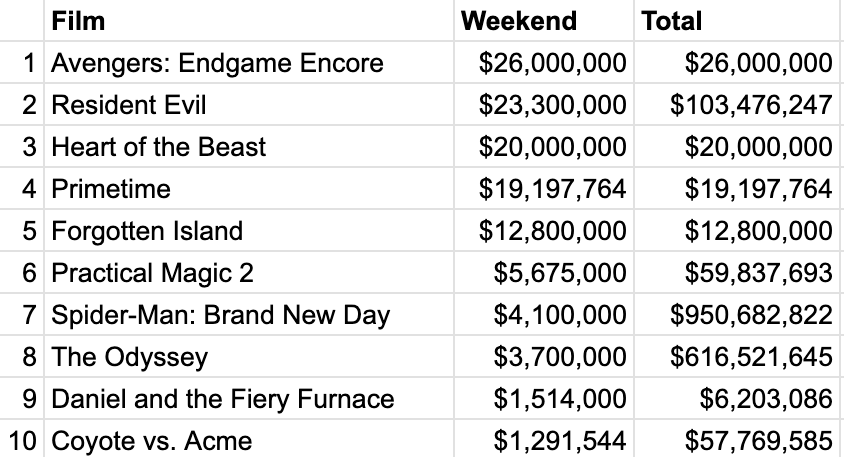
On a weekend when all the films in the box office top 5 cleared $10 million, Marvel Studios was king with a 2019 title in re-release – “Avengers: Endgame Encore.” Remarkably, the film took in $26 million domestically and $86 million worldwide.
The domestic total is just a touch above the $25.5 million grossed last year by the 20th anniversary re-release of “Star Wars: Episode III — Revenge of the Sith” and brings the lifetime total of “Endgame” to $884 million domestic and $2.88 billion worldwide.
Taking second is Sony’s “Resident Evil” with $23.3 million in its second weekend, bringing its domestic total to $103.4 million. While the arrival of “Endgame Encore” may have led to a sharper 61% drop despite the strong reception for Zach Cregger’s horror film, it should still be a solid theatrical success as it moves past the $100 million mark.
Filling out the rest of the top 5 is a trio of new releases: A24’s “Primetime,” Paramount’s “Heart of the Beast” and Universal/DreamWorks’ “Forgotten Island.” Of the three, “Primetime” is in the best place to turn a theatrical profit with a reported $15 million budget before marketing, while the other two face a more uphill battle with production spends of $80 million.
But it is “Heart of the Beast” that narrowly leads the bunch with a $20 million domestic and $50 million global opening from 3,435 locations. Domestically, the film will have to leg out with its core audience of white moviegoers over 35, predominantly in rural states. Reception for the film is strong with an A- on CinemaScore and PostTrak scores of 74% “definite recommend” and 90% overall positive.

“Primetime” is just behind “Heart of the Beast” with a $19.1 million opening from 2,874 screens. It remains to be seen how word-of-mouth will affect the legs of “Primetime,” as the film’s critical eye towards “Predator,” host Chris Hansen and true crime TV in general may have put off some moviegoers who thought they were getting a more straightforward biopic about the show. The film had a B+ CinemaScore.
But what is clear is that despite the film’s subject matter and 2000s setting, “Primetime” is being driven by Gen Z, with an audience that is 69% under the age of 30, showing both the drawing power of lead star Robert Pattinson and A24’s success in building a core fanbase of young cinephiles.
Then there is “Forgotten Island,” which, despite excellent critical and audience reception, is sputtering out of the gate with an opening weekend of just $12.8 million from 3,548 locations.
Those who have seen “Forgotten Island” have raved about it, giving the film an A on CinemaScore and excellent PostTrak scores of 81% definite recommend and 96% overall positive. But with this start, any legs that come from such strong word-of-mouth would likely only get it close to the break-even point, making this title the latest example of Hollywood struggling to get audiences to buy into original theatrical animation even with rave reviews. – Jeremy Fuster

As David Ellison aims to wrap up Paramount’s acquisition of Warner Bros. Discovery in the coming weeks, what does the merger mean for creatives in the industry? Lucas Manfredi and Jeremy Fuster spoke with insiders about the layoffs to come. Read the full story here.
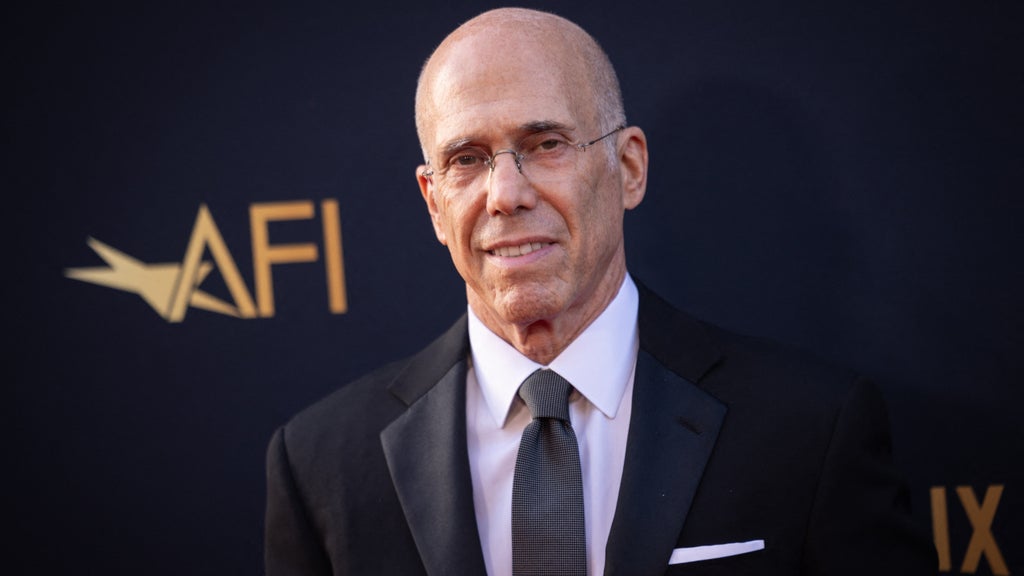
Katzenberg Is All-in on AI: Jeffrey Katzenberg tells Sharon Waxman that he plans to launch an animation studio that will use generative AI to make films.
The Best Picture Race So Far: Steve Pond offers his initial predictions for what gets into the Best Picture Oscar lineup at this stage.
M. Night Shyamalan Looks Back: The filmmaker got candid with TheWrap’s Drew Taylor about his most underrated film, working with Bruce Willis on his last “real” movie and more.
Quiet on Set: “The Love Hypothesis” star Lili Reinhart says her decision to make TikToks on set initially got her in trouble — then it became a cornerstone of the Amazon film’s marketing.
Skywalker Lives: Jon Watts, the filmmaker who directed the first three Tom Holland Spider-Man movies, will direct “Star Wars: Episode X.”
Chris Hansen’s review of “Primetime” isn’t as vitriolic as you might think.
Exclusive: Ebon Moss-Bacharach is Kelso in “Heat 2.”
Sabrina Carpenter is Ginger Rogers and Margaret Qualley is Adele Astaire in Tom Holland’s Fred Astaire biopic.
The next “Saw” movie has a director.
The documentary “NAZA” will stream for free on The Guardian’s website after its international rollout.
Robert Eggers will next direct a “Romeo & Juliet” adaptation. Can Shakespeare’s classic get even darker? We’re going to find out.
There’s a new documentary produced by Rachel Maddow on Peacock that offers a fascinating — and at times disheartening — look at a shocking war between a small family-run newspaper and local law enforcement in a rural Oklahoma county. Called “Kill. Bury. Print.,” you may recall the events at the center of the film, in which a commissioner and sheriff were caught on tape allegedly plotting to murder the reporter who’d been writing negative stories about the sheriff. Much has rightly been written about Trump’s actions against coverage he deems negative, but this shines a light on the trickle-down effect those actions have had on establishments elsewhere in the country.

>


Search For Canadian TV Actor Stewart McLean Now Homicide Investigation


These ’90s fashion trends are making a comeback in 2017
According to Dior Couture, this taboo fashion accessory is back
Model Jocelyn Chew’s Instagram is the best vacation you’ve ever had
Emily Ratajkowski channels back-to-school style
9 Celebrities who have spoken out about being photoshopped


Rurouni Kenshin: Hokkaido Arc Manga Takes 1-Issue Break – News


HIDIVE to Stream English Dubs for The World Is Dancing, The Forsaken Saintess and Her Foodie Roadtrip in Another World, The Dangers in My Heart: The Movie Anime – News