
Entertainment
‘The Electric Kiss’ Review: Cannes Opening Night Film

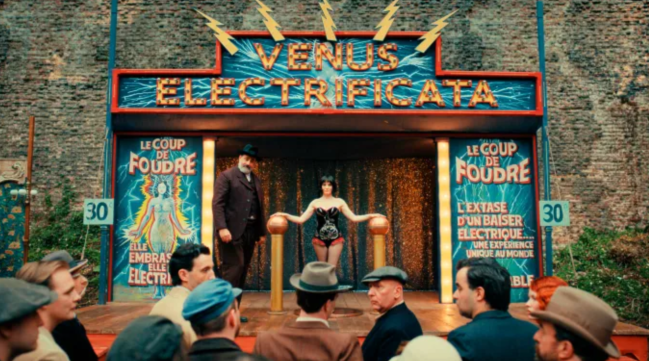
Too many inputs overcharge Pierre Salvadori’s “The Electric Kiss,” an otherwise low-key, low-stakes charmer that opens this year’s Cannes Film Festival with only a faint spark.
No shortage of fine, fizzy films already exist within the confines of this 122-minute romp, but Salvadori (not without reason) recognizes that committing to any one means sacrificing the others. Instead, he folds them together into a period rom-com that badly overstays its welcome, cycling through inspired detours and frustrating dead ends as it unevenly channels several competing sensibilities before eventually fizzling out.
Still, credit the film for innovation: while all-star casts are hardly uncommon on the Cannes red carpet, “The Electric Kiss” ups the ante with an equal wattage of screenwriters. Rebecca Zlotowski (“A Private Life”) and Robin Campillo (“BPM”) share story credits alongside Benjamin Charbit (“The Beast”) and longtime collaborators Salvadori and Benoît Graffin, together overcrowding a carny-and-conman comedy that strains a little too hard for the Lubitsch touch.


The year is 1920, and the carnival has come to town. Just beyond the respectable edges of Paris, among the soothsayers and strongmen, works Suzanne (Anaïs Demoustier). Inside the fairgrounds she’s known as Venus Electrificata, a flapper femme fatale perched atop a low-voltage platform, ready to deliver a mild shock to any punter willing to spend a few francs for a kiss. “Love is pain, love is ecstasy,” shouts the act’s barker (Gustave Kervern), a small-time hustler who keeps Suzanne in near-indentured servitude while running the attraction like a PG-rated pimp.
Understandably, Suzanne wants out. Fortuitously, she finds a possible escape by moonlighting as a medium for the grieving artist Antoine Balestro (Pio Marmaï). Wracked with guilt, flush with cash, and never far from a drink, the widower will pay any price to reconnect with his dearly departed muse — and so too will his frustrated gallerist (Gilles Lellouche), who sees the fake medium as the ideal catalyst for getting his top earner back to work. There’s money to be made from a drunken widower, but a productive painter promises wealth on an entirely different scale. And what difference does it make for Suzanne, who already spends her days functioning as a kind of conduit?
“The Electric Kiss” peaks early, finding its surest and most entertaining footing as the gal and the gallerist set their con in motion. For all the moving parts and elaborate period design, Salvadori finds grace in the simplest visual language when cutting between two perfectly cast faces in close-up. Of all contemporary Gallic stars, Lellouche and Demoustier already feel slightly out of time, their features recalling both silent-era performers and screwball archetypes. Salvadori leans into it, framing Demoustier’s wide eyes and sharp cheekbones beneath a Louise Brooks bob, while fitting Lellouche’s rectangular head with a mustache that somehow makes him seem even more French. Watching the pair scheme in crisp shot-reverse-shot carries much of the film’s easy charm, like witnessing a pair of Al Hirschfeld caricatures suddenly brought to life.
“The Electric Kiss” soon stumbles, however, once it introduces a new narrative strand and a fourth key player. To sustain her ruse, Suzanne discovers volumes of diaries written by the painter’s late wife. From there, the film plunges into flashback, following Irène (Vimala Pons) as she falls in love and gradually transforms a dissolute artist into a great modernist painter. Pons is, as ever, an excellent comic performer, but the film does her no favors in the way it stacks its two narrative drives. On one hand, there is the present-day grift; on the other, a time-hopping love triangle between a girl, a guy, and a ghost. If both strands hew to familiar rom-com rhythms — heck, the title alone signals where things are headed — the film still seems to forget the genre’s most basic geometry: if three’s a party, four’s a crowd.
Unable to neatly reconcile its two narrative premises, the film loses momentum, pushing well past the brisk runtime and zippy pace this kind of material usually depends on. That overextension also affects tone, as Salvadori never quite settles on how sharp the film should be. “The Electric Kiss” may build this tension into its very title, promising both pleasure and pain, but the finished product never quite strikes that balance. Once the bubbles fade and the doldrums set in, one is left thinking back to the film’s many collaborators, wondering who threaded in its darker undertow — as Suzanne’s backstory and her relationship with her carny master carry an unmistakable strain of cruelty and latent sadomasochism — and who, by contrast, insisted on yet another sequence of lovers frolicking in sunlit meadows.
For his part, Salvadori seems content to shoot it all and see what lands, veering between the ominous and the earnest, generosity and genuine menace. Motivations and motifs shift from scene to scene, but what does it matter when life is a carnival and the cast is so winning? Fair enough, perhaps, but take heed: this particular attraction comes with whiplash.
Grade: C
“The Electric Kiss” premiered at the 2026 Cannes Film Festival.
Want to stay up to date on IndieWire’s film reviews and critical thoughts? Subscribe here to our newsletter In Review by David Ehrlich, in which our Chief Film Critic and Head Reviews Editor rounds up the best new reviews and streaming picks along with some exclusive musings — all only available to subscribers.
>
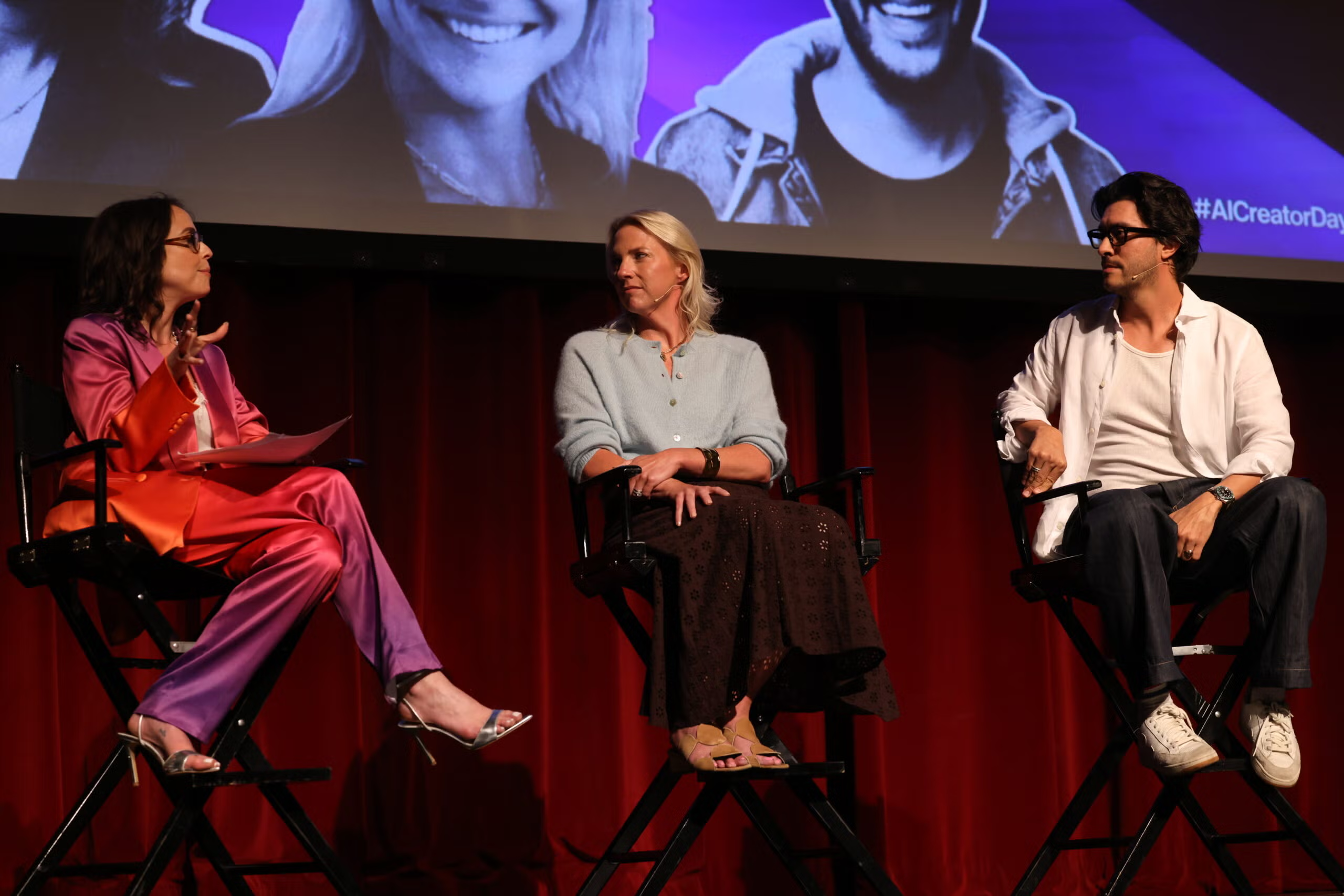
Artificial intelligence is here and can’t be ignored, which one creator summed up neatly with a matter-of-fact comment.
“I do voice acting as well, and so I’m already preparing for my job to not exist,” said Vincent Marcus, a creator and comedian who does impersonations, about why he’s gone all-in on AI.
Marcus was speaking on Tuesday at TheWrap’s inaugural AI Creator Day, a part of our annual Grill business conference. The subject of the panel was about voicing AI-generated bot characters for AI social platform Cantina, which offers the potential for him to monetize his creativity.
Being able to better monetize creator ideas and imagination was a key theme to the all-day conference. But an undercurrent was the inevitability of AI, and the perils of ignoring the technology that’s disrupting every industry. For creators, it’s a fine line to walk, with even the hint of using AI eliciting fan backlash.
But for those at the panel, the upside of AI is too attractive to ignore.
“This is where the future is heading,” said Rebecca Zamolo, a YouTube and founder of MOLO Fertility. “I think it’s important that we acknowledge that. I think it’s about being transparent with your audience.”
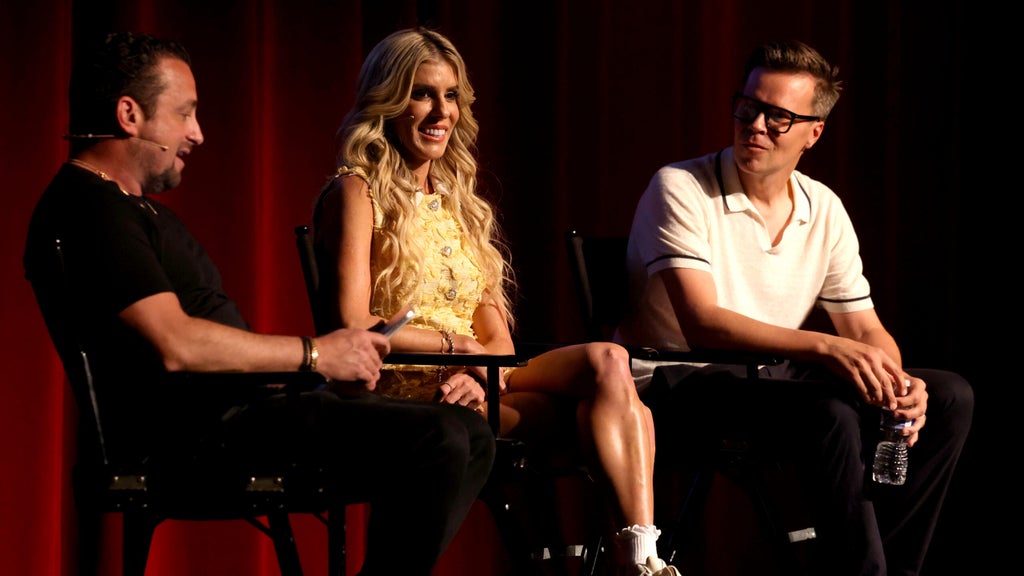
As AI has become more prevalent, more creators have been using the technology in their workflows. Some creators use this tech through third-party companies like Cantina; some use popular AI platforms like ChatGPT and Claude directly, and some use AI tools that have been directly added to the biggest social media platforms.
For example, YouTube’s AI tools let creators A/B test headlines and thumbnails, and Ask Studio — the platform’s AI-powered Q&A offering — acts as a specialized AI agent that’s fluent in a creator’s channel, a feature that’s helpful for data analytics. TikTok has its Symphony Creative Studio, a generative suite that lets creators use AI to create text-to-video, image-to-animation and digital avatars. As for Instagram, the Meta-owned platform has Muse, a personal AI agent designed to help Instagram creators manage workflows, analyze account activity and plan content
Zamolo and husband Matt Slays talked about how AI dubbing of its content has extended the reach of their YouTube channel. Slays noted that its channel went from having 65% of its audience being in the U.S. to 35% in short time (he didn’t specify), noting the wider international audience it now gets
“We were able to exponentially grow our markets without doing as much,” Slays said.

Don’t hate the game
Shira Lazar acknowledged the stigma of the “AI creator” and polled several participants about what they should do it about it.
“We don’t get to decide,” said Destorm Power, an entrepreneur and creator. “If they want to call me an AI creator, that’s fine.”
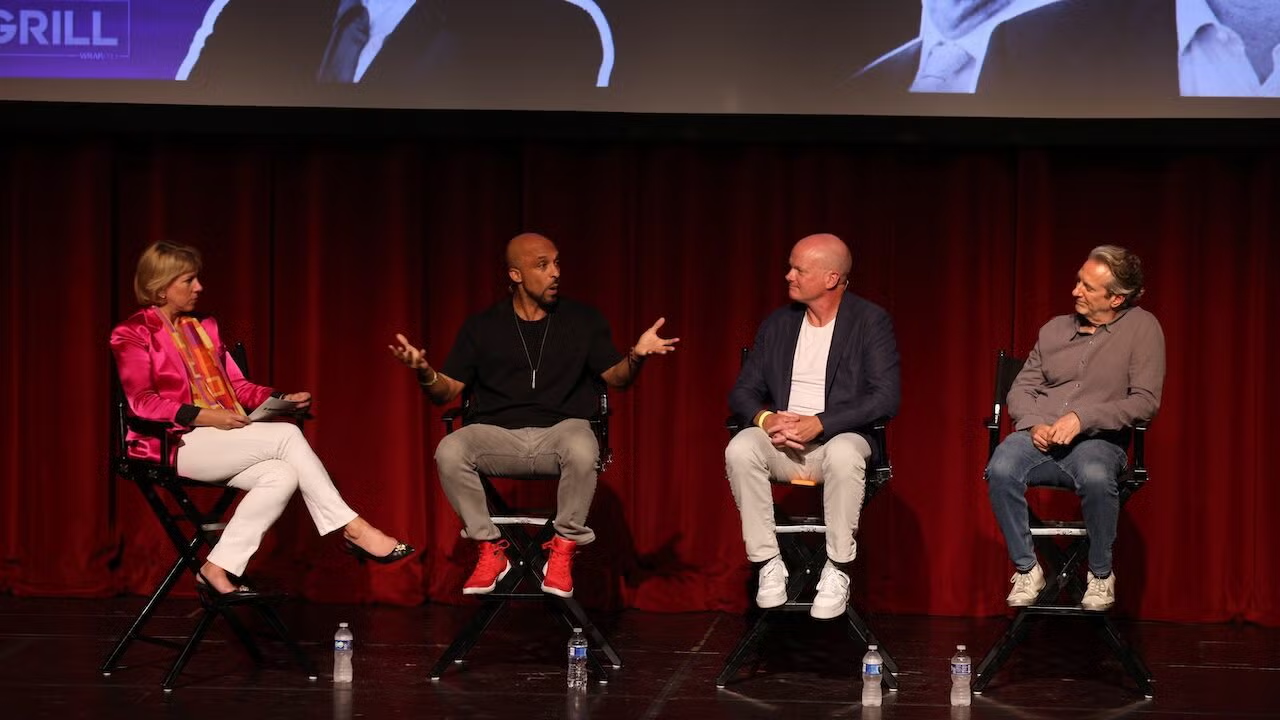
“The game is changing, we’re just in the game,” said Bernie Su, head of creative for Pickford and an Emmy-winning web series creator. “We’ll do our thing. Audiences will react to us, and we’ll see what happens.”
Zamolo acknowledged that they’re still testing the boundaries with what is and isn’t okay with AI.
“If it gets crazy, they usually will call us out in the comments,” she said. “But I think that’s just part of learning how to use it correctly anyway.”
But one of the key ideas several participants stressed was dispelling the notion that AI was killing creativity. Instead, that’s something that’s in greater need as the technology allows people to bring to life their wildest ideas.
“Everyone’s creative. Get those ideas out there. Write them down,” said Katherine Rundell, senior director of partnerships at Cantina. “Keep those ideas flowing. Creativity is more important than ever in the age of AI. Lean into that.”

Q: I guess do you get any pushback from my past provision from other creators? You know, even being here, I think that you saw some creators that are like instead coming here to talk about this, and others that are scared because they get a lot of pushback from the audience. Are you ever worried about it, guys.
A (Rebecca Zomolo speaking):
>
>
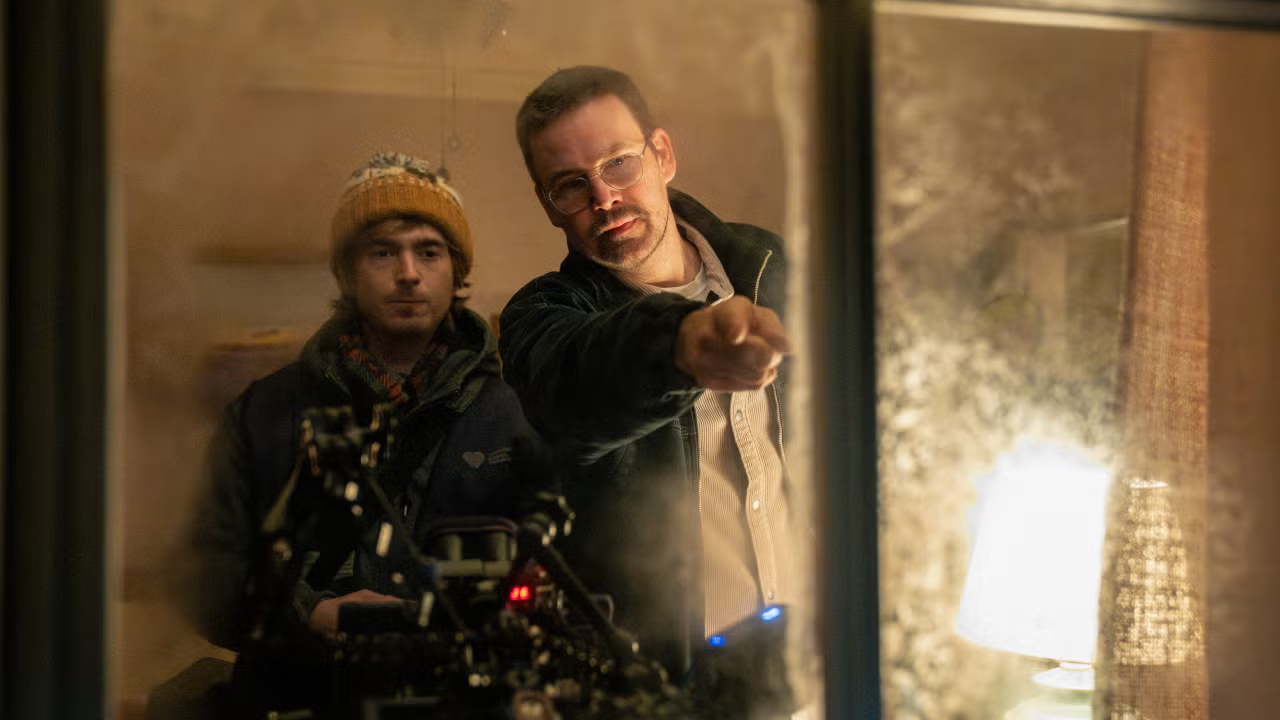
Zach Cregger’s “Resident Evil,” in a little more than two weeks, has already amassed nearly $200 million at the global box office.
Instead of a straight adaptation of the long-running video game series (or an extension of the already-existing film franchise), Cregger chose to tell a new story within the world of the games – a story that follows a hapless medical courier named Bryan (played by Austin Abrams), who is sent on a desperate mission to the heart of Raccoon City during a zombie outbreak. It is an all-gas, no-brakes rollercoaster ride that is carried along by Abrams’ performance – vulnerable, hilarious, inquisitive, the perfect audience surrogate. Even when things get weird, really weird, Abrams’ oddly emotional performance keeps us engaged.
Abrams said that Cregger first mentioned the project while the two were working on “Weapons,” which would go on to be a box office hit and an unlikely Oscar winner. But Cregger didn’t say anything specific about Abrams joining the project.
“It wasn’t until he was in post-production for ‘Weapons’ that he called and wanted me to read the script basically,” Abrams said. He hadn’t played the games (“Other than seeing it and being too afraid to play it”) but once he got the part it emboldened him to play horror/survival games that had a similar spirit.
Whereas “Weapons” was an ensemble piece, with Abrams portraying an unforgettable character (a junkie/thief who stumbles upon the mystery of a missing classroom of kids), with “Resident Evil” he would take center stage. The movie is him. And that left him a little nervous.
“You never know if you can do something until it’s done. It’s huge question marks. I feel personally like we’re going to be interested enough in watching this person,” Abrams said. “Not that everyone could feel that way. Or are they going to be like, I don’t really care about this guy that much. I don’t really want to watch this movie? It could happen. There’s a lot of feelings of the unknown came up.”
While shooting the movie, Abrams started to get the impression that it was going to be okay. “You catch the vibe of the people around you and they’re seeming to be into the character and that helps. You’re not getting like red lights. You keep going,” he added.
And while Abrams knew that he would be the audience stand-in, crafting a character through physicality rather than dialogue (“It feels good being in the body and using it as a tool,” he said) there were still some pretty radical changes to the final film, like when Cregger admitted that, after a test screening, he went through the movie and pulled out most of the jokes.

“There were some asides where I was like, ‘Are you going to keep that?’ Or ‘maybe check that out again.’ There was a bunch of stuff like that where we would take it to a place that was too far, really for our own enjoyment. And you never really know, until you get in the edit, how much you’re going want or not,” said Abrams. ”Especially for like this, where it’s a straight shot and there aren’t all these other characters that you’re interacting with. You want options. I don’t think it would be as enjoyable to watch if it was just straight through. If there wasn’t any laughs in it, I think it would be too unrelenting. Adding comedy, which is what I think Zach is so smart about too, really helps the enjoyment of it and relieves some of the pressure.”
One thing scarier than zombies or plague-infested monsters was the response of the die-hard Resident Evil fans to Cregger making a movie that eschewed the classic characters and established lore of the series. They were very upset about his approach.
Abrams was sympathetic. “I read a book that I love and then they’re going to do another one or make it into a different one. You don’t want someone to f–k it up. You have a personal connection with it. I get what that feeling is like. There’s that passion there,” Abrams said.
He said that he and Cregger “did the best job we could.” “We had a strong base of love and I think our best shot at making something that they would enjoy,” Abrams said. Cregger is a huge fan of the games and has played them all, including this year’s Resident Evil: Requiem. Their approach? “Make what you dig and then hope that other people dig it,” said Abrams.
Fan service was not something that they were interested in (Abrams said it doesn’t work in “a meaningful way”). “If you’re going to end up making something that feels fresh, I think that’s the best shot you have making something interesting,” he said. But still, he said, “I only send love to all those people.”
Before he started working with Cregger, Abrams was a fan of “Barbarian,” his debut feature. He remembers thinking, I love whoever’s made this movie, because they have guts and extreme talent and skill, and a comedic understanding that is really rare and that I relate to. Meeting him, Abrams found that they were perfectly in sync.
“We connect on many other levels, aspiring for the same thing and we have a similar level of what we deem to be the work that we want to make,” Abrams said. “I think that helps us to push each other. We both understand what it is we’re trying to make and have a similar sensibility.”
“He is a total dream to work with. I mean, truly a dream, and he is a beautiful, kind person. And he’s such a formidable actor. He’s so good at whatever he tries to do. I have yet to see him find his limit. That guy’s range is miraculous,” said Cregger. “When it was time to go and put this one together, it was like there wasn’t even a decision. There was not a moment of like, Well, who else could we? No, it’s Austin.”

There isn’t a role for Abrams in Cregger’s upcoming sci-fi freakout “The Flood” (which just cast Jennifer Lawrence in the lead role), but when we asked Abrams if he was the Kurt Russell to Cregger’s John Carpenter, he smiled wide and said, “Hey, you said it. I didn’t say it.”
When it came to – spoilers ahoy! – Abrams’ monstrous transformation towards the end of the film, he said that he actually found the motion-capture process enjoyable.
“I was shocked at like how minimal they needed to be able to capture everything,” said Abrams. “It’s all those other guys. You see them in a room, just imagining all this stuff.”
And given the open-endedness of the movie (and the fact that the video game series has been running for so long), we had to ask if Cregger had said anything to him about coming back for another installment. Another entry seems more and more likely, especially as its box office tally continues to grow.
“We’ve had the smallest of discussions. I also don’t want to go into it too much at all because I don’t know how things would play,” said Abrams.
Still, it’s very clear – if Cregger has an idea for how to bring Bryan back to snowy Raccoon City, Abrams would be there. In whatever shape – monstrous or otherwise – that would take.
“Resident Evil” is in theaters now.

>
NBA attempting crackdown on off-arm shoves by offensive players

Van Veen: MvG's early World Grand Prix exit 'not as much of a shock'

Creators: AI Is the Future. We Need to Be Transparent About Using It
-

 movies4 months ago
Search For Canadian TV Actor Stewart McLean Now Homicide Investigation
-

 Fashion9 years ago
These ’90s fashion trends are making a comeback in 2017
-
Fashion9 years ago
According to Dior Couture, this taboo fashion accessory is back
-
Fashion9 years ago
Model Jocelyn Chew’s Instagram is the best vacation you’ve ever had
-
Fashion9 years ago
Emily Ratajkowski channels back-to-school style
-
Fashion9 years ago
9 Celebrities who have spoken out about being photoshopped
-

 Anime4 months ago
Rurouni Kenshin: Hokkaido Arc Manga Takes 1-Issue Break – News
-

 Anime3 months ago
HIDIVE to Stream English Dubs for The World Is Dancing, The Forsaken Saintess and Her Foodie Roadtrip in Another World, The Dangers in My Heart: The Movie Anime – News