
Tech
IEEE Society ‘s Pitch Sessions Link Lab With Market

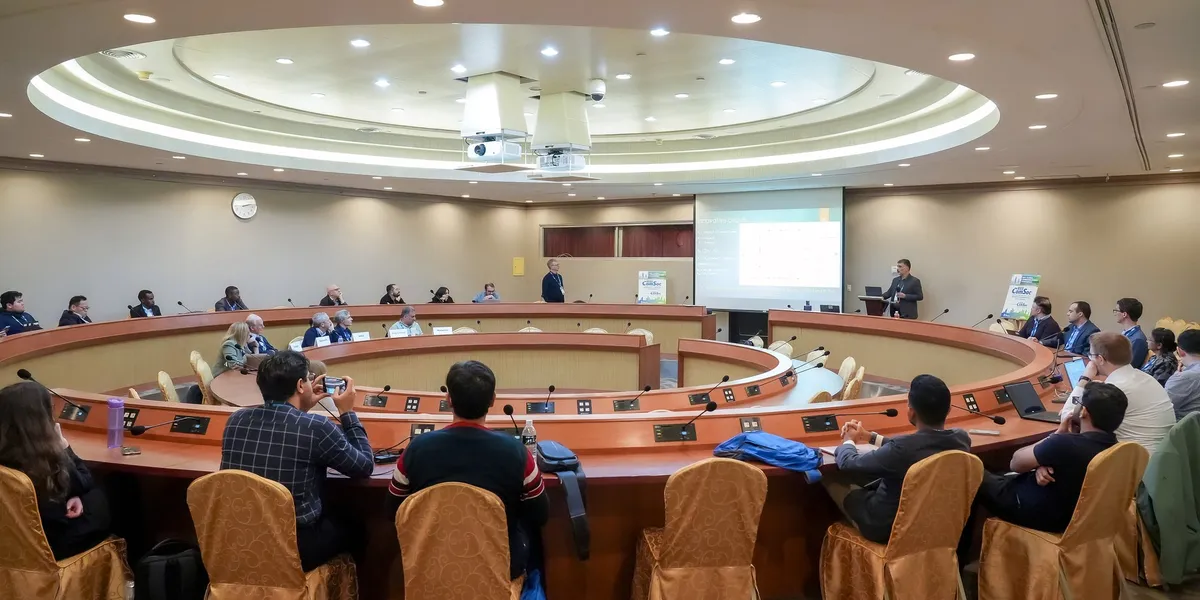

The IEEE Communications Society (ComSoc)’s Research Collaboration Pitch Session initiative is proving to be a catalyst for meaningful engagement between academic researchers and industry innovators. Launched last year, the program connects promising researchers with industry leaders who can offer them funding, mentorship, and connections to bring interesting ideas closer to real-world deployment.
Rather than relying on chance encounters at conferences, the pitch sessions create a focused environment. Five academic presenters share their work with five industry representatives, known as “innovation scouts”: senior leaders primarily chosen from ComSoc’s Corporate Program partner companies such as Ericsson, Intel, Keysight, and Nokia. The curated format ensures that each idea receives dedicated attention from professionals who are seeking new concepts aligned with their organization’s priorities.
The initiative was launched in November at the IEEE Middle East Conference on Communications and Networking (MECOM) in Cairo and appeared in December at the IEEE Global Communications Conference (GLOBECOM) in Taipei, Taiwan.
AI-driven communication network
One of the most compelling outcomes came from the inaugural session in Cairo. Angela Waithaka, a student member and biomedical engineering student at Kenyatta University, in Nairobi, Kenya, presented her “AI-Driven Predictive Communication Networks for Enhanced Performance in Resource-Constrained Environments” paper. You can view her presentation along with others on IEEE.tv.
Waithaka’s research tackles a critical challenge: Next-generation communication systems increasingly rely on artificial intelligence and machine learning, yet most existing architectures consume abundant computational and energy resources, which are not always present in developing regions.
Waithaka proposed lightweight, adaptive AI/machine learning models capable of delivering predictive, reliable communication performance even under tight resource constraints.
Her vision resonated with Ruiqi “Richie” Liu, a master researcher at ZTE in China. ZTE is a global leader in integrated information and communication technology solutions. Liu says he recognized the relevance Waithaka’s proposal had to his company’s work with the International Telecommunication Union. He invited her to establish an ITU account so she could participate in the organization’s meetings discussing global telecommunications standardization projects—which would elevate her work to an international stage.
Simplifying data center protocols
The momentum continued at GLOBECOM. Among the presenters was Nirmala Shenoy, a professor at the Rochester Institute of Technology, in New York. Shenoy, an IEEE member, spoke on the topic of simplifying data center network protocols. She highlighted the growing complexity of the critical networks, which underpin cloud services, enterprise IT, and emerging AI workloads.
Shenoy’s focus on reducing protocol complexity while maintaining scalability, resilience, and low latency caught the attention of an innovation scout from Nokia, who heads its eXtended Reality Lab in Madrid. He found the key person at Nokia for Shenoy to connect with to discuss her research, and it led her to record a video for the company detailing her approach and its potential applications.
A model for accelerating innovation
The early success stories demonstrate the power of intentional, structured engagement. By bringing researchers and industry leaders together in a format designed for discovery, ComSoc is helping accelerate innovation and expand opportunities for collaboration. The pitch sessions are not merely conference events; they are becoming a bridge between academic creativity and industry implementation.
This year sessions will be held during the IEEE International Conference on Communications in Glasgow from 24 to 28 May, and more are scheduled during the IEEE International Mediterranean Conference on Communications and Networking in Sardinia from 6 to 9 July, and at GLOBECOM in Macau from 7 to 11 December.
As the program continues to grow, it could become a signature ComSoc initiative, one that strengthens the research ecosystem, supports emerging talent, and ensures that promising ideas find pathways to real-world impact.
From Your Site Articles
Related Articles Around the Web
>

As part of a planned data center in Pecos County, Texas, Amazon is investing in an on-site power plant that could become the largest source of climate pollution in the United States, according to The New York Times.
The NYT says the plant would burn natural gas and is permitted to release 33 million tons of carbon dioxide per year — more than any other power plant in the U.S.
In a statement, an Amazon spokesperson confirmed that the data center will “be powered by new on-site generation that won’t raise electricity costs for Texas families.” (Data centers face growing political opposition for a number of reasons, including their effect on electricity costs.)
AI has already had a significant impact on Amazon’s carbon emissions, which it reported were up 16% last year — the wrong direction for a company that pledged to eliminate its carbon emissions by 2040. And that could get worse as Amazon and tech companies back the development of huge natural gas plants to support their power-hungry data centers.
The Amazon spokesperson said, “The world looks different now than when we co-founded the climate pledge,” while also claiming, “Our commitment hasn’t changed.”
>

NextSlide recently announced that it’s joining OpenAI, with the presentation startup’s team members now working on ChatGPT.
The NextSlide website currently displays a note from founder Ahmed Beshry describing the startup’s product as one “that could turn prompts, notes, documents, or research into a polished, editable presentation.”
The ultimate goal, Beshry said, was “to make visual communication more accessible and help more people express their ideas clearly.” So by joining OpenAI, the team will “continue pursuing that same mission: building AI products that help people create, communicate, and turn their ideas into meaningful work.”
The financial terms of the deal were not disclosed. In a note on LinkedIn, Beshry said the announcement is coming “a few months late,” as the acquisition took place “earlier this year.”
Beshry was previously a co-founder at Caper AI, a smart cart/cashier-less checkout startup acquired by Instacart in 2021.
>

X, the social media platform now owned by Elon Musk’s SpaceX, is shaking up how it pays influencers and creators.
In announcing the change, the company said it will be winding down its existing Revenue Sharing program and replacing it with something called Original Content Rewards. X will stop accepting new Revenue Sharing participants, while existing participants will continue earning money through September 7.
Then, starting on September 8, they’ll be able to apply for the new program. Participants will still need to subscribe to one of X’s Premium tiers, and there will be qualifying thresholds for follower count (500 verified followers) and impressions (500,000 Home Timeline impressions from verified users in 90 days), but it sounds like the big change is the emphasis on originality.
What counts as original content? X said it can include original reporting and analysis, photos and videos created by the poster, or memes and graphics they’ve designed themselves. Commentary also counts, but “if your content regularly incorporates material created by others, you’ll need to contribute meaningful original value for it to qualify under our original content guidelines.”
The company also included examples of posts that won’t count as original, such as those just copied over from another account, downloaded from one account and re-uploaded to your own, or reposting content “without meaningful transformation.”
This announcement follows repeated attempts by X to reform the Revenue Sharing program, for example reducing payments to aggregators and “clickbait” accounts in April. But these efforts have also prompted complaints from popular accounts profiting from the current system; Musk even reversed some of those changes (giving a creator’s local audience more weight when calculating payouts) after a backlash.
In a post about the new changes, X’s Allegra Jacchia wrote that the existing program “had reached a point where its incentives were misaligned.”
“Creators should be focused on bringing net new content to the platform instead of maximizing payouts,” she said. “We could have kept adding more rules and exceptions, but ultimately the better decision was to start fresh and build a program designed from day one to reward originality.”
Jacchia added that X be “continue refining the program, improving our models, and raising the bar over time.”
When you purchase through links in our articles, we may earn a small commission. This doesn’t affect our editorial independence.
>

Wales must learn from Bosnia and Herzegovina loss in Euros bid – Ian Rush

Barcelona beating Real Madrid to Rodri’s signing would be a power shift in Clasico rivalry

Brandon Williams interview: ‘I was immature and stupid. I look back now and think what an idiot I was’
-

 movies3 months ago
Search For Canadian TV Actor Stewart McLean Now Homicide Investigation
-

 Fashion9 years ago
These ’90s fashion trends are making a comeback in 2017
-
Fashion9 years ago
According to Dior Couture, this taboo fashion accessory is back
-
Fashion9 years ago
Model Jocelyn Chew’s Instagram is the best vacation you’ve ever had
-
Fashion9 years ago
Your comprehensive guide to this fall’s biggest trends
-
Fashion9 years ago
9 Celebrities who have spoken out about being photoshopped
-
Fashion9 years ago
Emily Ratajkowski channels back-to-school style
-
Fashion9 years ago
A photo diary of the nightlife scene from LA To Ibiza