
movies
‘The Meltdown’ Review: Slow-Burn Mystery Set in Chile’s Wintry Andes


As The Meltdown (El Deshielo) begins, vintage news footage reveals the strange-but-true sight of something being lifted out of a frosty sea. It’s a huge chunk of an Antarctic iceberg, on its way to becoming the centerpiece of Chile’s pavilion at the 1992 world’s fair. As a symbol of national ingenuity and know-how, the frosty specimen is kind of out-there. And yet, for a country emerging from 17 years of military rule and determined to redefine itself, it represents an understandable leap of faith. It’s also an apt starting point for a movie in which submerged things come to light, if only briefly — a coming-of-age story where the key lesson is to keep what you know to yourself.
Manuela Martelli’s well-received debut, 1976 (aka Chile ’76), a selection of the 2022 Directors’ Fortnight, took place during Chile’s Pinochet era. The writer-director sets her sophomore feature barely two years after the country shook off the despot’s iron grip. Inés, the lead character, was born in the final years of the dictatorship. A cherub-faced 9-year-old with an old soul, she watches the grown-ups around her calibrate their actions to a shifting world. Truth, she discovers, is less important than the ability to anticipate how people will react to it.
The Meltdown
The Bottom Line
Haunted and haunting.
Venue: Cannes Film Festival (Un Certain Regard)
Cast: Maya O’Rourke, Saskia Rosendahl, Maia Rae Domagala, Jakub Gierszal, Paulina Urrutia, Mauricio Pešutić
Director-screenwriter: Manuela Martelli
1 hour 48 minutes
Watchful, precocious and utterly un-cutesy in the compelling performance of Maya O’Rourke, Inés moves freely around her grandparents’ mountain ski lodge while her mother and father are away. It’s not clear whether they’re bureaucrats, scientists, artists or entrepreneurs, but they’re in Spain as members of Chile’s iceberg-delivering delegation at Expo ’92 in Seville. While her grandmother, Techa (Paulina Urrutia), and grandfather, Ricardo (Mauricio Pešutić), are busy entertaining potential investors, Inés basically has the run of the place, a tightly operated and pleasingly dated hotel in a remote corner of the Andes, near a ski lift. Inés is friends with the pair of hardy dogs who oversee the property, and moves easily among the hotel’s employees and, later, when she’s in detective mode, its guest rooms. She hangs with receptionist Sonia (Paula Zúñiga) at the front desk, trades greetings with Sonia’s brother, bartender Genaro (Luis Uribe), and, against Techa’s wishes, slips into the room of housekeeper Paty (Daniela Pino) when she doesn’t want to sleep alone.
Inés becomes fascinated with one of the guests, a German skier about five years her senior. Hanna (Maia Rae Domagala), the only girl on her training team, is also its star, but her dwindling drive frustrates her coach, Alexander (Jakub Gierszal), whose bond with Hanna appears more complicated and troubling each time the screenplay places them together.
Inés approaches the teen with a homemade gift, and despite their age difference, they bond readily, two girls separated from their parents, English their common language. Hanna shares her broody music and dark nail polish, and alludes to strained relations with her single mother, a former skating champion from East Germany or, as Hanna calls it, “a country that doesn’t exist anymore.” German reunification took place within months of Pinochet’s replacement as president, and Martelli’s screenplay is sensitive to a child’s-eye view of dramatic geopolitical events. Wise-beyond-her-years Inés is vaguely aware that a brother of Sonia and Genaro’s is one of Chile’s desaparecidos, assumed murdered by the government.
Exploring the snow-covered mountain, the girls skip stones on its frozen lake and traipse through its defunct military outpost, a piece of land that Inés’ grandparents are determined to sell to a couple from Madrid. With visions of a high-end skiers’ destination and a substantial payday, Techa cautions her granddaughter: “Behave yourself while the Spaniards are here.”
But troubling events intrude on the Spaniards’ visit: One morning, after an eventful evening that includes separate and overlapping interludes with Alexander, Inés and Sebastián (Lautaro Cantillana), Inés’ teenage cousin, Hanna is gone. A disappearance, a far-flung location — it’s a classic plot engine, fueled by upheaval and dark secrets, and given fresh life in this telling. Benjamín Echazarreta’s cinematography is alert to the workaday energy of the hotel as well as the eerie beauty of the setting, with its mix of fairy-tale wonder and bone-deep dread. The discordant, Bernard Herrmann-esque bursts of María Portugal’s rich score ratchet up the suspense and foreboding.
The film’s second half places Inés alongside Hanna’s anguished mother, Lina, brought to anxious, guilt-ridden, ferocious life by Saskia Rosendahl. Excluded from the local authorities’ search for her daughter, Lina conducts her own. A hopeful but guarded Inés rides shotgun with her and serves as translator when necessary, a role that puts her in an uncomfortable and painfully enlightening spot when the official excuses are pathetic or the civilian indifference is acute. Among the various aspects of the movie that its English title refers to, not least is the unhinged rampage Lina unleashes at a couple of schoolgirls, a gringa loca on the razor’s edge.
The movie’s Spanish title could also be translated as The Thaw, as fitting and double-edged as The Meltdown, but with a slightly different slant, as in Lina’s eventual warming to Inés. It’s the kind of motherly attention that should come with a warning label.
Martelli, herself an accomplished actor, has drawn persuasive and involving performances from her international cast. The production design by Nohemí González and Carolina Espina’s costumes are outstanding contributions that never overshadow the action (though the hand-stitched embroidery on one of Inés’ sweaters might break your heart a little with its brightness and innocence).
In a couple of instances, the director overplays her hand. The opening sequence ponders a long, slow swirl of blood down a bathroom sink — from a child’s lost baby tooth, no less — that feels like foreshadowing in overdrive. Later, a long close-up of a shattered glass of milk works neither as visual rhyme with the snowy setting nor dramatic insight. It’s merely distracting.
But these are quibbles when a movie conjures a world as aching and in-between as the one in The Meltdown. Confused connections, parental proxies, colonial histories — Martelli interweaves these narrative strands with skill and artistry. Through the mystery of one person’s fate, a young hero awakens to certain ground rules and discovers a haunted place. You might call it the place of things that “you don’t think about but are still there,” as the story’s unhappy teenager puts it in the journal she’s left behind.
>

Well, on the bright side of things, the autumn box office should continue at a great hum this weekend thanks to Amazon MGM Studio’s feature take of Colleen Hoover thriller, Verity, starring Dakota Johnson, Anne Hathaway, and Josh Hartnett. The domestic outlook is $30M+ at 3,510 theaters with the definite potential to over perform given how there’s walk-up business from Hoover-philes. The Michael Showalter directed thriller has a shot at $20M-$25M in 70 offshore territories sans Japan, South Korea Taiwan, Vietnam and CIS in this suite, for a $50M-$55M+ global start. Previews stateside start today on Verity at 2PM.
Meanwhile, light candles and say prayers for Warner Bros/Legendary Entertainment’s Tom Cruise starring, Alejandro Iñárritu directed Digger. Many are bracing for what could be one of Tom Cruise’s lowest wide openings at the box office during the millennium. Warners believes the movie can get to $12M-$15M at 3,300 theaters, others believe it’s lucky to break $10M at the domestic box office. Seventy-three foreign territories except Poland, Vietnam, Malaysia and Thailand (no China release) are expected to deliver another $15M-$20M abroad at 14,000+ screens, for a $35M WW global start at the high-end for the reported net $125M production (rumors out there is that the movie was much higher between $140M-$150M). Unlike the Dune franchise, Legendary didn’t co-finance this, but they did produce Digger. Previews start at 2PM in North America with tickets on sale in Imax, Dolby Cinema, VistaVision, PLFs, and motion seats.
Digger was shot at Leavesden with UK tax credits. Global marketing spend is approaching $100M. To say that the movie is divisive is an understatement with some critics hailing the brilliance of the polemic movie in its Doctor Strangelove satire while others were simply impatient while watching it. Current Rotten Tomatoes critical score is 52% and know that Cruise has had lower ratings (2017’s The Mummy was 15% Rotten with reviewers; 2016’s Jack Reacher: Never Go Back was 37% Rotten). Warners in a last minute marketing salvo is leaning into selling the controversy of the film with a final spot, this tweet having clocked 2.2 million views:
Back in his heyday as a star, Cruise posted low openings at the domestic box office in the single digit range (i.e. classic Rain Man opened to $7M in 1988 at 1,248 theaters and powered to $172.8M domestic), but those were very different distribution days when movies opened small and played long. Post 2000, some of Cruise’s lowest North American opening have included the 2007 drama Lions for Lambs ($6.7M, $35M production cost), 2012’s Rock of Ages ($14.4M, $75M production cost) and Jack Reacher ($15.2M, $60M production cost, but it spawned a Prime series TV franchise) and 2017’s American Made ($16.7M, $60M net production). However, on a seismic bomb level for the leading man, 2017’s The Mummy at $31.6M domestic opening/$172.6M worldwide wasn’t enough to save that $195M production which finaled at $80.2M domestic, $409.2M WW). The arguments made for his lofty costing Mission: Impossible movies, particularly the last two, is that they’re bound to profit in their nth cycle (You gotta look at the overall library, not just the individual movie has been the Paramount defense).
What positive things are there to say about Digger at this point? Domestic tracking in first choice climbed from a 2 since landing on tracking to a 7 which is the same as Cruise’s American Made ($16.7M opening, $60M production cost) and higher than Marty Supreme ($17.7M opening). Who wants to see this movie? Best first choice right now is men over 25, which is above American Made and Marty Supreme‘s tracking figures.
Back to Verity. We hear U.S./Canada presales are behind It Ends With Us ($50M opening, $148.5M domestic, $351.4M WW), but that’s not a bad thing. That movie was Hoover’s most popular novel, and it opened when Blake Lively was in the mega-ether of Deadpool & Wolverine. Not to mention female audiences were intrigued by the percolating crisis between the actress and her co-star/directorJustin Baldoni (fans were already deconstructing bad blood between them from red carpet photos alone). Hollywood went on a buying spree, snapping up Hoover tomes for the big screen, but two of them, Paramount’s Regretting You ($13.6M opening, $48.8M domestic, $90.4M WW) and Reminders of Him ($17.9M opening, $48.5M domestic, $89.2M WW) were alright in regards to their budgets, not box office sensations. Verity is arguably Hoover’s second-most popular novel after It Ends With Us.
Like-for-like comps for Verity abroad are above The Drama ($9.4M international opening), lit thriller Where the Crawdads Sing ($12M), and Reminders of Him ($10M, but that was in 56 territories). The lit adaptation should do well in Europe, specifically Scandinavia, however, we’re hearing advance ticket sales are really hot in Brazil, where Verity is above It Ends With Us. In like-for-likes, It Ends With Us had a $45.6M opening.
Meanwhile, don’t count out A24’s Primetime. Many thought this was would be front-loaded but the movie has posted solid weekdays now up to a running total of $23.8M. The Robert Pattinson directed and Lance Oppenheimer movie could hold to better than -60%. Older adults will continue to go to Paramount’s Brad Pitt green beret survival movie, The Heart of the Beast, with a second weekend dip of around -40% U.S./Canada cume currently is $26M. Last weekend’s Avengers Endgame: Encore looks to decline around -60% in its second weekend. The reissue with extra Avengers: Doomsday footage stands at $31.1M.
>

Talia Ryder is the latest star lacing up their dance shoes for Tom Holland’s Fred Astaire biopic.
The Sony production about the legendary dancer and actor of Hollywood’s Golden Age has already tapped Margaret Qualley to play Adele Astaire, Fred’s older sister and Broadway partner, and Sabrina Carpenter as Ginger Rogers, Fred Astaire’s frequent film co-star. Ryder, a classically trained dancer, will play June Allyson, a dancer and MGM actress who was originally set to star opposite Astaire in the musical film Royal Wedding.
Paddington filmmaker Paul King is directing from a screenplay he wrote with Steven Levenson based on the book The Astaires: Fred & Adele by Kathleen Riley.
Amy Pascal and Rachel O’Connor produce for Pascal Pictures along with Ben Holden and Josh Hyams for Lightbulb Pictures and Holland for Billy17. Steven Levenson and King penned the script based on the book The Astaires: Fred & Adele by Kathleen Riley.
The film has support from some Astaire family members, including Fred’s daughter, Ava Astaire McKenzie. Her son, Tyler McKenzie, serves as a consultant and co-producer.
Ryder‘s onscreen credits include a breakout in Sundance indie Never Rarely Sometimes Always and Ethan Coen’s Honey Don’t, where she appeared opposite Qualley. As for musical cred, Ryder had a role in Steven Speilberg’s adaptation of West Side Story and began her career in Broadway‘s Matilda the Musical.
Ryder, who is repped by UTA, LBI and Vainshtein Law, will next be seen in Amazon MGM’s 4 Kids Walk Into A Bank and the second season of Amazon Prime’s Mr. & Mrs. Smith.
>
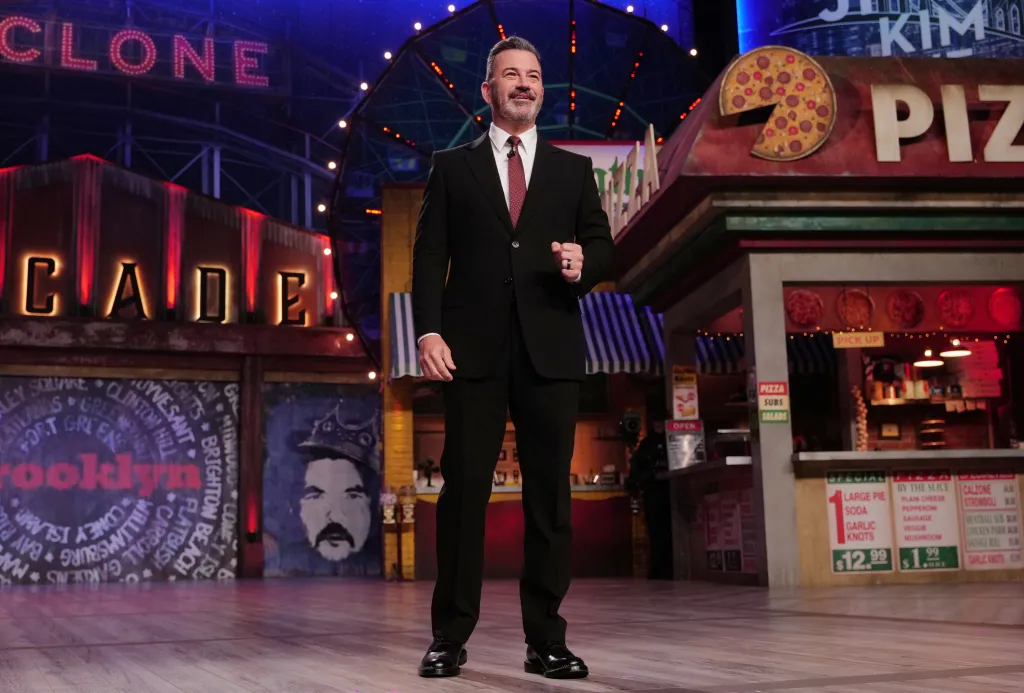
Jimmy Kimmel has had an incredibly busy year after being pulled off the air last September by ABC and becoming a free-speech hero in the process.
Last month, it emerged that he was in talks to renew his deal with Disney ahead of his contract expiring in May.
Dana Walden, President and Chief Creative Officer of The Walt Disney Company, was asked at the Bloomberg Screentime event why isn’t renewing Jimmy Kimmel Live! a “no-brainer”, particularly as his ratings have grown after CBS axed The Late Show with Stephen Colbert.
Walden admitted late-night was a “very challenging day part”.
“That’s not to say that Jimmy is not doing a phenomenal job, and his ratings are up, but they’re up relative to a smaller audience that’s watching late night on broadcast television. Obviously, there’s a YouTube channel [and] millions of people are watching on demand the parts of that show. That is not a lucrative opportunity for a very premium talk show. So, we’re trying to make sense of the business while also honoring a deep partnership.”
Late-night budgets are coming down; Colbert was asked to reduce the budget of The Late Show before it was canned by CBS and Late Night with Seth Meyers has seen a number of cuts including its band and a new schedule that saw him take off a large part of the summer.
Disney is clearing trying to cut costs on Jimmy Kimmel Live! but is walking a tightrope to keep one of its most loyal company men – Kimmel appears every year at its Upfronts among other corporate gigs – happy.
“I love Jimmy. We have a great friendship. He’s close to a number of the people at Disney, and again, we’re trying to work through it and make sense of both what does Jimmy want, what’s the right thing to do, and what’s the right thing for our business?,” Walden said.
There have been a few suggestions; Kimmel started taking the summers off in 2020 but the show continues with guest hosts, so taking the whole summer off is one suggestion. This week he is in Brooklyn for one of his regular New York trips, which is an expensive move given that he brings his entire 200-strong team with him. That is another option to cut, although it’s also tricky as these shows tend to perform well and bring A-list stars such as Robert DeNiro, who appeared with a baseball bat acting as FCC boss Brendan Carr, Billy Crystal, Ben Affleck, Matt Damon and NY Mayor Zohran Mamdani.
Kimmel has previously said that there’s no reasons for late-night to cost as much as it does. “I don’t think there’s a reason for these shows to go away. I think there are different. There are ways. These shows started out because they were a way to get high priced talent for almost free. That was the whole trick. That was the whole reason they started these shows. It was deemed to be promotional. So, the idea that these shows need to cost $120M is crazy,” he said.
Kimmel and his wife Molly McNearney, who is also an exec producer of Jimmy Kimmel Live!, discussed the topic of retirement recently on Dax Shepard’s Armchair Expert podcast.
Shepard asked Kimmel if he would regret retirement. “I know people who’ve been in that situation,” said Kimmel, who has hosted JKL! since 2003. “It’s funny. People make a big show of like ‘I’m done and I’m tired of doing this,’ and then they make a lesser comeback trying to do the same thing. That’s always a bummer. I always look at that and go, ‘Oh, is that going to be me?’”
>
UEFA receives ‘substantial’ dossier from Real Madrid on Barcelona’s payments to ex-referees chief

Box Office: ‘Verity’ To Seduce $55M+ WW, Tom Cruise ‘Digger’ Not Good
How does Kirk Ferentz’s Iowa keep doing this? ‘We’re not in the entertainment business’
-

 movies4 months ago
Search For Canadian TV Actor Stewart McLean Now Homicide Investigation
-

 Fashion9 years ago
These ’90s fashion trends are making a comeback in 2017
-
Fashion9 years ago
According to Dior Couture, this taboo fashion accessory is back
-
Fashion9 years ago
Model Jocelyn Chew’s Instagram is the best vacation you’ve ever had
-
Fashion9 years ago
Emily Ratajkowski channels back-to-school style
-
Fashion9 years ago
9 Celebrities who have spoken out about being photoshopped
-

 Anime4 months ago
Rurouni Kenshin: Hokkaido Arc Manga Takes 1-Issue Break – News
-

 Anime3 months ago
HIDIVE to Stream English Dubs for The World Is Dancing, The Forsaken Saintess and Her Foodie Roadtrip in Another World, The Dangers in My Heart: The Movie Anime – News