
Entertainment
Iron Boy Review: Former Pixar Animator Makes Magical Hand-Drawn Movie


A bittersweet, gorgeously animated family film that looks like a watercolor painting come to life, Louis Clichy’s “Iron Boy” (“Le Corset”) is a solo feature debut whose sense of imagination is matched only by its sharp craft and the passionate care of its storytelling. Drawing from much of the director’s own life and proving all the more vibrant because of its specificity, it’s the type of film that already feels like it could become a new classic for animation lovers new and old.
That Clichy, who previously worked as an animator for Pixar on projects like “WALL-E” and “Up” as well as co-directing a couple of the “Asterix” films, is setting off on his own only makes it that more exciting that his first film already feels like the work of a confident, bold new voice. It proves that he’s not only up to the task of directing a film all his own, but that he and his animation team have a real skill for stylistic experimentation that you can only hope we’ll get to see more of from them. In an animation landscape that can often feel dominated by bigger studios like Pixar going back to what they’ve done before rather than trying anything formally or narratively new, Clichy offers a path forward. He shows us the wonder that can be found from striking out on your own and making something beautifully original.

Premiering Tuesday at the Cannes Film Festival, the film centers on 11-year-old Christophe, who himself already feels like a classic animated character. Wonderfully voiced by Gary Clichy, the director’s own son, he’s just like any other kid in that he is still finding his place in the world and is often full of energy that he doesn’t know what to do with. What makes him different is that he is also beginning to periodically tip over, even collapse, without always realizing that it’s happening. This is introduced via a hilarious opening montage involving class photos, but poor Christophe is not laughing about the fact that he’s now expected to wear an iron corset to keep himself upright.
While this is the beginning of what will become a grounded yet high-flying journey that’s bursting with more imaginative, almost magical breaks in reality, to start, the young lad’s reality is quite miserable. Despite the corset drastically restricting his freedom of movement, it’s something he’s expected to do day and night, even when he’s sleeping. His family, who runs a farm that’s going through increasingly hard times, doesn’t always seem to know how to be there for him.
Thus, he’s often left to his own devices and soon discovers there’s so much out there for him. Namely, he finds some of his first loves, one involving a person and the other involving the organ music being played at the local church. It’s there where the film starts to make beautiful music of its own just as Christophe starts to do so himself. The pains of reality remain threaded through every frame, but the simply stunning animation also makes it all feel magical.
Brought to life via Chinese inkbrush paintings, every frame is full of rich details while not being tied down by too much realism. Everything feels alive and textured, as if the town itself is something you could wander through and various drawings move to make it all feel like a dream. There are even recurring moments where gravity itself is upended as Christophe imagines his tilting as a way of also tilting the world around him. It takes the breath away just to see everything being thrown up in the air, especially in a flooring finale that pulls out all the stops. If anything, it’s a moving thesis statement for the film itself: sometimes, all you need is a different perspective to see the beauty of the world.

In the film’s animation, this beauty can come from embracing a hand-drawn approach rather than stiff yet familiar 3D techniques. In its plotting, it can come from telling a story about seeing everyday people, each of them full of complexities most others would overlook — be they the young girl trying to avoid paying the bus fare, with whom Christophe forms a deep yet fleeting bond; the elderly man who begins to teach him how to play the organ; or his own family that, for all their flaws, still deeply cares for him. Each character is overflowing with life that Clichy and his animation remain deeply attuned to.
While “Iron Boy” is not the best animated film of the festival, as that’s still “We Are Aliens,” it’s a mighty close second and a spectacular reintroduction to Clichy and company. That it is uninterested in talking down to potential younger viewers and instead invites them to reflect on the many complexities of life only makes it that much richer a work. It’s a film you can’t help falling in love with just as Christophe gradually does with his own life. In every beautiful song and stunning frame of animation, Clichy makes something truly magical from the everyday.

>
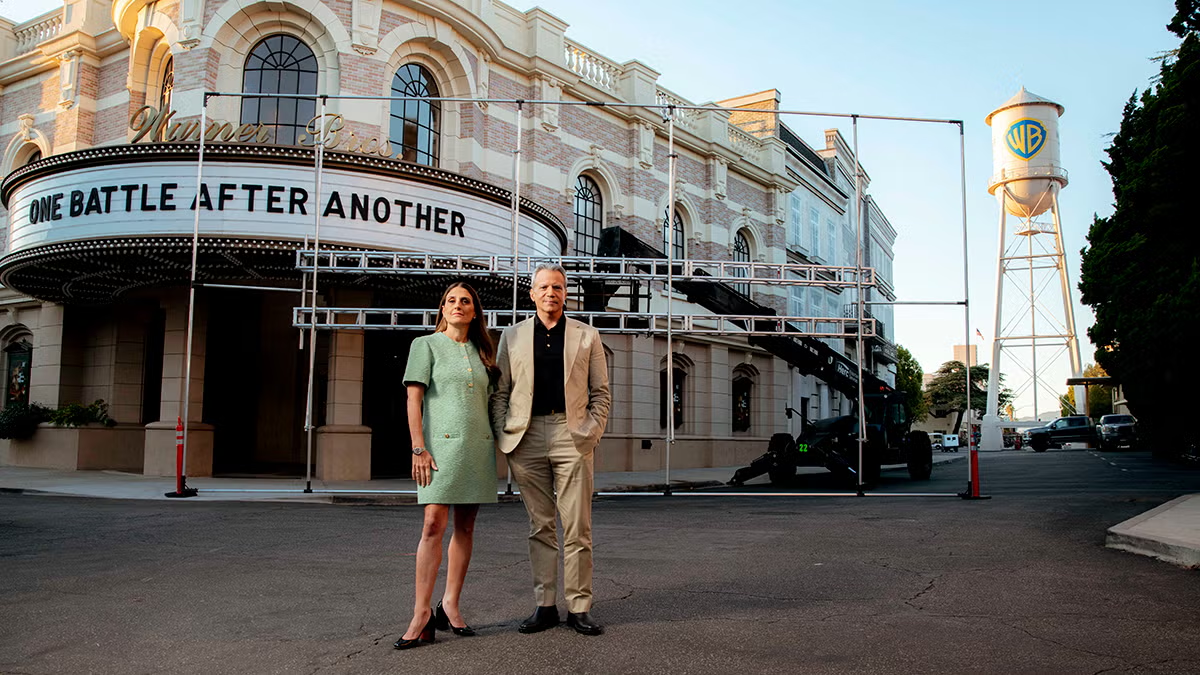
On Friday Warner Bros film chiefs Mike De Luca and Pam Abdy waited for a phone call informing them of their future employment.
It came in the morning from Skydance CEO David Ellison confirming what they had read online the previous night in an anonymous report: that they would not be joining the new merged Warner-Paramount studio. That their upcoming slate of a half-dozen releases, including “Batman 2” and “Gremlins 3,” would be handled by someone else. And that their services were no longer needed.
It was certainly an inelegant way to handle the exit of two studio chiefs who had ushered Warner Bros to glory at the Academy Awards earlier this year, with the triumph of “One Battle After Another” winning Best Picture and Michael B. Jordan taking Best Actor for critical darling “Sinners,” capped off by a standout 2025 at the box office.
All day the internet was feeding on the unconfirmed (until now) report of their exit by Puck, with Paramount (now renamed Skydance) declining to comment. The executives were left dangling in the news cycle, increasingly angry at the slight.
Ellison called each of the executives, separately, to inform them in a tense exchange. According to knowledgeable individuals, he told them that the merged companies have a ton of debt and needed to restructure in order to meet those obligations. That, of course, is no secret to anyone. The combined entity is expected to carry around $80 billion in total debt.
They were not offered a production deal. Their film slates will be handled for the moment by their deputies, Jesse Ehrman and Mike Ireland, who are currently the Presidents of Production. Josh Greenstein and Dana Goldberg are co-chairs of Paramount Pictures and expected to lead the merged film studios.

Both De Luca and Abdy were livid at the way their exit was handled, according to individuals with knowledge of their reaction. Abdy was particularly offended and told the mogul with some bitterness: “Good luck to you. I left you 39 movies.”
Warner’s go-forward film slate is packed with likely blockbusters, including “The Lord of the Rings: The Hunt for Gollum,” “The Batman Part II,” “Gremlins 3” and “A Minecraft Movie Squared.”
Under De Luca and Abdy, Warner Bros. had a spectacular year in 2025, with two films nominated for Best Picture at the Academy Awards and Paul Thomas Anderson’s “One Battle After Another” ultimately winning the top prize, and multiple box office hits, including “A Minecraft Movie.”
But 2026 has been much tougher with movies like “Supergirl” and “The Bride!” failing to motivate audiences. The reported decision comes ahead of an expected underwhelming domestic opening weekend for the Tom Cruise-led film, “Digger,” which is predicted to bring in $12 million to $15 million.
Abdy and De Luca had no comment for this story. Paramount/ Skydance declined to comment.
The executives’ last day is expected to be when the two companies complete their merger on Tuesday.
>

The Justice Department argued that Donald Trump can legally ban CNN, MS NOW and Politico from the White House because he determined that they didn’t meet the “minimum requirements of professionalism.”
Last month, a federal judge granted the three outlets a temporary restraining order that forced the White House to reinstate dozens of their reporters’ hard passes. The outlets are now asking the judge to extend that 14-day order for a longer term via a preliminary injunction, claiming that Trump’s ban is a violation of their First and Fifth amendment rights.
U.S. District Judge Timothy Kelly, a Trump appointee, has said that he is bound by the precedent set in In a 1977 D.C. Circuit opinion, Sherrill vs. Knight, in which the judges ruled that “the protection afforded newsgathering under the First Amendment guarantee of freedom of the press requires that this access not be denied arbitrarily or for less than compelling reasons.”
In a court filing on Friday, the DOJ claimed that the Sherrill case still would allow for the president to restrict the three outlets from accessing the White House grounds because the White House has a “compelling interest.”
The DOJ lawyers claimed that the Sherrill decision does not “prevent the President from concluding that bona fide journalists would identify sources instead of relying on anonymous sources, commit to factual accuracy, and provide the White House an opportunity to comment, rather than ‘perform their duties in a way that … interfere[s] with the White House’s daily operations.’ …At a bare minimum, it is a significant violation of decorum to publish classified and sensitive national security information.”
The news outlets’ legal team has rejected that assertion, writing in a filing earlier this week that Trump’s “statements also make clear he implemented the ban to coerce more favorable coverage from CNN, MS NOW, and Politico, and to deter other journalists and news organizations from newsgathering and reporting that the President might view as negative. And his administration has continued to retaliate against Plaintiffs even after the temporary restraining order, only underscoring that Defendants’ motive is to punish and chill journalism they dislike.”
Even as access to the White House grounds has been reinstated, the White House has continued to restrict CNN from coverage of TV pool assignments, including travel with Trump on Air Force One.
The outlets’ lawyers, led by Theodore Boutrous Jr., also noted that Trump and other White House officials “overlooked that the First Amendment protects reporting on matters affecting national security.”
Kelly has set a hearing for Thursday on the news outlets’ motion for a preliminary injunction.
In granting a TRO, Kelly concluded that the White House failed to provide due process to the news outlets.
The DOJ has pointed to letters sent to the outlets as evidence that they were given due process. But those letters were sent on Sept. 22, four days after Trump’s ban was started.
The judge also has noted that some of the objectionable stories cited by the DOJ do not have to do with national security. Kelly wrote in his order that “even the justifications provided to Plaintiffs after this case was filed are ambiguous about the true purpose of the revocations: while Defendants’ letters to Plaintiffs mention national security concerns, they purport to identify reporting that ‘threatened national security and/or spread falsehoods’ leaving open the possibility that all the stories fall into the later bucket, rather than the former.”
>
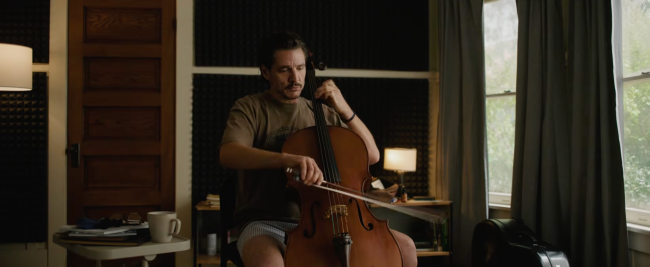
In New York Film Festival Centerpiece “Behemoth!,” writer/director Tony Gilroy has created a delicately calibrated film about a cellist (Pedro Pascal) in a midlife crisis. The movie played well at a packed Alice Tully Hall, and afterparty revelers were mildly upbeat.
Critics approve (see Metascore) of Pascal’s quiet, almost silent, reactive performance — he carries the movie, appearing in every scene — but the Best Actor category is so crowded that it will be tough for Pascal, who has never been nominated, to squeak past louder thespians like Matt Damon (“The Odyssey”), John Malkovich (“Wild Horse Nine”), Andrew Scott (“Elsinore”), Ryan Gosling (“Project Hail Mary”), and John Turturro (“The Only Living Pickpocket in New York”). So far, Pascal has been recognized for his television work in HBO’s “The Last of Us.” “Behemoth!” marks his most ambitious lead film role to date.


The movie’s strength is its innovative music structure, as Pascal’s cellist plays different movie scores in a series of Hollywood sessions that throw his memories back in time. Gilroy deployed nine composers, including James Newton Howard, Michael Giacchino, and Alan Silvestri, whom he calls The Behemoth! Collective. Academy rules call for no more than three composers to be entered for consideration for a movie’s Original Score. But Searchlight hopes the music committee will consider accepting the one Collective in this case.
The music branch was flexible about the “K-Pop Demon Hunters” multiple songwriters, who shared their one Oscar. But the “Birdman” drumming score was disqualified as not being music. The two composers on “Arrival,” Max Richter and Jóhann Jóhannsson, were disqualified. But later on, Richter was allowed to include both new material and old on “Hamnet.”
Searchlight will have no issues submitting the Lukas Frank song “Your God Is Sleeping.”
And “Andor” showrunner and “Michael Clayton” Original Screenplay and Directing nominee Gilroy, respected by the industry for his writing prowess, could be in the running for Original Screenplay. It defines the term.
Searchlight Pictures opens “Behemoth!” starting December 4.
>
How to watch White Sox vs. Guardians: Game 1 TV channel and streaming options for October 3
Gabby Williams needed a team to have faith in her. Now, she's given Valkyries reason to believe

Wales v Denmark: How Craig Bellamy can boost Euro 2028 hopes
-

 movies4 months ago
Search For Canadian TV Actor Stewart McLean Now Homicide Investigation
-

 Fashion9 years ago
These ’90s fashion trends are making a comeback in 2017
-
Fashion9 years ago
According to Dior Couture, this taboo fashion accessory is back
-
Fashion9 years ago
Model Jocelyn Chew’s Instagram is the best vacation you’ve ever had
-
Fashion9 years ago
Emily Ratajkowski channels back-to-school style
-
Fashion9 years ago
9 Celebrities who have spoken out about being photoshopped
-

 Anime4 months ago
Rurouni Kenshin: Hokkaido Arc Manga Takes 1-Issue Break – News
-

 Anime3 months ago
HIDIVE to Stream English Dubs for The World Is Dancing, The Forsaken Saintess and Her Foodie Roadtrip in Another World, The Dangers in My Heart: The Movie Anime – News