
Entertainment
Cannes review: ‘Diamond’ Andy Garcia


You had to feel bad for Andy Garcia right at the beginning of the screening of his film “Diamond” at the Cannes Film Festival on Tuesday night.
The film opens with all the trappings of film noir in the 1940s and ’50s, with grainy photos of Angels Flight, Chinatown, the Bradbury Building and other landmarks. Somebody drops the tonearm on a old-fashioned record player and some moody jazz fills a darkened room. A man, seen mostly in shadow, irons a pocket handkerchief and then selects his wardrobe from a closet full of white shirts and dark suits. He reaches for a handful of business cards that read “Joe Diamond, Private Investigator,” dons a Fedora and walks out of an old brick building in downtown Los Angeles … where he’s almost run over by a Waymo, those ubiquitous white self-driving cars that have taken over the rideshare business lately.
At a screening in L.A., that visual joke would have killed. In the Grand Theatre Lumiere on the Croisette in the South of France, it was met with dead silence.
Either the French take their noir very, very seriously, or they haven’t seen Waymos yet. Or both. Either way, it was an inauspicious beginning for Garcia’s film, which puts a spin on the beloved genre but requires an audience with a sense of humor, a heart and a passing familiarity with the genre trappings that writer-director-star-and-co-composer Garcia is both affectionately saluting and also sending up.

It was the second big Cannes premiere in the last few days for a director better known as an actor, and Garcia is definitely the winner in any faceoff between “Diamond” and John Travolta’s “Propeller One-Way Night Coach,” which premiered on Friday. The project grew out of a literature class project of Garcia’s daughter in high school 20 years ago, and at times it betrays its amateur beginnings with clunky plotting – but it’s miles more ambitious and more assured than Travolta’s treatment of a children’s book he wrote in 1997.
And Garcia recruited a formidable cast for his low-budget, quick shoot. He plays Joe Diamond, a private dick who appears stuck in the 1940s and oblivious to the fact that he’s a hit on TikTok; Vicky Krieps is Sharon Cobb, who’s hired Joe to figure out who killed her husband, a crime for which she’s being accused; Bill Murray is Jimbo, the bartender and part-time lawyer at a downtown joint; Rosemarie DeWitt is Angel, a flirtatious regular at the same joint; Dustin Hoffman is Dr. Harry Kleinman, a coroner who just loves bending the rules for Joe; Brenda Fraser is “Danny Boy” McVicar, who might be a bad cop but also wants to be Joe’s friend; and Demian Bichir, Danny Huston, LaTanya Richardson, Robert Patrick and others fill out the cast.
Los Angeles stars in the film as well, with locations including the Bradbury Building and the now-closed Cole’s restaurant. Between the cast and the city, it’s enough to make a viewer wish that some of Joe’s narration was more hard-boiled and less over-easy and some of his apparently fabulous detecting actually looked impressive while he was doing it. But the point is to have fun with the noir trappings, and Garcia and his all-star team certainly do that.

Hoffman wins the award for gleeful scenery-chewing, while DeWitt might take top honors for packing the most humanity into her performance. She does so mostly in the film’s homestretch, when “Diamond” drops a surprise that grounds what has come before in genuine emotion and helps explain why Joe Diamond has often seemed to be playacting as a great detective rather than actually being one.
But he’s dogged, and so is Garcia, who brings the story to an agreeable conclusion and then keeps going until he’s hunted down and tied every loose end he can find. Screening out of competition, “Diamond” isn’t going to go down as one of the more accomplished or substantial of this year’s Cannes films, but there’s nothing wrong with adding a little heart and humor to the usual film noir recipe.

>
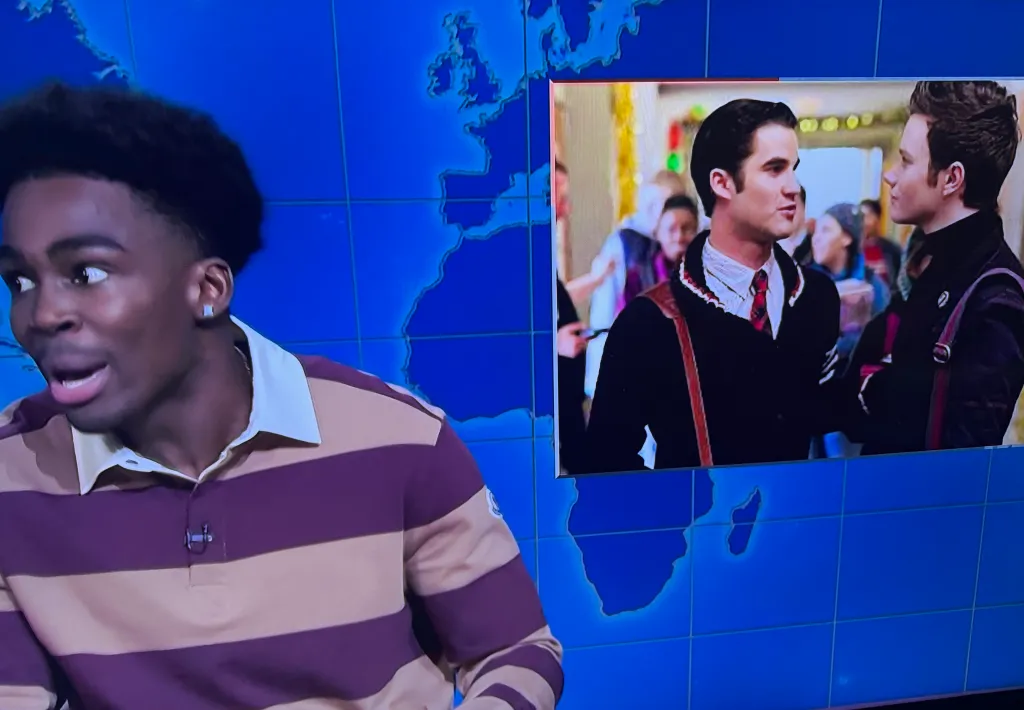
After cracks about Pete Hegseth, Kristi Noem and President Trump’s vendetta against CNN, Michael Che touched on the ongoing controversy at Cornell University and Ryan Murphy’s decision to bring back Glee.
Che first served up a serious note by referencing the sexual assault case at Cornell University and how “obviously we don’t want to make light of anything that happened, but it is a good time to talk about men holding other men accountable.”
As the camera panned toward to a silent Colin Jost, Che said, “Look, we all have that one friend that seems like a nice guy, but they’re definitely not.. It could be someone you’re close to, or someone you work with. Maybe you can’t prove anything. You can just look at him and tell those weird, privileged Ivy League types always got some messed up stuff going on.”
Che then turned to Jost and said, “Is there anything you want to add, Colin?”
“Stop cutting to me,” Jost responded.
Later, cast member Kam Patterson joined the desk to show his enthusiasm for the reboot of Glee. (Ryan Murphy recently said that he “just finished” a Glee reboot script). Che was a bit skeptical that Patterson is a true Gleek, despite Patterson claiming he was eager to find out if Rachel was still on Broadway and if Kurt and Blaine were still together.
But Che wasn’t convinced. “Look, I know you man. You don’t have to say yes to every day that a white writer pitches to you …. Look Kam. I’ve worked here, what, 30, 35 years. I know what this is. Two white writers came up to you in suits, pitched you an idea about Glee, and now you’re out here saying a bunch of names you’ve never heard before, right?”
Patterson admits he hasn’t and feels “pretty bad” that he “just did jazz hands on national television.”
>
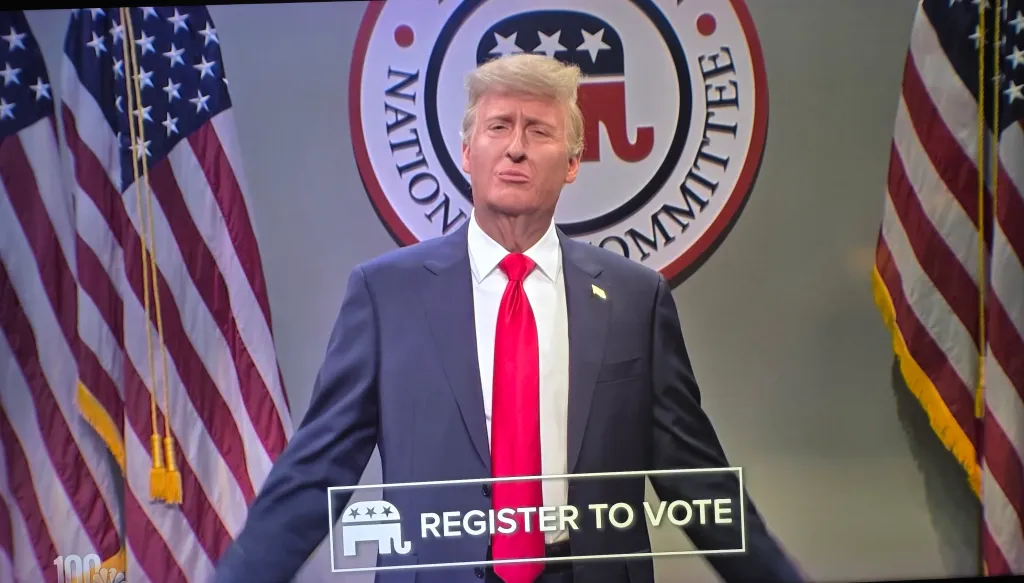
Just a month away from the volatile midterms and a president way down in the polls, there was once again a plethora of political material ripe for this week’s SNL cold open, and the NBC late-nighter went full MAGA, with some Mitch McConnell on the side.
Played by Mickey Day, the 84-year-old Kentucky senator offered a premature “Live from New York” before being cut off by RNC ad consultants desperate to turn things around for the GOP. There was a “He tricked us” Marco Rubio, portrayed by the always on point Marcello Hernández, and a 2028 J.D. Vance (Jeremy Culhane) that no one wanted to actually put in a spot.
Then there was Colin Jost’s Pete Hegseth, putting the fun in Defense Secretary once again.
“What’s up, schlong donkeys?” the Saturday Night Live Weekend Update co-anchor began in what might have been one of the greatest campaign ads ever (we’re talking 1954 Daisy level) if it was real. “Now listen up, okay, because I need all you patriots at home to do the gayest thing ever and vote. Thanks to me, the military finally has its priorities and sexuality straight.”
Tossing in some slam poetry, Jost’s Hegseth added: “In conclusion, vote, I guess. And remember, even if you’re stationed overseas, you can still vote by mail, which is the only by mail I’m cool with.”
Of course, this being a MAGA paraody and being SNL, the joke had to go further. Having said that, unlike many too-long cold open, this semi-morbid midterm skit work at the extra length – entirely because POTUS came to cook, base loathing and all.
“I’m President Trump and I approve this ramble,” started a typically and wonderfully unhinged James Austin Johnson.
Drawing from the fiction that is so much of Trumpland’s facts, he added in the fake ad: “We’re getting bogged out there, but not for long because I have a solution. If the Republicans win, I’ll give everyone $5,000, and that is not a bribe because I have no intention of following through on that promise.
“So, just pretend I’m on the ballot, okay? You have to use something called imagination. Imagination makes a MAGA nation. Wow, that’s pretty good. I can already see that written on the back of an obese woman’s booty shorts in dirty, disgusting Myrtle Beach. What a hell all this country is! It’s full of awful people.”
Perhaps but not in tonight’s spot-on cold open.
Delayed a tad again on the West Coast like last week’s season opener thanks to college football, tonight’s SNL is the second show of the 52nd season.
Verity star Dakota Johnson is hosting SNL for the third time. Coming off a big box office start for the Collen Hoover thriller, Johnson is joined by Turnstile as musical guest. This is the Maryland rockers’ SNL debut. Next week will see one-time dumped cast member Shane Gilis back for his third time hosting. The October 10 show will see the much-acclaimed Rosalía will be returning for her third SNL appearance.
>
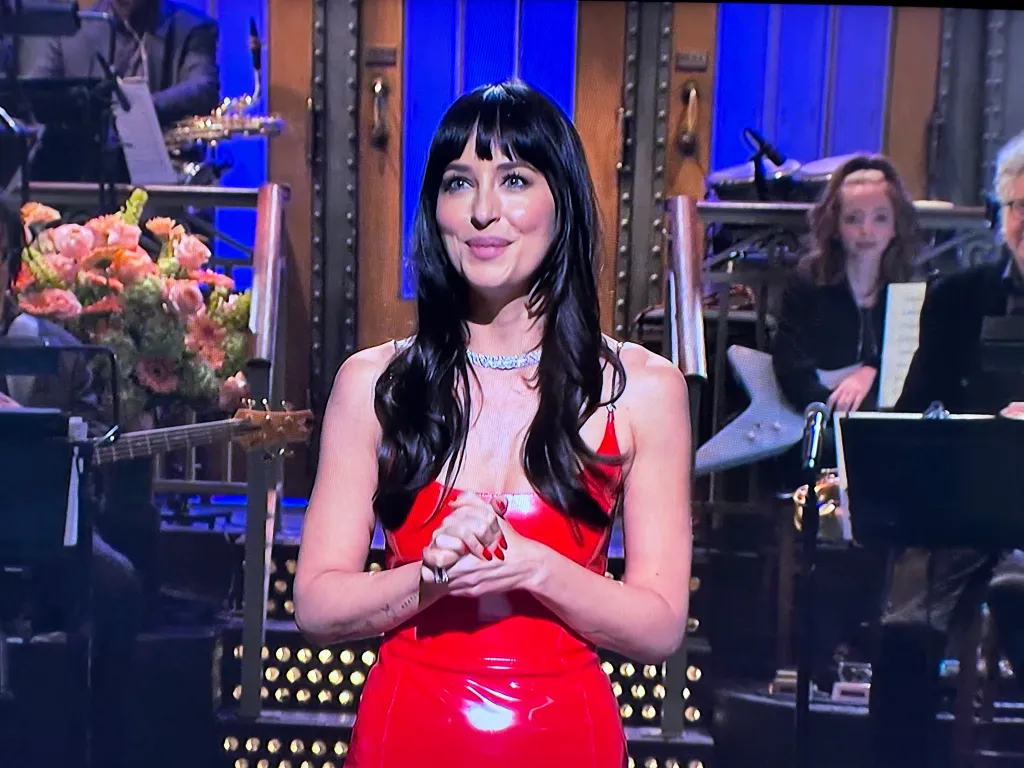
Taylor Swift gave Dakota Johnson some pretty sweet payback for appearing in her “Patient Zero” music video: the mega-star joined the Verity actress during her opening monologue.
Perhaps it was just a birthday present for Johnson, who turns 37 on Sunday. Either way, Swift came in to yuk it up with Johnson, who used her opening moment to wax on about dating musicians.
“I went through two very public, very lame breakups with two very awesome musicians,” Johnson said about what she’s been doing since the last time she hosted SNL. This is her third appearance on the NBC show.
“It’s not my fault, though,” Johnson continued. “Some people leave concerts with merch and I leave concerts with a two and a half year relationship.”
“But I have really good friends,” she continued. “They don’t judge me for dating these men. They’re actually really supportive.”
That’s when Swift joined her on stage. Fans at home went wild.
The Verity star made her SNL debut in season 40.
>

Sam Burgess: Warrington head coach says he will stay despite Grand Final loss
Bahrain GP in Malaysia: Submit your questions for our F1 mailbag

Luka Modric ‘ashamed’ of Croatia’s ‘catastrophic night’ against England
-

 movies4 months ago
Search For Canadian TV Actor Stewart McLean Now Homicide Investigation
-

 Fashion9 years ago
These ’90s fashion trends are making a comeback in 2017
-
Fashion9 years ago
According to Dior Couture, this taboo fashion accessory is back
-
Fashion9 years ago
Model Jocelyn Chew’s Instagram is the best vacation you’ve ever had
-
Fashion9 years ago
Emily Ratajkowski channels back-to-school style
-
Fashion9 years ago
9 Celebrities who have spoken out about being photoshopped
-

 Anime4 months ago
Rurouni Kenshin: Hokkaido Arc Manga Takes 1-Issue Break – News
-

 Anime3 months ago
HIDIVE to Stream English Dubs for The World Is Dancing, The Forsaken Saintess and Her Foodie Roadtrip in Another World, The Dangers in My Heart: The Movie Anime – News