
Entertainment
Stephen Miller and DNC X Account Hurl Insults at Each Other Over James Talarico


Stephen Miller and the official Democratic National Convention X account traded barbs on social media and neither held back punches.
On Wednesday, the DNC account posted a picture supporting Texas Senate candidate James Talarico in the wake of the Republican candidate Ken Paxton being picked to run against him in the midterms. Paxton won following President Donald Trump’s endorsement of the new candidate over the incumbent John Cornyn.
“Fired up. Ready to go,” the DNC post of Talarico read. “It’s time to take Texas back.”
Miller waited a few hours before responding to the post with a scathing attack of his own. Much of it stems from comments Talarico made in the past that God was “non-binary” and the candidate’s larger views on transgender issues.
“The Democrats made history in Texas by nominating their first transgender Senate candidate,” the Deputy Chief of Staff wrote.
The DNC’s official account’s response to Miller was short but scathing: “Shut up you ugly f–k.”
Miller has been the subject of many jokes and attacks from the left since Trump returned to office and brought Miller to the spotlight. Just a couple weeks ago, “Last Week Tonight” host John Oliver played a compilation on his show of Katie Miller outing a number of odd behaviors her husband has shown over the years.
“He insists that my children always wear socks with their shoes,” she explained. “Even if the shoes are already on, and they’re ready to get in the car, go out the door, he makes them come back inside and put socks on.”
Miller also revealed her husband insisted on a big wedding for their nuptials, jokingly calling him a “bridezilla,” and told Vice President JD Vance that mayonnaise is all her husband will eat.

>
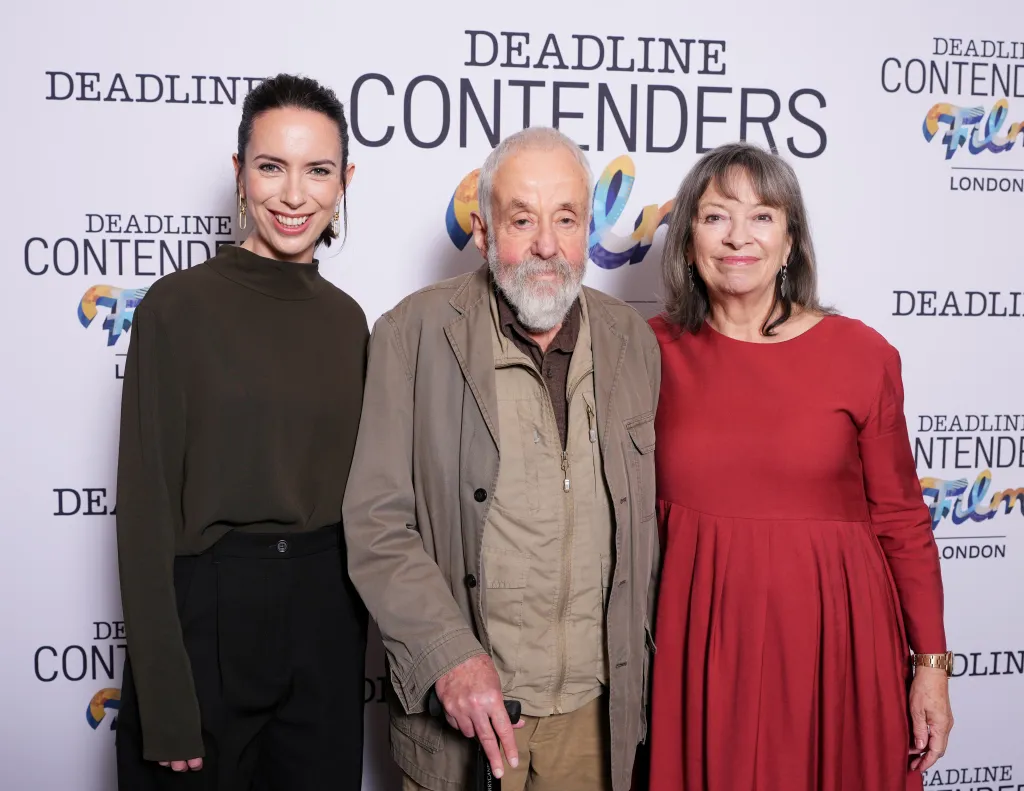
“It’s quite practical,” actor Kate O’Flynn concluded this morning when quizzed on working on Tender Loving Care with veteran filmmaker Mike Leigh, best known for his unique pre-production process, which includes no script and a collaborative approach to story development.
O’Flynn was speaking on stage at Deadline’s London Contenders event alongside Leigh and her co-star, Marion Bailey.
“It’s very quite simple, really. We’re just talking about what our characters would know with Mike, or how they would react. Is that accurate to who they are? You carve out the characters through those explorations,” O’Flynn continued.
Tender Loving Care debuted earlier this year at Telluride before playing San Sebastian, where it won several major awards, including the top prize, the Golden Shell, alongside the award for Best Screenplay and the Silver Shell for Best Leading Performance for actress Kate O’Flynn.
The film follows Amy (O’Flynn), who, after a bitter breakup, moves in with her best friend, Rosie (Alice Bailey Johnson). Both work as social workers in London, at opposite ends of the age spectrum. Rosie becomes like a second daughter to Amy’s parents, notably her elderly father, who is starting to show his age.
Leigh told the audience in London that the story for Tender Loving Care was developed after he had a feeling about exploring a narrative based around “positive and care.”
“And as it evolved, we thought about social workers,” he said. “We see them operating. And we see them in their private lives.”
Tender Loving Care will feel familiar for Mike Leigh fans, with its earnest exploration of working-class lives. But the filmmaker said he is never trying to reference his past work when developing a new story.
“I never think about that at all,” Leigh said. “I try to do something different with every film. And at the same time, any artist may inevitably say the same thing.”
Leigh has previously said Tender Loving Care may be his last film project. The veteran filmmaker now struggles with his mobility, which he said makes his work on set much more difficult. However, he did not entirely rule out working again.
“I’m a little disabled these days, so it makes it hard. But it is possible. I don’t know,” Leigh said.
Tender Loving Care is set for a December 4 release in the U.S. via Bleecker Street. StudioCanal will release the film in the UK next year.
>
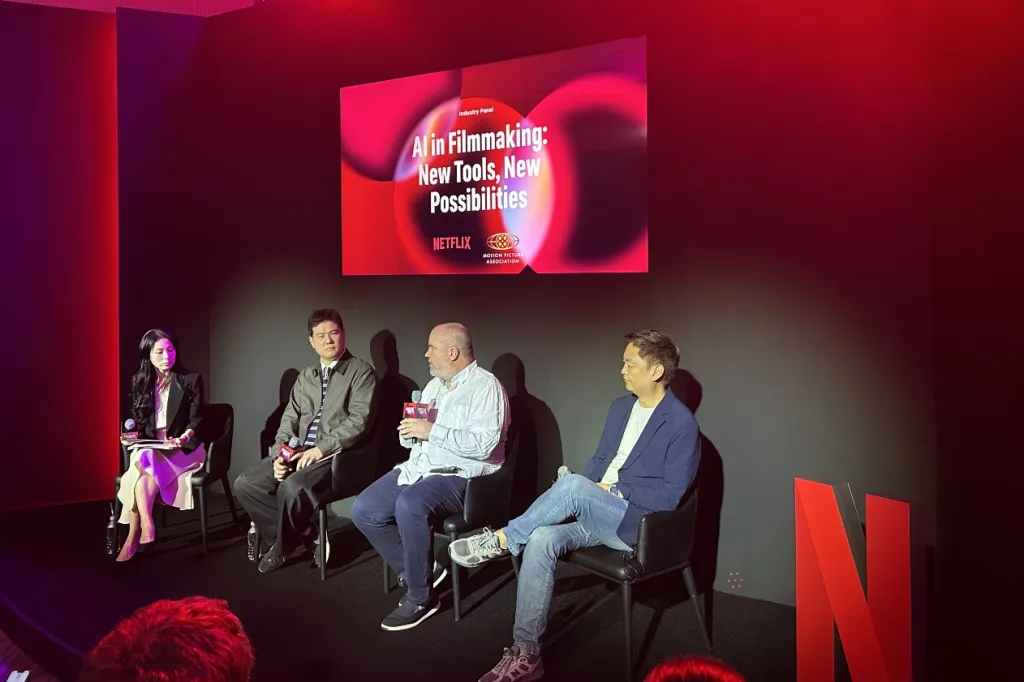
Kimball Thurston, Weta FX’s chief technology officer, Korean filmmaker Kang Yun-sung and Netflix’s APAC Senior Director, Production, Sung Q Lee, discussed the advantages and limitations of using AI tools in production workflows during Netflix’s Creative Asia day at Busan International Film Festival.
They agreed that AI is bringing a range of efficiencies to the production process – reducing budgets, speeding up workflows and helping filmmakers realize scenes that were previously impossible to achieve – but they also noted some of its limitations.
“We’ve been growing it at a measured pace; using using it for image clean-up; not necessarily for generating images; but generating the motion that goes into some of the crowd scenes; and beyond that we’re starting to see some other small use cases,” said Thurston. “But I think there’s still some problems that we have to solve.”
He noted that while the resolution issue is currently being solved – filmmakers can now output to 4K resolution in many cases – there are still issues around color volume: “There are still some some things that I hope that technology companies will come and collaborate with the creative industry on more than they have been historically,” Thurston said.
“There’s actually a number of color issues, not the resolution of the color, but the range of color volume. For example, if all your AI models have been trained on a certain set of video images, you might not be getting the right shade of red. I hope we can collaborate more so we can help these companies solve some of these problems.”
Thurston also noted that the way that creatives currently have to work with the technology is not so intuitive: “We need better interfaces – for a visual artists, a text-based prompt is not the best way to interact with this technology.”
All three speakers focused on the use of AI to provide filmmakers with more creative choices – more iterations of a sunset or battle scene, for example – rather than using fully AI-generated images or replacing actors. “Remember there are different forms of AI – it’s not just about image generation, there’s also assisted AI, it’s about using these tools to help the creative narrative,” Thurston said.
Netflix’s Sung said the streamer is using the technology for pre-visualization, editorial and VFX, and has often had discussions about other use cases, but stressed that the “human touch is always critical and necessary”.
After playing a showreel of work done by Netflix’s VFX subsidiary Eyeline Studios, Sung added: “We have strict guidelines within the company. We’re not just chasing after the use of AI for the sake of it – if it helps the viewer experience then we have an internal process and we work through that. We’re not trying to be the fastest by using AI.”
Sung also touched on sustainability issues when asked by an audience member, who quoted figures on AI technology’s use of water resources. “If we’re talking about sustainability, we need to talk about the bigger picture beyond just AI, to achieve net zero we need to look at a range of issues and make different attempts,” Sung said.
Kang, whose credits include Run To The West, South Korea’s first feature-length AI-assisted film, said that AI is enabling the Korean film industry to reach its full potential. “Incorporating AI into film is turning our imagination into reality. In the past, genre films were not able to be the biggest due to budget limitations, but AI can now extend creative possibilities.”
Kang also screened a teaser of Netflix’s upcoming Gulf Of Aden, a Korean-language action thriller that he is directing, and which is using AI tools to recreate scenes of war-torn African countries, battles with modern-day pirates and ships being hijacked. “Not just because of savings on CGI, but also because the shooting process was simplified and the production period shortened, we were able to make savings of 30-40% by using AI,” Kang said.
However, he added that he doesn’t believe AI can currently replace real life actors: “AI generated battle scenes may have better quality than what we can otherwise afford to achieve, but will the technology be able to convey real human emotions to the audience? We’re still in the transition phase, but right now, I don’t think so.”
Netflix’s Creative Asia day, which is aimed at local creatives and industry, also included masterclasses with The Blue Road director Han Jun-hee and Possible Love cinematographer Kim Ji-yong; an industry panel on New Voices in Filmmaking; and workshops on storytelling and understanding the perspective of buyers, among other sessions.
>

“It seems like the only way to look at the future these days is as dystopia,” said director Brad Bird at Deadline’s Contenders London this weekend. “And that’s fine. I love a lot of movies that take that thing, but there are other ways to look at the future too, and you can.”
Bird was talking about his new animated movie Ray Gunn, which features Sam Rockwell, Scarlett Johansson and Tom Waits in the voice cast. The Netflix and Skydance Animation production is set in Metropia, a gigantic city in the alternate future inhabited by aliens and humans as seen from a 1939 perspective. The story revolves around private eye Raymond Gunn (Rockwell), who is drawn into a case involving murder and a multimedia star named Venus Nova, voiced by Johansson.
“What interested me was having utopia, but also showing that characters are desperate,” said Bird. “They’re still lying. They’re still murdered…all those things are there, but it’s a little more interesting if you set it in an idealized setting. So, buildings are over a mile high, and aliens and humans are coexisting, and that kind of thing became very interesting to me.”
Bird, who was joined on stage by the film’s composer Michael Giacchino, talked about the film’s long journey to screen. Ray Gunn is a 35-year passion project from The Incredibles and Ratatouille director Bird.
“The easiest mistake is to make is to think we were working on it for 35 years, which makes us really idiotic,” quipped Bird. “It was not that. We tried to get it made a long time ago and, for whatever reason, the financing didn’t follow us, so we had to set it down. Basically, it went into a file, dust gathered and we had to move on with our lives. I made The Iron Giant and we worked on The Incredibles and Ratatouille and time went by and the opportunity arose to pull it out of the deep freeze, and I always believed in it and eventually reality agreed with me.”
Giacchino talked about his approach to scoring the film and noted that New Zealand singer-songwriter Kimbra wrote and produced all of the original songs for the character Venus Nova.
“She was so good at what she does,” he said. “She writes incredible music and she came on and delivered a few songs for Venus, which are just incredible. So, my part was just creating the world beyond that and filling in everything else and creating textures and themes and character stuff and just making sure the movie fit the glove it needed to fit.”
Giacchino added that he and the team used a raft of “old recording techniques”.
“We got microphones from the 1920s and 30s that we used here in Abbey Road. We had an 80-piece orchestra, so there’s a really organic score, but there are a few things layered in there, like weird vintage synthesizers that I use…but that’s not the focus of it. That’s just the decoration on it because the real emotional thing that you need, it’s got to fit the story.”
Check back on Monday for the panel video
>
What we’re seeing from Gavin McKenna, Porter Martone and the NHL’s top rookies
Red Wings internalize early lesson that they're 'not good enough' to survive lapses

Mike Leigh On ‘Tender Loving Care’ & Whether The Film Is His Last
-

 movies5 months ago
Search For Canadian TV Actor Stewart McLean Now Homicide Investigation
-

 Fashion9 years ago
These ’90s fashion trends are making a comeback in 2017
-
Fashion9 years ago
According to Dior Couture, this taboo fashion accessory is back
-
Fashion9 years ago
Model Jocelyn Chew’s Instagram is the best vacation you’ve ever had
-
Fashion9 years ago
Emily Ratajkowski channels back-to-school style
-
Fashion9 years ago
9 Celebrities who have spoken out about being photoshopped
-

 Anime4 months ago
Rurouni Kenshin: Hokkaido Arc Manga Takes 1-Issue Break – News
-

 Anime3 months ago
HIDIVE to Stream English Dubs for The World Is Dancing, The Forsaken Saintess and Her Foodie Roadtrip in Another World, The Dangers in My Heart: The Movie Anime – News