
Entertainment
Jill Biden Thought Joe Was Having a Stroke During Damning Trump Debate

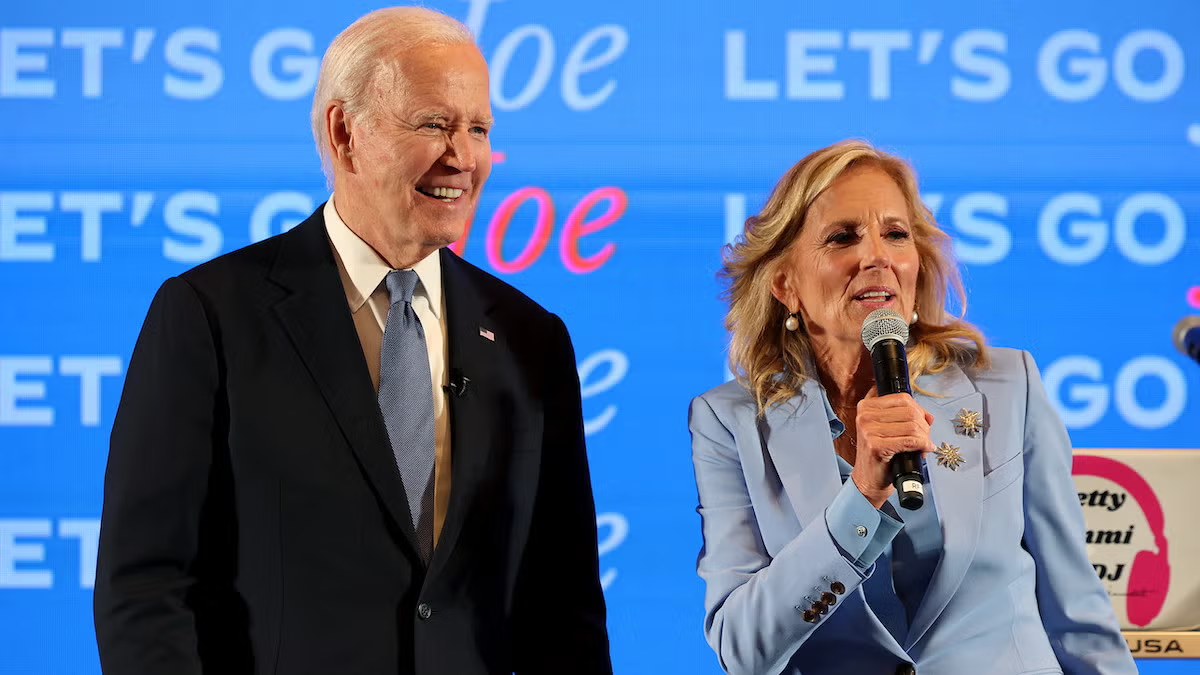
Jill Biden worried that her husband Joe was having a stroke amid his disaster presidential debate against Donald Trump in 2024.
In a conversation with CBS News Sunday Morning’s Rita Braver, the former first lady recounted her thoughts watching President Biden stumble through his June 2024 debate against Trump – their first major clash in the election race and one that ultimately led to Biden dropping out.
“I was frightened, because I had never ever seen Joe like that before or since. Never,” Dr. Jill said in a Wednesday preview clip. “I don’t know what happened. As I watched it, I thought, ‘Oh, my God, he’s having a stroke.’ And it scared me to death.”

Biden suffered from a scratchy throat during the 2024 debate that made him inarticulate and often inaudible, attributed by aides to a cold. His answers trailed off at times, and his odd mouth-open expressions made the case that he was too old for the job.
He tried to salvage his campaign in speeches the following day, urging his supporters at rallies that he might not be a young man or debate as strongly as he used to but that he was still the best choice for the job over “one-man crime wave” Trump.
“I don’t speak as smoothly as I used to,” he said at a rally following his poor debate performance. “But I know what I do know. I know how to tell the truth. I know right from wrong. And I know how to do this job. I know how to get things done.”
The damage was done, though. It took the urging of a number of prominent Democrats, but Biden eventually dropped out of the race a month later. That left Kamala Harris – Biden’s vice president, whom he later endorsed – a mere 107 days before the election. That also proved an insufficient amount of time to take on Trump, as he won the election for his second non-consecutive term in office.
Biden became only the second sitting president to ever drop out of an election race, following Lyndon B. Johnson back in 1968.
>
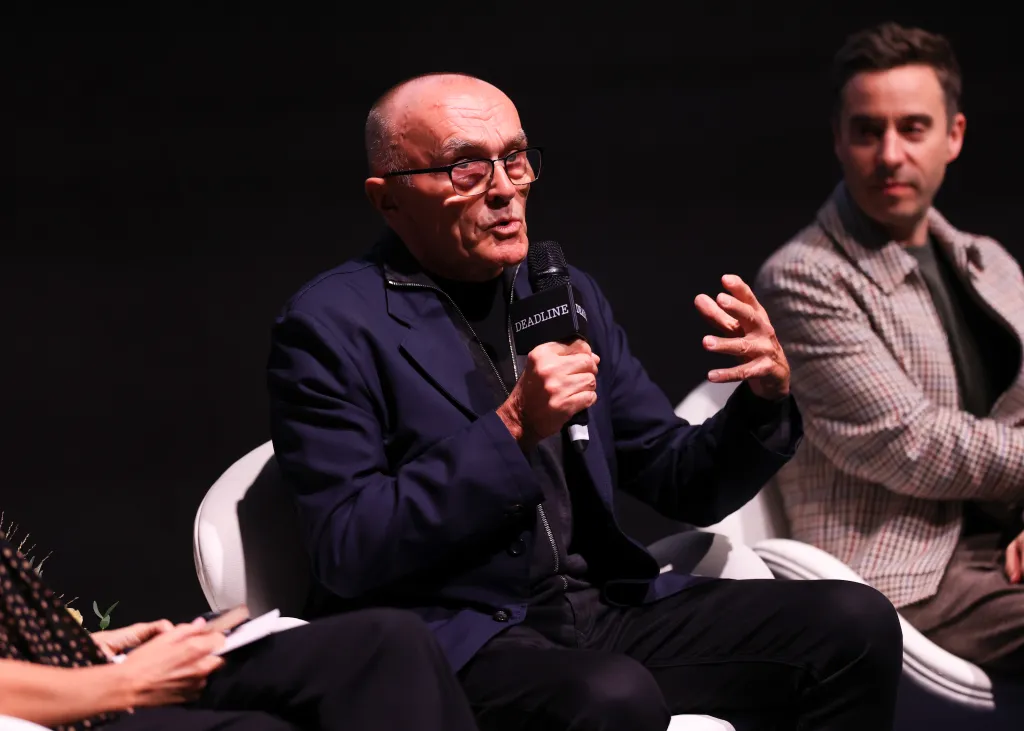
At Deadline’s Contenders London event this morning, Ink director Danny Boyle has spoken about the challenges he and his film team faced making the origin story of Rupert Murdoch-owned British tabloid The Sun. The filmmaker was joined on stage by writer James Graham and actor Jack O’Connell.
“We had a siege mentality while making it”, Boyle said about making the film, noting that the finance was hard to come by until Studiocanal stepped up and then partnered with Netflix on the release.
Set in 1969, the film follows how rising media tycoon Rupert Murdoch acquires UK newspaper The Sun and how his partnership with editor Larry Lamb (O’Connell) turns the paper into Britain’s most influential and at-times controversial tabloid. Boyle directs the feature from a screenplay written by Graham (Dear England), based on his Tony-nominated play Ink. O’Connell stars as The Sun newspaper editor Larry Lamb, with Guy Pearce as Rupert Murdoch. Claire Foy is Jules Davies.
“It was very difficult to raise the money,” in the first instance, Boyle said. “You can read into that whatever you want in terms of conspiracy theories. Why was it very difficult to raise the money for an incredibly successful stage play?”
He continued: “It was very tough. We didn’t have enough money, which was great because we had a siege mentality making it. ‘Nobody really wants us to do this, do they?’ [we thought] So we thought we would do it.”
“One of the challenges of the film”, he expanded, “which was really interesting, was to try and avoid people being too judgmental walking into it because it’s about The Sun. It’s very Marmite. And also because it’s about Murdoch, which people have a really Marmite [response to]…You’re worried about people going in, bringing that modern day judgment to it. So we tried to make the film as entertaining as possible.”
He continued: “The Sun, whatever you think about it, it ended up being the biggest selling newspaper in the world, and those four or 5 million people [behind it] weren’t stupid, and they didn’t buy it because it was a bad paper. There was something in it that spoke to them, and it’s a carousel or a slide that you’re on. You lose sight of certain things: standards. You lose sight, but you’re not aware you’re doing it at the time. We wanted to try and make that rather than feeling superior to it and judgmental of it to begin with.”
Speaking about his inspiration for writing the stage play and the movie, James Graham said: “Their [The Sun leaders] simple idea was rather than just telling people what we thought they should hear about the world and about politics, that Reithian and BBC philosophy of the news, which is to educate and entertain, they believed that we should be asking, ‘what do people want?’ That’s not an unimportant question. What do people want in their daily pleasures in their lives? Even some of the darkness in your soul that needs sating, whether that’s sex, or whatever, they came up with a model and a template for that, and the film explores the costs and the benefits of that. I think the cost is clear to this day. It’s literally the model that the internet runs on.”
Actor Jack O’Connell said that he didn’t see the original play and didn’t know who Larry Lamb was before reading the script, but was well aware of the lasting potency of The Sun.
“My grandma could talk about this guy,” he said. “My grandma still has an edition of The Sun newspaper on her kitchen table every day. She doesn’t leave the house, but there’s somehow a brand new edition of The Sun each day. I’ve tried to talk to her about it, but she’s she’s nearly 90.”
Boyle produces the Venice Film Festival opener alongside Tessa Ross (Conclave) and Michael Ellenberg (The Morning Show). Ink reunites Boyle and Ross following their collaboration on Slumdog Millionaire. Tracey Seaward (The Two Popes) also produces. Anna Marsh, Ron Halpern, Joe Naftalin, Tonia Davis, Zoe Edwards, James Graham, and Sudie Smyth are executive producers.
Studiocanal fully financed the film and will release it theatrically in Italy, the UK, France, Germany, Poland, the Benelux, Australia and NZ. Netflix is releasing the film in U.S. cinemas on December 11 before it lands on the streamer on Jan 8. StudioCanal will release the film in the UK on Jan 8.
>
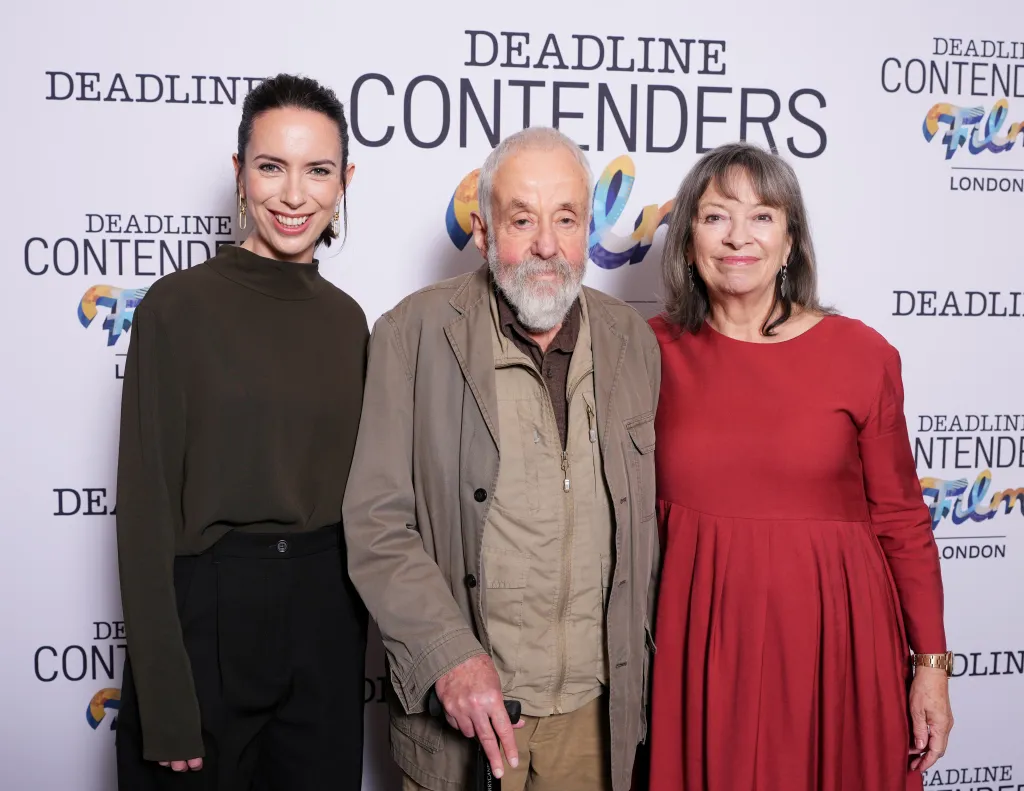
“It’s quite practical,” actor Kate O’Flynn concluded this morning when quizzed on working on Tender Loving Care with veteran filmmaker Mike Leigh, best known for his unique pre-production process, which includes no script and a collaborative approach to story development.
O’Flynn was speaking on stage at Deadline’s London Contenders event alongside Leigh and her co-star, Marion Bailey.
“It’s very quite simple, really. We’re just talking about what our characters would know with Mike, or how they would react. Is that accurate to who they are? You carve out the characters through those explorations,” O’Flynn continued.
Tender Loving Care debuted earlier this year at Telluride before playing San Sebastian, where it won several major awards, including the top prize, the Golden Shell, alongside the award for Best Screenplay and the Silver Shell for Best Leading Performance for actress Kate O’Flynn.
The film follows Amy (O’Flynn), who, after a bitter breakup, moves in with her best friend, Rosie (Alice Bailey Johnson). Both work as social workers in London, at opposite ends of the age spectrum. Rosie becomes like a second daughter to Amy’s parents, notably her elderly father, who is starting to show his age.
Leigh told the audience in London that the story for Tender Loving Care was developed after he had a feeling about exploring a narrative based around “positive and care.”
“And as it evolved, we thought about social workers,” he said. “We see them operating. And we see them in their private lives.”
Tender Loving Care will feel familiar for Mike Leigh fans, with its earnest exploration of working-class lives. But the filmmaker said he is never trying to reference his past work when developing a new story.
“I never think about that at all,” Leigh said. “I try to do something different with every film. And at the same time, any artist may inevitably say the same thing.”
Leigh has previously said Tender Loving Care may be his last film project. The veteran filmmaker now struggles with his mobility, which he said makes his work on set much more difficult. However, he did not entirely rule out working again.
“I’m a little disabled these days, so it makes it hard. But it is possible. I don’t know,” Leigh said.
Tender Loving Care is set for a December 4 release in the U.S. via Bleecker Street. StudioCanal will release the film in the UK next year.
>
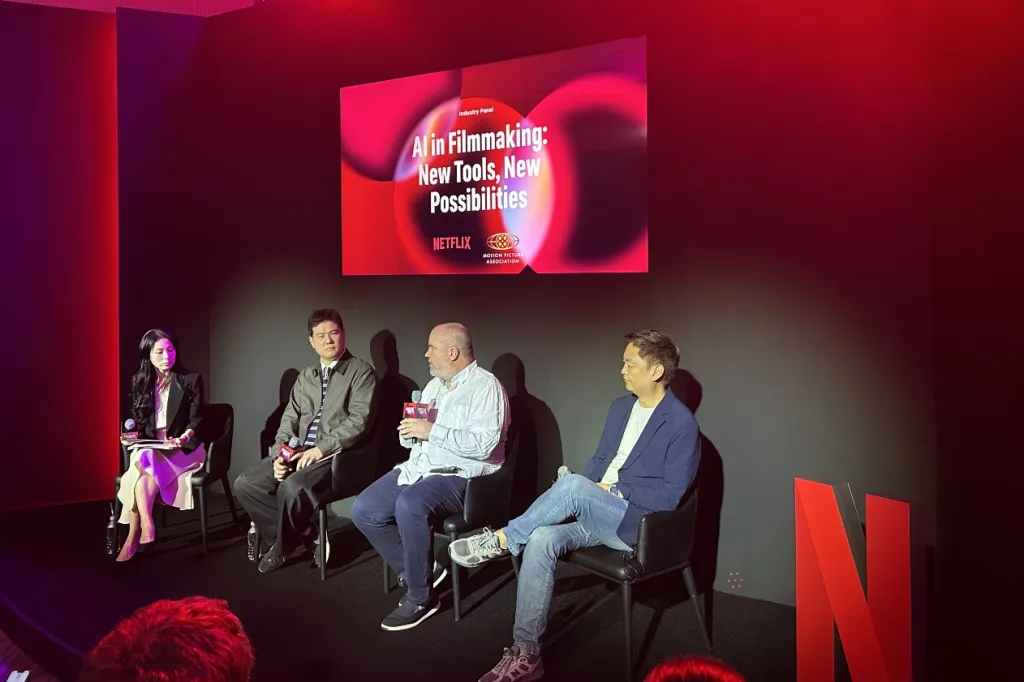
Kimball Thurston, Weta FX’s chief technology officer, Korean filmmaker Kang Yun-sung and Netflix’s APAC Senior Director, Production, Sung Q Lee, discussed the advantages and limitations of using AI tools in production workflows during Netflix’s Creative Asia day at Busan International Film Festival.
They agreed that AI is bringing a range of efficiencies to the production process – reducing budgets, speeding up workflows and helping filmmakers realize scenes that were previously impossible to achieve – but they also noted some of its limitations.
“We’ve been growing it at a measured pace; using using it for image clean-up; not necessarily for generating images; but generating the motion that goes into some of the crowd scenes; and beyond that we’re starting to see some other small use cases,” said Thurston. “But I think there’s still some problems that we have to solve.”
He noted that while the resolution issue is currently being solved – filmmakers can now output to 4K resolution in many cases – there are still issues around color volume: “There are still some some things that I hope that technology companies will come and collaborate with the creative industry on more than they have been historically,” Thurston said.
“There’s actually a number of color issues, not the resolution of the color, but the range of color volume. For example, if all your AI models have been trained on a certain set of video images, you might not be getting the right shade of red. I hope we can collaborate more so we can help these companies solve some of these problems.”
Thurston also noted that the way that creatives currently have to work with the technology is not so intuitive: “We need better interfaces – for a visual artists, a text-based prompt is not the best way to interact with this technology.”
All three speakers focused on the use of AI to provide filmmakers with more creative choices – more iterations of a sunset or battle scene, for example – rather than using fully AI-generated images or replacing actors. “Remember there are different forms of AI – it’s not just about image generation, there’s also assisted AI, it’s about using these tools to help the creative narrative,” Thurston said.
Netflix’s Sung said the streamer is using the technology for pre-visualization, editorial and VFX, and has often had discussions about other use cases, but stressed that the “human touch is always critical and necessary”.
After playing a showreel of work done by Netflix’s VFX subsidiary Eyeline Studios, Sung added: “We have strict guidelines within the company. We’re not just chasing after the use of AI for the sake of it – if it helps the viewer experience then we have an internal process and we work through that. We’re not trying to be the fastest by using AI.”
Sung also touched on sustainability issues when asked by an audience member, who quoted figures on AI technology’s use of water resources. “If we’re talking about sustainability, we need to talk about the bigger picture beyond just AI, to achieve net zero we need to look at a range of issues and make different attempts,” Sung said.
Kang, whose credits include Run To The West, South Korea’s first feature-length AI-assisted film, said that AI is enabling the Korean film industry to reach its full potential. “Incorporating AI into film is turning our imagination into reality. In the past, genre films were not able to be the biggest due to budget limitations, but AI can now extend creative possibilities.”
Kang also screened a teaser of Netflix’s upcoming Gulf Of Aden, a Korean-language action thriller that he is directing, and which is using AI tools to recreate scenes of war-torn African countries, battles with modern-day pirates and ships being hijacked. “Not just because of savings on CGI, but also because the shooting process was simplified and the production period shortened, we were able to make savings of 30-40% by using AI,” Kang said.
However, he added that he doesn’t believe AI can currently replace real life actors: “AI generated battle scenes may have better quality than what we can otherwise afford to achieve, but will the technology be able to convey real human emotions to the audience? We’re still in the transition phase, but right now, I don’t think so.”
Netflix’s Creative Asia day, which is aimed at local creatives and industry, also included masterclasses with The Blue Road director Han Jun-hee and Possible Love cinematographer Kim Ji-yong; an industry panel on New Voices in Filmmaking; and workshops on storytelling and understanding the perspective of buyers, among other sessions.
>
Wild await Boldy, Eriksson Ek breakthroughs, but ‘not saying they’re missing in action’
After playoff elimination, Liberty players' silence on coach Chris DeMarco speaks volumes
The Pistons know Ausar Thompson’s defensive impact. Now he wants to prove himself on offense
-

 movies5 months ago
Search For Canadian TV Actor Stewart McLean Now Homicide Investigation
-

 Fashion9 years ago
These ’90s fashion trends are making a comeback in 2017
-
Fashion9 years ago
According to Dior Couture, this taboo fashion accessory is back
-
Fashion9 years ago
Model Jocelyn Chew’s Instagram is the best vacation you’ve ever had
-
Fashion9 years ago
Emily Ratajkowski channels back-to-school style
-
Fashion9 years ago
9 Celebrities who have spoken out about being photoshopped
-

 Anime4 months ago
Rurouni Kenshin: Hokkaido Arc Manga Takes 1-Issue Break – News
-

 Anime3 months ago
HIDIVE to Stream English Dubs for The World Is Dancing, The Forsaken Saintess and Her Foodie Roadtrip in Another World, The Dangers in My Heart: The Movie Anime – News