
movies
Danny Boyle On ‘Ink’: “We Had A Siege Mentality While Making It”

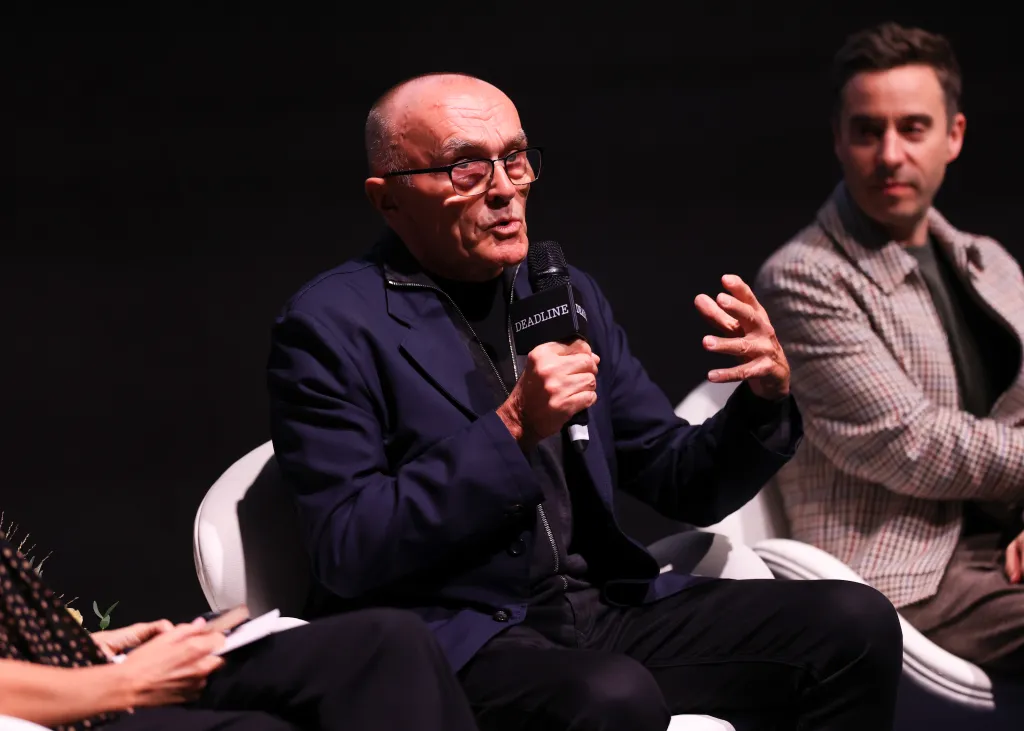
At Deadline’s Contenders London event this morning, Ink director Danny Boyle has spoken about the challenges he and his film team faced making the origin story of Rupert Murdoch-owned British tabloid The Sun. The filmmaker was joined on stage by writer James Graham and actor Jack O’Connell.
“We had a siege mentality while making it”, Boyle said about making the film, noting that the finance was hard to come by until Studiocanal stepped up and then partnered with Netflix on the release.
Set in 1969, the film follows how rising media tycoon Rupert Murdoch acquires UK newspaper The Sun and how his partnership with editor Larry Lamb (O’Connell) turns the paper into Britain’s most influential and at-times controversial tabloid. Boyle directs the feature from a screenplay written by Graham (Dear England), based on his Tony-nominated play Ink. O’Connell stars as The Sun newspaper editor Larry Lamb, with Guy Pearce as Rupert Murdoch. Claire Foy is Jules Davies.
“It was very difficult to raise the money,” in the first instance, Boyle said. “You can read into that whatever you want in terms of conspiracy theories. Why was it very difficult to raise the money for an incredibly successful stage play?”
He continued: “It was very tough. We didn’t have enough money, which was great because we had a siege mentality making it. ‘Nobody really wants us to do this, do they?’ [we thought] So we thought we would do it.”
“One of the challenges of the film”, he expanded, “which was really interesting, was to try and avoid people being too judgmental walking into it because it’s about The Sun. It’s very Marmite. And also because it’s about Murdoch, which people have a really Marmite [response to]…You’re worried about people going in, bringing that modern day judgment to it. So we tried to make the film as entertaining as possible.”
He continued: “The Sun, whatever you think about it, it ended up being the biggest selling newspaper in the world, and those four or 5 million people [behind it] weren’t stupid, and they didn’t buy it because it was a bad paper. There was something in it that spoke to them, and it’s a carousel or a slide that you’re on. You lose sight of certain things: standards. You lose sight, but you’re not aware you’re doing it at the time. We wanted to try and make that rather than feeling superior to it and judgmental of it to begin with.”
Speaking about his inspiration for writing the stage play and the movie, James Graham said: “Their [The Sun leaders] simple idea was rather than just telling people what we thought they should hear about the world and about politics, that Reithian and BBC philosophy of the news, which is to educate and entertain, they believed that we should be asking, ‘what do people want?’ That’s not an unimportant question. What do people want in their daily pleasures in their lives? Even some of the darkness in your soul that needs sating, whether that’s sex, or whatever, they came up with a model and a template for that, and the film explores the costs and the benefits of that. I think the cost is clear to this day. It’s literally the model that the internet runs on.”
Actor Jack O’Connell said that he didn’t see the original play and didn’t know who Larry Lamb was before reading the script, but was well aware of the lasting potency of The Sun.
“My grandma could talk about this guy,” he said. “My grandma still has an edition of The Sun newspaper on her kitchen table every day. She doesn’t leave the house, but there’s somehow a brand new edition of The Sun each day. I’ve tried to talk to her about it, but she’s she’s nearly 90.”
Boyle produces the Venice Film Festival opener alongside Tessa Ross (Conclave) and Michael Ellenberg (The Morning Show). Ink reunites Boyle and Ross following their collaboration on Slumdog Millionaire. Tracey Seaward (The Two Popes) also produces. Anna Marsh, Ron Halpern, Joe Naftalin, Tonia Davis, Zoe Edwards, James Graham, and Sudie Smyth are executive producers.
Studiocanal fully financed the film and will release it theatrically in Italy, the UK, France, Germany, Poland, the Benelux, Australia and NZ. Netflix is releasing the film in U.S. cinemas on December 11 before it lands on the streamer on Jan 8. StudioCanal will release the film in the UK on Jan 8.
>
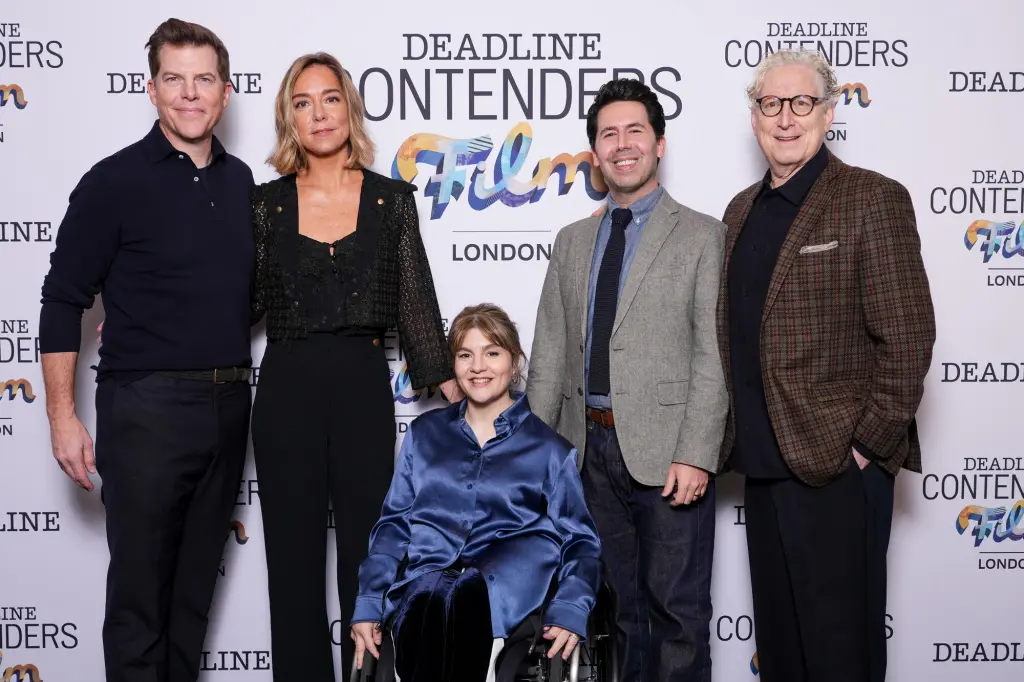
“I think we created history,” Being Heumann producer Kevin Walsh concluded this morning during a Q&A session at Deadline’s Contenders London.
The veteran producer wasn’t speaking specifically about the feature film, but the accessible environment he and director Siân Heder created on the film’s set.
“We are as proud of that as we are of the movie,” Walsh continued.
The Apple Original Films title tells the true story of disability-rights advocate Judy Heumann, played by Doctor Who alum Ruth Madeley. Based on Heumann’s memoir, it centers on the year 1977, when Heumann led more than 100 disabled people to take over the San Francisco Federal Building, kicking off a 28-day sit-in — the longest occupation of a federal building in U.S. history.
The protesters form a tightly bound community, refusing to leave until the government enforces Section 504 of the Rehabilitation Act, which required all federal spaces to become accessible.
“We really approached this film with the same kind of relentlessness that Judy approached her life,” Walsh said. “We had 10 disabled leads. It took a lot of detail to make it accessible. Making ramps that were accessible with trailers, retrofitting hair and makeup trailers for disabled actors to be able to use. It took a company like Apple to really support us.”
Discussing the origins of the project, Heder said a friend who worked on the Sundance documentary Crip Camp, which starred the late Judy Heumann, tipped her off about Heumann’s life story.
“A friend of mine was the accessibility coordinator for Crip Camp at Sundance, and she sent me a text message and said, I’m hanging out with this woman, Judy Heumann. She’s the coolest woman on the planet, and someone should make a movie about her,” Heder explained.
“I’d had a very profound experience on Coda, entering the deaf community and really understanding how many of these stories aren’t told. There are so many of these incredible stories within the disability community, and they are just never represented.”
Heder said she later saw Crip Camp and read Heumann’s memoir, which introduced her to the story of the 504 protests.
“I was just really intrigued by Judy because she’s so funny. She was this little woman with this Brooklyn accent. She was so self-possessed and so hilariously in command of everybody,” Heder said.
Being Heumann debuted last month at TIFF and screens this week in London as one of the London Film Festival headline galas.
The film will debut in select theaters on November 6 before dropping on Apple TV on November 13.
>
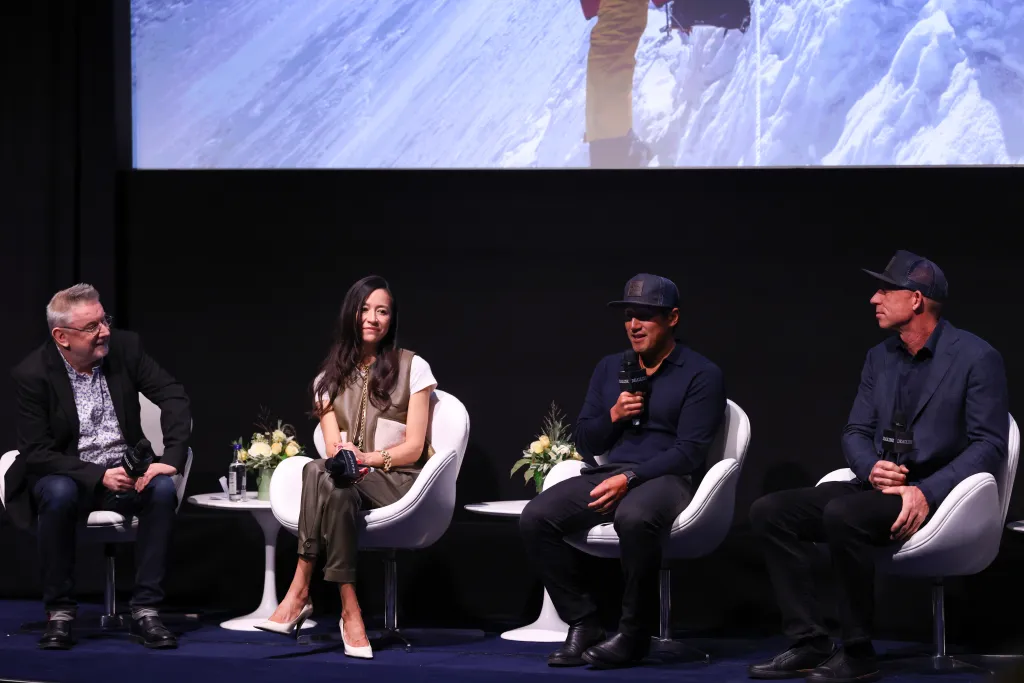
Oscar-winning directors Elizabeth Chai Vasarhelyi and Jimmy Chin dug into the challenges of making Everest: The Other Side at Deadline’s Contenders London event on Saturday.
The heart-stopping documentary follows the quest of mountaineer-skiers Jim Morrison, who joined them on stage, and Hilaree Nelson to scale the North Face of Mount Everest and the ski down it.
Thousands of people have ascended the mountain from the southeast ridge in Nepal, but only five had ever reached its summit from the North Face.
“I think it’s pretty safe to say this is the most difficult film we’ve made. It really required every experience that I’ve had as a climber and as a director and producer,” said Chin, who is himself a world-class mountaineer.
“A lot of the challenges we faced, I faced before, but in a smaller scale… the scope and scale of it was different, “ he said.
Everest: The Other Side follows a string of works by Chai Vasarhelyi and Chin exploring people who push themselves to the limits of human endurance, including 2018 Oscar and Bafta-winning documentary Free Solo as well as The Rescue, and fiction feature Nyad based on the true story of long-distance swimmer Diana Nyad.
“Very similar to Free Solo, we had to have a world-class team of mountaineers and climbers first, and they had to be world-class cinematographers and be able to operate at 28,000 feet, 29,000 feet,” said Chin.
Chai Vasarhelyi said that alongside capturing the physical feat at the heart of the documentary, there is also a deep love story and a “serious meditation” on taking risk.
“Risk was always part of this story, and then it turned into a more serious meditation on risk, which I think this film more than any other film I’ve made… really dives into the ethical implications,” she explained.
Asked why he continues to push himself to the limits, Morrison replied: “Why? Because I don’t know how not to do it. Yes, this film is certainly a meditation of mortality to a degree. It’s about a lot of things, but it’s something I’m starting to examine.”
“When we are out there and on the edge, we face mortality fairly consistently, and I’m not talking like we’re always in life and death situations, but you’re always making those assessments.”
>
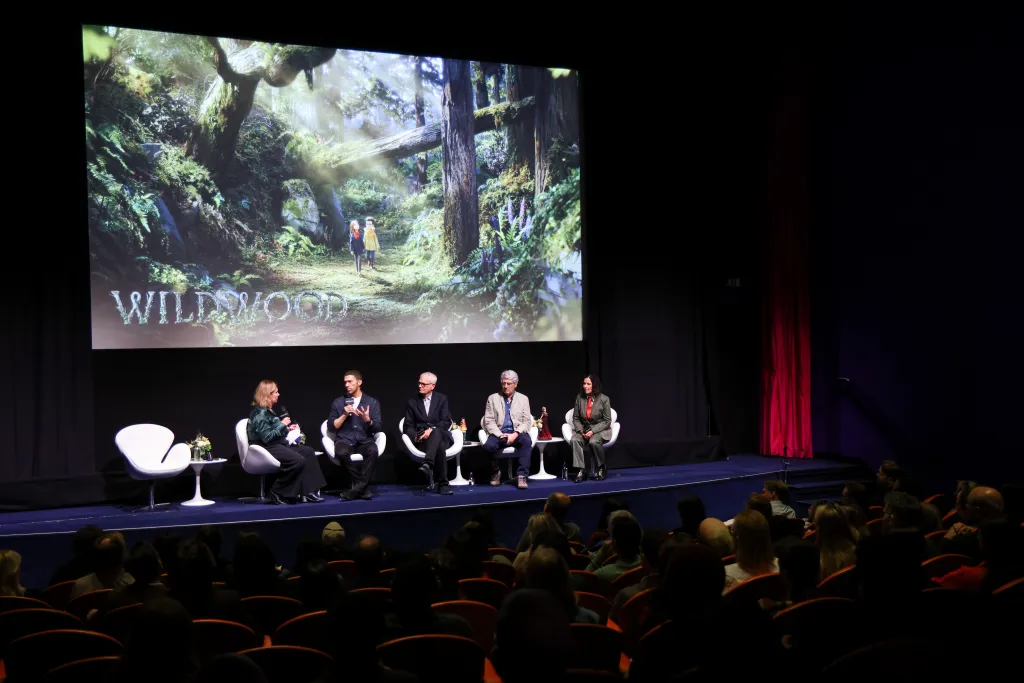
Travis Knight took to the stage at Deadline’s Contenders London event to explain just how much work had gone into making LAIKA’s new release Wildwood. Accompanied by cinematographer Caleb Deschanel, composer Dario Marianelli and costume designer Deb Cook, Knight revealed that the legendarily difficult stop-motion process did not exactly make life easy when making a film set in various different magical realms, with murder upon murder of vicious crows, and full-on epic battle scenes.
“For those who don’t know,” said Knight, “the way stop-motion works is that we build thousands and thousands of tiny little [animations]. We put them under set lights, we move them a microscopic distance, take a picture, move them another microscopic distance, take another picture, and you repeat that process over and over and over again until either a movie emerges or society collapses, whichever comes first. And with this one, it actually could have gone either way because it took us 16 years to make this movie. To put that in perspective, Barack Obama was a fresh-faced president in his first term at the time.”
“Stop-motion is very painful” he added. “It’s the absolute worst way there is to make a movie, but I think that it has its own unique beauty and that comes from the fact that it’s made by hand. It’s crafted by these incredible artists and craftsmen who build the world with their own hands. It’s very challenging, but it has a unique feeling. And I think it felt like that was in the DNA of what this story wanted to be: It felt like it was handcrafted. I am a firm believer of the notion that the process of creating art leaves fingerprints on the art itself. And so the fact that we had this whole incredible group of artists and craftsmen who poured years of their lives in devotion into carrying this thing into existence, I think you feel it in the movie itself.”
Unusually for the studio, Wildwood — potentially the first in a series based on the 2011 novel by Colin Meloy — is LAIKA’s first film to be rated PG-13. “There wasn’t really any hesitation in terms of where we were going with the movie,” said Knight, “but I think we wanted to make sure that we were treating it with great care, because we are exploring sophisticated themes, important themes, like loss and grief. And we wanted to make sure that we were treating that sensitively and with care. And I think that one of the things about animation and fantasy is that it provides us a couple of steps removed from the real world. So it allows us to give difficult feelings a shape. And so you go into this fantastic world and hopefully you’re discovering things about your own life and it’s being reflected at you through a different prism.
“I don’t think we should forget that young audiences have complex inner lives as well,” he continued. “Young people know what it is to feel alone, to feel afraid, to feel powerless. And I think stories have an obligation to treat that sensitively and responsibly. We’ve tried to do that with this movie. We ask difficult things, like how far would you go for love? When should you let go? What is the cost of holding on? And how do you keep your heart open when we know how much it costs us? I think the film ultimately arrives at a really light and joyful place — but we earn the light honestly.”
Check back Monday for the panel video.
>
After decades of consistency, USWNT doesn't have a No. 1 goalkeeper. It's by design

Siân Heder On Creating An Inclusive Film With ‘Being Heumann’
F1's heat hazard solution can make drivers hotter. Would rule changes fix cockpit cooling?
-

 movies5 months ago
Search For Canadian TV Actor Stewart McLean Now Homicide Investigation
-

 Fashion9 years ago
These ’90s fashion trends are making a comeback in 2017
-
Fashion9 years ago
According to Dior Couture, this taboo fashion accessory is back
-
Fashion9 years ago
Model Jocelyn Chew’s Instagram is the best vacation you’ve ever had
-
Fashion9 years ago
Emily Ratajkowski channels back-to-school style
-
Fashion9 years ago
9 Celebrities who have spoken out about being photoshopped
-

 Anime4 months ago
Rurouni Kenshin: Hokkaido Arc Manga Takes 1-Issue Break – News
-

 Anime3 months ago
HIDIVE to Stream English Dubs for The World Is Dancing, The Forsaken Saintess and Her Foodie Roadtrip in Another World, The Dangers in My Heart: The Movie Anime – News