
movies
Siân Heder On Creating An Inclusive Film With ‘Being Heumann’

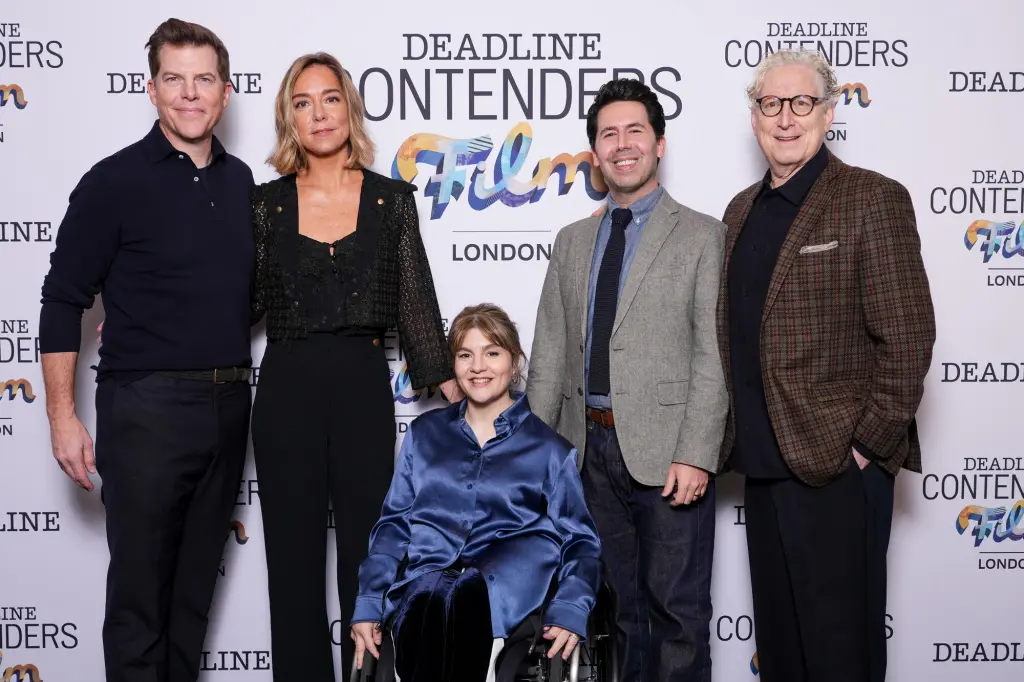
“I think we created history,” Being Heumann producer Kevin Walsh concluded this morning during a Q&A session at Deadline’s Contenders London.
The veteran producer wasn’t speaking specifically about the feature film, but the accessible environment he and director Siân Heder created on the film’s set.
“We are as proud of that as we are of the movie,” Walsh continued.
The Apple Original Films title tells the true story of disability-rights advocate Judy Heumann, played by Doctor Who alum Ruth Madeley. Based on Heumann’s memoir, it centers on the year 1977, when Heumann led more than 100 disabled people to take over the San Francisco Federal Building, kicking off a 28-day sit-in — the longest occupation of a federal building in U.S. history.
The protesters form a tightly bound community, refusing to leave until the government enforces Section 504 of the Rehabilitation Act, which required all federal spaces to become accessible.
“We really approached this film with the same kind of relentlessness that Judy approached her life,” Walsh said. “We had 10 disabled leads. It took a lot of detail to make it accessible. Making ramps that were accessible with trailers, retrofitting hair and makeup trailers for disabled actors to be able to use. It took a company like Apple to really support us.”
Discussing the origins of the project, Heder said a friend who worked on the Sundance documentary Crip Camp, which starred the late Judy Heumann, tipped her off about Heumann’s life story.
“A friend of mine was the accessibility coordinator for Crip Camp at Sundance, and she sent me a text message and said, I’m hanging out with this woman, Judy Heumann. She’s the coolest woman on the planet, and someone should make a movie about her,” Heder explained.
“I’d had a very profound experience on Coda, entering the deaf community and really understanding how many of these stories aren’t told. There are so many of these incredible stories within the disability community, and they are just never represented.”
Heder said she later saw Crip Camp and read Heumann’s memoir, which introduced her to the story of the 504 protests.
“I was just really intrigued by Judy because she’s so funny. She was this little woman with this Brooklyn accent. She was so self-possessed and so hilariously in command of everybody,” Heder said.
Being Heumann debuted last month at TIFF and screens this week in London as one of the London Film Festival headline galas.
The film will debut in select theaters on November 6 before dropping on Apple TV on November 13.
>

Gentle Monster writer-director Marie Kreutzer and star Léa Seydoux took to the stage at Deadline’s Contenders London event to discuss the journey behind their Cannes drama.
Seydoux plays Lucy, an experimental pianist who moves with her beloved but panic attack-liable husband Philip (Laurence Rupp) and young son to a rural farmhouse in Bavaria. Life seems swell until a special unit of big-city police led by Detective Kühn (Jella Haase) swoop in and seize one of Philip’s devices. As expected, they find and seize thousands of images of child pornography — and his double life is exposed. Catherine Deneuve plays Lucy’s mother in the feature.
The project has a striking resonance for Kreutzer. In 2022, the Austrian director released Corsage, starring Vicky Krieps and Florian Teichtmeister. The following year, Teichtmeister was arrested and pleaded guilty to possession of child pornography: 76,000 files spread over 22 devices. He received a suspended sentence, which outraged many Austrians horrified by the crime committed by a prominent cultural figure. Inevitably, Kreutzer’s film was tarnished by association and even withdrawn from some cinemas.
How did that experience shape Gentle Monster?
Kreutzer explained today that she “started working on Gentle Monster in 2020, after reading an article in a German newspaper about a ring of criminals being uncovered in Germany. So when all that happened with the actor, I knew so much about the issue, and it was a very disturbing coincidence. I thought, ‘I can’t make the film anymore’, because it will always be connected to an actor, but sometime later, I realized it’s maybe more of a reason to make the film and to confront it and not run away from it.”
Seydoux described why she was drawn to the film: “I loved the script. I thought it was well written and and very subtle, because the subject is obviously a tough subject, and it’s not that easy to make a film about a subject like this one. I love the fact that it was told through the woman’s perspective, and that it’s through her eyes that the the story formed. It’s not through the victim’s perspective or through the perpetrator’s perspective. I thought that was extremely interesting because I was able to to express very contradictory feelings and a large range of different emotions.”
She described the revelation at the heart of the movie as “a horrible thing” that creates “an earthquake inside” her character.
The actress said that among the most challenging practical aspects of the film were speaking German and the concert scenes where she has to play the piano.
Kreutzer agreed that the concert scene was among the most difficult to capture: “The big concert scene was a really hard thing for for both Lea and me because she’s a very intuitive actress, which I love, and I’m a very intuitive director, and less technical. I know what I need to know, but I don’t want any marks for the actors, I want them to move freely, so don’t plan shots in millimeters. That’s not how I do it. And so when you’re shooting a scene like that, you have to do that. It was a day where I felt like it was out of my hands and I can’t really do anything and everyone’s really stressed.”
Kreutzer also described a “wild day” when Seydoux, who doesn’t drive, had to drive a car in reverse with a child in the back seat.
Netflix acquired the film as Cannes was wrapping up in May and opens it October 30 in limited release before it starts streaming on November 18. Alexander Glehr and Johanna Scherz are the producers.
>

Writer-director Guy Nattiv and actress Carrie Coon joined Deadline’s Contenders London event today where the pair discussed making The Liberation, a very personal story inspired by real events from Nattiv’s own grandmother.
The film, which Bleecker Street is releasing in in the U.S. in January, is set in the early 1980s where Rita, a depressed New Jersey bank worker and Holocaust survivor (Coon), is lured into an all-female woodland commune by a charismatic leader (Lily James), while her daughters attempt a rescue.
“I was only eight when my family took me to seminars to see my grandmother and participate with her in those meetings,” said Nattiv. “I didn’t know what it meant. It was like dancing with people in the dark. I heard horrific stories from people, and my grandmother crying, it was so weird to me. But no one told me what it was exactly, and I didn’t know until I became a teenager when my family had basically broken in front of my eyes, and my grandmother left my grandfather, left our family, and just joined this. Now, we know it was a cult but at the time we didn’t know what it was.”
Nattiv said that when he was older and was processing these events as a film student, he started asking a lot of questions but didn’t get a lot of answers. It was a decade ago that he decided to take his camera and visit the cult after his grandmother had passed away. “I asked questions and I got answers…ish.”
He entered the process with “a lot of empathy” and found that the cult “tried to free her” from her trauma of being a Holocaust survivor. “She had the courage to do something very uncommon: To leave your family, say goodbye to your daughters and your husband and go into the unknown and try to save yourself.”
Coon admitted she was “absolutely fascinated by the story” and said she watched “hours and hours” of footage from Yad Vashem and from Shoah Foundation testimonies, “particularly women from Poland,” to help her research for the role of Rita.
“There’s something very specific about the way the recounting of those unspeakable things is held in the body,” said Coon. “And also, the stories themselves, the myriad forms of trauma that were inflicted upon people. But then also that they were resilient enough to survive was also very fascinating and people had a find a way to survive and Rita had a very particular idea about what that looked like for herself…who are we to say what is required for someone to move on?”
Coon continued that it was helpful for her to view the story as “a love story.”
“What I became very fascinated by with reading is the idea that these social rules we are living by are tacit agreements,” she said. “There’s nothing written down. We wake up in the morning and we’re a wife and a mother and we follow all of these rules. But it’s all made up. We could essentially walk away from our lives at any time, but we don’t do it. And we did [in this film]. I just find that brave and shocking.”
Check back on Monday for the panel video.
>
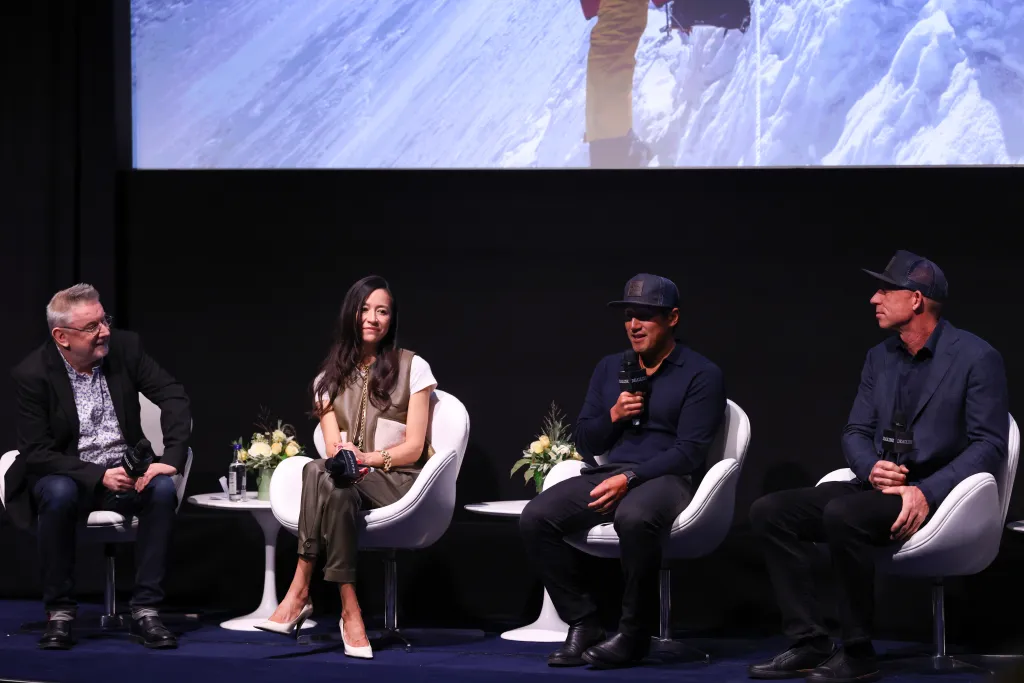
Oscar-winning directors Elizabeth Chai Vasarhelyi and Jimmy Chin dug into the challenges of making Everest: The Other Side at Deadline’s Contenders London event on Saturday.
The heart-stopping documentary follows the quest of mountaineer-skiers Jim Morrison, who joined them on stage, and Hilaree Nelson to scale the North Face of Mount Everest and the ski down it.
Thousands of people have ascended the mountain from the southeast ridge in Nepal, but only five had ever reached its summit from the North Face.
“I think it’s pretty safe to say this is the most difficult film we’ve made. It really required every experience that I’ve had as a climber and as a director and producer,” said Chin, who is himself a world-class mountaineer.
“A lot of the challenges we faced, I faced before, but in a smaller scale… the scope and scale of it was different, “ he said.
Everest: The Other Side follows a string of works by Chai Vasarhelyi and Chin exploring people who push themselves to the limits of human endurance, including 2018 Oscar and Bafta-winning documentary Free Solo as well as The Rescue, and fiction feature Nyad based on the true story of long-distance swimmer Diana Nyad.
“Very similar to Free Solo, we had to have a world-class team of mountaineers and climbers first, and they had to be world-class cinematographers and be able to operate at 28,000 feet, 29,000 feet,” said Chin.
Chai Vasarhelyi said that alongside capturing the physical feat at the heart of the documentary, there is also a deep love story and a “serious meditation” on taking risk.
“Risk was always part of this story, and then it turned into a more serious meditation on risk, which I think this film more than any other film I’ve made… really dives into the ethical implications,” she explained.
Asked why he continues to push himself to the limits, Morrison replied: “Why? Because I don’t know how not to do it. Yes, this film is certainly a meditation of mortality to a degree. It’s about a lot of things, but it’s something I’m starting to examine.”
“When we are out there and on the edge, we face mortality fairly consistently, and I’m not talking like we’re always in life and death situations, but you’re always making those assessments.”
>

Léa Seydoux, Marie Kreutzer On The “Earthquake” Of ‘Gentle Monster’
The Guardians fought their way home. Now Game 5 awaits at Cleveland’s house of magic
One NHL player from every team with the most on the line in the 2026-27 season
-

 movies5 months ago
Search For Canadian TV Actor Stewart McLean Now Homicide Investigation
-

 Fashion9 years ago
These ’90s fashion trends are making a comeback in 2017
-
Fashion9 years ago
According to Dior Couture, this taboo fashion accessory is back
-
Fashion9 years ago
Model Jocelyn Chew’s Instagram is the best vacation you’ve ever had
-
Fashion9 years ago
Emily Ratajkowski channels back-to-school style
-
Fashion9 years ago
9 Celebrities who have spoken out about being photoshopped
-

 Anime4 months ago
Rurouni Kenshin: Hokkaido Arc Manga Takes 1-Issue Break – News
-

 Anime3 months ago
HIDIVE to Stream English Dubs for The World Is Dancing, The Forsaken Saintess and Her Foodie Roadtrip in Another World, The Dangers in My Heart: The Movie Anime – News