
Sports
The world’s largest domestic sporting union announces first-of-its-kind fertility care


The NWSL has a record number of active mothers rostered, 28, this season. The figure represents a shift in support and understanding around pregnancy, postpartum and parenting. The Athletic explores these topics and more in a series devoted to motherhood and soccer.
“You feel like you’re going around in secrecy, maybe we should start asking some questions, but who do we ask?”
Being in a same-sex couple, former Everton player Fern Whelan and her partner had to go through a fertility clinic to get pregnant. The only reason they chose their provider was because they had seen former England international, now Canada’s head coach, Casey Stoney attend the same one with her partner.
“I had no knowledge,” says Whelan, women’s football equality, diversity and inclusion/player services executive at the Professional Footballers’ Association (PFA), expressing how she felt isolated. “It’s so nice that now players do not have to feel like that.”
That is because on Wednesday, the PFA, the world’s largest domestic sportsperson union, representing 5,000 current and 50,000 former players, launched a first-of-its-kind for a UK sporting organisation partnership with Care Fertility, the UK’s largest fertility provider.
The partnership will offer male and female players across the Women’s Super League, Women’s Super League 2, the Premier League and English Football League access to clinician-led fertility education, assessments, preservation, including egg freezing, in vitro fertilisation (IVF) and family-planning support. The partnership’s priority is to educate players through webinars, in-person events, and a digital hub that provides information, reduces stigma around fertility, and signs players to clinics.
The Athletic spoke to fertility researchers, fertility clinics, the PFA, clubs and leagues to find out about fertility provision in England.

Former Brighton player Fern Whelan became a mother attending a fertility clinic with her partner (Jess Hornby – The FA/The FA via Getty Images)
There is a lot to learn: from high treatment costs to hormones breaching anti-doping regulations. The key message, however, for players is that a woman’s fertility decreases with age — it’s at its highest in one’s 20s, begins to fall around the age of 30, before significantly decreasing after the age of 35 — and as female athletes’ careers become longer, their peak competitive years often overlap with their peak reproductive years.
“Men are like factories of sperm manufacture,” says Alison Campbell, Care Fertility’s chief scientific officer. “Women just have the eggs they are born with. It frightens me (that) when they decide they’re ready to have a family, it’s often after their peak fertility has passed.”
Fertility timelines will not change but the sport’s infrastructure must.
Fertility support and player welfare
Although there are differences in each country’s healthcare system, the women’s game in England is far behind the United States in terms of fertility treatment provision. More than half of National Women’s Soccer League (NWSL) clubs started partnerships with fertility clinics a couple of years ago — Racing Louisville being the first to offer provision to its players in 2021.
In addition to club support, the NWSL’s Collective Bargaining Agreement also states they shall secure a vendor to assist players with family building benefits, including IVF treatment, ovulation tracking, fertility testing, genetic testing and surrogacy. The NWSL will pay for the administrative costs, while the player’s health insurance covers other fees, with any amounts not covered by insurance falling to the player.
Whelan believes the first step in England is to start the conversation before putting an onus on clubs financially.
When The Athletic asked the 12 WSL clubs about their fertility treatment provision, Arsenal were the only ones to engage. They view fertility support as a player welfare matter. “Clubs who proactively support fertility health are recognising the athlete as a whole person, not just a performer on matchday,” says Emma Saunders, Arsenal’s female athlete health physiotherapist, responsible for developing the club’s female athlete health programme along with head of performance Gary Lewin and a team doctor.
The PFA is unaware of any clubs other than Arsenal offering official fertility treatment support. The north London side believes that female-specific health support — including menstrual health, contraception, fertility, pregnancy, and menopause — should sit alongside nutrition, psychology, and physical performance. As they started to build their health strategy and conversations around women’s health became more open, players started to feel more comfortable raising different topics, including fertility.
Arsenal provides fertility education workshops, access to specialist fertility clinicians and individual consultations with the club’s medical team on demand. Collaboration between the player and club doctors, gynecology specialists, performance staff, and psychologists, as well as creating a culture in which players feel comfortable talking about their fertility, is key to their strategy.
Education and egg freezing
The PFA recognised a demand from players for education, security that it is OK to start conversations with their clubs and external bodies, and support when they return to play after giving birth.
Hannah Blundell, who was on loan at Everton from Manchester United last season, conceived naturally and gave birth to her daughter Romi last year. She had never received any education, nor even thought about her fertility. Conversations about an athlete’s fertility timeline, in her words, are still “very minimal”.

Hannah Blundell returned to action for Everton after conceiving naturally (Lewis Storey/Getty Images)
That tallies with findings of Professor Margie Davenport, the perinatal research lead for FIFA’s female athlete project, who has also worked with the NWSL and Women’s Tennis Association (WTA). She advocates for younger athletes, in their late teens or early 20s, to be informed of their fertility timeline so they can be empowered to make an informed decision. “Options are the most important thing,” she says.
The fertility treatment garnering the most traction among athletes, particularly in the United States but also globally, is egg freezing. This form of fertility preservation puts fertility on ice and has only entered the athlete world in the last couple of years.
The earlier in life a woman does an egg retrieval cycle, the more likely the collected eggs are higher in quantity and quality which results in a better chance of having a pregnancy.
Investing in fertility treatment reflects the evolution of women’s football. FIFPRO’s 2017 World Players’ Union survey found of the 3,295 women footballers participants, only two per cent of respondents were mothers, and 47 per cent felt they would stop their career early to start a family. “So you’re losing 47 per cent of all female players before they have fulfilled their career,” says Davenport.
“If doing egg retrieval or supporting pregnancy means they’re going to continue afterwards for a year or more, that’s a huge return on investment. (Think of) the loss of expertise and leadership, we should be finding ways to keep women in sport as long as possible.”
The egg freezing procedure involves appointments, around seven to 10 days of hormone injections to stimulate egg production, followed by a minor one-day operation under sedation for the retrieval of the eggs. It requires careful, but feasible, scheduling around the demands of athletes’ training and competition.
The challenge of fitting treatment around a professional football calendar was highlighted by Mary Earps in her book All In, when she recalled asking a medical expert: “I’ve got three weeks. Do you think I could fit in an egg-freezing cycle in that time?”
Some time away from training at a lower impact is necessary but exactly how long and at what intensity is much debated.
At a women in sport congress held in Australia in March, Davenport presented a paper, which is still under review, which found from an online survey of 216 recreational and elite athletes, primarily from the U.S., Canada and the UK, who underwent egg freezing and/or in-vitro fertilization in the last five years, patients were most commonly told to reduce their activity levels to walking or stopping completely for the one to two weeks before and after egg retrieval. But recommendations vary hugely.
Some fertility clinics in the United States that work with higher-level athletes recommend activity reduction for just one or two days around the time of egg retrieval.
The survey results concluded that: “exercise did not increase the odds of experiencing an adverse event during ovarian stimulation” but further research is required.
To tell an athlete to reduce their training without the evidence to support this is “not appropriate”, says Davenport. “There is no evidence-based standard available yet. When our baseline is nothing, we’re just guessing either way.”
Another interview study, conducted by Davenport but still under review, of 22 athletes who underwent egg freezing and were asked to reduce or stop their training for a very short period of time, had some “profound effects” on an athlete’s mental health.
“If you take away somebody’s athletic identity, take away a form of stress reduction and mental health support, it’s going to potentially cause other mental health issues as you’re going through the process,” she says. “Many athletes talk about this being a very stressful time because they’re going through this procedure that’s changing their hormones but they’re also stopping what they love, and they don’t know why they’re doing it or don’t feel they have the appropriate information to do it.”
Arsenal educates their players on the process and tries to use periods in players’ schedules where there is a natural break, if possible.
All those The Athletic has spoken to emphasise the importance of a transparent and confidential communication line with a relevant individual, such as a team doctor.
That’s especially important given drugs such as clomiphene or letrozole, which are used to induce egg production for egg freezing or IVF are banned by the World Anti-Doping Agency (WADA). Athletes must obtain a Therapeutic Use Exemption (TUE) to avoid breaching anti-doping rules. Under WADA regulations, athletes are also required to disclose any medication or procedures to their team doctor.
“Because there is still some stigma about egg freezing, some female athletes do not want people to know they’re undergoing this procedure,” says Davenport.
Saunders, who has worked at Arsenal since 2017, explains that from the player perspective, confidentiality builds trust, reduces anxiety, encourages early communication and allows better decision-making.
Meanwhile, from the club’s perspective, open communication allows staff to manage a player’s training load, anticipate physical responses to treatment, support recovery and plan their availability. “If players are comfortable in their environment and share their problems, it will benefit their performance,” says Saunders.
The picture is also more complicated than purely assessing if exercise can impact fertility. An understanding of an athlete’s overall energy availability and the impact of appropriate fuelling on reproductive health is missing.
The biggest gap, however, is most research on female fertility is based on the general population, not professional athletes. The PFA’s fertility partnership is a potential opportunity to build the data set to help future athletes.
Looking back, such a partnership, Whelan says, would have taken a “massive weight off (her) shoulders”. As the women’s game continues to grow, the support surrounding each individual must evolve as well, recognising them first as women, which in turn will benefit them as players.
>

INDIANAPOLIS — This is a column about basketball. Just the way Sophie Cunningham would have wanted.
On Thursday night, the Indiana Fever and Las Vegas Aces played a highly entertaining basketball game. Though other things happened around the basketball part.
Recently, Cunningham’s team has found itself squirming beneath an unrelenting spotlight because of something Cunningham said about trans women in sports. In an interview with ESPN, Cunningham offered: “I want to protect young girls in a locker room, or young girls in sport who shouldn’t have to go against biological men.” Following those comments, her teammates and head coach have been dragged into the depths of this culture sewage. That means basketball hasn’t been the focus, much to Cunningham’s chagrin.
“The WNBA media, all we ever do is cover everything except basketball,” Cunningham said Wednesday morning. “It’s like, ‘What are we doing?’”
There’s no way Cunningham could’ve predicted that her fiery comments about something unrelated to basketball would spark a media inferno. This is a woman singularly focused on basketball — except, maybe, when she hosts a semi-regular podcast with a reality TV star. (One recent episode teased how co-host West Wilson would break his silence on why he stepped away from “Summer House.” Quite a contrast from The Athletic’s No Offseason podcast, which just talks about basketball and stuff.)
So, allow this story to attempt a rare thing with the Indiana Fever of the Women’s National Basketball Association, and mention the word “basketball” as much as possible.
As we were saying: On Thursday night, the Fever and Aces played a highly entertaining basketball game. Well, until the third quarter, when a long delay interrupted the action while Aces all-star Jackie Young pointed out a courtside fan and security escorted two men out. The pair did not return to their seats. The team said they did not violate the Fan Code of Conduct, though Young said one of the men “made (a comment) that was a little bit too far.”
Oops. Sorry for that. Let’s redirect to basketball, where Aces guard Chelsea Gray became the first player in WNBA history to hit two rare buzzer-beaters in the same game — a 3 to tie the game at the end of regulation, and another 3 to win the game in overtime. How’s this for basketball analysis: Gray had as many buzzer-beating 3-pointers as Cunningham had points in the game.
The Aces’ 86-84 overtime victory was appealing for anyone who craves late-game chaos. And about what happened earlier … regret to mention that a demonstrator of one spent an hour or so before the game outside Gainbridge Fieldhouse, speaking into a megaphone about chromosomes.
Since Cunningham’s comments, there have been small groups of protestors demonstrating everywhere her team has resumed its basketball activities because of a topic that has little to do with basketball. In Seattle, in Portland and in Minneapolis, the groups have assembled in support of Cunningham. At times, they’ve met peaceful resistance. However, in downtown Indianapolis, one man paced alone with a sign that on one side read, in part: “No Child is Trans.”
A grandfather, holding a young girl’s hand, flipped the bird behind his back toward the demonstrator, and an Angel Reese fan from Dayton, Ohio, in town to celebrate her 70th birthday, stopped to talk with the man about his sign, she said she agreed but their conversation dovetailed into race. Mostly, the protest was ignored. Fans walked past him, delightfully unbothered so that they could take a photo beneath Caitlin Clark’s banner hanging outside the basketball arena.
Oh right, that reminds me again of basketball, and Clark, the Fever’s most popular basketball player.
On Thursday, Clark missed her first shot, a deep 3; this season, she ranks fifth in the league in 3-point attempts. This is considered a basketball stat. She did eventually score, however, and on her first bucket she moved around her former teammate, Aces center Brianna Turner. This is the same player who recently had made ripples for non-basketball reasons when she accused the Fever of allegedly silencing players after the team had fired a male staffer over sexual harassment claims. The Fever denied Turner’s allegations two weeks later.
But back to basketball, where on Thursday, Clark and teammate Aliyah Boston were named to the USA Basketball roster for September’s FIBA Women’s Basketball World Cup in Berlin. Also this week, Clark’s other All-Star teammate, Kelsey Mitchell, earned Eastern Conference Player of the Month honors for July. Fever fans can’t get enough of their basketball stars, and during the game against the Aces, one woman held up a small sign: “CC + Kelsey MVP.” In Indiana, Clark is viewed as a Most Valuable Player.
However, in MAGA spaces, she’s called a “coward.”
It feels non-basketbally to bring up that Clark has refused to wade into the conversation that Cunningham sparked about trans women in sports. Initially, after the controversy began, Clark did not speak with reporters. When her absence from the frontlines of this cultural war was noted, and when pro-Cunningham demonstrations continued to overshadow the basketball, Clark finally said: “It’s for leagues and the governing bodies to work with their athletes to find solutions, but our focus is on basketball.”
Clark has since been torn down by members of the very community that had held her up as its representative. Cunningham, meanwhile, got a shout-out from Indiana’s Lt. Gov. Micah Beckwith, who once defended the purpose behind the Three-Fifths Compromise of 1787, which counted enslaved people as three-fifths of a human.
Beckwith said he was “proud” that Cunningham was a Hoosier, and his praise had little to do with her basketball skill set. People like him are not actually listening to Cunningham when she says let’s focus on sports, they’re using her. And they don’t actually care about basketball. Just listen to them.
“This is week three … covering the WNBA, and I have to say, I’m done. I hate the WNBA,” said Fox News host Jesse Watters. “I mean, I don’t mind women’s basketball. My girls play basketball, but I don’t want to cover women’s basketball. I don’t want to be a WNBA analyst. We get paid to have an opinion about everything. And this is something I don’t care about.”
In other news of conservative men supporting women, Outkick founder Clay Travis, who has called Cunningham “a rock star,” spent the week baiting the Aces, the defending WNBA champs, to a $10 million payday if they defeated a boys’ state championship team. Cunningham, for some reason, reserved her criticism for the WNBA media.
This is the problem that hounds the Fever. No matter how much the media, the fans and especially the players want to focus on basketball, the sideshow overshadows everything on the court. The protestors and politicians keep showing up. The blue check marks in Elon’s rage arena keep posting about this sport with impure intentions. It’s so exhausting.
For her part, Cunningham is trying to have it both ways. She throws gasoline on the complex discussion of trans women in sport, and fans those flames by spending time before the Aug. 2 game in Minneapolis, smiling and posing for photos with women wearing XX XY T-shirts. Then she complains when WNBA media notice what she stands for.
Cunningham wants all the good that comes with her proximity to a superstar like Clark, and the newfound fame she has built with her own outspokenness, but she wants none of the consequences. It would be nice for her if the world worked like that, just like it would be nice if the rest of us could stick to basketball.
>
PHILADELPHIA — Myles Straw peered around the Toronto Blue Jays clubhouse as Macklemore’s “Thrift Shop” blared in the background. It was as if he needed to take stock of the room and a new 26-man roster. The team had changed a lot.
“It seems to be a pretty good vibe,” Straw said, “for what just happened these last couple days.”
There was shock in the clubhouse after the Jays’ busy trade deadline for remaining and new players. It’s understandable; three big-league staples, Kevin Gausman, Daulton Varsho and Jeff Hoffman, departed while four MLB players and six prospects arrived. The Jays blended present and future across six deadline moves — but for the big-league club, right now is what matters.
“This wasn’t a teardown,” Max Scherzer said. “If anything, this was a restructuring.”
Which MLB teams did the most?
Levi Weaver and Madison Eades
Manager John Schneider admitted he is already scoreboard watching with nearly two months left to play. You probably are, too. There’s a reason leaving 13 runners in scoring position on Thursday in Chicago hurt so much. There’s a reason Tyler Rogers’ final few pitches in Friday’s 5-4 victory in Philadelphia were so tense.
The games still matter for a Toronto team that entered Friday just 3.5 games back of a playoff spot. The playoff odds are very low, with many teams between Toronto and October. But the Blue Jays still believe.
“We purposely kept guys here that we thought could help us win,” Schneider said, “and purposely acquired guys that we thought could help us win this year and going forward.”
The Jays, and specifically their manager, have to say things like this. They can’t publicly admit defeat with two months to play. But Toronto’s additions, at least on Friday, are giving their optimistic words real life. A win on the weekend would mean four straight series wins.
José Soriano’s Blue Jays debut was the perfect encapsulation of Toronto’s dual interests, balancing 2026 and beyond. Every heavy sinker ducking under a Phillies bat helped both causes. The right-hander, who threw 4 2/3 innings with one earned run allowed in front of a raucous Philly crowd, is under team control through 2028.
Soriano will likely make dozens of starts for Toronto. Even as he’s in the midst of a solid season, with a 3.29 ERA in 22 starts entering Friday, the Jays hope to get more of him. They look at Dylan Cease, another starter with untamed stuff, as an example for how to turn Soriano from great to elite.
“Trying to dominate the 1-1 and the 0-0 counts,” Schneider said. “Those are things we talk about. Dylan is kind of a good template for that.”
That progression won’t come all at once. Soriano said he was told to keep things simple on Saturday, doing what he had done with the Angels. Any pitch shape changes or arsenal tweaks will come later. Overhauling takes reps and buy-in from a player who just arrived five days ago. In the meantime, Soriano’s outings still have meaning. Friday’s start and every one that follows this year is about keeping a dream alive.
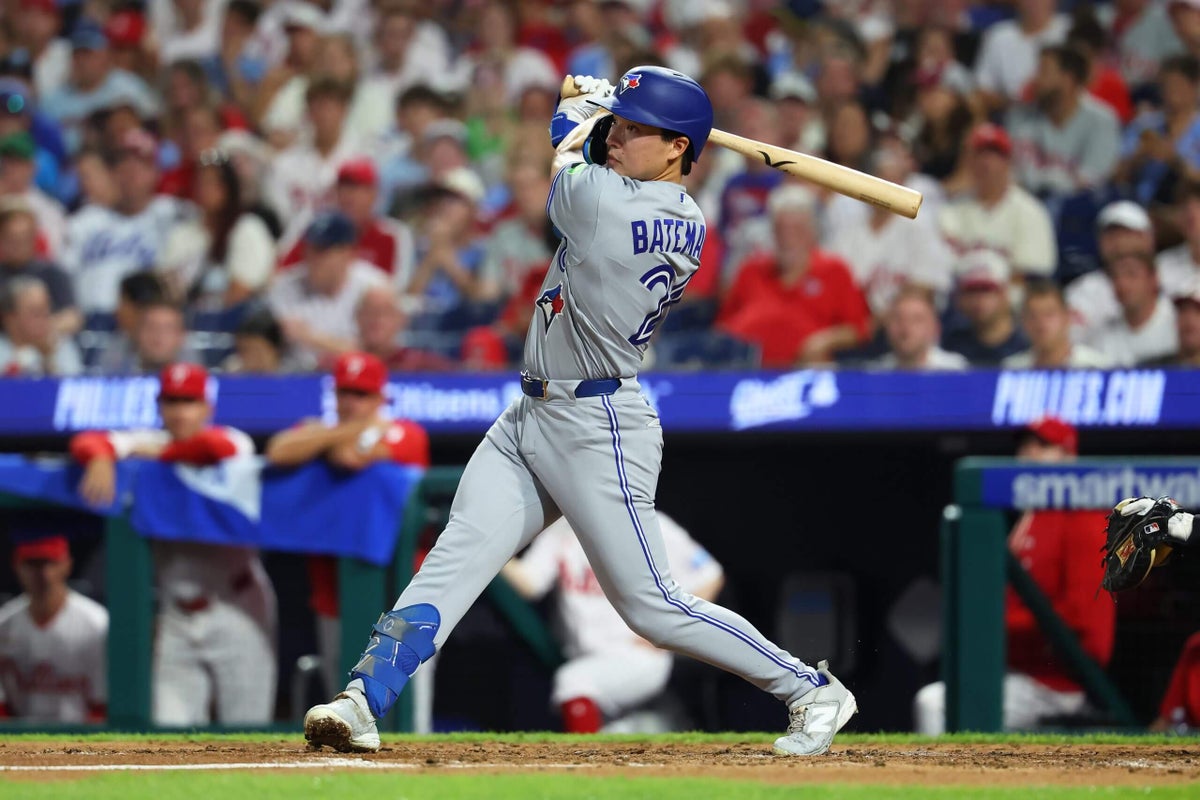
The same is true for rookie Brett Bateman, who was promoted from Triple A and made his MLB debut Friday. When the Jays got the 24-year-old from the Cubs as half of the return for Gausman, he made sense as a potential long-term solution in centre. Bateman was having a career year in Triple A, hitting .312, but likely 2026 NL MVP Pete Crow-Armstrong blocked his path to MLB. It took just four days in the Blue Jays organization, and one diving catch with the Buffalo Bisons, for Bateman to earn his big-league debut. Now he’s on a team that desperately needs wins.
“This isn’t like, ‘Hey, let’s see what this kid can do that we traded for,’” Schneider said. “We think he can help us win games.”
On Friday, the new guys all did the job. Soriano held Philly’s lineup largely quiet and handed the ball to the bullpen with the lead. Bateman was on base all night, launching a double to left on his first big-league pitch and walking twice more. Josh Smith, brought over as a buy-low from Texas, tallied three hits, stole a base and launched an insurance home run. The additions won the day, even if just barely.
“I think it makes them feel a little bit more welcome,” Schneider said, “a little bit more normal. (He’s) kind of just able to fit in a little bit more. And the guys that have been here are doing a really good job of embracing the new guys.”
Even if all of Toronto’s new players take off, though, the postseason isn’t a sure thing. The Jays traded Gausman, their seventh-inning reliever and an innings-eating rotation piece, and Varsho, their fantasy football commissioner and outfield roamer. They’re behind many teams that bought big at the deadline. So much will need to go right for a team that entered Friday with 4 percent playoff odds.
The Jays probably need Trey Yesavage’s MRI review of his meniscus injury to go well Monday. They’ll need Spencer Arrighetti, who left his rehab start on Thursday with lingering foot issues, to get back on a mound soon. They’ll need Braydon Fisher and Brendon Little to step up and fill the leverage role Hoffman left. More than anything else, they’ll need Vladimir Guerrero Jr., who missed his third-straight game on Friday, to get healthy and get right at the plate.
That’s a lot to go right.
Those many hopes are the reason Toronto’s front office made moves for the future earlier this week. A respectable front office can’t bank on that many dominoes falling in their favour. But inside the Blue Jays clubhouse, the post-victory music still plays. They have to believe, so they do.
“We just know we’re still in the hunt,” Straw said.
Wheeler and Jays dugout jaw
Phillies starter Zack Wheeler and the Jays dugout exchanged profanity on Friday. It stemmed from, of all things, the starter’s back heel.
The Jays, Schneider said, thought Wheeler’s heel was illegally off the pitching rubber during his motion. They alerted home plate umpire John Tumpane early, and hitting coach David Popkins was later ejected for continuing the gripe.
As Popkins was ejected, Wheeler let the Jays dugout know how he felt. He dropped an obscenity, and Straw appeared to return the favour. After the game, Schneider diffused the situation.
“Wheeler is an unbelievable pitcher and has been for a long time,” the Jays manager said. “I have all the respect in the world for him, and you guys all know how I feel about Don Mattingly. We were just getting information that his foot was off the rubber.”
In the grand scheme of things, the issue is meaningless. Wheeler hasn’t established himself as one of baseball’s best pitchers because of a little daylight between his foot and the rubber. But for a Jays team that needs every inch and every win right now, they tried to find one on Friday.
“I’m going to keep doing what I do,” Wheeler said after the game. “I’ve been pitching over there forever, and I’m going to keep doing it. You know, they’ve lost a lot of games over there, so they’re probably trying to pick some things up to complain about.”
— The Athletic’s Matt Gelb contributed to this story.
>
Sports
Inside Bruno Guimaraes’ £75m transfer: The move Newcastle didn’t want but Arsenal couldn’t ignore

Bruno Guimaraes is finally an Arsenal player.
For Newcastle United, this was never a sale they wanted to make. For Arsenal, it became the move they could no longer ignore.
In January 2022, Arsenal had the chance to sign the Brazilian from Lyon. Edu, their technical director at the time, and executive vice-chair Tim Lewis thrashed out a deal for the then 24-year-old, only for Mikel Arteta to decide against the move, unconvinced he was the right fit for the squad he was building.
Newcastle seized the opportunity in that same window instead, acquiring a player who would become their captain, talisman and one of the Premier League’s outstanding midfielders.
Four and a half years on, Arsenal have got their man. On Saturday, they confirmed Guimaraes had signed a four-year deal with the option of a further 12 months.
The £75million ($101m) deal — with no performance-related add-ons, although Lyon and Guimaraes’ former clubs in Brazil will receive parts of the fee — brings one of this summer’s longest-running transfer sagas to an end.
It also closes the loop on a decision Arsenal once walked away from, Arteta’s admiration for the player having grown through years of watching him thrive — and often clash with his side — in some of the Premier League’s fiercest recent contests. Guimaraes told club media that, after those years of hard-fought battles, Declan Rice had sent him a message saying, “Come here and please no more fights, now we’re friends.”
The details of Bruno Guimaraes’ move to Arsenal from Newcastle United
David Ornstein
Arsenal entered this window with central midfield a clear priority. They expected to lose Christian Norgaard, who has since joined Everton, and wanted to bring in someone with the capability to take the team forward: an established player who would immediately make them better.
They were interested in Guimaraes’ then Newcastle team-mate Sandro Tonali, but were put off by the cost of any potential package. Tonali ultimately joined Arsenal’s neighbours Tottenham Hotspur in an early July deal that could be worth £100m.
With Tonali out of reach, Guimaraes became the clear preferred target to upgrade the midfield. Despite his initial reservations back in 2022, the Arsenal manager was persuaded by his performances with Newcastle and Brazil across the intervening seasons.
Arteta and Arsenal sporting director Andrea Berta viewed Guimaraes as a very complete midfielder, whose ability to play as a No 6 or No 8 unlocks a variety of combinations in the centre of the pitch. His passing ability in particular could add another dimension to Arsenal’s attacking play.
Guimaraes, who will be 29 in November, is a little outside of Arsenal’s typical recruitment age range. They feel his experience and leadership qualities are assets, however. They have already sold Leandro Trossard (31) and Norgaard (32) this summer. Gabriel Jesus (29) is also available for transfer.
Mikel Merino (30) is currently Arsenal’s oldest outfield player, and the squad as currently constructed can absorb the addition of an older player. In fact, Arteta and company believe it may be necessary so the Premier League champions can keep winning.

Arsenal are confident they have captured one of the Premier League’s outstanding midfielders in Bruno Guimaraes (George Wood/Getty Images)
There was, however, a challenge: while the sales of Tonali and Anthony Gordon, to Barcelona for €80m (£68.5m; $92.3m at the current rates) this summer had been anticipated — even planned — Newcastle had no intention of parting with Guimaraes.
Arsenal had no issue agreeing personal terms with the player, who was adamant throughout that he wanted to join them and play for Arteta, but closing a deal between clubs would prove more difficult.
Their stance was that Guimaraes meant far more to Newcastle — to the team, to the fans, and to the community — than he would to Arsenal. Selling him would, they insisted, require an amount of money described as “irrational” by one person. Were Arsenal prepared to be irrational?
With the Tonali fee having established a precedent, Newcastle’s early position was that it would require a bid of at least £100m to even open the conversation.
Much of the brokering was done through others rather than direct dialogue between the two clubs. Instead of Berta, it was intermediary Kia Joorabchian who handled a lot of the day-to-day negotiating.
This approach frustrated some at Newcastle, who felt Arsenal were too distant throughout the process. Weeks would pass without substantive contact, even as speculation, claims and counter-claims circulated elsewhere. It became attritional. While Arsenal’s pursuit of Guimaraes was an open secret in football, Newcastle were determined not to appear willing sellers.
Arsenal, meanwhile, were content to play the long game, believing that as the summer wore on and Guimaraes’ desire to leave became harder to ignore, Newcastle’s position would soften.
That said, they did come forward with several bids for Guimaraes — their initial offer in June was worth £45m.
Newcastle’s then head coach Eddie Howe had been pessimistic about the chances of retaining the player from the moment reports of Arsenal’s interest emerged. He had a close bond with his captain, and had spoken to him throughout his time away with Brazil at the World Cup.
Howe’s reaction was one of resignation rather than resentment. According to sources close to the situation, he understood why Guimaraes would want to join Arsenal and recognised that Newcastle could not compete financially with Europe’s biggest clubs. The 28-year-old was already Newcastle’s highest earner, so a contract renewal was not on the agenda — for either player or club.
After a bruising 2025-26 season and a difficult summer, Guimaraes’ desire to leave represented something of a tipping point. Shortly after it became clear the midfielder’s head had been turned, Howe informed Newcastle’s hierarchy that he wished to step down after almost five years as coach.
As Guimaraes’ return to Tyneside after a post-World Cup break drew closer, the pressure on all parties intensified.
At Newcastle, there was a growing acceptance that he was unsettled and that the situation verged on untenable. Guimaraes was given the option of travelling back to England to then fly with the Newcastle squad to their La Manga training camp. Instead, he went directly to Spain on Monday, August 3, where the deal entered its decisive phase.

Bruno Guimaraes and Brazil reached the last 16 of the 2026 World Cup (Chandan Khanna/AFP via Getty Images)
Behind the scenes, Newcastle sought clarity.
As Guimaraes’ departure began to feel increasingly inevitable, a senior club executive contacted an Arsenal counterpart directly in an attempt to establish exactly where the north London club stood. There was a desire at St James’ Park to bring what one person described as the “melodrama” of this saga to a close.
Arsenal hoped to conclude a deal for around £65million, but Newcastle held firm. Club sources insist £75m was always the minimum figure that would persuade them to sell their captain, and the two clubs compromised on that figure. It is a straight fee, with no add-ons. Lyon, Guimaraes’ previous club, are entitled to 20 per cent of Newcastle’s profit on the midfielder, so will earn £6million to £7m from this deal. Around £3.75m will go to the midfielder’s other former teams in Brazil in solidarity payments.
With a month of the transfer window remaining, Newcastle had deliberately resisted rushing into the market for replacements. By resolving this issue in early August, they feel they have avoided the last-minute scramble that followed Alexander Isak’s protracted departure to Liverpool last summer. The £75m fee is being framed at their end as a record for a midfielder of Guimaraes’ age. As one club source put it: “We are not pleased with this outcome, but if he was going to go, this is a good outcome.”
Guimaraes is understood to have been very emotional as he said farewell to Newcastle players and staff on Wednesday. People inside the club insist he remained professional throughout this process and was keen, as far as possible, to preserve the relationship he had built with supporters rather than leave under a cloud.
But for Newcastle, there is no disguising the sense of loss. They have sold the player they hoped would, as captain, lead the club’s next chapter. Instead, his departure marks the end of the preceding one.
Yet with £75m to reinvest and the window not closing until September 1, there is at least time to react and replace him. New head coach Matthias Jaissle gets the opportunity to start with a clean slate, rather than dealing with a key player minded to leave.
Arsenal, meanwhile, feel they have improved from what was already a position of considerable strength. They hope the signing of Guimaraes will enable them to tighten their grip on the Premier League title they waited 22 years to bring back to north London.
This transfer serves as a reminder that, in football, first impressions are not always final ones.
At one stage, Arsenal looked closely at Guimaraes and decided he was not the answer. Four years on, they have just made him one of the biggest investments of the Arteta era.
>

Sophie Cunningham and the Fever are focusing on basketball. Does anyone care?

Blue Jays keeping 2026 playoff dream alive after trade deadline ‘restructuring’

Team Trump Trolls Taylor Swift With Song Use Before Copyright Claim
-

 movies3 months ago
Search For Canadian TV Actor Stewart McLean Now Homicide Investigation
-

 Fashion9 years ago
These ’90s fashion trends are making a comeback in 2017
-
Fashion9 years ago
According to Dior Couture, this taboo fashion accessory is back
-
Fashion9 years ago
Model Jocelyn Chew’s Instagram is the best vacation you’ve ever had
-
Fashion9 years ago
Your comprehensive guide to this fall’s biggest trends
-
Fashion9 years ago
9 Celebrities who have spoken out about being photoshopped
-
Fashion9 years ago
Emily Ratajkowski channels back-to-school style
-
Fashion9 years ago
A photo diary of the nightlife scene from LA To Ibiza