
Sports
The Soccer 100: Pele — Brazil’s globetrotting ambassador

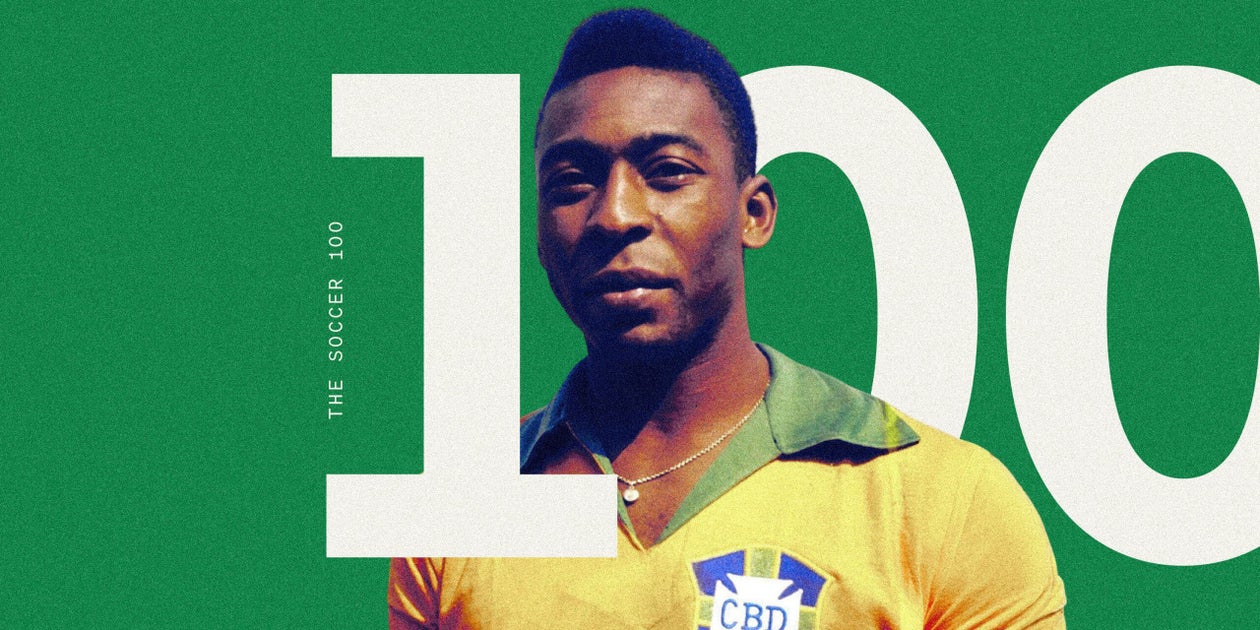
As part of our buildup to the 2026 FIFA men’s World Cup in the United States, Canada and Mexico, we are publishing excerpted chapters from The Soccer 100, The Athletic’s definitive book on the 100 greatest players of all time, courtesy of HarperCollins Publishers.
The 10 players we will feature are the highest ranked World Cup winners of our 100. Today we look at a Brazilian icon.
The paper is yellowing. The pages, for all the effort that has gone into preserving them, are a little dog-eared. They contain black-and-white advertisements for a cabinet supplier, the local zoo (“Wife trouble Saturdays?”), and Ron Dewdney’s pasties, plus a few outmoded stereotypes. It is a document of its time— 1973 — but also of its place: Plymouth, a faded jewel of England’s southwest coast, about as worldly as a crisp sandwich and only slightly more glamorous.
It is that context that makes the rest of this little booklet all the more surreal and magical.
It is a souvenir program from a Plymouth Argyle match. The color scheme of its cover — green and an evocative sunshine gold — immediately signals that this was no run-of-the-mill Division Three fixture. The visitors to Home Park on that March evening were not Scunthorpe United or Southend United, but, as the program has it, “SANTOS of BRAZIL,” capital letters nonnegotiable.
And there, above the text, gazing serenely out across the decades, is Edson Arantes do Nascimento — Pelé to all but his closest relatives — regarded almost unanimously at that juncture as the greatest footballer of all time.
The tone of the editorial a few pages later is, as you may well imagine, feverish. Pelé in Plymouth! Even at the time, there was a palpable sense of disbelief to it all. My dad attended the game aged 14 — the program, now one of my prized possessions, was once his — and still talks about it like a Christian might about bumping into Jesus at a gas station.

Pelé dribbles past a defender during a friendly between Brazil and the Swedish club, Malmo, in 1960 (Central Press/AFP via Getty Images)
Any account of Pelé’s brilliance will alight on the big-ticket stuff: the controlled explosions of his teenage years, the four-figure goal tally, the indelible mark he left on the World Cup, culminating in the Technicolor dreamscape that was the 1970 edition. We will circle back around to all that. But there is another aspect that often gets lost when we assess his career from the pedestal of modernity. It is there in that program and in a million memories, lovingly passed down through the generations in Plymouth and Port of Spain, Casablanca and Cádiz, Bangkok and Baltimore.
The best footballers today have global reach as standard. They all play for the same handful of European clubs, whose matches are broadcast weekly on every continent. It was different for Pelé. Despite offers from abroad, he remained at Santos — a relatively small, provincial outfit, both then and now — for 18 years, only undertaking a new adventure, with the New York Cosmos, in the twilight of his career. The World Cup, yes, made him famous, but it was as a touring attraction that he really secured a place in people’s hearts.
Pelé had never left Brazil before the 1958 World Cup in Sweden. Between that tournament and his retirement in 1977, he played matches in 74 different countries, as well as in every conceivable corner of Brazil. The vast majority of those were exhibition games for Santos, who — at least during their imperial phase, in the early to mid-1960s — could lay claim to being both the best team in the world and the busiest.

Autograph hunters swarm around Pelé (Central Press/Getty Images)
It is hard to underestimate the extent to which Santos spread the gospel of Brazilian football during that period. It was a miniature national
team, full of World Cup winners — Zito, Pepe, Gilmar, Mauro Ramos, Coutinho, and Mengálvio in the early days, then Joel Camargo, Clodoaldo, Carlos Alberto, Edu — and their play lived up to that billing.
At the heart of it all was Pelé, gleaming goal emissary, the Platonic ideal of a Brazilian footballer made flesh before the eyes of a different public, night after night.
It stands to reason that there has always been an anecdotal, even mythical flavor to Pelé’s genius. When it comes to placing him in the pantheon, that can work against him: Set against rigorous statistics and huge bodies of recorded footage, anecdotes and myths can be easy to dismiss.
But we should embrace them. The stories — even those that have been lovingly embellished — are the whole point. Sport exists to elevate our souls. It does that best when it is happening not on a screen, but right in front of your face. Pelé put himself in front of more faces than anyone.
He was, more than any player before or since, available.
This point extends beyond the never-ending fixture list. One of the first things that becomes evident when you go through some of the old newsreels is that Pelé existed in the center of a mob, forever being grabbed, hugged, yanked this way and that. People groped at his skin as if they expected it to confer magic powers.
This was not the strain of celebrity we know now, mediated by security guards, press officers, and social media strategies. Pelé was public property, a tangible public good. That he smiled his way through it all only added to the charm.
Pelé was not just the most gifted footballer of his generation, possibly ever; he also perfected the art of genuine connection. He was a globetrotting ambassador — for his sport, for his nation, for his own talent. Unlike any player before or since, he took the transcendental and made it local, in Plymouth and in countless other towns that have been dining out on the experience ever since.

A statue of Pelé at Rei Pele pier, Sao Vicente, Sao Paulo state in Brazil (Nelson Almeida/AFP via Getty Images)
To fully comprehend what Pelé means to Brazil and Brazilians, you have to understand “mongrel complex.”
Coined by playwright Nelson Rodrigues, the phrase referred to an enduring inferiority felt by many Brazilians when they looked out into the world. Theirs was a young country, not long liberated from the tentacles of the Portuguese empire. From there, after a brief interregnum, Brazil had lurched into dictatorship, acquiring the attendant psychological scars. Democracy arrived in the wake of World War II, but it did not immediately spark an upturn in the nation’s mood.
Even good things turned to rot. Brazil hosted the World Cup in 1950. It was a chance to display the country’s feathers to European visitors and to make a statement on the field. But the national team fluffed its lines, losing to Uruguay in the final match when a draw would have secured the title. It was a historic embarrassment, made worse by the staggering levels of hubris that had preceded it; two newspapers and the mayor of Rio de Janeiro had declared Brazil champions before the game had even kicked off.
“Our Hiroshima,” Rodrigues called it, a distasteful epithet that nonetheless captured the depths of the ensuing despair.
It is no great exaggeration to say that Pelé helped Brazil to feel good about itself again.
The 1958 tournament was the start of that process. Pelé was a late bolter for the squad, a 17-year-old wild card. He missed Brazil’s first two games due to a knee injury, then missed his first two chances after being selected against the Soviet Union.
From that point, however, he was electric. Pelé set up Vavá’s decisive second goal against the Soviets, then scored the only goal in the quarterfinal against Wales, prodding into the corner after a sumptuous turn inside the penalty area. He netted three more times against France in the semifinal, then twice in the 5–2 final victory against Sweden.

A 17-year-old Pelé bursts away from two Wales defenders in the World Cup quarterfinal of 1958 (STAFF/AFP via Getty Images)
Brazil were mongrels no more. Pelé, young and fearless, did not so much represent his country’s newfound self-confidence as embody it. Indeed, it is revealing that no less a cultural icon than Gilberto Gil, one of Brazil’s most respected musicians, at home and abroad, has described Pelé as “the symbol of Brazilian emancipation.”
It hardly needs restating, but he was also just a breathtakingly talented footballer. To watch those 1958 games now is to be struck by just how inevitable Pelé was, even in his rawest form. He was at once Mensa-smart, two-footed, technically faultless, a physical marvel — seriously, has anyone ever looked healthier than he did in those coltish early years? — and about as likely to take prisoners as a hurricane. His opponents never stood a chance.
He burnished his reputation at club level as Santos established themselves as South America’s preeminent force in the years that followed. From 1960 to 1965, inspired by their talisman, the seasiders won five national championships, five São Paulo state trophies, and two Copa Libertadores titles. They also lifted the Intercontinental Cup twice, overcoming Benfica over two legs in 1962 and AC Milan over three the following year. Pelé scored seven times in those five matches.
His overall goal tally for Santos and Brazil has been the subject of significant debate over the years: There is no real consensus over whether to include goals scored in friendly matches and unofficial internationals or for the Brazilian military. Pelé himself famously counted them all — insert joke about backyard kickarounds with his grandkids here — and put the total close to 1,300. Even the most conservative quotes are well north of 700. But there can be no doubt that he was a finisher of the very highest order, with both feet and with his head.

Yet, in some ways, the focus on the raw numbers diminishes Pelé. He was a startlingly complete forward, a creator as much as a finisher. He could hold his own in the midfield battleground. In a pinch, his physique would probably have made him a decent stand-in defender, too. “I have gone through my memories looking for any kind of deficiency in his game, but I haven’t found one,” his former Brazil teammate Tostão once wrote.
It was really only injuries — or the timing of them — that threatened to slow Pelé down. He won his second World Cup in 1962, but it was a frustrating tournament on a personal level. He scored in Brazil’s first game, against Mexico, but aggravated a long-standing groin injury in the following game against Czechoslovakia and missed the rest of the campaign.
He was still only 21, but already there was a sense that his exertions were catching up with him. Santos filled stadiums around the world, but there was little time for rest; Pelé played 80, 90, even 100 games a year as standard. “We were in demand and the suits were very keen to cash in,” he once lamented. On one “ridiculous” tour of Europe, Santos played 22 matches in six weeks; little wonder Pelé ended it feeling “bruised and drained.”
Worse was to come in 1966, when Pelé was kicked out of his third World Cup. After just about surviving a tetchy game against Bulgaria — “I was kicked to pieces, especially by (Dobromir) Zhechev, who seemed to mistake my ankles for the ball” — he was further targeted by Portugal, ending the match limping and helpless to prevent Brazil being knocked out of the tournament.
Pelé was so angry at the violence and at the lack of protection from referees that he vowed never to play at the World Cup again.

Pelé is helped from the pitch by Brazil’s team doctor Hilton Gosling (left) and trainer Americo at the 1966 World Cup (PA Images via Getty Images)
Pelé added at least two memorable phrases to the Brazilian football lexicon.
The first is “the goal Pelé didn’t score,” a reference to his audacious attempt from the center circle against Czechoslovakia in 1970. The best part about this is that the same description could easily have been used for — and, indeed, may even have better suited — the madcap, run-the-long-way-around-the-goalkeeper effort against Uruguay 14 days later. Pelé’s misses were cooler than most people’s goals.
The second dates back to 1961, when Pelé netted for Santos against Fluminense. No video exists of the goal, but reporters from local newspaper O Esporte named it the most beautiful ever to be scored at the Maracanã and installed a plaque to commemorate it. Even now, commentators are apt to describe a particularly fine strike as a gol de placa — a plaque-worthy goal.
Then there is the visual iconography. There is the Gordon Banks save, the embrace with Bobby Moore, the celebration atop a platform of shoulders at the Azteca — and that was all in a single summer.
In Brazil, a couple of others are up there on a similar level. One is a picture of Pelé holding a football high above his head, surrounded by radio aerials. He has just scored for Santos against Vasco da Gama, and although the match is not yet over, everything has stopped. There are reporters on the pitch. Soon the night sky will be full of white balloons. Pelé’s facial expression is equal parts ecstasy and relief. He has just scored his 1,000th career goal.

Pele is lifted by his Santos teammates after scoring the 1,000th goal of his career in November 1969 (Pictorial Parade/Archive Photos/Getty Images)
The other is a photo from a charity match between the Brazil national team and club side Flamengo in 1976. Pelé, now moving inexorably toward retirement’s embrace, is holding his right arm out, seemingly calling for a pass. There are three big patches of sweat on his canary-yellow jersey. One is around his armpit, another just below his collar. The third is the curious one. It adorns his chest. It is the shape of a heart.
By the end of the 1960s, the great tropical utopia — heralded by a wave of cultural expression as well as those two World Cup wins — had curdled into a nightmare. As an authoritarian military government tightened its grip on Brazil, Pelé’s position as national treasure began to carry uncomfortable new connotations.
Images of him shaking hands with General Emílio Médici, the head of a regime that normalized the torture of its own citizens, were quietly damning. A footballer who had once represented progress — not least as a prominent Black athlete in a nation with a complex history of racial dynamics — came to be viewed in some quarters as part of the problem.
“He was a ‘Yes-sir’ Black man,” former Brazil teammate Paulo Cézar Caju said in Netflix’s 2021 documentary, Pelé. “One statement from Pelé would have gone a long way.”
Pelé was always evasive on the topic. He would have been justified in fearing the consequences of speaking out at the time, but it is interesting that he did not hide behind easy excuses later in his life. “I was never forced to do anything,” he admitted in the same documentary. “I always had an open door … even when things were bad.”
That political neutrality might have tainted Pelé’s legacy were it not for his 1970 World Cup campaign, a definitive statement of his excellence told in six chapters.
Even the most casual football fan will be familiar with those glorious images from Mexico, but the context adds to the emotional pull. Pelé had been persuaded to return to the Brazil setup after the trials of 1966, but the lead-up to the tournament was not straightforward. He clashed with the coach, João Saldanha, only settling when Saldanha was ousted and replaced by Mário Zagallo, a former teammate. Even then there were doubts over his fitness, plus mounting pressure on the team from the Médici regime.
A lesser player, a lesser character, would have caved. Pelé bore the weight with customary poise and inspired his team to victory. He did so with just the right amount of swagger, in the process cementing his place as the world’s most beloved player.
Pelé died in December 2022. The public grief that ensued left little room for doubt about the degree to which he touched the lives of Brazilians. Hundreds of thousands of people lined up to pay their respects at his coffin, which was left open, at Santos’s Vila Belmiro stadium. The funeral procession was broadcast in its entirety on multiple television channels — the kind of coverage usually reserved for heads of state.

Crowds follow Pelé’s funeral procession through the streets of Santos (Mario Tama/Getty Images)
In the days that followed, fresh eulogies jostled for space with quotes from Pelé’s contemporaries, dating back to the 1970s and beyond. Many blended together, as can happen in these cases. A few stood out, cutting through the layers of cliché.
Johan Cruyff: “Pelé was the only footballer who surpassed the boundaries of logic.”
Mário Zagallo: “Pelé was everything. Everything you could imagine.”
Ferenc Puskás: “The greatest player in history was Alfredo Di Stéfano. I refuse to classify Pelé as a player. He was above that.”
At this point, we are firmly back in mythic territory and not only because the precise origins of those Cruyff and Puskás lines seem to have been lost to history.
Some people will squirm at this way of paying tribute to a player, consider it imprecise or even cloying. Maybe Pelé — Brazilian football, even — is not for them.
The rest of us, though? We can luxuriate in the warm glow of the words, safe in the knowledge that their subject — the King, the first (and still only) man to win three World Cups as a player, a one-man memory factory and a globetrotting ambassador, both for his nation and for a romantic ideal of football — was
worthy of the poetic license.
Excerpted from The Soccer 100 by Oliver Kay & James Horncastle with The Athletic Soccer Staff, published by William Morrow. Copyright © 2025 by The Athletic Media Company. Reprinted courtesy of HarperCollins Publishers.
>
Sports
Argentina 10-17 South Africa: Springboks win Buenos Aires thriller but Siya Kolisi suffers injury ahead of New Zealand series | Rugby Union News

South Africa scraped past Argentina 17-10 in Test rugby at the possible expense of inspirational captain Siya Kolisi in Buenos Aires on Saturday.
Kolisi, in his first match in seven weeks following a hamstring injury, trudged off in the 25th minute. He may be a doubt to lead the Springboks back home against New Zealand in two weeks in the opening Test of the blockbuster Greatest Rivalry series.
“I hurt my hamstring again unfortunately,” he said. “It’s tough but I can’t be sad about it. There’s nothing I can do but go in for a scan and see how long I’m out for.”
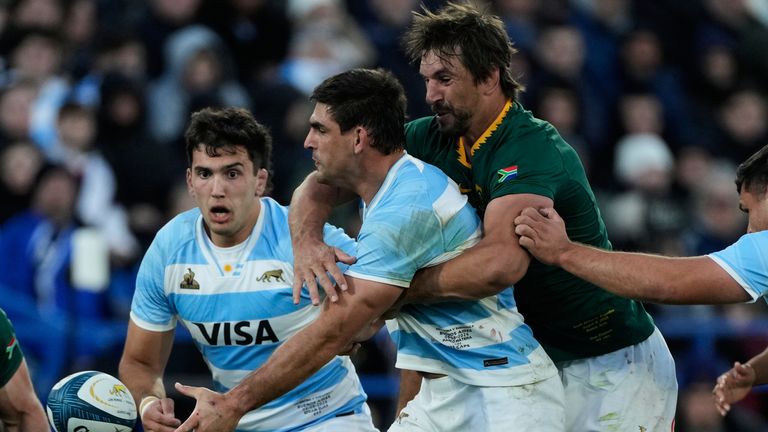
Argentina’s Pablo Matera, left, is tackled by South Africa’s Eben Etzebeth
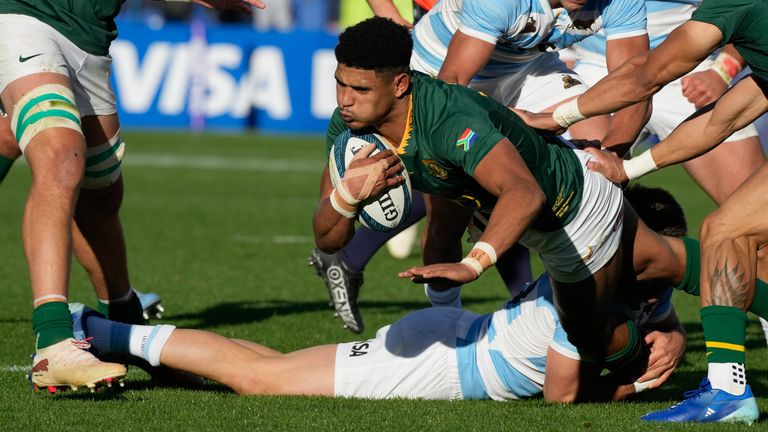
South Africa continue their winning start in the Nations Championship
The skipper was among a core group of Springbok stalwarts given match time in Buenos Aires after missing the Nations Championship in July because of injuries.
Caps record-holder Eben Etzebeth and fly-half Sacha Feinberg-Mngomezulu played every minute and lock Lood de Jager, coming back from a hip injury, lasted until the third quarter.
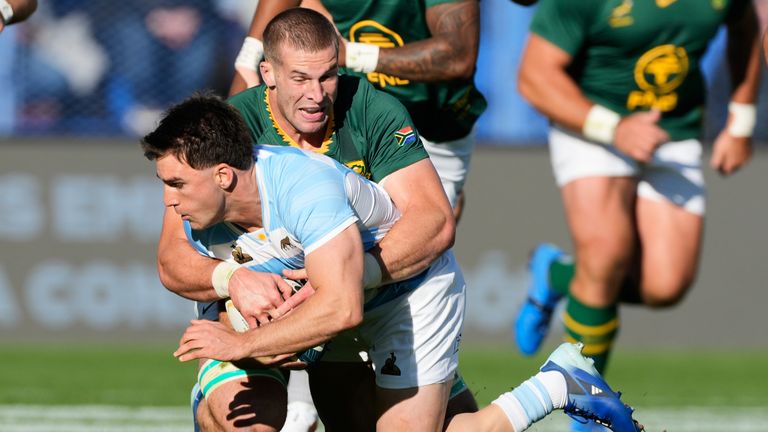
Prisciantelli is tackled by Hanekom
They got to celebrate a 12th straight Test win, but only just.
The depleted Pumas almost snatched a draw after the full-time whistle. From a tap penalty in front of the Springbok posts, they pounded the visitors for 15 phases until the final high pass to an unmarked Matías Moroni was dropped.
Argentina Coach Felipe Contepomi pounded the coaches’ booth and Moroni was in tears.
Watch South Africa’s four-Test series against New Zealand live on Sky Sports. Get Sky Sports or stream rugby with no contract.
>
Sports
Valencia 1-2 Newcastle: Yoane Wissa’s double gives Matthias Jaissle winning start as Anthony Elanga stretchered off | Football News

Substitute Yoane Wissa scored twice to give Matthias Jaissle a winning start as Newcastle boss with a 2-1 comeback pre-season win at 10-man Valencia.
But the friendly at the Mestalla threatened to be overshadowed by Jose Gaya’s red-card horror tackle on Anthony Elanga, which saw the Newcastle winger stretchered off in the first half and led to both sets of players clashing.
Fortunately for the Sweden international, his injury does not appear to be serious, with Elanga later up and walking after a contusion to the shin.
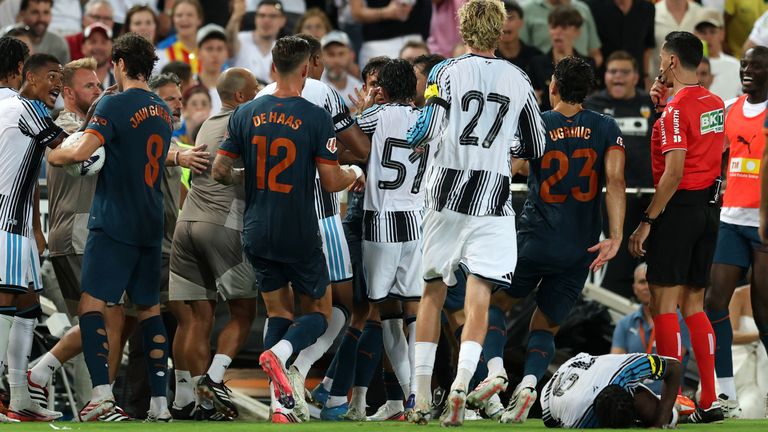
Tempers flared after Jose Gaya’s challenge saw Anthony Elanga stretchered off
Speaking at his post-match press conference, Jaissle was “relaxed” over Elanga’s injury.
The German said: “It seems to be not bad, so we are pleased. I hope it’s true, then he can start again next week.”
He added: “Of course I was in fear [it was a serious injury], definitely, but now I’m more relaxed as the medical department is showing almost green lights, and there’s nothing serious.”
Elanga’s injury after Valencia’s Filip Ugrinic’s stunning fifth-minute opener had given Jaissle a nightmare start to life in the Newcastle dugout.
But his half-time changes sparked a Toon turnaround with new signings Bazoumana Toure and Sean Steur impressing.
It was last summer’s signing Wissa who pounced on a mistake to level in the 52nd minute.
New arrival Toure then broke clear of the Valencia defence to unselfishly set up Wissa for a tap-in to complete the comeback in the 76th minute.
Toure should have had a second assist after fine work down the left, but Jacob Murphy put over his cross in stoppage time.
The win brings some relief to Newcastle on the day they lost their captain Bruno Guimaraes to Arsenal.
Jaissle’s next pre-season test will come on Wednesday as his new side face Everton at Murrayfield in Edinburgh.
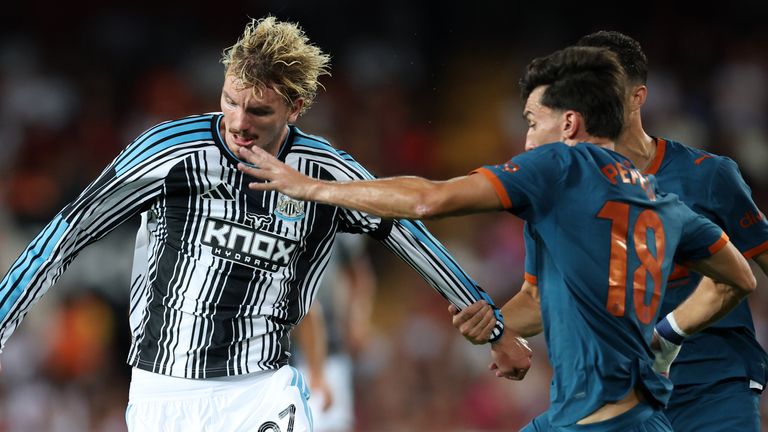
Newcastle’s Nick Woltemade (left) started at the Mestalla
Wissa’s fresh start under Jaissle
Sky Sports News’ Keith Downie at the Mestalla:
“A good end to a positive week in Spain for Newcastle – and a trophy for Jaissle in his first match in charge as they lift the ‘Orange Cup’.
“Some impressive signs from new signings Aladji Bamba, Steur and Toure.
“Newcastle’s travelling fans sent home from The Mestalla with a spring in their step.
“One major positive was Wissa’s performance.
“Newcastle really need him to come good this season. It was a huge £55m outlay on a 29-year-old, and last season was a nightmare for him.
“He looks sharp and is coming off a good World Cup showing. Maybe this could be a fresh start for the striker.”
Jaissle keeping ‘balanced’ after debut win
Newcastle head coach Matthias Jaissle speaking at his post-match press conference:
“First of all, I’m really happy that there are no serious injuries. Anthony, we are happy, and it seems to be okay, actually – that was the most important thing.
“Of course, winning games always helps to gain confidence, but we also knew that we had a hard week behind us. The players did well in the camp; there was a pure commitment in each session.
“We had a hard load, so therefore now we deserve two days off, and then we start again.
“It was a friendly today; we will not smash the locker room now and celebrate a lot.
“We’re quite balanced; we know what it is about. Now it’s pre-season, and we’re still looking to work on it.
“It’s just a journey; we don’t want to hang onto that.
“The victory is higher than it is, but also we don’t see the losses lower than it is then, so we should be quite balanced in our approach.
“We should just analyse the situation and develop from there, and that’s what we’re going to do.
“Now next week, there are things we need to work on, definitely.”
>
Sports
Aaron McKenna wins dream homecoming bout against Etinosa Oliha to become IBF middleweight world champion in Dublin | Boxing News

Ireland’s Aaron McKenna defeated Etinosa Oliha to become a middleweight world champion.
For McKenna this fight in Dublin was a dream homecoming. The Irish middleweight had pursued his career across America, sparring in some of the world’s best gyms and amassing an undefeated pro record.
This contest, for the vacant IBF middleweight title, was his first world title fight and his first professional contest in Ireland.
With brother Stevie taking a spectacular knockout earlier, McKenna made a memorable entrance, wildly cheered into the ring by the 3Arena crowd, so loudly that the floor was almost rumbling.
But he didn’t let emotions carry him away at the start of the fight. He edged forward onto the front foot, feinting. He timed a left hook as Oliha, unbeaten himself coming in, stepped to him.
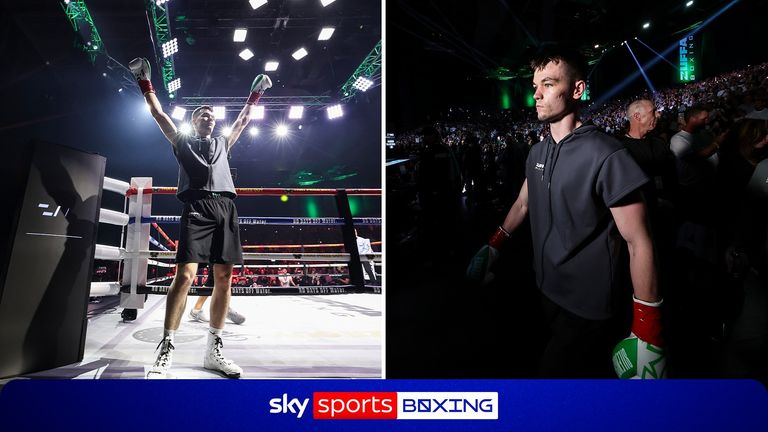
Aaron McKenna had an incredible entrance ahead of his IBF world middleweight title fight with Etinosa Oliha, first coming into Sinead O’Connor’s The Foggy Dew and then Faithless’ Insomnia!
McKenna let his jab flicker out. His hands were quick, his right streaked in and McKenna used his left hook to let a cross blast through.
But the Italian wrested the second round his way, thumping through right hooks, punches McKenna felt, to show that he too could launch meaningful attacks.
McKenna ground forward, stifling his own long-range work but bodily forcing Oliha back.
When he did strike his opponent with a reaching right, the crowd roared and as the fight progressed into its second half McKenna did move more on his toes, darting back to scrape his left hook into the side of Oliha’s head.
The Italian looked to rip hooks into him but McKenna marshalled him to the ropes and slugged Oliha with a left hook.
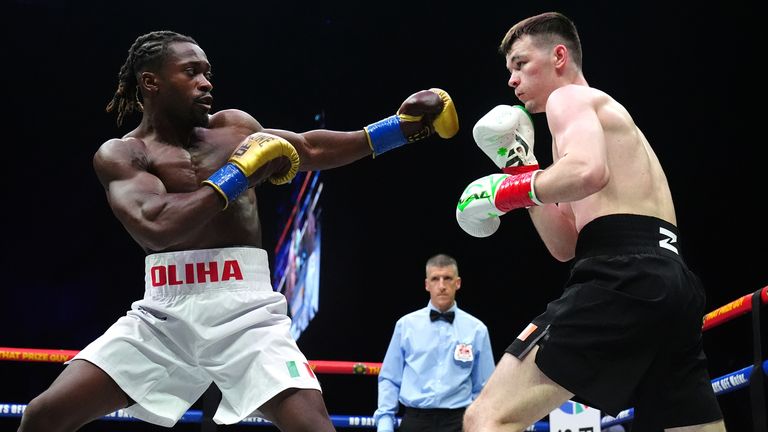
McKenna and Oliha were both unbeaten coming into this world title fight
McKenna imposed himself again in the ninth round but Oliha, a solid operator, showed little sign of wilting.
In the 10th round McKenna circled out and reeled off double jabs. As they grappled in a clinch though, Oliha unleashed a flurry that caught the Irishman.
McKenna briefly put space between them with a cross to the chin. He scored to the body with thudding right hooks too.
Oliha charged from his corner with a long one-two to start the 11th round. With flashier work, McKenna landed a left uppercut off his jab. Oliha though hacked back at him with a right hook up close.
McKenna continued to punch in greater volume. A clash saw him cut on the forehead just before the end of the 11th. He trusted in a hefty right hook as a response.
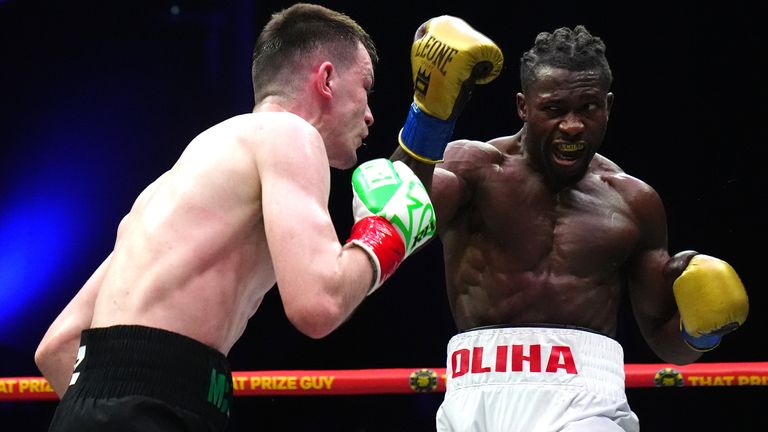
McKenna tears into Oliha.
He didn’t want or need to take risks in the last round. He moved sharply, striking an increasingly desperate Oliha with jabs and the crowd all around him stood up cheering, clapping and chanting his name.
McKenna worked an uppercut, Oliha drove in a right but even when McKenna took shots he didn’t let them shake him as he closed out a unanimous decision.
When that final bell chimed, McKenna rushed to the corner post and jumped up onto the ropes to celebrate.
As soon as the words “from Monaghan” were declared by the ring announcer, confirming McKenna a 118-110, 117-111 and 116-112 victor, the arena burst into deafening cheers once again.
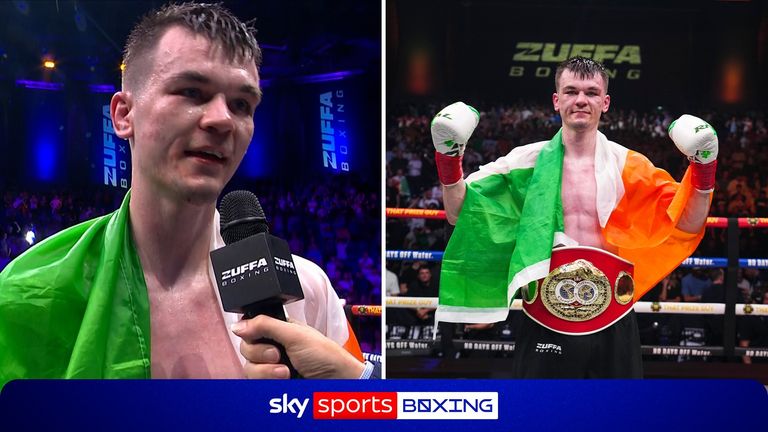
Aaron McKenna was in buoyant mood after beating Etinosa Oliha to become IBF world middleweight champion in front of his home crowd in Dublin.
“A new world champion. I’ve been saying it for years. A big thank you to Zuffa Boxing for giving me this platform and bringing a fight back to Ireland for me,” McKenna beamed afterwards.
“I’ve been a professional for nine years and never got the chance to fight in Ireland. Why? Just look at these beautiful fans.
“I never lost discipline in training. There were times when I wondered whether I’d ever get the chance.
“My dad [their trainer] sacrificed his whole life for me and my brother, dedicating everything to helping us chase our dreams.
“Finally, I’ve got my hands on this.”
>

Argentina 10-17 South Africa: Springboks win Buenos Aires thriller but Siya Kolisi suffers injury ahead of New Zealand series | Rugby Union News

Valencia 1-2 Newcastle: Yoane Wissa’s double gives Matthias Jaissle winning start as Anthony Elanga stretchered off | Football News

Aaron McKenna wins dream homecoming bout against Etinosa Oliha to become IBF middleweight world champion in Dublin | Boxing News
-

 movies3 months ago
Search For Canadian TV Actor Stewart McLean Now Homicide Investigation
-

 Fashion9 years ago
These ’90s fashion trends are making a comeback in 2017
-
Fashion9 years ago
According to Dior Couture, this taboo fashion accessory is back
-
Fashion9 years ago
Model Jocelyn Chew’s Instagram is the best vacation you’ve ever had
-
Fashion9 years ago
Your comprehensive guide to this fall’s biggest trends
-
Fashion9 years ago
9 Celebrities who have spoken out about being photoshopped
-
Fashion9 years ago
Emily Ratajkowski channels back-to-school style
-
Fashion9 years ago
A photo diary of the nightlife scene from LA To Ibiza