
Entertainment
Composer Breton Vivian and Editor Chad Galster on ‘The Madison’


Taylor Sheridan is one of the most popular showrunners in television, with huge hits like “Yellowstone” and “Landman” on his resume. For his latest series, however, he stepped outside his comfort zone to create something completely new. Even longtime collaborators like editor Chad Galster, who has worked with Sheridan on everything from “1883” and “1923” to feature films and the aforementioned “Yellowstone” and “Landman,” were surprised by the direction Sheridan took with “The Madison.”
“It felt wildly different from anything we’ve done,” Galster told IndieWire of the Paramount+ drama, which follows New York City socialite Stacy Clyburn (Michelle Pfeiffer) as she mourns her husband Preston’s (Kurt Russell) death on the land where he was happiest: the family ranch in Montana. Although “The Madison” deals with family and relationships with the complexity and humor Sheridan’s fans have come to expect, this time the filmmaker is working without the safety net of genre or corporate intrigue — “The Madison” is a pure character study that generates drama from its heroine’s internal struggle, not from shoot-outs or oil industry machinations.


That the lead character is a woman also made “The Madison” a departure for Sheridan, and composer Breton Vivian (another frequent Sheridan partner on “Yellowstone,” “Marshals,” “Dutton Ranch” and others) was sure to connect his score to the subtleties of Stacy’s shifting feelings. “Everything was inspired by Stacey’s journey through grief,” Vivian said. “This sound that I’m using that is reflecting her own emotional rollercoaster.” Just as director Christina Alexandra Voros’ images of roads and rivers twisting through the landscape visually expressed Stacy’s circuitous journey, Vivian tried to do something similar with the music.
In the videos below, watch how editor Chad Galster and composer Breton Vivian used the tools of their craft to give voice to Stacy’s silent journey from grief to healing on “The Madison.”
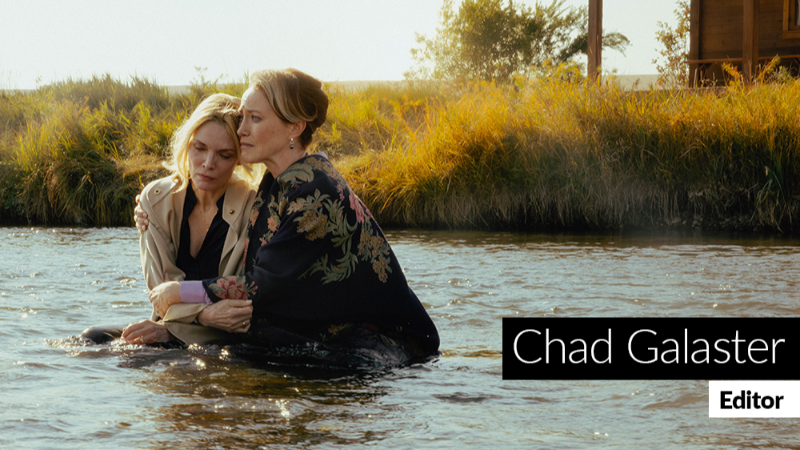
The Editing of ‘The Madison’
Because “The Madison” felt like such a departure from Galster’s other work with Taylor Sheridan, the editor’s first step was finding a rhythm that matched the new series’ voice. “I got the footage, and I started just playing around with it,” Galster said. “Trying to figure out stylistically something that felt fresh and felt different from what we’ve normally done.” Galster had the footage from all of the episodes at once, which allowed for an organic process. “The luxury of having all the footage there is that you could start playing around with ideas and grab things from other episodes, and really start going back and forth instead of being tied into whatever that production day was.”
Although Kurt Russell’s Preston dies in the first episode, he reappears throughout the season in the form of flashbacks and memories. For Galster, it was important that Preston’s presence never be far from Stacy’s mind. “In Episode 1 I started experimenting with the idea of, what if Preston was around somehow in the visuals of the show? What would that feel like? And would it feel corny or would it feel organic, and would it feel interesting?” While landscape is always important in a Taylor Sheridan series, it became even more so on “The Madison” given Preston’s love of the land and its role as a motivating factor in Stacy’s life moving forward without him.
“The landscape is a character unto itself,” Galster said. “It’s a character that we have to meet and that we have to fall in love with as an audience. We don’t assume that people come to our show loving it necessarily, so you have to allow the audience to fall in love with it and find details that Stacy might be seeing for the first time. Seeing a waterfall, seeing a river, seeing some animals that she maybe hasn’t seen before. There’s a strong emotional purpose behind all of those shots and all of the world-building that we do.”
Given that the show exists in two worlds — New York City and Montana — it was important for Galster to find a contrast between them in the cutting. “In New York, it’s faster paced and it’s chaotic,” Galster said. “The environment lends itself to different types of shots. You’re not going to linger on Fifth Avenue for 20 seconds the way you might linger on a river or a mountain.”
In the video above, Chad Galster discusses balancing character, landscape, and tone in the editing of “The Madison.”
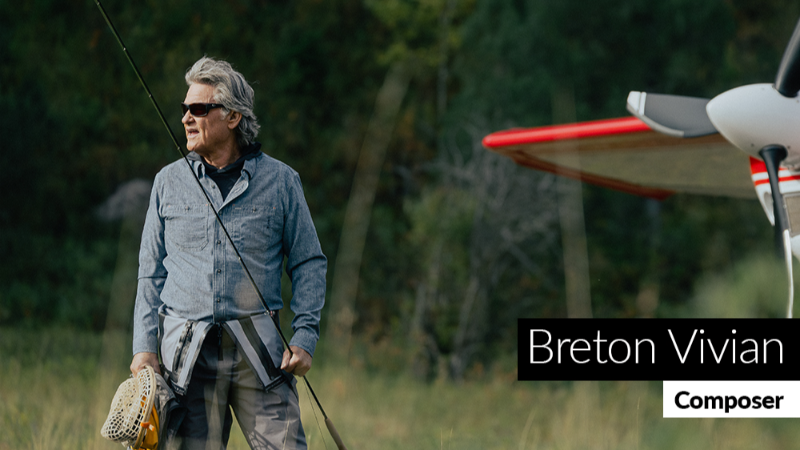
The Music of ‘The Madison’
Like Galster, composer Breton Vivian was initially led by Michelle Pfeiffer’s performance when finding a musical language for the series. “I used very slow, sliding glissando strings,” Vivian said. “On the one hand, she’s in this almost fugue-like state of shock, and then also in this kind of dream scenario where she’s in a beautiful land and there’s all this nature around her that is what her husband loved as well. A lot of that nature aspect helped with the choices I made in scoring.”
Vivian felt that Preston needed his own special theme that reflected his love of the land. “It’s this very folk, homegrown piece of music that I wrote that is really simple and really melodic,” Vivian said. Although Preston’s theme was straightforward and simple, Vivian also knew when to go big on the show. “One of the things with Taylor is, he loves putting in moments where he just lets the score do its thing and sing out. One of those big moments was during Preston’s funeral where we really go big, and it’s one of my favorite themes in the show. It’s a long scene, and it’s very quiet, and it allows the music to really play out and take its time to develop and then go really, really big.”
Although Pfeiffer’s performance inspired a great deal of Vivian’s music, which was designed to express many of the feelings she’s unable to put into words, the composer was careful to know when not to score her emotions too explicitly. “The thing with having an incredible actress like Michelle Pfeiffer presenting Stacy’s grief on screen is she’s doing so much of the heavy lifting,” Vivian said. “The last thing I wanted to do was to have score come in and push her out the way. I think a big part of this series was knowing when to step back and to know that everything is being told through her acting. Supporting that and not outstaying my welcome. I think there’s so much you can say with a score with very little — just do simple ideas well and execute them well.
In the video above, watch Breton Vivian explain how he gave a musical voice to the characters and landscape of “The Madison.”
Presented in partnership with Paramount+.
>

It’s almost a month since I started here, and I’ve been getting to know more of you and of the BBC. I’ve heard your belief in the mission, and your ambition to reinvent the BBC for the future – both of which I’m working on and will come back with more in September. Of course, you also want to know what the announced savings mean for you. It is important to me that you have clarity on this as soon as possible.
The scale of savings requires tough choices, careful work and won’t all be ready at once. We are committed to letting you know as soon as we have plans in your area. All divisions will be making significant savings. Today, some divisions are ready to set out the first phase of these plans, with more to follow.
We have first updates from News, Nations and Content. Together, by the end of this financial year, they deliver £160 million of cost savings, including staff and non-staff costs, and a net reduction of around 550 roles. This is part of the 1,800–2,000 roles announced to go over the next three years.
More savings will be set out in the months ahead, across all divisions. This includes corporate divisions where work is underway – we expect around 700 roles to close in these areas.
Reductions of this scale inevitably mean some compulsory redundancies, though we will work hard to avoid this wherever we can. Many divisions have already opened voluntary redundancy windows; more will be opening today.
We will also have to close some programmes. These are difficult choices and we will apply three guiding principles:
Sustain output with the highest audience value and impact.
Meet audiences where they are, reducing spend elsewhere. For example, we will reduce commissioning spend across Content, News and Nations by around £80 million in 2027–28 and review our broadcast TV channels and radio network portfolio as audiences move online.
Make the BBC simpler and faster – we must reduce duplication, clarify accountability, and increase the speed of decision making. This includes reducing senior leaders by at least 10%.
The News, Nations and Content divisions will set out more details in calls and updates over the coming days. For other divisions, leaders will update you with the latest progress on the size of the savings needed, the opening of voluntary redundancy windows and when you will hear more.
Aside from calls with your own teams, I will host an all-staff session on Tuesday, 23 June at 2pm BST, taking your questions, alongside Kate Phillips, Rhuanedd Richards and Jonathan Munro. Please do join if you can.
We live in very uncertain times. Our audiences rely on us every day to keep them informed, entertained and equipped to make sense of the world. Making savings while fulfilling our mission means a doubly difficult time for everyone. Do speak to your leaders and use the support that’s available. In the meantime, thank you for all you are doing.
>

EXCLUSIVE: U.S.-based producer Autumn Bailey-Ford (Tulsa) and Simo Kubheka and Damien Brown of the South African-based NV Film Studios and Services have partnered to launch AfriNova Entertainment Group.
The group said the new company will aim to bridge “African and international storytelling through innovative entertainment partnerships.”
Bailey-Ford, Kubheka, and Brown have said the company’s main focus will be international film and television production, co-productions between Africa and global markets, talent development and creative partnerships, distribution and financing opportunities, and culturally impactful storytelling with worldwide appeal.
“AfriNova Entertainment Group was created to build bridges through storytelling,” Bailey-Ford said in a statement. “Our vision is to create powerful content that not only entertains audiences around the world but also creates sustainable opportunities for filmmakers, talent, and creative professionals across Africa and beyond.”
She added that the company will aim to open new doors as “an international production house, with centres in the United States and Africa, which we all call home.”
Kubheka added: “This is a new era of African film production at a global level. The combination of Autumn’s creative talents, paired with our locations’ natural wonders, plus the biggest film studio in Africa, forms a unique opportunity to show what it means to be ‘Made in Africa’.”
NV Film Studios launched in 2023. The facility is based at Lourensford Estate, around 40km from Cape Town International Airport, with 118,000 sq ft of stage space. NV Film Services is the company’s production service arm. Bailey-Ford is a producer with credits such as Netflix’s forthcoming Color Book and Blackbear (2019).
>

After rape allegations on Married At First Sight UK rocked the UK television industry, there has been a growing conversation about how welfare is administered on major reality shows. In this guest column, former welfare producer Emma Pringle reflects on her experiences from the front line of contributor safeguarding.
It has been almost six months since I walked away from my career as a freelance series welfare producer.
From the outside, it probably looked like I had made it. Over 15 years in television, I worked on some of the country’s biggest productions for broadcasters, production companies, and streamers. By most measures, I was exactly where I was supposed to be.
But behind the credits, I was struggling.
I was exhausted. Not because I had lost my passion for television, but because of the emotional weight that comes with working at the sharp end of contributor welfare. The pressure had become relentless, the boundaries increasingly blurred, and the cost to my own wellbeing impossible to ignore.
For the first time in my career, I found myself asking a question I never thought I would ask: Was television still an industry I wanted to be part of?
As I stepped away, I realised my experience wasn’t unique. Across the industry, freelancers were quietly reaching breaking point. Many were exhausted, disillusioned, and questioning whether they could continue. Yet few felt able to speak openly about it.
That should concern all of us.
Recent headlines have prompted difficult but necessary conversations about welfare, safeguarding and accountability in television. For the first time, people are beginning to look beyond what happens on screen and question the systems operating behind it.
At the centre of that conversation is a question the industry can no longer afford to ignore: What is the real cost of outsourcing contributor welfare?
For years, freelance welfare professionals have been trusted with complex safeguarding responsibilities, often supporting vulnerable contributors through emotionally demanding situations. Yet many operate within a system that asks them to carry enormous responsibility without always providing the support that responsibility demands.
Throughout my career, I managed situations that left a lasting impact on my own wellbeing – situations I did not always feel adequately equipped, trained or supported to navigate.
This is not a criticism of any one production or broadcaster. It is a question about whether the industry has fully recognised the level of expertise, support and protection required for those working on the frontline of contributor welfare.
There is another uncomfortable reality that comes with outsourcing welfare to freelancers: the power imbalance.
Television is a small industry and careers are often built on reputation. Future opportunities can depend as much on who is willing to recommend you as they do on your experience or qualifications.
Most freelancers want to do a good job, support their teams and maintain positive working relationships. But when your livelihood depends on securing your next contract, raising concerns can feel incredibly difficult.
Of course, there are routes for escalation. Yet many freelancers will recognise the internal conflict that comes with using them. The fear of being labelled “difficult,” “negative,” or “not a team player” can be enough to keep people silent, even when something doesn’t feel right.
This creates a particularly challenging environment for those working in contributor welfare. The people responsible for safeguarding others can sometimes feel they have very little protection of their own.
What makes welfare work different from many other freelance roles is that the responsibility doesn’t end when filming stops. We are often trusted with people’s most vulnerable moments. We hear their fears, witness their struggles and, in some cases, become the person they turn to when they feel they have nowhere else to go.
That responsibility carries an emotional weight that is difficult to quantify. Unlike many other production roles, success is not measured by ratings or delivery deadlines. It is measured by the wellbeing of real people.
Safeguarding requires more than good intentions. It requires specialist training, clear boundaries, ongoing support and systems that recognise the emotional impact the work can have on those providing it.
If contributor welfare is one of the most important responsibilities within modern television, then we must start treating the people carrying out that work as a critical part of the production process, rather than an afterthought.
So what needs to change?
The answer is not to abandon freelance welfare teams. They bring valuable experience, compassion and expertise to productions across the industry. But if contributor welfare is now recognized as a core part of modern television, then it is time to start treating it that way.
That means investing in clearer professional standards, stronger industry oversight and specialist training. It means creating environments where concerns can be raised without fear of professional consequences. And it means recognising that the people responsible for safeguarding contributors also require safeguarding themselves.
Perhaps most importantly, it means moving beyond viewing welfare as a box-ticking exercise. Contributor care is a specialist discipline and should be recognised, supported and resourced accordingly.
The current conversation presents a rare opportunity for meaningful change. My hope is that we use it to build a system that better supports contributors, welfare professionals, and production teams alike.
Because ultimately, a healthier industry is in everyone’s interest.
>
Jude Bellingham: Why unique talent is key to England’s World Cup dreams

Psyren Anime Streams 1st Teaser With Anime Footage – News

Lions minicamp observations: Mike Kafka’s interview and Isaac TeSlaa’s next step
-

 Fashion9 years ago
These ’90s fashion trends are making a comeback in 2017
-
Fashion9 years ago
According to Dior Couture, this taboo fashion accessory is back
-
Fashion9 years ago
Model Jocelyn Chew’s Instagram is the best vacation you’ve ever had
-
Fashion9 years ago
Your comprehensive guide to this fall’s biggest trends
-
Fashion9 years ago
A photo diary of the nightlife scene from LA To Ibiza
-
Fashion9 years ago
Emily Ratajkowski channels back-to-school style
-
Fashion9 years ago
9 Celebrities who have spoken out about being photoshopped
-
Fashion9 years ago
The tremendous importance of owning a perfect piece of clothing