
Politics
The House | “It Is Just Demoralising”: Young People’s Despair Over AI And What To Do About It



Credit Matthew Titley

10 min read
Ministers insist they are tackling youth unemployment, but is AI transforming the world of work too quickly for government to keep up? Zoe Crowther explores young people’s despair over AI and whether government is doing enough to help
Young people increasingly find themselves applying for jobs without ever interacting with another human being.
In response to her application for a door-to-door sales role, 22-year-old graduate Siena tells The House she received repeated emails addressed to “Dear English” after the recruitment system – likely powered by AI – appeared to mistake the word ‘English’ on her CV for her name.
“I understand some companies are overwhelmed with applications, but it’s got to a different level now,” she says. “It just feels like there’s a lack of actual personal connection with the people who are hiring.
“It is just demoralising. I’ve seen people with so much experience who can’t even get a hospitality job. It makes me feel like everything I’ve worked towards isn’t really worth it in the end.”
Others report that thousands of AI-generated ‘ghost’ adverts have made online job searches even harder to navigate.
The automation in the job application process works both ways. Danny, who has spent months struggling to get a graduate job, resorted to taking a free online course by digital learning platform TechTalk that taught him how to use AI to his own benefit when applying for jobs.
Danny uses AI to edit and tailor CVs and cover letters for each application, as he says he has to write up to 10 applications a day, which “gets a bit tedious when companies either don’t read them or reject them”.
“I don’t want to overuse AI because it creates generic cover letters which lack personality,” he says. “But I’m not sure it makes any difference, as it seems that AI is reading them too.”
The use of AI has rapidly expanded at a time when young people’s confidence in the future is already collapsing. Former health secretary Alan Milburn’s detailed review revealed a “lost generation” of more than one million 16- to 24-year-olds who are now Neet (not in education, employment, or training) – the highest level for over a decade and still growing.
The IPPR think tank has published new research showing a crisis of hope among young people, with only a quarter of 16- to 29-year-olds believing talent and hard work lead to fair opportunities. The report suggests that pessimism itself is becoming a policy problem as it could further discourage people from pursuing education, training or employment.
While many young people say AI is deepening those fears, Keir Starmer’s government made clear it saw adoption of AI as central to its mission to grow the economy. For many of those ministers still in post, the greatest risk of all would be businesses failing to build trust around adoption and bringing workforces with them.
Notably, both those worried AI is moving too quickly and those urging Britain to adopt it faster argue that the country is getting the transition wrong.
Experts and employers are concerned that Britain is failing to prepare workers, employers and the education system for an AI economy. This uncertainty is already forcing difficult questions about the advice young people have long been given, in terms of which skills to develop and which routes they can take towards achieving their career goals.
Dex Hunter-Torricke spent more than a decade leading communications for some of the world’s biggest technology companies, including Google DeepMind, before leaving the industry in autumn last year. He then joined the HM Treasury Board as a non-executive director to advise Chancellor Rachel Reeves on how AI could transform the economy.
He tells The House he would encourage young people to have a “wide-ranging intellectual curiosity” and build up skills and knowledge around a broad range of areas, rather than rely on narrow technical expertise in an increasingly automated economy.
“The tech industry in particular pushed this idea that coding and Stem were the key to success in the future,” he says.
“I have always strongly disagreed with this; it turns out machines are very, very good at doing lots of quantitative work, and are having a transformational impact on how many of those domains are operating.”
Anna Brailsford, CEO of Code First Girls, an organisation that provides free coding courses to women and connects them with employers, recently shared similar reflections with The House while considering the future of software engineering.
“The most well-rounded candidate is a humanities student that is technically brilliant. Their ability to articulate themselves, their ability to go client-facing – those women are absolute gold dust,” she said.
But the crisis of hopelessness among young people has cast doubt over whether going to university remains the most important guarantor of success, as many graduates struggle to find jobs. The British Social Attitudes Survey published this month found that 34 per cent of the public believes a university education “just isn’t worth the time and money it usually takes” – up from 14 per cent in 2005.
When ChatGPT was launched to the public in late 2022, it made powerful generative AI accessible to ordinary people overnight and changed the policy conversation almost instantly.
According to Francesca Fraser, former No 10 special adviser in the previous Conservative government, the adoption rate of ChatGPT took some parts of the government “by surprise”.
She says governments “always struggle with doing really long-term thinking”, particularly when the nature of technological impacts on the economy is so unpredictable.
Fraser is now head of policy and public affairs at Multiverse, the British educational technology company co-founded by Euan Blair that works with employers to deliver apprenticeships and workforce training.
“Ultimately, the impact that AI will have on the labour market will definitely be profound, but the precise way it lands depends on the economics of supply and demand and how people continue to use it,” she says. “So, it’s a really hard thing to map out.”
Starmer ministers point to the Youth Guarantee pledge that every 18- to 21-year-old should have access to education, training, an apprenticeship, work experience or employment, as well as expanded youth hubs and more than £1bn of AI investment, as evidence they are preparing young people for the future labour market.
However, critics argue these initiatives remain fragmented and do not amount to a coherent strategy to address the overall decline in entry-level jobs and the long-term impact of technological change, including AI, on junior roles.
Hunter-Torricke believes, as many do, that AI will deeply transform our societies and our economies, and that young people will need to be protected from an impending huge shock to the job market. The former tech insider tells The House that the money the government is throwing at the problem is simply acting as a sticking plaster.
“It makes me feel like everything I’ve worked towards isn’t really worth it in the end”
“But there are huge question marks about whether it’s even going to be competitive against the enormous amounts of investment from US big tech and other ecosystems,” he says.
“British businesses generally have been bad at adapting towards technology – that has been the case for decades now.”
AI adoption among UK SMEs is rising rapidly, with 35 per cent having actively used AI in 2025, up from 25 per cent in 2024, according to the British Chambers of Commerce. However, only around 11 per cent are deploying AI extensively to automate or streamline services.
“If you can’t invest in the general transformation and modernisation of industries and companies and workers, how do you expect them to be in a position where they’re able to hire young people?” Hunter-Torricke asks.
He says “sporadic announcements” and investments in AI-related infrastructure and supercomputers will not be as impactful as fixing the physical infrastructure in schools and investing back into public spaces and civil society.
“If you are only investing in those things which you know are likely to attract approving nods from Silicon Valley and from the tech elite, then you’re going to [see] what we’ve seen over the last couple of decades: which is a very small number of companies and people are going to do extraordinarily well, and the vast majority of workers remain stuck in low-wage jobs, which have very limited growth opportunities.
“What we have clearly been missing is the kind of political vision of what kind of country we want to be and how we intend to prepare our country to deal with a set of societal-wide and global transformations that are under way as a result of the arrival of the most powerful technology in history.”
Fraser from Multiverse argues that the problem lies partly in the way Britain develops skills policy. With the government struggling to build a system that keeps pace with technological change, she says employers need greater freedom to respond quickly to emerging skills gaps.
“There is a need for a slightly more agile skills system, whereby if employers see gaps they can fill those gaps without having to go to government and have an 18-month process to work out how the training should look,” she says. “The existing route to develop apprenticeship standards is probably a little bit too clunky.”
Fraser argues that helping people adapt to AI will be essential if governments are to maintain public confidence in the technology. “The best way you maintain consent for AI is by giving people human agency. The best way you can empower people is by training them, so that they can adapt in an AI-affected world.”
Labour MP Natasha Irons, who chairs the All-Party Parliamentary Group on Youth Affairs, tells The House that AI is simply exacerbating deeper structural issues that have created a “hostile environment for young people in this country”.
She believes that a feeling of despair among young people has built over years of events that have stacked up against them: the stripping back of youth services through austerity in the 2010s; the Brexit referendum; worsening mental health and the rise of addictive social media algorithms; rising housing costs and insecure living standards; the disappearance of traditional routes into stable careers; and the Covid pandemic.
For Irons, the problem with the government’s approach to helping young people has been a lack of “joined-up vision” for what growing up in this country should look like.
“I’m not sure there’s that thought leadership on this at the moment,” she says. “I would hope that the new Milburn review is an opportunity for the government to make this a real cross-government mission.”
Irons, who has children aged five and 11, says young people themselves might have to find ways to individually adapt to a changing world.
“Perhaps we’re moving to a world where, instead of having your path planned out for you the second you’re a teenager and you pick your GCSEs, we’re going to have to be more flexible and resilient to the jobs market around us,” she says.
“Our job as government and politicians is to ensure that our young people have those opportunities to develop those skills. The current education system is ‘pass an exam’ and that’s it, but actually we need our kids to be resilient and confident and be able to seek opportunities around them and not wait for things to happen for them.
“With votes at 16, young people have a real chance to flex their political muscles. If they’re concerned about the impact of AI, then perhaps it’s time they pull together their views and put forward a counterargument to it being an inevitable thing that we will have to just deal with. Maybe that’s where the hope will come from – from young people themselves.”
>
Politics
Politics Home | Thousands Join Pro-Restore Britain Facebook Groups Run From Pakistan And Bangladesh


5 min read
Tens of thousands have joined pro-Restore Britain Facebook groups being run by people who appear to be based in Pakistan and Bangladesh, an investigation has revealed.
Research by the organisation Institute for Strategic Dialogue (ISD UK) and PoliticsHome has found that multiple Facebook groups showing support for Rupert Lowe and his Restore Britain party are run by individuals who appear to be based in Asia, with the investigation also finding admins based in the United States.
Some of these groups, which have tens of thousands of members, are later being turned into vessels for selling firesticks, download codes and tech support, with admins changing the group name and picture to suit the new purpose.
Siddharth Venkataramakrishnan, Analyst and Editorial Manager at ISD UK who uncovered the groups, told PoliticsHome that the phenomenon was “really a continuation of an increasingly common trend we’ve seen: accounts promoting content that is misleading, politically charged or hateful for clicks”.
“There is obviously a particular irony that groups producing anti-Muslim content are run by Muslims themselves, but we are seeing these groups being run globally.”
Venkataramakrishnan said that the politics in these groups is “incidental”, with the groups ultimately just “a vehicle to monetisation”.
Lowe, the MP for Great Yarmouth, has built a huge following on Facebook compared to other political party leaders. The Restore Britain leader currently has 1.3m followers on the platform. He also has a significant following on X, where, as PoliticsHome recently reported, he has made tens of thousands of pounds since being elected in 2024.
One group uncovered by the investigation, called ‘Rupert lowe [sic] fans’, which was set up in February 2026, is run by Mahiya Mim, Rifaat Alamin and Eliana Maya.
According to their Facebook profiles, Maya is based in New York, while Alamin is based in Sylhet, Bangladesh. Mim does not specify her location but claims to have attended school in Bangladesh. In an added twist, Mim and Alamin appear to be married.
Both Mim and Alamin have been admins for the group since the date it was created, while Maya became an admin two days later.
The posts made on the group range from nostalgic British posts about former high street retailer Woolworths to pictures of women in the burqa, asking: “Do you agree that these should be banned?”
Posts on ‘Rupert lowe fans’ also encourage engagement, posing questions such as “should Muslims be banned from all public office in the UK” and “who do you trust more to lead Britain?” with a picture of Lowe and Reform UK leader Nigel Farage included. The pages also post “relatable” British culture references, such as asking whether local bank branches should be reopened.
While the group has amassed more than 28,000 members, the admins have been recently attempting to push members towards what they call their “new group”, ‘Restore Britain & Rupert lowe [sic] for PM’, which currently has just over 6,000 members and was created in April.
Another similar group called ‘Restore Britain – Rupert lowe [sic] for PM’, which has more than 19,000 followers, was set up in March.
At the time of writing, the admins of this Facebook group are listed as Sheren Dmax, who is based in Birmingham, and Arsala Rauf, who is based in Rawalpindi, Pakistan. As none of the individuals were admins from the group’s inception, it can be presumed they are not the creators.
It is unclear whether the accounts or groups are managing to monetise from the platform, but the income could be coming from elsewhere.
While many of these groups continue to purport to be Rupert Lowe or Restore Britain fan bases, some have been completely changed, with the groups instead becoming advertisements or selling pages for Amazon Firesticks.
Venkataramakrishnan also found evidence of Clarkson’s Farm fan groups being set up and later pivoting to promoting firesticks and tech support.
One Facebook group, which has more than 4,000 members, was created on 4 March 2026 and was originally called ‘Restore Britain Rupert lowe [sic] for pm’. In April, the name was changed to ‘Downloader Codes 2026’.
Originally, the group was politics-focused, including posts about British political party leaders and issues like border control, as well as offensive content like hateful posts about Muslims. However, on 13 April, the group name was changed by Itx Saddam. According to his Facebook page, Saddam lives in Islamabad, Pakistan.
When the group name and picture changed, there was very little pushback from members, apart from Andy Milne, who wrote “FUCK OFF YOU PR1CK, NOT GHE GROUP I FVCKIN JOINED!! [sic]”
While the group claims to be based in the UK, the group is run by Shan Arsal, who is based in Karachi, Pakistan, according to his Facebook profile.
Other listed admins include Fabian Rahlmann (whose location is unknown), Adrian Wystub (who is based in the UK), Adam Chester (based in New York), and Babar Ali (based in Lahore, Pakistan).
Venkataramakrishnan told PoliticsHome: “One part of that is advertising revenue, but these groups are obviously trying to maximise how much money they can get. Promoting questionable goods is just one expansion of that; another likely one is targeting commenters with scams.
“This again just shows how there is a complete disconnect from the impact that these groups have both on those being targeted with hate and the accounts being drawn in – they’re all just avenues to making cash.”
Victoire Rio, executive director of technology charity What To Fix, told PoliticsHome: “We regularly see people ‘hijack’ political issues to ‘warm up’ Facebook pages and groups. This can be a good way to build a targeted following – in this particular case, Brits. There is also a vast resale industry for digital assets, so it’s also possible that these groups are being warmed up for resale.”
>
Politics
The House | “The Consensus Is Being Challenged”: Inside Reform’s Plans To Scrap The Equality Act
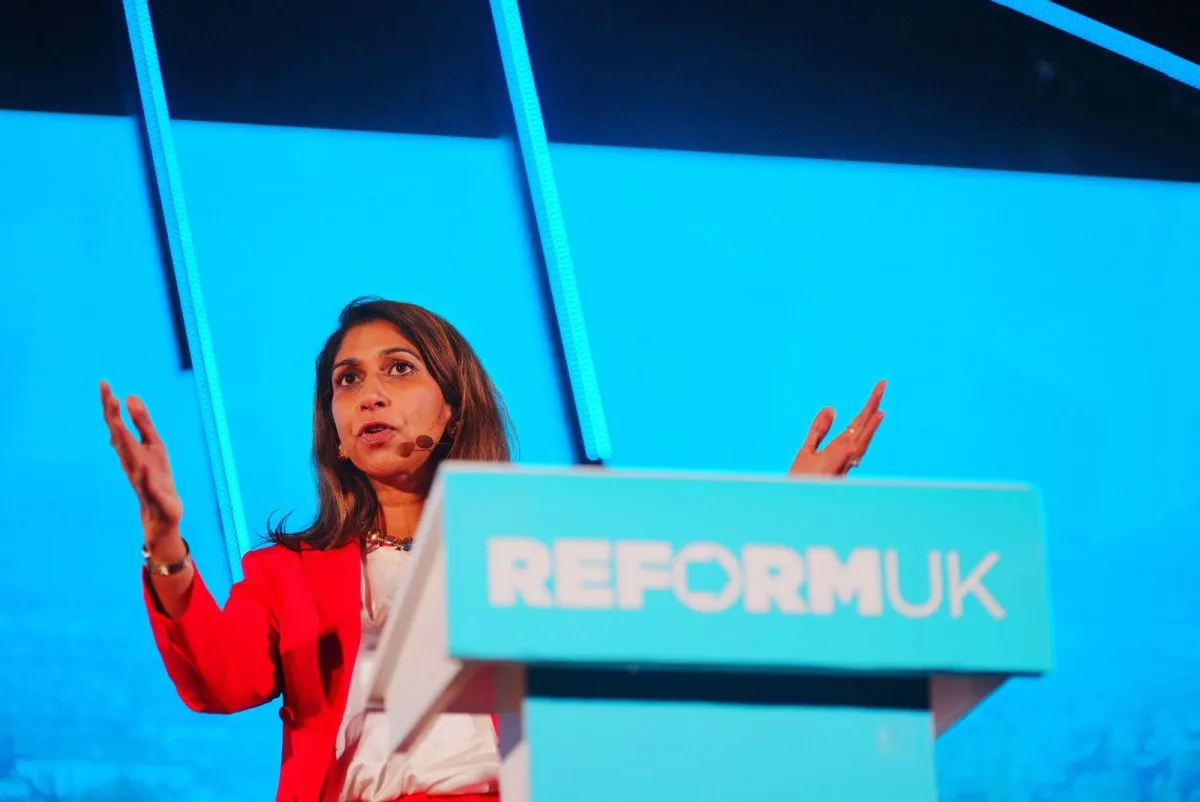

Suella Braverman (PA Images/Alamy)

10 min read
Reform UK’s promise to scrap the Equality Act has raised questions about what will replace it. At the same time, Labour is under pressure from its own side to go further in implementing it. Noah Vickers reports
In February 2018, a junior minister in Theresa May’s government stood up in Parliament to make one thing very clear: post-Brexit Britain would not be a place in which rights and equality laws are rowed back on.
Citing the UK’s “proud record, history and tradition” of “supporting workers, protecting civil liberties and championing human rights”, then-Brexit minister Suella Braverman proudly declared: “Our gender pay gap reporting requirements and our public sector equality duty are world-leading initiatives that go beyond EU law in many ways”.
Braverman was referring to measures enshrined in the 2010 Equality Act – a statute that, eight years later and in a new party, she is now determined to abolish.
Until relatively recently, the Equality Act was not a controversial piece of legislation, and no major political party was proposing changes to it.
“Originally, the Tories resisted it, but then the consensus grew – with [David] Cameron and with Theresa May… about the role of the state in promoting equality,” says Baroness Harman, the architect of the legislation. “There were arguments about how that should be done, but there was a consensus that it should be done.”
When Braverman, now Reform UK’s equalities spokesperson, announced in February that Reform would scrap the Equality Act if it won the next general election, she was re-committing the party to a policy that had already featured in its 2024 manifesto. Removing the legislation, she said, would allow Reform to “build a country defined by meritocracy, not tokenism” and “personal responsibility, not victimhood”.
In June, the Conservatives then set out their own stall on the issue by promising to ditch the Equality Act’s public sector equality duty. The duty requires public bodies to have “due regard” to the legislation’s overarching aims of eliminating unlawful discrimination, advancing equality of opportunity and “fostering good relations” between groups of people with or without different protected characteristics.
Braverman said this “half-baked and half-hearted attempt to copy Reform” was “embarrassing”, but shadow equalities minister Claire Coutinho counters that Reform’s plan would backfire.
“White men have successfully fought discrimination claims under the Equality Act because it protects everyone on the basis of race and sex, not just ethnic minorities and women,” she tells The House. “They would lose this protection under the plans Reform has announced, as would disabled people.”
Coutinho continues: “Reform’s plan would also make positive discrimination and race quotas in the workplace legal. We want to maintain protections against genuine discrimination whilst getting rid of the grievance culture which says minority groups are worthy of special treatment.”
But she confirms that other parts of the Equality Act would also be amended by the Conservatives, as party leader Kemi Badenoch has said removing the duty would only be the start of a wider “overhaul”.
“People should be judged on merit, protected from discrimination and abuse, and free to live their lives with everyone equal under the law,” Coutinho says. “There are other elements of the Equality Act, such as positive action and ‘work of equal value’ pay claims, which are social engineering in a way that undermines those principles.
“We will be rooting out anything that is incompatible with our values, but that doesn’t mean just binning the entire act without properly understanding what’s in it. Just to get a political headline, Reform was willing not just to throw out the baby with the bathwater but pregnant women, new mums and disabled people as well.”
It is a line of attack that Reform is clearly conscious of the need to counter. To replace the Equality Act, the party has pledged to introduce a Workplace Fairness Act that will treat people “as individuals”.
The Equality Act consolidated more than 116 pieces of pre-existing equalities legislation into one statute and Braverman has said that “much of what was valuable” in it stems from those earlier laws.
The Workplace Fairness Act, therefore, would re-consolidate the pre-2010 legislation into a new statute – including, Reform says, protections which apply “both inside and outside the workplace”, despite the proposed legislation’s name. But it will not carry over provisions like positive action or the public sector equality duty.
Braverman has pledged to repeal the Equality Act on “day one” of a Reform government and the party says its Workplace Fairness Act would be implemented on the same day. “The repealing and replacement legislation will be in the same act,” a Reform spokesperson tells The House.
One source familiar with Reform’s political operation says the policy is not so much about broadening the party’s appeal with new voters as it is about firing up its base and the commentariat. It also stems from a concern within the party that the Equality Act could prove an obstacle to parts of its agenda in government.
“The second-order issue is, of course, that the Equality Act can be used to frustrate a whole lot of legislation Reform would want to bring in,” the source says, pointing to the party’s plans to ban foreigners from accessing social housing as an example of a policy that could be challenged under the current equalities framework.
“The big issue for Reform is making it clear – particularly to female voters, where they’re aware they have a weakness – that getting rid of the Equality Act doesn’t therefore mean they want women to go back to the kitchen, or that they’re going to dump maternity rights.” The insider believes Reform has “not successfully communicated that”.
“The genius of the Equality Act is that the branding’s very good. Most people in the modern world are in favour of equality. But, on the other hand, what it creates by [introducing] special categories [of people] is a whole lot of inequality,” they add.
Earlier this month, Reform announced plans for a Women and Motherhood Protection Act, which will consolidate the pre-2010 legislation pertaining to women’s rights, while also building on them, they say – such as by increasing the time limit for pregnancy and maternity discrimination claims from three months to 12 months.
The Trades Union Congress criticised the proposals as “shameless and deceptive”, as Reform’s press release appeared to cast doubt on the Equality Act’s principle of equal pay for work of equal value. Reform said its changes would ensure that “genuine cases of pay discrimination” would be tackled but avoid “allowing courts and tribunals to determine the relative value of fundamentally different occupations”.
“Just to get a political headline, Reform was willing not just to throw out the baby with the bathwater but pregnant women, new mums and disabled people as well”
The Women and Motherhood Protection Act would confer “explicit breastfeeding rights” for mothers. Reform’s spokesperson clarifies for The House that, in practice, this will not necessarily mean women gaining any new rights to breastfeed. Rather, breastfeeding rights that currently exist “across employment legislation and the Equality Act will be brought together and, where necessary, made explicit or further codified”.
In the case of older people, meanwhile, regulations introduced in 2006 were limited to employment. It was only under the Equality Act that older people gained additional rights in other areas like the provision of services.
Caroline Abrahams, charity director at Age UK, tells The House that scrapping the Equality Act “would be a disaster for older people”.
“We would strongly oppose any repealing of this act, because it would legitimise age discrimination, in a way. It’s bad enough with the act – it would be a lot worse without it,” she says. “It’s totemic and it gives a signal to society that we think it’s important to respect different people’s rights.”
The 2010 legislation, she argues, has played an important role in governing how NHS treatment decisions are made, for example.
“Certainly, digital exclusion is another issue that arises here – your ability to physically access or in other ways access a service,” Abrahams adds.
“Older people already have to pay more for things like travel and motor insurance, but without the Equality Act they would have total freedom to be very discriminatory in who they sold their products to.”
Asked whether Reform intends to carry over rights that were introduced for the first time in 2010, a party spokesman replies: “We are considering what additional protections would be needed for genuinely vulnerable groups in society.”
When Disability Rights UK raised similar concerns about protections specific to the 2010 legislation being lost, in an article published by Disability News Service, Reform was adamant that no protections would be removed.
“Of course these protections won’t be scrapped and all provisions for disabled people will be kept,” a spokesperson said. “A Reform UK government will always support protections against discrimination based on disability, including in services. Neither Suella nor the party have ever made any suggestion that we will water down provisions for disabled people.”
At the same time as the Equality Act is under fire, Labour is under pressure to fulfil its manifesto pledge to expand the legislation’s reach.
Section One of the Equality Act – the socio-economic duty – has never been implemented, as Theresa May cancelled its planned enactment within months of taking office as women and equalities minister in 2010.
The duty, which requires public bodies to consider how their decisions might help reduce inequalities associated with socio-economic disadvantage, has since been implemented in Scotland and Wales – but not in England.
In 2024, Labour promised to enact it, but Keir Starmer’s government never confirmed when this would happen.
“It was good that it was in the manifesto, but we should have done it straight away,” Harman, who was appointed as Starmer’s adviser on women and girls in May, tells The House.
“I’m a bit frustrated that two years in, we haven’t set a time for implementing it,” Harman says – not least, she adds, because when she was in government in 2010, working on the Equality Act with the then-chair of the Equality and Human Rights Commission Trevor Phillips, they drew up draft guidance for implementing the duty. “We were ready to go but we lost power. So, that guidance is still there and still ready.”
With the Equality Act’s principles being more politically contested than ever before, she urges: “It’s important for the government to recognise that that consensus is being challenged, and they need to remind everybody why it’s the right thing for this country to be done – and get on with the socio-economic duty.”
Labour says it remains “proud” of the Equality Act and will “robustly” defend it in government.
“It’s fair to say we will be talking more about the importance of it and defending the core principles of it,” says one party source, speaking prior to Starmer’s resignation announcement, “but where it’s challenged, we’ve pushed back pretty firmly.”
When it comes to implementing the socio-economic duty, they admit that the legislative timing is ultimately “a decision of the centre”, though they insist it will be delivered.
In answer to a written question in April, equalities minister Baroness Smith said: “We are currently working toward commencement of the duty, which includes drafting statutory guidance that will clarify how the duty can be applied effectively. As part of this process, we are working with listed public bodies to ensure the guidance supports them effectively.”
>


75 MPs from a variety of parties have called on the government to sanction Israeli Prime Minister Benjamin Netanyahu. (Alamy)

3 min read
A cross-party group of 75 MPs has called on Prime Minister Keir Starmer to sanction Israel’s Prime Minister Benjamin Netanyahu and Minister of Justice Yariv Levin over the alleged torture of Palestinian civilians.
The letter to Foreign Secretary Yvette Cooper, organised by Labour MP Neil Duncan-Jordan and shared with PoliticsHome, expresses “deep concern that the government has yet to sanction members of the Israeli government for the systematic torture and ill-treatment of Palestinian detainees”.
Citing a report by UN Special Rapporteur on the Occupied Palestinian Territories, Francesca Albanese, MPs say responsibility for “well-documented torture of Palestinian civilians lies with the government of Israel, including Prime Minister Netanyahu”.
The letter also references the decision by Israel in March to drop charges against soldiers for the alleged rape of a Palestinian detainee, a decision praised by Netanyahu, and the interception of the Global Sumud Flotilla and Freedom Flotilla Coalition vessels in international waters by the Israeli Defence Forces (IDF).
The Israeli government and IDF have repeatedly denied allegations of torture and rape, and have defended the interception of multiple flotillas in international waters, accusing them of being sympathetic to terrorist organisation Hamas.
In the letter, cross-party MPs say that while they welcome sanctions against far-right ministers like Ben-Gvir and finance minister Bezalel Smotrich, more needs to be done.
“We write to express our deep concern that the government has yet to sanction members of the Israeli government for the systematic torture and ill-treatment of Palestinian detainees, including children, in Israeli detention,” the letter reads.
“Responsibility for the systematic and well-documented torture of Palestinian civilians lies with the government of Israel, including Prime Minister Netanyahu.
“While the sanctions announced in June 2025 against ministers Itamar Ben-Gvir and Bezalel Smotrich remain welcome, they have done little to change the government of Israel’s approach to Palestinian detainees. Since the sanctions were announced, the systematic torture of Palestinians, including children, has escalated, with near total impunity.”
The UK government sanctioned Ben-Gvir and Smotrich in 2025 in response to the pair’s “repeated incitements of violence against Palestinian communities”, with then foreign secretary David Lammy in a statement accusing them of inciting “extremist violence and serious abuses of Palestinian human rights”.
The letter from MPs also calls on the UK government to sanction both Netanyahu and Levin, arguing the government must end the “impunity” for Israel’s actions.
“We urge you to take further steps to help end this impunity by sanctioning the government of Israel’s Minister of Justice, Yariv Levin and Prime Minister Benjamin Netanyahu,” the letter reads.
MPs who have signed the letter include Labour MP Paula Barker, Your Party MP and former Labour leader Jeremy Corbyn, Liberal Democrat MP Manuela Perteghella, and Conservative MP Desmond Swayne.
The Foreign, Development and Commonwealth Office was approached for comment.
>

Refugees are playing a key role for the Socceroos, a team who are a ‘reflection of modern Australia’

Arsenal sign Lioness Georgia Stanway from Bayern Munich

The House | “It Is Just Demoralising”: Young People’s Despair Over AI And What To Do About It

-

 Fashion9 years ago
These ’90s fashion trends are making a comeback in 2017
-
Fashion9 years ago
According to Dior Couture, this taboo fashion accessory is back
-
Fashion9 years ago
Model Jocelyn Chew’s Instagram is the best vacation you’ve ever had
-
Fashion9 years ago
Your comprehensive guide to this fall’s biggest trends
-
Fashion9 years ago
A photo diary of the nightlife scene from LA To Ibiza
-
Fashion9 years ago
9 Celebrities who have spoken out about being photoshopped
-
Fashion9 years ago
Emily Ratajkowski channels back-to-school style
-
Fashion9 years ago
The tremendous importance of owning a perfect piece of clothing
