
Politics
Politics Home | Burnham’s No 10 Expected To Undergo Restructuring Under Chief Of Staff James Purnell


James Purnell, then a Labour MP, pictured leaving Parliament in June 2009 (Alamy)

3 min read
The Prime Minister’s No 10 office in Downing Street is expected to undergo a significant restructuring under Andy Burnham and his chief of staff James Purnell, in addition to the founding of a new ‘No 10 North’ in Manchester, PoliticsHome understands.
Purnell, the former Blairite minister who has been picked by Burnham as his chief of staff, was a member of the expert advisory group that recently helped guide a paper on how a reformed Downing Street department would work.
Published by the Future Governance Forum (FGF) think tank in November last year, the report proposed a streamlined ‘Executive Office for the Prime Minister’.
The new set-up would see No 10 configured around four functions: a politics and strategy group; a policy and delivery group; a diplomacy and security group; and a private office. A communications team and political office would also operate across all four.
“This new Downing Street is not a new bureaucracy, adding more complexity to the centre,” the FGF paper reads.
“The entire intention is that it should be the opposite: streamlining the centre of government, with the very centre attempting to do less directly itself by setting clearer expectations of what can and should be done elsewhere in Whitehall (and what can and should be stopped altogether).”
A well-placed source described it as “nailed on” that Burnham’s No 10 would implement at least some of the FGF’s recommendations on a new structure, and insiders say Burnham will enact No 10 reform as part of his wider reset.
The politics and strategy group is the function considered by insiders as best-suited to being based out of No 10 North.
“I think they want to move a lot of senior people there. It’s real,” the same source quoted above said of the planned new encampment in Manchester.
The incoming prime minister has promised that the Manchester office will act as “the nerve-centre of a rewired Britain”. The plan is not to duplicate the work of London’s No 10 but to task No 10 North specifically with driving his “devolution and growth agenda”.
Caroline Simpson, the Greater Manchester Combined Authority’s chief executive who is credited with helping Burnham as mayor to deliver fast growth in the region, will lead that work and be based in No 10 North as the prime minister’s deputy chief of staff.
Burnham would like to see No 10 North located at a government hub already under construction, the Manchester Digital Campus in Ancoats, but it is not due to be completed until 2032.
Those working on the project say other sites in Greater Manchester fit the bill, however, and PoliticsHome understands that interim arrangements are being made to get the new office up and running “as quickly as possible”.
The independent Institute for Government (IfG) think tank also supports breaking up the Cabinet Office and creating a ‘Department of the Prime Minister and Cabinet’.
Commenting on Burnham’s plans for a ‘No 10 North’, IfG associate director Hannah Keenan said of 10 Downing Street: “It has been horribly underpowered for too long. Now, this isn’t going to fix it…
“You need to do much more fundamental reforms to the centre of government. You still have an enormous Cabinet Office that is quite amorphous and too large and unfocused and doesn’t really support the prime minister properly – what are you doing with that?
“But it is fine and good to bolster the power of No 10.”
Burnham is set to become the UK’s seventh prime minister in a decade later this month after a large majority of Labour MPs nominated the former Manchester mayor to replace Keir Starmer on Thursday.
>


3 min read
Keeping the UK out of the war between the US and Iran is seen as Keir Starmer’s greatest achievement in office, new research for PoliticsHome has found.
Thirty per cent of people selected this option when research organisation Thinks Insight & Strategy asked what historians will consider to be the outgoing PM’s greatest achievements.
The second most selected option was getting the Labour Party elected at the 2024 general election (22 per cent), and third was introducing a social ban for under-16s (19 per cent), according to an online survey of 2,079 people carried out between 24-25 June.
However, the largest share (33 per cent) said “none of these / “don’t know” in response to twelve options put to them.
Ben Shimshon, co-founder and CEO of Thinks Insight & Strategy, said the findings indicate that Starmer has struggled to persuade the public that he has delivered in areas that were core to his premiership.
“At the moment, few of the claims Starmer made in his resignation speech are supported by the public. Only small minorities are prepared to acknowledge any improvement in the economy, the NHS, or even immigration numbers (where the official numbers do indicate significant falls),” he told PoliticsHome.
“For the two-thirds who acknowledge any achievements at all, getting Labour elected is the most established, alongside two relatively late, but relatively popular decisions: the social media ban for under-16s, and most strongly, keeping the UK out of the US/ Iran.”
The joint fourth-most-selected achievements, at 16 per cent, were starting to repair the UK’s EU relationship and bringing down NHS waiting times. Reducing small boat crossings and closing asylum hotels was selected by just 6 per cent.
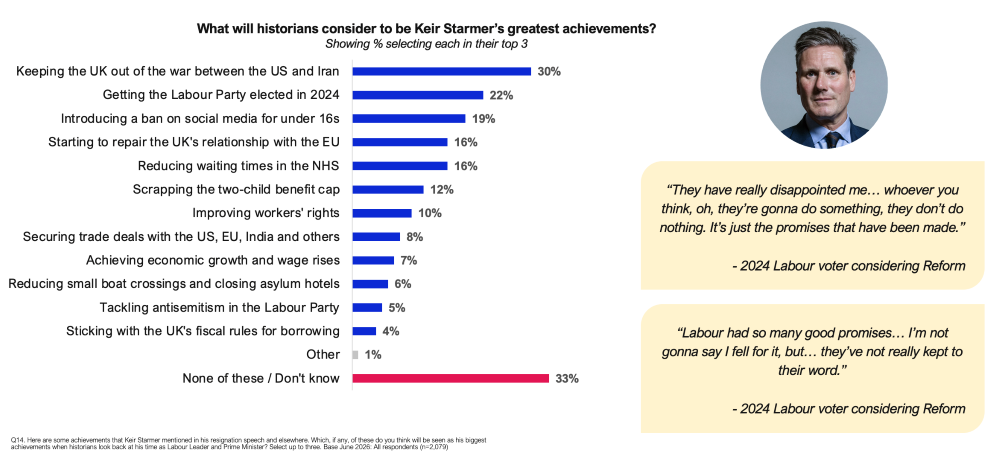
The survey was carried out after Starmer’s resignation speech on 22 June and Andy Burnham’s emphatic victory in the Makerfield by-election a few days before.
It is now almost certain that Burnham will become the UK’s seventh prime minister in a decade later this month after well over 300 Labour MPs, a comfortable majority of the party, nominated the former Manchester mayor to succeed Starmer in No 10 on Thursday.
Elsewhere, the Thinks Insight & Strategy research found that a Burnham leadership boosts Labour’s chances of keeping hold of voters who supported them at the last general election, especially those who are considering Zack Polanski’s Greens.
However, the findings also suggested that Burnham will not have long to impress the public.
Over half of respondents (54 per cent) said they would know within six months whether a new prime minister was doing a good job, and only 19 per cent said they would give them longer than that. Twelve per cent said they would know straight away.
Just over half of respondents (51 per cent) said that if Burnham is effective as PM, they would see real improvements within a year of him entering office, while 37 per cent said it would take at least a year or two.
“The direction of travel needs to be clear within 12 months, and whatever it is, that direction needs to feel like change,” said Shimshon.
>
Politics
Politics Home | Rupert Lowe Criticised For Describing Dunblane School Massacre As “One Murder”


3 min read
Rupert Lowe has sparked anger after referring to the Dunblane school massacre as “one murder”.
The leader of Restore Britain made the remark during an appearance on the Joe Rogan Experience podcast.
His comments have been described as “insulting” and “despicable” by local politicians.
In March 1996, 16 children, aged five and six, and their teacher Gwen Mayor were shot dead by Thomas Hamilton in the gym hall of Dunblane Primary School, in what is still the deadliest mass shooting ever in the UK. A further 15 children and three adults were wounded, and Hamilton turned the gun on himself.
The MP for Great Yarmouth made the comment when speaking on legislation to ban handguns that was introduced following the massacre.
He said: “They don’t want the public to have guns, and they are doing their very best to damage the shooters who perfectly and legitimately like to go and shoot clay pigeons, who like to go and shoot game, who like to go and hunt.
“Effectively, they are trying to make that very difficult through the licensing laws for guns.
“As you probably know, they banned handguns in the late 90s because there was a murder up in Dunblane.”
Joe Rogan asked: “One murder?”
Lowe replied: “One murder.”
He added: “My father used to shoot pistols for Oxford University, he’s dead now, bless him, but he had all his pistols taken away, the pistols he used to shoot with at Oxford University. I mean, we now have a society that needs radical change.”
Conservative MSP Stephen Kerr has described Lowe’s comments as “genuinely shocking” and that “to reduce that atrocity to ‘one murder’ is deeply insulting”.
Posting on X, he said his children’s school, which was “about 15 minutes from Dunblane”, was locked down that day.
“They’ll never forget being kept in the gym hall until everyone learned the gunman was dead. They’ll never forget the teachers trying to hold themselves together while reassuring frightened children,” he said.
Kerr added: “It wasn’t a single murder. It was a mass murder. In a primary school.
“Almost as disturbing was the tone – one of disbelief, even mockery, that anyone could respond by tightening gun laws.
“This wasn’t some obscure historical event. It happened in 1996, when Lowe was 38 years old. He should have known what happened on that terrifying day in Dunblane.
“For anyone who remembers that day, hearing it dismissed so casually is genuinely shocking.”
The SNP depute leader and MSP for Dunblane, Keith Brown, described Lowe’s comments as “beyond despicable”.
He added: “Despite these hideous remarks from Rupert Lowe, the Snowdrop Campaign that followed that terrible day ensured a ban on the private ownership of most handguns – that is the proud legacy of the bereaved families and the local community.
“Their courage and determination in the aftermath of the attack is something we should never betray and our community will never let the likes of Rupert Lowe do exactly that.”
The Snowdrop Petition calling for tighter gun laws that followed the massacre was signed more than 750,000 times, and along with the Cullen Inquiry, led to the ban on private ownership of higher-calibre handguns in 1997. The ban was then extended to .22 handguns later that year.
This article originally appeared on Holyrood
>


Olivia Bailey, Parliamentary Under-Secretary of State for Equalities (Credit: House of Commons)

3 min read
Parents who are found guilty of “abusively” trying to change their child’s sexuality or gender identity could be jailed under new legislation, a minister has confirmed.
Olivia Bailey, the minister for LGBT+ equalities, said parents would not be given any “carve-out” from the government’s planned ban on “abusive conversion practices” which cause “serious harm” to the victim. Those found guilty of breaching the proposed law could be sentenced to up to five years in prison.
Amid concern from religious and gender-critical campaigners that the draft Conversion Practices Bill could undermine parental autonomy, Bailey insisted the legislation will not prevent parents from choosing how to raise their children, as the courts will only convict people guilty of practices which meet strict thresholds for abuse.
The minister told The House magazine: “This is about abuse; it is about a very specific form of abuse. It is not about policing opinions, it is not about policing how parents parent, and it is for the courts to determine, not politicians, but – rightly – for the courts to determine what meets that threshold of abuse.”
Asked whether she expects any parents to go to prison as a result of the legislation, she said: “I think that anybody committing abuse, no matter where you find it, no matter in what walk of life – there are not carve-outs for abuse by parents in any other legal environment.
“So I think it is completely right that we just say very clearly in this legislation: we want to stop abuse, we want to stop abuse wherever it happens. Full stop. End of story.”
The bill defines a conversion practice as “any conduct” carried out with the intention of causing another person to have or not to have, or to believe they have or do not have, a particular sexuality or transgender identity.
But an offence only occurs where that conduct “amounts to an abuse of the individual”. In determining that, consideration would be given as to whether words or behaviour “of a sexual nature” or which are “violent or threatening” or “controlling or coercive” have been used, as well as whether “economic” or “psychological or emotional” pressure has been applied, “among other things”.
The victim must also have been caused “serious harm” to their “mental or physical health”, or “serious alarm or distress” which has a “substantial adverse effect on their usual day-to-day activities”.
The law will not only prohibit conversion practices aimed at making someone straight or cisgender and will, at least in principle, apply equally to practices aimed at making someone adopt an LGBTQ+ identity.
Healthcare services will be exempt from the bill’s provisions, except where a healthcare practitioner “falls far below the standards reasonably expected of a person in their position”.
The full interview with Olivia Bailey on the draft Conversion Practices Bill will feature in the next edition of The House magazine in print and online.
>

Moana Box Office: Disney Live-Action Remake Opens With Evil Dead Burn

Wimbledon 2026 results: Arthur Fery’s dream run ended by Alexander Zverev in semi-finals

Lino Brocka’s ‘Macho Dancer’ in 4K Revives a Queer Landmark

-

 Fashion9 years ago
These ’90s fashion trends are making a comeback in 2017
-
Fashion9 years ago
According to Dior Couture, this taboo fashion accessory is back
-
Fashion9 years ago
Model Jocelyn Chew’s Instagram is the best vacation you’ve ever had
-
Fashion9 years ago
Your comprehensive guide to this fall’s biggest trends
-
Fashion9 years ago
A photo diary of the nightlife scene from LA To Ibiza
-
Fashion9 years ago
9 Celebrities who have spoken out about being photoshopped
-
Fashion9 years ago
Emily Ratajkowski channels back-to-school style
-

 Tech3 months ago
OpenAI CEO apologizes to Tumbler Ridge community

